


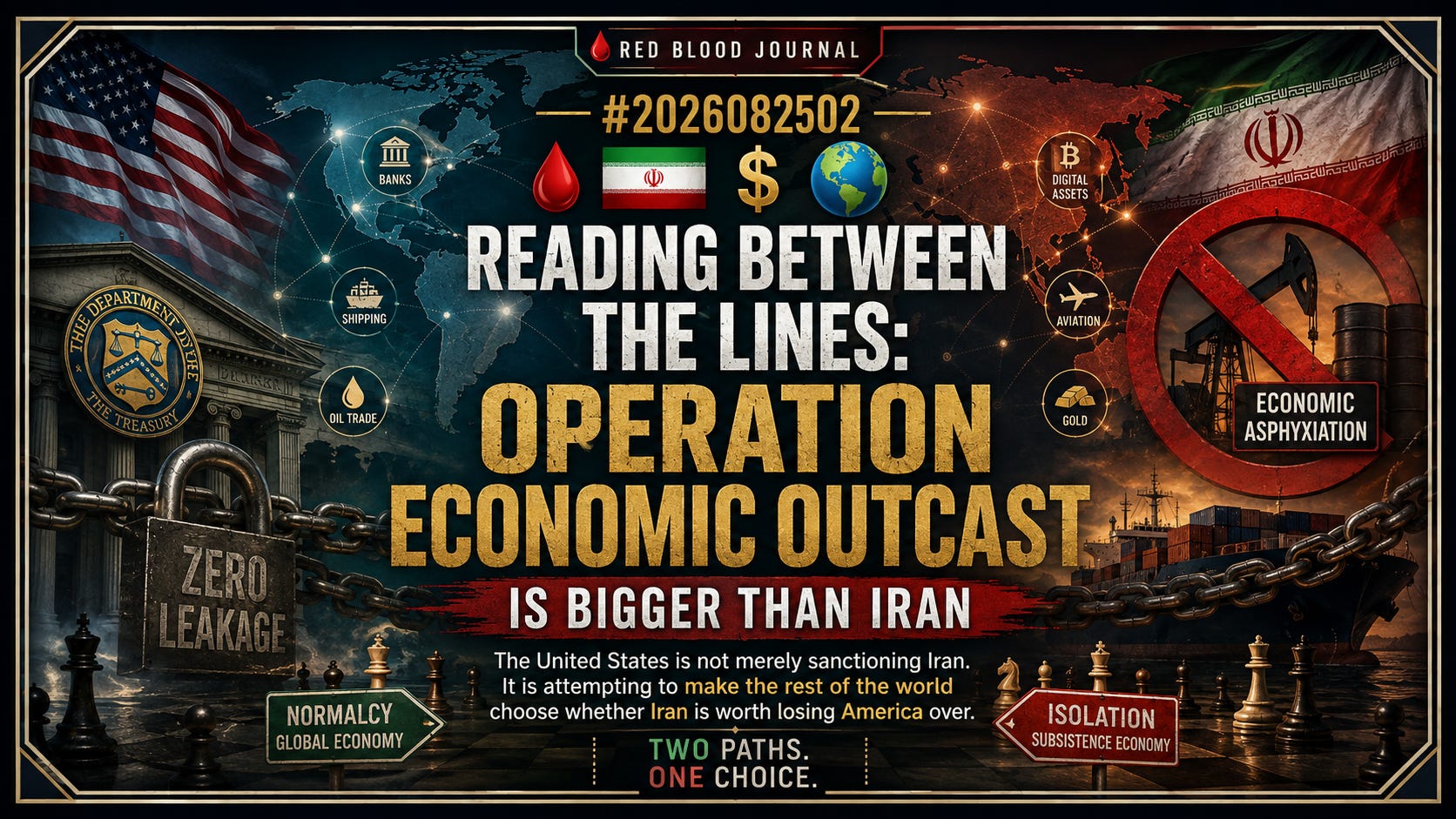
🩸 🇮🇷 💵 🌎 #2026082502 — Reading Between the Lines: Operation Economic Outcast Is Bigger Than Iran
The United States is not merely sanctioning Iran. It is attempting to make the rest of the world choose whether Iran is worth losing America over.
RedBloodJournal.com
Scott Bessent’s announcement of Operation Economic Outcast was presented as an unprecedented financial campaign against the Islamic Republic of Iran.
But the sanctions themselves are only the visible part.
The deeper strategy is much larger.
Washington is attempting to transform Iran from a sanctioned country into an economically isolated one—and to accomplish that not simply by attacking Iranian institutions, but by forcing every foreign bank, shipping company, exchange house, oil trader, technology provider and government dealing with Iran to calculate the price of continuing.
Bessent described the objective plainly:
sever every economic lifeline until Tehran stands alone.
That is not ordinary sanctions enforcement.
It is an attempt to change the architecture surrounding Iran.
1. Washington says the era of “managing” Iran is over
One sentence in the announcement deserves more attention than almost everything else.
Bessent said previous administrations had managed the Iranian threat.
Under President Trump, he said:
“We are ending it.”
That is a major rhetorical escalation.
Economic pressure has traditionally been justified as leverage:
change nuclear policy,
limit missile activity,
restrict terrorism financing,
reduce oil income,
or compel negotiations.
But this speech presents something more ambitious.
Iran is told that only two futures remain:
complete global isolation and a subsistence economy
or
a path back toward normal participation in the global economy.
The most revealing phrase follows:
Operation Economic Outcast is intended to “foreclose every other option.”
That means Washington is targeting the middle ground.
The old model allowed Iran to remain heavily sanctioned while continuing to survive through intermediaries, sympathetic governments, oil buyers, informal finance, exchange houses, shipping networks and sanctions-evasion mechanisms.
The new strategy appears designed to remove that comfortable gray zone.
2. Iran may be the target—but the rest of the world is the battlefield
Listen carefully to whom Bessent spends much of the speech threatening.
It is not merely Tehran.
He identifies governments and commercial intermediaries that:
purchase Iranian petroleum,
transport it,
move Iranian money through exchange houses,
operate through free-trade zones,
accept Iranian flights,
register ships,
facilitate fuel transfers,
permit overland transit,
and allow Iranian-linked transactions through banks.
That tells us what Operation Economic Outcast really is.
It is a campaign against Iran’s connectors.
Washington does not necessarily have to stop Iran from wanting to trade.
It has to make everyone else afraid to trade with Iran.
That is a fundamentally different form of pressure.
3. The dollar is the weapon behind the weapon
Bessent makes the threat unmistakable.
An institution facilitating prohibited Iranian financial activity can be removed from the U.S. dollar system.
That is where American power becomes global.
A foreign bank does not need to love Washington.
A shipping company does not need to agree with American foreign policy.
A government does not even need to agree with sanctions against Iran.
It only needs to ask:
Is doing business with Iran worth jeopardizing access to the dollar, U.S. banks, American markets and the wider financial system that depends upon them?
For most institutions, that is not a philosophical question.
It is mathematics.
This is why secondary sanctions can be enormously more powerful than sanctions placed directly on Iran.
America is using the attractiveness of its own system as leverage.
4. “Zero leakage” changes the strategy
Treasury says it has mapped:
every node, every facilitator and every network through which Iran smuggles oil and evades sanctions.
Then Bessent introduces another revealing phrase:
“zero leakage.”
Taken literally, zero leakage is almost certainly impossible.
The global economy is too large.
Financial networks mutate.
Companies change ownership.
Ships change flags.
Oil changes documentation.
Money changes jurisdictions.
But the phrase reveals the intention.
Washington no longer wants merely to sanction Iran’s major institutions.
It wants to chase the mechanisms that allow those institutions to survive sanctions.
That means the enforcement target moves outward:
from Tehran,
to Dubai,
to Asian banks,
to shipping registries,
to cryptocurrency routes,
to front companies,
to commodity traders,
to financial intermediaries.
The sanctions system becomes a network hunt.
5. Treasury has effectively published a map of Iran’s remaining oxygen
Five sectors were singled out:
digital assets, technology, gold, aviation and shipping.
Those categories deserve attention because they reveal where Washington apparently believes Iran continues to maintain international mobility.
Shipping
Without shipping, oil becomes much harder to monetize.
Gold
Gold can function as value outside ordinary dollar transactions.
Digital assets
Cryptocurrency and related mechanisms potentially offer channels around conventional banking systems.
Aviation
Air connections preserve commercial, logistical and political access to other states.
Technology
Technology can sustain industrial, military and economic capability despite isolation.
Taken together, these are not simply five industries.
They are possible escape valves.
Operation Economic Outcast appears designed to close them sequentially.
6. Trump’s phone calls may matter more than another sanctions list
Bessent says President Trump is personally calling foreign leaders with specific requests to terminate interactions with Iran.
Treasury, State and the U.S. military then follow those conversations with governments and institutions.
Countries are apparently receiving defined timelines for compliance.
Yet those timelines are not being disclosed publicly.
That secrecy may itself be part of the strategy.
A government pressured publicly may resist simply to avoid appearing weak.
A government pressured privately can quietly alter banking rules, shipping permissions or commercial relationships without having to announce that Washington forced it to do so.
This provides a face-saving exit.
And it produces something Treasury would greatly prefer to formal enforcement:
voluntary compliance before sanctions are necessary.
7. Fear may become more effective than punishment
The strongest sanctions system is not necessarily one that sanctions thousands of companies.
It is one in which companies sanction themselves.
Imagine being the compliance officer at an international bank.
You hear the U.S. Treasury Secretary announce:
Washington knows the companies involved.
Washington knows the banks.
Washington knows the trade routes.
Nobody is exempt.
Institutions are being privately warned.
A major financial institution will soon be sanctioned.
The dollar system is at stake.
You do not wait for OFAC to publish your institution’s name.
You terminate the Iranian transaction.
That is anticipatory compliance.
And if enough institutions make the same calculation, Iran can become progressively isolated without Treasury having to pursue every transaction individually.
8. China is the real stress test
Reuters asked the most important practical question.
If nobody is beyond the reach of American sanctions, what happens to Chinese banks facilitating Iranian transactions?
Bessent did not announce action against a major Chinese bank.
Instead, he said Washington prefers quiet diplomacy, knows who the institutions are and expects them to understand the consequences.
That answer reveals the limits of rhetoric.
It is easy to sanction a small intermediary.
It is much more consequential to sanction a financial institution whose punishment could disrupt a major trading relationship.
China therefore becomes the test of whether “zero leakage” really means zero leakage.
If Washington aggressively targets large Chinese financial institutions, then Operation Economic Outcast is as serious as its rhetoric suggests.
If the largest institutions remain effectively protected because the economic consequences are too dangerous, then Iran may continue to possess breathing spaces.
9. The UAE may become Washington’s demonstration case
Bessent was asked whether the United Arab Emirates had already begun reducing its dealings with Iran.
He did not formally confirm the details.
But he said recent UAE actions were probably not coincidental and were “likely causal.”
That matters because successful coercion spreads through example.
If one major regional commercial hub cuts exposure to Iran, every neighboring institution starts asking:
Are we next?
That is how a sanctions campaign becomes a quarantine.
10. Then the speech stops being financial and becomes psychological
One of the most revealing moments comes when Bessent directly addresses ordinary Iranian soldiers.
He tells them to notice when salaries stop arriving—or supposedly become merely “delayed.”
Then he tells them to ask whether their commanders are leading Iran toward victory or ruin.
Finally, he invokes the fall of the Berlin Wall and reminds them that ordinary soldiers eventually chose not to fire upon their own population.
Why would the Treasury Secretary mention soldiers during a sanctions announcement?
Because Washington appears to see a chain reaction:
Reduce revenue.
↓
Reduce government resources.
↓
Make salaries and patronage harder to maintain.
↓
Weaken institutional loyalty.
↓
Increase pressure inside the Iranian state.
The intended audience therefore includes members of Iran’s own security apparatus.
That is not conventional economic policy.
It is economic pressure being deliberately connected to political psychology.
11. Washington finally says exactly what it is attempting
Bessent later uses a phrase so stark that little interpretation is required:
“economic asphyxiation of this regime.”
The metaphor matters.
Asphyxiation does not describe a single blow.
It describes progressively removing the ability to breathe.
That fits the rest of the language:
sever every lifeline.
zero leakage.
collapse every last option.
stand alone.
The strategy appears designed not to strike Iran economically once, but to progressively eliminate alternative survival mechanisms.
12. But the final question exposes Washington’s own vulnerability
A reporter notices something strange about the D-Day comparison.
D-Day was not announced in advance.
Germany was not given a cure period.
So if Treasury is launching an economic D-Day, why warn institutions rather than immediately sanctioning them?
Bessent answers with perhaps the most revealing sentence of the entire press conference:
“Why would I want to blow up the global financial system?”
There it is.
The limits of American power are hidden inside American power itself.
The United States can exert enormous pressure because the international system is deeply interconnected with America.
But that same interconnectedness means Washington cannot recklessly sever everything simultaneously without risking collateral damage to the system it is using as a weapon.
So Treasury intends to warn, provide cure periods, allow institutions to disengage and then escalate.
This is therefore not really financial D-Day.
It resembles a controlled financial siege.
13. The actual battle is over behavior—not punishment
The most successful outcome for Treasury would be surprisingly boring.
It would not require sanctioning every bank.
It would not require chasing every tanker.
It would not require identifying every cryptocurrency wallet.
Instead, Washington wants the threat to become credible enough that the market does the enforcement itself.
Banks refuse Iranian transactions.
Insurers decline Iranian cargo.
Shipowners reject Iranian oil.
Governments close exchange houses.
Technology firms withdraw.
Airlines stop routes.
Trading houses avoid contracts.
Then the isolation process accelerates automatically.
The sanction becomes less important than the fear of the sanction.
14. What to watch now
Do not measure Operation Economic Outcast simply by counting new OFAC announcements.
Watch the behavior of:
Chinese banks.
UAE institutions.
oil buyers.
shipping registries.
insurance companies.
exchange houses.
gold traders.
cryptocurrency networks.
airlines.
technology intermediaries.
The critical question is whether these actors begin disengaging before Washington sanctions them.
If they do, Treasury will have achieved something significantly larger than another sanctions package.
It will have created a self-enforcing financial quarantine.
15. The danger for Iran
For Tehran, the threat is not merely that fewer dollars enter the country.
It is that isolation can reinforce itself.
A foreign bank loses confidence.
That creates difficulty settling trade.
A shipping company withdraws.
That raises transportation costs.
An insurer refuses coverage.
That makes shipping still harder.
A trading partner becomes nervous.
That pushes transactions into increasingly expensive informal networks.
The state then spends more money merely to maintain the same amount of economic activity.
Eventually sanctions do not simply reduce revenue.
They increase the cost of survival itself.
That may be what Washington means by eliminating every economic lifeline.
16. But there is also a danger for Washington
Economic weapons depend upon continued confidence in the economic system wielding them.
Every time access to the dollar becomes a geopolitical weapon, countries have another incentive to search for alternatives.
One sanction does not dethrone the dollar.
Neither do ten.
But over decades, repeated financial coercion can encourage governments to develop alternative payment mechanisms precisely because they do not want their international trade permanently vulnerable to American political decisions.
So Washington is balancing two objectives:
use dollar dominance aggressively enough to achieve political goals,
but not so aggressively that the world accelerates its search for ways around that dominance.
Operation Economic Outcast therefore tests not only Iran.
It tests the endurance of America’s financial leverage.
17. The greatest irony
Iran has spent decades arguing that it can resist American economic pressure.
America is now attempting to prove that resistance becomes irrelevant if the outside world refuses to participate in it.
That is the central idea behind Operation Economic Outcast.
Washington is not trying simply to defeat Iran’s sanctions-evasion machinery.
It is attempting to make the machinery socially and financially radioactive.
Anyone touching it risks becoming contaminated.
That is why the title Economic Outcast is unusually precise.
The operation is designed to make Iran an outcast by threatening to make its partners outcasts too.
🩸 The Red Blood Perspective
This is bigger than Iran because it demonstrates the extraordinary power hidden inside ordinary financial infrastructure.
Banks look boring.
Payment networks look technical.
Shipping registries look administrative.
Currency clearing looks invisible.
But collectively they can become instruments of geopolitical warfare.
No bombs are required to close an account.
No aircraft are required to deny insurance.
No missiles are required to prevent a transaction from clearing.
Yet each decision can constrict an economy.
The most important question therefore is not whether America possesses enough sanctions.
It clearly possesses formidable tools.
The question is whether Washington can apply them strongly enough to isolate Iran without damaging the global system whose cooperation makes those tools powerful in the first place.
China may provide the answer.
Iran may provide the consequence.
And the rest of the world may discover that the twenty-first-century battlefield is increasingly not only land, sea, air or cyberspace.
It is access.
🌊 Ocean of Love and Positivity Perspective
Even inside a confrontation described with words such as asphyxiation, isolation, D-Day and zero leakage, there is still something positive worth searching for.
The first positive possibility is simple:
economic pressure is still reversible.
A destroyed bridge cannot instantly be rebuilt.
A dead soldier cannot return home.
A bombed city cannot be restored by signing an agreement the next morning.
But a frozen account can be unfrozen.
A sanctioned bank can someday be reconnected.
Trade can restart.
Aircraft can fly again.
Oil can be sold openly again.
Diplomatic relationships can be repaired.
That means even an extraordinarily severe economic campaign preserves possibilities that total military destruction does not.
And Bessent’s own two-path framework leaves one of those possibilities visible:
a return to normalcy and reintegration into the global economy.
That door matters.
Perhaps another positive outcome lies inside the pressure itself.
For decades, Iran has developed systems designed to survive isolation.
If Operation Economic Outcast exposes how much national prosperity has become dependent on opaque intermediaries, hidden oil networks, sanctions circumvention and political confrontation, Iranian society may eventually be forced to confront a larger question:
Why should an ancient civilization with enormous human, geographic and natural resources need underground financial lifelines simply to participate in the world economy?
That question can become destructive.
Or it can become transformative.
A society forced to examine what went wrong may eventually demand something better.
Better economic stewardship.
Greater transparency.
Less corruption.
More accountability.
More normal relations with the outside world.
And an economy designed to improve the lives of ordinary citizens rather than perpetually finance confrontation.
There is positivity for the wider world as well.
This confrontation exposes how deeply nations depend upon one another.
America may possess enormous financial power, but Bessent himself acknowledges that exercising it carelessly could damage the global financial system.
That dependence is usually treated as a weakness.
Perhaps it is also humanity’s protection.
When countries become economically intertwined, destroying an opponent increasingly means injuring oneself.
That reality may frustrate governments.
But it can also restrain them.
Interdependence can become an invisible peacekeeper.
Not always.
Not perfectly.
But enough to make leaders think twice before converting every disagreement into total war.
And there may be an even greater positive possibility.
If this enormous pressure ultimately creates negotiations rather than bombs;
if Iranian leaders conclude that economic reintegration is more valuable than perpetual confrontation;
if American leaders discover that leverage can achieve objectives without another generation of war;
if ordinary Iranian people ultimately gain access to opportunity instead of isolation;
and if neighboring countries gain stability instead of another battlefield,
then the darkest language in this announcement may eventually produce something unexpectedly constructive.
Not because economic suffering itself is positive.
It is not.
But because no experience has to be wasted.
Failure can reveal what must change.
Pressure can expose what was unsustainable.
Isolation can remind a nation how valuable connection is.
Conflict can remind humanity why peace matters.
And even a strategy designed to close doors can accidentally illuminate the one door that everyone eventually needs to walk through:
coexistence.
That is what the Ocean of Love and Positivity searches for.
Not denial of darkness.
Not pretending suffering is beautiful.
But finding the lesson, the opening, the transformation and the better road that can still emerge from it.
There is always something to learn.
There is always something that can improve.
There is always another direction available.
And as long as that possibility remains, darkness never gets the final word.
In an Ocean of Love and Positivity.
🩸🌊✨ Fantastic!
⛓️
Operation Economic Outcast: A Strategy of Financial Asphyxiation
Aug 25, 2026
The provided text explores Operation Economic Outcast, a comprehensive American strategy designed to achieve the total financial isolation of Iran. Rather than merely targeting Iranian entities, the United States is pressuring global intermediaries—including banks, shipping firms, and foreign governments—to choose between trading with Tehran or maintaining access to the U.S. dollar. This approach aims for “zero leakage” by closing escape valves in sectors like digital assets, gold, and aviation. The strategy shifts the burden of enforcement onto the private sector through anticipatory compliance, effectively making Iran “radioactive” to international markets. Ultimately, the initiative tests the strength of American financial leverage and its ability to compel behavior from major powers like China without destabilizing the global economy.
#Iran #IranSanctions #OperationEconomicOutcast #EconomicWarfare #ScottBessent #USForeignPolicy #USSanctions #Treasury #OFAC #SecondarySanctions #DollarSystem #FinancialWarfare #EconomicPressure #IranEconomy #GlobalFinance #China #UAE #OilSanctions #ShippingSanctions #DigitalAssets #Geopolitics #EconomicIsolation #MaximumPressure #RedBloodJournal
Treasury Secretary Scott Bessent speaks on planned Iran sanctions


