


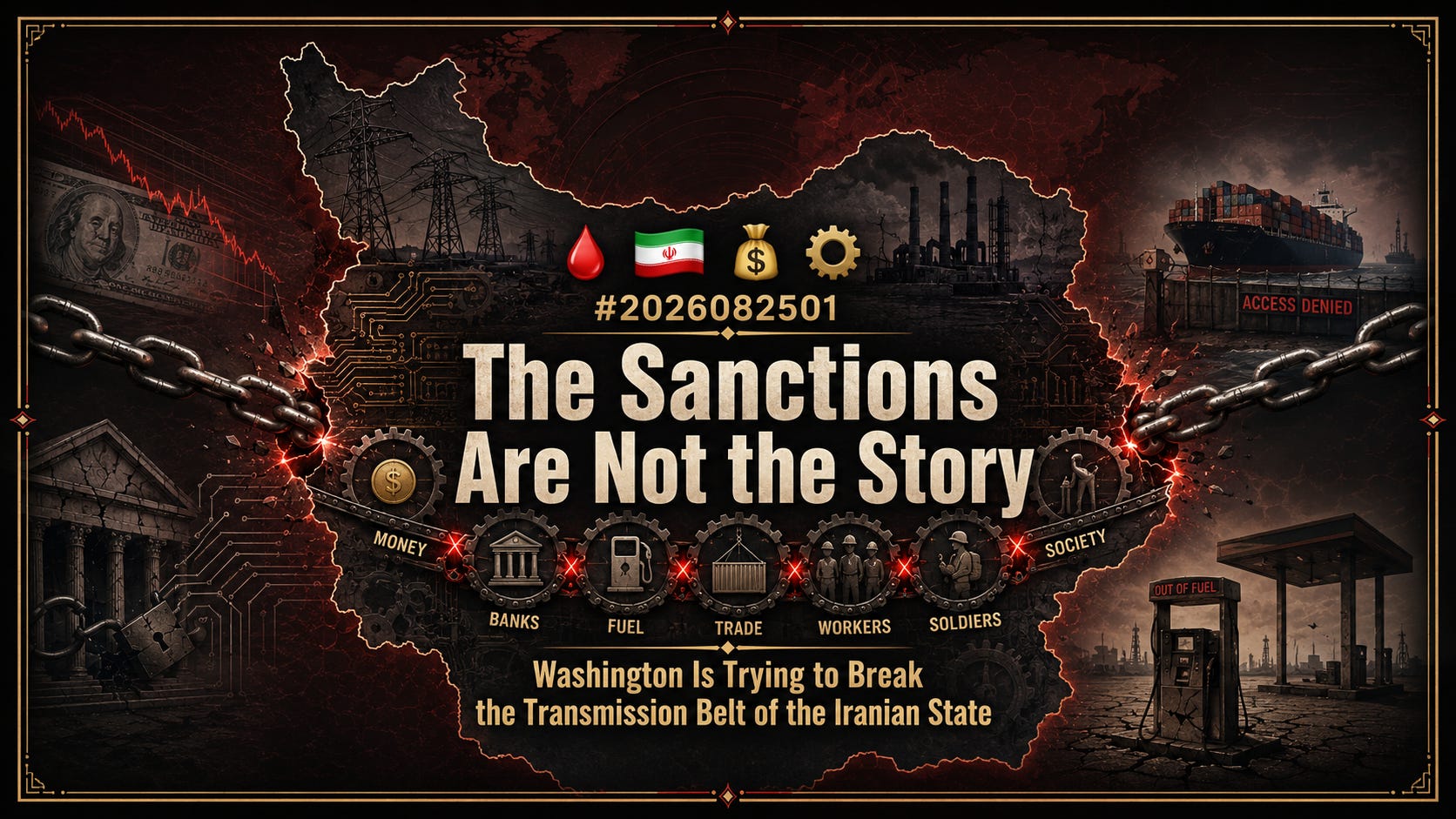
🩸 🇮🇷 💰 ⚙️ #2026082501 — The Sanctions Are Not the Story: Washington Is Trying to Break the Transmission Belt of the Iranian State
When empty shelves, unpaid soldiers, frightened banks, strikes and inflation become parts of the same machine
RedBloodJournal.com
There is a temptation to look at Iran’s present crisis as five different stories.
One story is about empty supermarket shelves.
Another is about gasoline.
Another is about the rial.
Another is about American sanctions.
Another is about people being encouraged to strike.
But read the transcript carefully and something much larger appears.
They may all be the same story.
The battlefield being described is no longer primarily the oil field, the missile base, the Strait of Hormuz, or even the banking system.
It is the transmission system connecting the Iranian state to the people who keep that state alive.
That means:
money → salaries → workers → soldiers → transportation → commerce → food → public obedience.
Break enough links in that chain at the same time, and the problem is no longer merely economic.
It becomes political.
1. The Empty Shelf May Be the Wrong Measurement
The transcript begins with people describing partially empty stores, disappearing brands, rising food prices and concern about approaching scarcity.
But then comes a much more interesting argument.
What if the shelf does not have to become completely empty?
If something that once cost 100 becomes 300, the product may remain on the shelf because millions of people can no longer afford it.
The physical product is still there.
Economically, however, it has disappeared.
That produces a strange form of scarcity:
availability without accessibility.
A government can therefore point toward merchandise and say:
“There is no shortage.”
The family standing in front of it may answer:
“There is for us.”
The transcript explicitly raises this possibility, describing the argument that prices can rise enough to suppress purchasing and therefore prevent shelves from visibly emptying.
That distinction matters enormously.
A famine does not begin when the final bag of rice disappears.
For many families, it begins when the bag remains visible but might as well be behind glass.
2. Gasoline Is More Politically Dangerous Than Rice
The reports of gasoline stations without fuel deserve special attention.
The transcript itself notes why.
Tehran’s filling stations have historically been kept supplied even during difficult periods because fuel availability helps maintain the appearance that the state remains functional.
That makes gasoline different from another expensive commodity.
Gasoline is movement.
It means taxis.
Trucks.
Workers.
Food distribution.
Emergency movement.
Commerce.
Police.
Government vehicles.
Military logistics.
A country can tolerate expensive pistachios.
It cannot easily tolerate immobilization.
When gasoline becomes uncertain, the public receives a message much more powerful than any political speech:
the machine may be losing its ability to move itself.
3. Washington’s Target May Not Be Iran’s Money
Here is where the transcript becomes much more interesting.
The conventional understanding of sanctions is simple:
America prevents Iran from earning money.
But the strategy described here appears more sophisticated.
The transcript presents a threat against banks, companies and countries dealing with Iran: cooperate with Tehran and you may endanger your own access to the dollar-based financial system.
That changes the psychology.
Washington does not necessarily have to police every Iranian transaction.
It does not have to identify every ship.
It does not have to catch every middleman.
It merely has to create one thought inside the mind of every banker:
“Is this Iranian transaction worth losing access to America?”
Once that thought takes hold, sanctions begin enforcing themselves.
The transcript recognizes precisely this mechanism: the objective becomes globalizing the fear of doing business with Iran so that banks withdraw before Washington even has to sanction them directly.
That is a very different weapon.
Traditional sanctions punish.
This kind of sanction changes behavior before punishment occurs.
4. The Real Weapon Is the Counterparty
Iran has spent decades learning how to survive sanctions.
Smuggling.
Middlemen.
Front companies.
Regional banks.
Alternative currencies.
Informal exchange networks.
Oil discounts.
Reflagged shipments.
But all those systems require something Iran does not control:
another person willing to participate.
That may be the hidden vulnerability.
The Iranian government can order one of its own ministries to accept risk.
It cannot order a foreign bank to risk exclusion from the dollar system.
It cannot order an insurer to insure a vessel.
It cannot order a foreign supplier to accept uncertain payment.
It cannot order another country’s businessman to become collateral damage in Tehran’s confrontation with Washington.
This is why the transcript’s discussion of the UAE may be more significant than another sanctions list.
The UAE has long functioned as one of Iran’s commercial lungs.
If that lung constricts, everything becomes more expensive even when trade does not stop completely.
The blockade does not have to be perfect.
It merely has to make every breath harder.
5. Then Came the Most Important Message — And It Was Not Addressed to Khamenei
According to the transcript, Scott Bessent’s message was directed not only toward banks and governments.
It was also directed toward ordinary personnel serving the Iranian state.
The argument was brutally simple:
When your salary is delayed or disappears, ask whether your commanders are leading the country toward victory or destruction.
Then came the Berlin Wall analogy: regimes can appear solid until ordinary soldiers decide they will no longer shoot their own population.
That tells us something important.
The economic campaign described here may have two audiences.
Audience One: the financial world
Do not transact with Iran.
Audience Two: the Iranian state employee
Do not die protecting a system that can no longer even pay you.
That is not merely economic warfare.
It is an attempt to convert economic deprivation into a loyalty crisis.
6. Why Salaries Matter More Than Speeches
Every government ultimately depends upon thousands or millions of ordinary people performing ordinary tasks.
The customs officer opens the gate.
The banker clears the transfer.
The refinery worker keeps the fuel moving.
The truck driver delivers food.
The government clerk processes salaries.
The policeman stands at the intersection.
The soldier follows the order.
Most states do not survive because every participant passionately believes in the ruling ideology.
They survive because the system continues functioning tomorrow morning.
The truly dangerous moment arrives when tomorrow morning becomes uncertain.
A soldier asks:
Will I be paid?
A worker asks:
Why should I show up?
A shopkeeper asks:
Why should I sell today when replacing the merchandise tomorrow may cost twice as much?
A wholesaler asks:
Why should I release inventory if I cannot import the next shipment?
A citizen asks:
Why should I keep my savings in rial?
Individually these are economic decisions.
Collectively they can become a political event.
7. This Explains the Sudden Importance of Strikes
The transcript repeatedly raises national strikes as an alternative to immediate street confrontation.
That makes sense inside this larger framework.
A demonstration challenges government authority visibly.
A strike challenges the government’s metabolism.
No buses.
No factories.
No bazaar.
No trucking.
No bureaucracy.
No fuel distribution.
No normal tax collection.
No ordinary commerce.
The government may still possess weapons.
But weapons cannot run an economy.
This is why a nationwide strike can be more threatening to a weakened government than another night of demonstrations.
The question changes from:
“Can the state suppress the protesters?”
to:
“Can the state force the country to function?”
Those are very different questions.
8. Iran’s Historic Sanctions Argument May Finally Be Running Into a New Variable
Iran has survived sanctions for decades.
That fact is important.
It is also incomplete.
The transcript introduces a significant distinction.
The country being sanctioned today is not necessarily the same economic organism that entered sanctions decades ago.
It describes depleted productive capacity, a deeply damaged currency and, critically, large reconstruction requirements following war.
The analysis identifies three normal ways a country can obtain external financial oxygen:
Sell things.
Borrow money.
Attract investment.
If all three are constrained while enormous reconstruction expenses arrive simultaneously, the government is forced toward the remaining source:
create money internally.
And that means inflation.
9. Money Printing Is a Hidden Tax With No Tax Collector
This may be the central economic mechanism underneath the entire report.
Suppose the government cannot obtain enough dollars.
It still has salaries.
Pensions.
Military costs.
Subsidies.
Reconstruction.
Infrastructure.
State companies.
Security forces.
Political institutions.
Those obligations do not disappear merely because government revenue collapses.
So money is created.
The nominal salary may continue arriving.
But its purchasing power disappears.
The transcript connects precisely this dynamic with soaring prices and depreciation of the rial.
This is how the state can transfer the cost of survival onto citizens without mailing anyone a tax bill.
The government prints.
The currency falls.
Prices rise.
Savings evaporate.
The population pays.
10. That Means the Population Is Becoming the Government’s Last Reserve Currency
This is the deepest line hidden inside the transcript.
Countries have foreign currency reserves.
Gold reserves.
Oil reserves.
Strategic reserves.
But a government under extreme isolation has another reserve:
the living standards of its population.
It can reduce them.
Again.
And again.
And again.
Less meat.
Less travel.
Less medicine.
Less electricity.
Less fuel.
Less savings.
Less purchasing power.
More inflation.
More taxes.
Higher prices.
Lower subsidies.
The regime survives by drawing down society itself.
Eventually, however, that reserve can also approach exhaustion.
And this is exactly where the transcript ends:
The question is no longer simply what economic theory says Iran can withstand.
The question becomes how long the population is willing to pay.
That may be the most consequential sentence in the entire recording.
11. Read Between the Lines: Washington May Be Testing a Threshold, Not Seeking a Number
If the transcript’s description of American strategy is accurate, Washington may not be targeting a specific exchange rate.
Not 200,000 toman.
Not 250,000.
Not 300,000.
And perhaps not a specific oil-export figure either.
The real target may be a threshold.
The point at which enough actors simultaneously decide:
continuing the existing arrangement costs more than abandoning it.
For the banker:
Iran is no longer worth the risk.
For the merchant:
Holding inventory is safer than selling.
For the worker:
Going to work is no longer worth the salary.
For the soldier:
Protecting the system is no longer worth confronting the population.
For the citizen:
Holding rial is no longer rational.
For the businessman:
Remaining inside Iran is more dangerous than moving capital outside it.
None of these decisions alone collapses a state.
But they can reinforce one another.
That is how systems sometimes move from stability to instability much faster than conventional forecasts expect.
12. The Regime’s Greatest Problem May Be Synchronization
Iran has survived terrible inflation before.
It has survived sanctions.
It has survived demonstrations.
It has survived international isolation.
It has survived military confrontation.
It has survived shortages.
But the danger described in this transcript is that too many pressures may now be arriving together.
War damage.
Reconstruction costs.
Financial isolation.
Commercial isolation.
Currency weakness.
Fuel problems.
Goods shortages.
Reduced household purchasing power.
Potential strikes.
Deteriorating salaries.
Pressure on security-force loyalty.
Each problem individually may be survivable.
The danger comes from synchronization.
Five weak ropes can hold a load if they fail at different times.
If they snap together, the result is different.
13. The Hormuz Threat May Reveal the Opposite of What It Intends
The transcript also discusses Iranian rhetoric about stopping oil exports through the region and contrasts it with international energy prices that were moving lower at the time described.
The intended message is strength:
We can disrupt the world economy.
But there is another possible interpretation.
The more frequently a government must remind the world of its final escalation weapon, the more it may reveal how few ordinary economic weapons remain.
A healthy economy threatens competition.
A powerful commercial state threatens to withdraw investment.
A financially connected state threatens markets.
A state pushed toward threatening shipping lanes may be signaling something else:
economic leverage is being replaced by destructive leverage.
That is not necessarily strength.
Sometimes it is the economics of desperation.
14. One Part of the Transcript Must Be Treated Carefully
There is speculation in the recording that the United States could establish or seize territory around the Omani side of the Strait of Hormuz and transform its position there.
Nothing in the transcript establishes this as fact.
It is prediction and conjecture by speakers.
That distinction matters.
The broader economic argument does not require this speculation to be true.
In fact, the economic strategy described elsewhere in the transcript points toward something potentially cheaper:
make Iran economically unable to sustain prolonged confrontation rather than immediately expanding the conventional battlefield.
15. The Clock Nobody Can See
That leaves one extraordinary unanswered question.
How much pain can a modern society absorb before behavior changes?
Economists cannot calculate that precisely.
Neither can intelligence agencies.
Neither can Tehran.
Neither can Washington.
A government may survive 50% inflation and collapse after something apparently smaller.
A population may endure years of hardship and then react to a gasoline shortage.
A soldier may obey through ideological disagreement but reconsider after three missed salaries.
A merchant may tolerate sanctions but close when he realizes he cannot replace inventory.
Political systems often appear stable right until the invisible threshold is crossed.
That is why the final battle described by this transcript may not ultimately be fought over the rial, Hormuz, or Bank Melli.
It may be fought inside millions of private calculations:
Is continuing like this still worth it?
🩸 The Red Blood Perspective
The deepest lesson in this report is not merely that economic pressure can weaken a government.
It is that every political system, every military structure, every financial institution, and every ideology eventually reaches the same final boundary:
human beings.
Banks do not suffer.
Currencies do not become hungry.
Governments do not stand in food lines.
Ordinary people do.
That is why the true measurement of any political or economic strategy should never be only whether it defeats an opponent.
It should also be:
What happens to the people caught underneath it?
Iran may be entering a period in which the government attempts to preserve itself by transferring more and more of its financial burden onto the population.
Inflation transfers the burden.
Shortages transfer the burden.
Collapsed purchasing power transfers the burden.
Delayed salaries transfer the burden.
Broken infrastructure transfers the burden.
And eventually the question becomes whether the people continue carrying it.
But there is another side to that reality.
When a system becomes increasingly dependent upon ordinary people accepting unbearable conditions, those ordinary people also become increasingly important.
The worker matters.
The shopkeeper matters.
The truck driver matters.
The soldier matters.
The mother trying to feed her family matters.
The young person deciding whether to remain silent matters.
The citizen who refuses hatred matters.
The individual who chooses conscience over fear matters.
That is where real power ultimately lives.
A government can possess weapons, institutions and money.
But society possesses something even more fundamental:
participation.
When enough human beings begin choosing conscience, cooperation and responsibility instead of fear, corruption and blind obedience, even a seemingly immovable system can change.
That is the deeper Red Blood lesson.
Not that suffering itself is desirable.
Never.
But suffering can expose what was previously hidden.
It can reveal corruption.
It can reveal dependency.
It can reveal which institutions actually serve the population and which survive by consuming it.
And once something is clearly seen, it becomes much harder to hide again.
That awareness can become the beginning of transformation.
🌊 Ocean of Love and Positivity Perspective
And this is where we deliberately search for the positive possibility hidden inside even the darkest subject.
Because there is one.
There must always be one worth looking for.
The positive possibility is not famine.
It is not economic destruction.
It is not war.
It is not sanctions.
It is not collapse.
The positive possibility is what human beings may choose to build after seeing clearly what no longer works.
A society forced to confront corruption may eventually demand transparency.
A population that experiences the consequences of concentrated power may become more protective of decentralized power.
People who discover that political slogans cannot fill an empty refrigerator may begin judging governments by competence rather than propaganda.
Soldiers asked to choose between orders and their own people may rediscover that they are citizens before they are uniforms.
Workers who recognize their collective importance may discover that a country is not held together by politicians alone.
Families surviving hardship may rediscover community.
Neighbors may help neighbors.
Merchants may protect customers.
Doctors may treat patients despite failing institutions.
Citizens may begin rebuilding trust from the ground upward.
And perhaps most importantly, Iranians who have spent decades being divided into opposing camps may eventually recognize something much simpler:
they are suffering inside the same country.
That realization can dissolve manufactured divisions.
Left and right.
Religious and secular.
Young and old.
Rich and poor.
Inside Iran and outside Iran.
Those divisions can appear enormous until people recognize the larger truth underneath them:
everyone wants dignity, security, food, opportunity, peace, and a future for their children.
That common ground is where rebuilding can begin.
The collapse of an unhealthy structure does not automatically create something better.
Human beings must choose something better.
But the destruction of an illusion can create the opportunity for truth.
Economic pain can teach the importance of sound money.
Corruption can teach the importance of accountability.
Authoritarianism can teach the value of individual liberty.
War can teach the value of peace.
Isolation can teach the value of cooperation.
Fear can teach courage.
Division can teach unity.
And hatred, when its consequences become unbearable enough, can remind humanity why love matters.
That is the positive possibility buried beneath this entire story.
Perhaps Iran’s greatest future resource is not oil.
Not gas.
Not gold.
Not strategic geography.
Not missiles.
Not even foreign investment.
It may be the Iranian people themselves, once their energy is directed toward building instead of merely surviving.
Imagine what becomes possible if the intelligence, creativity, education, history, culture and entrepreneurial ability of millions of Iranians are no longer consumed by navigating corruption, inflation, sanctions, censorship and political confrontation.
That energy does not disappear.
It is waiting.
And when destructive systems finally exhaust themselves, that human potential can become the foundation of something completely different.
A healthier economy.
More accountable government.
Peaceful relations with the world.
More opportunity for young people.
Greater dignity for workers.
A society where disagreement does not require hatred.
A country where government serves the population rather than demanding that the population sacrifice endlessly for the government.
That possibility is the light at the end of this report.
We do not search for positivity because darkness is imaginary.
We search for positivity because darkness is real, and therefore finding the path through it matters even more.
Every crisis contains information.
Every failure contains a lesson.
Every injustice exposes something that can be corrected.
Every broken system teaches something about how the next one should be built.
Every division creates an opportunity for reconciliation.
Every ending opens space for another beginning.
And every human being who refuses to surrender compassion, even while surrounded by fear, remains connected to something larger than politics, economics or governments.
That is how we remain part of the Ocean.
We look directly at what is wrong.
We refuse to pretend suffering is good.
Then we ask the question that must always come next:
What good can humanity create from what we have now learned?
There is always something.
A lesson.
An awakening.
A correction.
A reconciliation.
A new beginning.
A better choice.
A deeper understanding.
A stronger community.
A more compassionate future.
Sometimes the positive outcome is visible immediately.
Sometimes it takes years.
Sometimes one generation suffers so the next generation finally understands what must never be repeated.
But the possibility remains.
That is the Ocean of Love and Positivity.
Not blindness to darkness.
The determination to find the light that darkness reveals.
And as long as we continue searching for that light—in every event, every tragedy, every mistake, every conflict, and every human experience—we remain connected to the Ocean rather than becoming consumed by the storm.
In an Ocean of Love and Positivity.
🩸🌊✨ Fantastic!
🔗
Breaking the Iranian State: A Strategy of Financial Asphyxiation
Aug 25, 2026
The provided text examines a sophisticated American strategy designed to destabilize the Iranian state by dismantling the economic links between the government and its citizens. Rather than focusing solely on direct punishments, the United States leverages the dominance of the dollar to force global banks and businesses to abandon Iranian partnerships out of fear. This approach creates a “transmission belt” failure where the regime struggles to pay soldiers, distribute fuel, and maintain affordable food supplies. Consequently, the state is forced to consume the living standards of its population to survive, leading to extreme inflation and social unrest. The source suggests that this pressure aims to reach a critical threshold where ordinary personnel and citizens decide that protecting the system is no longer viable. Ultimately, the analysis posits that such systemic exhaustion may lead to a fundamental transformation driven by the collective refusal of the people to participate in a failing structure.
#Iran #IranSanctions #EconomicWarfare #IranEconomy #IranCrisis #IranianRial #Inflation #FoodShortage #FuelShortage #BankMelli #ScottBessent #USSanctions #MaximumPressure #FinancialWarfare #EconomicCollapse #CurrencyCollapse #StraitOfHormuz #GeneralStrike #IranProtests #IranRevolution #RegimeChange #Tehran #MiddleEast #Geopolitics #Washington #TreasuryDepartment #SecondarySanctions #BankingSanctions #EconomicSiege #RedBloodJournal


