


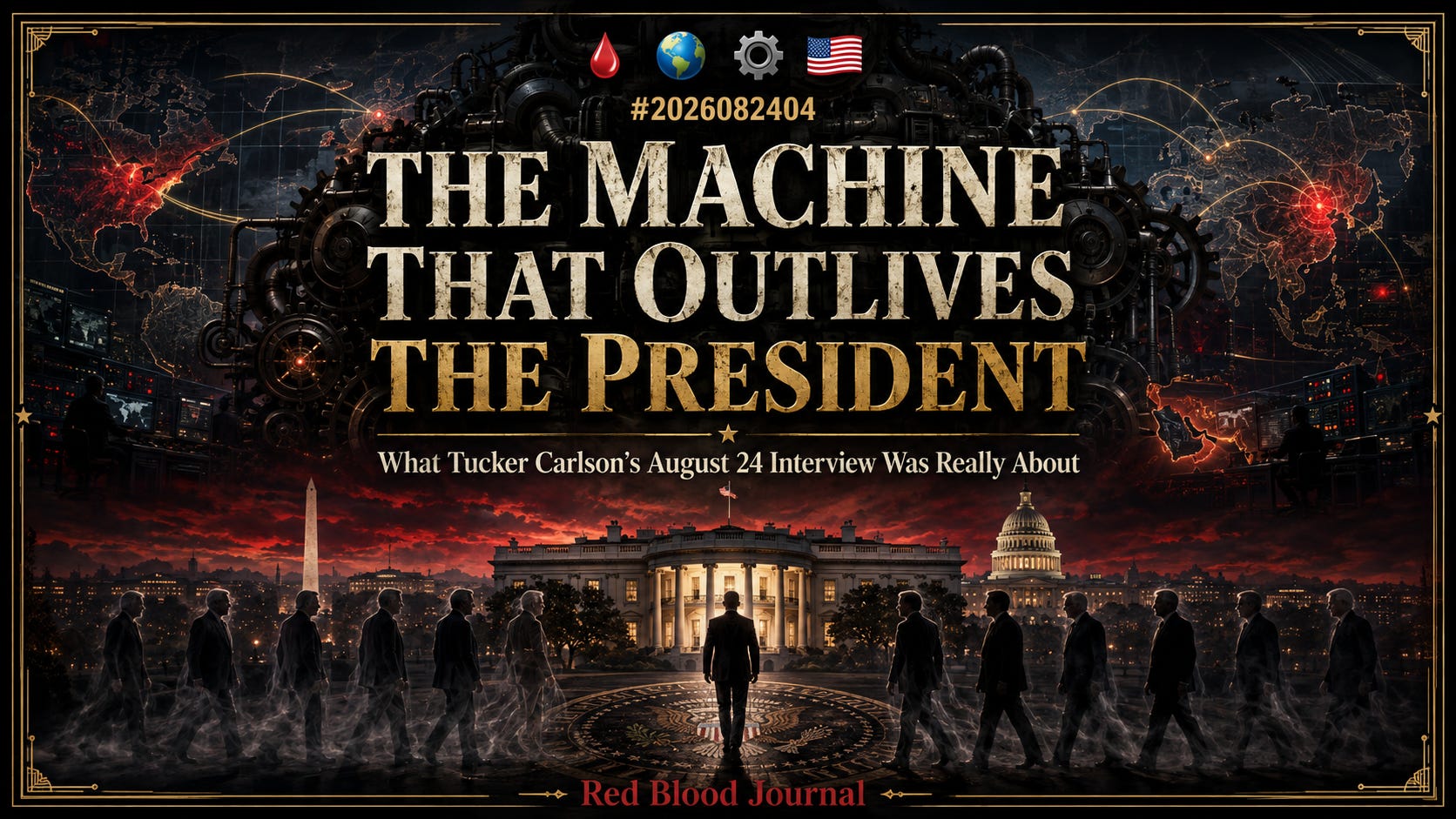
🩸 🌎 ⚙️ 🇺🇸 #2026082404 — The Machine That Outlives the President: What Tucker Carlson’s August 24 Interview Was Really About
A Red Blood Journal Report
The August 24 Tucker Carlson interview appears to be about Iran, Ukraine, China, NATO, Israel, Trump and the Middle East.
Read literally, it is a foreign-policy discussion.
Read carefully, it is something much larger.
It is a report about a system that may have become strong enough to survive elections, presidents, public opinion and even repeated failure.
The central question hiding beneath the entire conversation is not simply:
Why did America enter another war?
It is:
Who actually controls the direction of American foreign policy?
Because presidents repeatedly campaign against intervention.
The public repeatedly demands greater attention at home.
Wars repeatedly become unpopular.
And yet the machinery repeatedly returns to the same destination.
That pattern is difficult to dismiss as coincidence.
1. Presidents Change. The Direction Barely Does.
The interview traces a remarkable sequence.
George W. Bush campaigned on a “strong but humble” foreign policy.
Barack Obama rose partly because he had opposed the Iraq War.
Donald Trump openly attacked forever wars, neoconservatives and the foreign-policy establishment.
Yet each administration, in different ways and to different degrees, became involved in military operations abroad.
The guest explicitly argues that presidents have repeatedly recognized what voters wanted to hear — more attention at home and less foreign intervention — but that this preference did not reliably translate into governing behavior.
That raises the first uncomfortable possibility:
Maybe elections change the driver without changing the road.
The president matters.
But perhaps the president enters an already moving vehicle.
The intelligence bureaucracy remains.
The military structure remains.
The alliance commitments remain.
The lobbying networks remain.
The think tanks remain.
The defense contractors remain.
The congressional committees remain.
The permanent diplomatic establishment remains.
A president can attempt to turn the wheel.
But the entire machine has momentum.
2. Trump Becomes the Most Important Test
This is why Trump matters so much in the interview.
Trump did not merely promise competent intervention.
He promised to challenge the interventionist system itself.
He criticized Iraq.
He criticized Afghanistan.
He attacked the architects of the forever wars.
He presented himself as the president who understood that America could be strong without constantly starting or inheriting wars.
That is precisely why the Iran question becomes so important.
If even Donald Trump — whose political identity was partly built around opposition to endless intervention — can become deeply involved in another major conflict, then perhaps the explanation cannot be reduced to Trump himself.
It suggests something more structural.
The interview becomes less:
Why did Trump do this?
and more:
What happens to presidents after they enter Washington?
3. Iran Is a Test of Power — But Also of Political Endurance
Militarily, the United States is vastly more powerful than Iran.
That is not the interesting part.
The interesting part is the imbalance in motivation.
The guest characterizes the conflict as a war of choice for Washington but a war of survival for the Iranian government.
For Washington, withdrawal is politically painful.
For Tehran, defeat may mean regime destruction.
Those are not equal motivations.
This leads to a principle that conventional military comparisons often miss:
The stronger army does not always possess the stronger reason to continue fighting.
America may have more aircraft.
More missiles.
More satellites.
More money.
More allies.
More technology.
But Iran may have something militarily weaker states often possess:
a greater willingness to absorb pain.
If one side wants victory and the other believes defeat means death, the weaker side may remain in the fight far longer than anticipated.
Vietnam taught this.
Afghanistan taught this.
Iraq should have taught this.
Iran may be teaching it again.
4. Iran Does Not Need to Defeat America
One of the most important ideas in the interview is that Iran’s strategy does not necessarily require conventional military victory.
Iran only has to raise the cost.
Economic cost.
Political cost.
Regional instability.
Energy disruption.
Electoral consequences.
Pressure from neighboring governments.
The guest explicitly discusses the possibility that significant economic consequences inside the United States could themselves influence American politics and discourage future presidents from repeating the same policy.
That changes the definition of victory.
Iran does not need Washington to surrender.
Iran needs Washington eventually to conclude:
This is no longer worth continuing.
That is asymmetric warfare at its most fundamental level.
The stronger power measures bombs.
The weaker power measures patience.
5. The Most Dangerous Failure Is Not Military
An American military operation can succeed technically and fail politically.
This distinction runs through the interview.
A target can be destroyed.
A military commander can be killed.
A government building can disappear.
A nuclear facility can be damaged.
An economy can be crippled.
None of those things automatically answers the next question:
Then what?
Who governs?
Who provides legitimacy?
Who controls the military?
Who controls the streets?
Who controls the competing factions?
Who prevents civil war?
Who prevents neighboring powers from intervening?
Who convinces the population that the new system belongs to them rather than to the foreign power that destroyed the previous one?
Military planning can identify targets.
Political reality does not come with coordinates.
This may be the central weakness in modern interventionism:
It repeatedly confuses the ability to remove something with the ability to replace it.
6. The China Section Exposes Another Kind of Failure
The interview’s China discussion reveals that foreign-policy failure does not always involve bombs.
Sometimes it involves incentives.
American companies moved production to China because it was profitable.
Consumers benefited from inexpensive goods.
Political leaders encouraged economic integration partly because they believed growing prosperity would eventually liberalize China politically.
The expected sequence was:
Markets → wealth → middle class → democracy.
China took the markets.
China took the investment.
China took the technology.
China grew.
But China did not become the political system Washington predicted.
Meanwhile, the long-term balance of economic power changed.
This exposes a deeper systemic problem.
There did not need to be a conspiracy.
Every participant could behave rationally.
Corporations pursued profit.
Consumers pursued lower prices.
Politicians avoided economic pain.
Investors pursued returns.
And collectively the country helped strengthen its most important strategic competitor.
That leads to a powerful lesson:
A system can produce a disastrous outcome even when every participant believes he is acting rationally.
Nobody needs to secretly control the machine.
Sometimes the machine controls itself.
7. America Kept Looking at the Middle East While China Kept Growing
The guest argues that Washington recognized China’s rise years ago.
But 9/11 changed priorities.
Then came Afghanistan.
Iraq.
Syria.
Iran.
Counterterrorism.
Regional crises.
Each administration announced some version of a renewed focus on Asia.
Each was pulled back toward the Middle East.
The guest explicitly argues that this recurring distraction benefited China because Washington was unable to sustain the strategic concentration many officials believed was necessary.
That creates another disturbing possibility:
America’s competitors may not need to defeat America.
They may simply need America to keep exhausting itself elsewhere.
A billion dollars spent unnecessarily in one theater is a billion dollars unavailable somewhere else.
A missile fired in one war cannot be fired in another.
Diplomatic attention is finite.
Political attention is finite.
Public patience is finite.
Even great powers have limits.
8. Rules Destroyed Against Enemies Eventually Disappear for Everyone
The interview’s discussion of assassination deserves more attention than it usually receives.
The guest argues that the international norm against assassinating leaders has substantially eroded.
At first, that sounds like a moral discussion.
It is really a strategic one.
Powerful states often justify extraordinary actions by declaring the adversary extraordinary.
This enemy is uniquely dangerous.
This situation is different.
This action is necessary.
But other governments rarely preserve the moral footnotes.
They remember the precedent.
If one government claims the right to eliminate foreign leaders, other governments can eventually claim the same right.
If one government treats regime change as legitimate national security policy, others may follow.
If one government attacks during negotiations, adversaries learn that negotiations may provide no protection.
The rule does not remain:
America may do this under exceptional circumstances.
The rule slowly becomes:
States may do this.
That is a much more dangerous world.
9. Diplomacy Was Never Supposed to Mean Friendship
Another hidden theme concerns Washington’s habit of refusing direct engagement with governments it finds morally objectionable.
The guest contrasts this with Russia and China, which maintain relations with governments across ideological divides.
The deeper issue is a confusion between communication and approval.
Talking to Iran does not mean approving Iran.
Talking to Russia does not mean approving Russia.
Talking to China does not mean approving China.
Diplomacy exists because enemies need communication more than friends do.
Once talking itself becomes politically suspicious, foreign policy becomes increasingly dependent on pressure, sanctions, coercion and eventually force.
That is not moral clarity.
It can become strategic paralysis.
10. Ukraine Shows What Real Negotiation Actually Looks Like
The Ukraine portion of the interview exposes something politicians rarely say publicly:
A negotiated peace usually requires both sides to accept outcomes they dislike.
The guest argues Ukraine likely cannot recover every lost territory by force under present conditions.
He also argues Russia should not receive everything it wants.
His proposed logic is leverage on both sides:
America continues supporting Ukraine.
Ukraine reduces maximal territorial and NATO ambitions.
Russia accepts limits.
Ukraine remains sovereign and militarily capable.
The essential principle is:
Peace begins when victory is redefined from “everything we demanded” to “something we can live with.”
War rhetoric encourages absolutes.
Diplomacy requires compromise.
That difference may explain why diplomacy is so politically difficult.
The person demanding total victory sounds stronger.
The person negotiating reality sounds weaker.
Until the bill arrives.
11. The Accountability Problem May Be the Biggest Problem of All
Near the end of the interview, the guest discusses foreign-policy experts who repeatedly advocate policies that fail.
He does not argue that one mistake should destroy a person’s career.
Foreign policy is uncertain.
Predictions fail.
Intelligence is incomplete.
But repeated failure without intellectual correction is different.
If someone repeatedly supports policies that produce disastrous results and then returns years later advocating the same model again, why does the system continue listening?
The guest argues that willingness to admit error matters enormously.
This may be the most powerful institutional criticism in the entire interview.
In ordinary life:
A mechanic who repeatedly destroys engines loses customers.
A surgeon with catastrophic outcomes faces investigation.
A contractor who repeatedly builds defective structures loses contracts.
A manager who bankrupts businesses stops receiving promotions.
But foreign-policy failure can sometimes produce something remarkable:
another television appearance.
Another think-tank position.
Another administration.
Another advisory role.
Another war.
The consequences fall on soldiers, civilians and taxpayers.
The reputational consequences may barely reach the architects.
12. Why There May Be No Single Villain
It is tempting to search for one hidden hand.
The president.
Israel.
The Pentagon.
The CIA.
Donors.
Defense contractors.
Lobbyists.
Congress.
The intelligence community.
But the interview points toward something potentially more troubling.
There may be no single control room.
Different institutions may push toward similar outcomes for completely different reasons.
The military wants readiness.
Defense companies want contracts.
Politicians want donors and electoral safety.
Allies want protection.
Bureaucracies protect missions.
Think tanks protect doctrines.
News organizations reward dramatic conflict.
Presidents want historical legacies.
None needs to secretly coordinate with the others.
The result can still look coordinated.
This is what makes systems more powerful than conspiracies.
A conspiracy requires meetings.
A system only requires incentives.
13. The Question Tucker Keeps Approaching
Throughout the interview Tucker repeatedly returns to contradictions.
Why do presidents promise peace and produce war?
Why does public preference appear unable to redirect foreign policy?
Why are failed policymakers continually recycled?
Why does Washington refuse to talk to enemies?
Why does intervention continue after repeated disappointment?
Why are Americans relatively disconnected from wars being fought in their name?
Taken together, these questions lead toward one larger question:
Does America control its foreign-policy machinery — or does the machinery increasingly control America?
The transcript does not prove that a hidden organization dictates American policy.
That conclusion would go beyond the evidence.
But the pattern the interview identifies is real within its own argument:
Different presidents.
Different parties.
Different rhetoric.
Recurring results.
That deserves examination.
The Red Blood Perspective
The United States is not suffering from a lack of power.
It may be suffering from something more dangerous:
The inability to distinguish power from wisdom.
Power says:
We can do it.
Wisdom asks:
Should we?
Power says:
We can destroy the government.
Wisdom asks:
What replaces it?
Power says:
We can punish the enemy.
Wisdom asks:
What will the enemy learn from being punished?
Power says:
We can win the battle.
Wisdom asks:
What constitutes winning the war?
And perhaps most importantly:
Power asks whether America can force another country to change.
Wisdom asks whether America’s own institutions are capable of changing after they fail.
That may be the real subject of Tucker Carlson’s August 24 interview.
Not Iran.
Not China.
Not Russia.
Not Ukraine.
Not even Trump.
The machine.
The machine that survived Bush.
The machine that survived Obama.
The machine that survived Trump.
The machine that survived Biden.
The machine that repeatedly hears the American public ask for fewer foreign adventures and repeatedly discovers another reason why the next intervention is different.
And if that interpretation is correct, then replacing one president will never be sufficient.
Because a driver cannot permanently change direction if the road beneath him has already been built.
🌊 The Ocean of Love and Positivity Perspective
There is nothing weak about questioning power.
It may be the highest form of patriotism.
A nation should be able to examine its mistakes without hating itself.
A government should be able to speak with an enemy without surrendering to him.
A leader should be able to admit an error without losing dignity.
And citizens should never be forced to choose between loving their country and questioning what their government does in its name.
Real strength does not fear examination.
Real democracy does not fear accountability.
Real diplomacy does not fear conversation.
And real peace begins when nations stop confusing the ability to destroy with the ability to lead.
In an Ocean of Love and Positivity.
🩸🌊✨ Fantastic!
⚙️
The Machine: Why American Foreign Policy Never Changes
Aug 24, 2026
This text analyzes an interview by Tucker Carlson that explores the idea of a permanent foreign-policy machine in the United States that operates independently of presidential elections. The author argues that while leaders frequently campaign on promises of non-interventionism, the underlying bureaucratic and military structures consistently drive the nation toward global conflict. Using examples like Iran, China, and Ukraine, the report illustrates how institutional momentum and a lack of accountability often override the desires of the voting public. The source highlights a troubling disconnect where military success is frequently mistaken for strategic wisdom, leading to cycles of repeated failure. Ultimately, the piece suggests that the American political system has become a self-sustaining engine that preserves its own interventionist path regardless of who sits in the Oval Office.
#TuckerCarlson #TuckerCarlsonInterview #USForeignPolicy #AmericanForeignPolicy #IranWar #Iran #UnitedStates #Geopolitics #ForeverWars #RegimeChange #MilitaryIndustrialComplex #ForeignPolicyEstablishment #WashingtonDC #PoliticalAccountability #AmericanPolitics #DonaldTrump #TrumpForeignPolicy #China #Russia #Ukraine #MiddleEast #Diplomacy #WarAndPeace #NationalSecurity #DeepStateDebate #InstitutionalPower #PoliticalSystem #AmericanEmpire #GlobalPower #RedBloodJournal


