


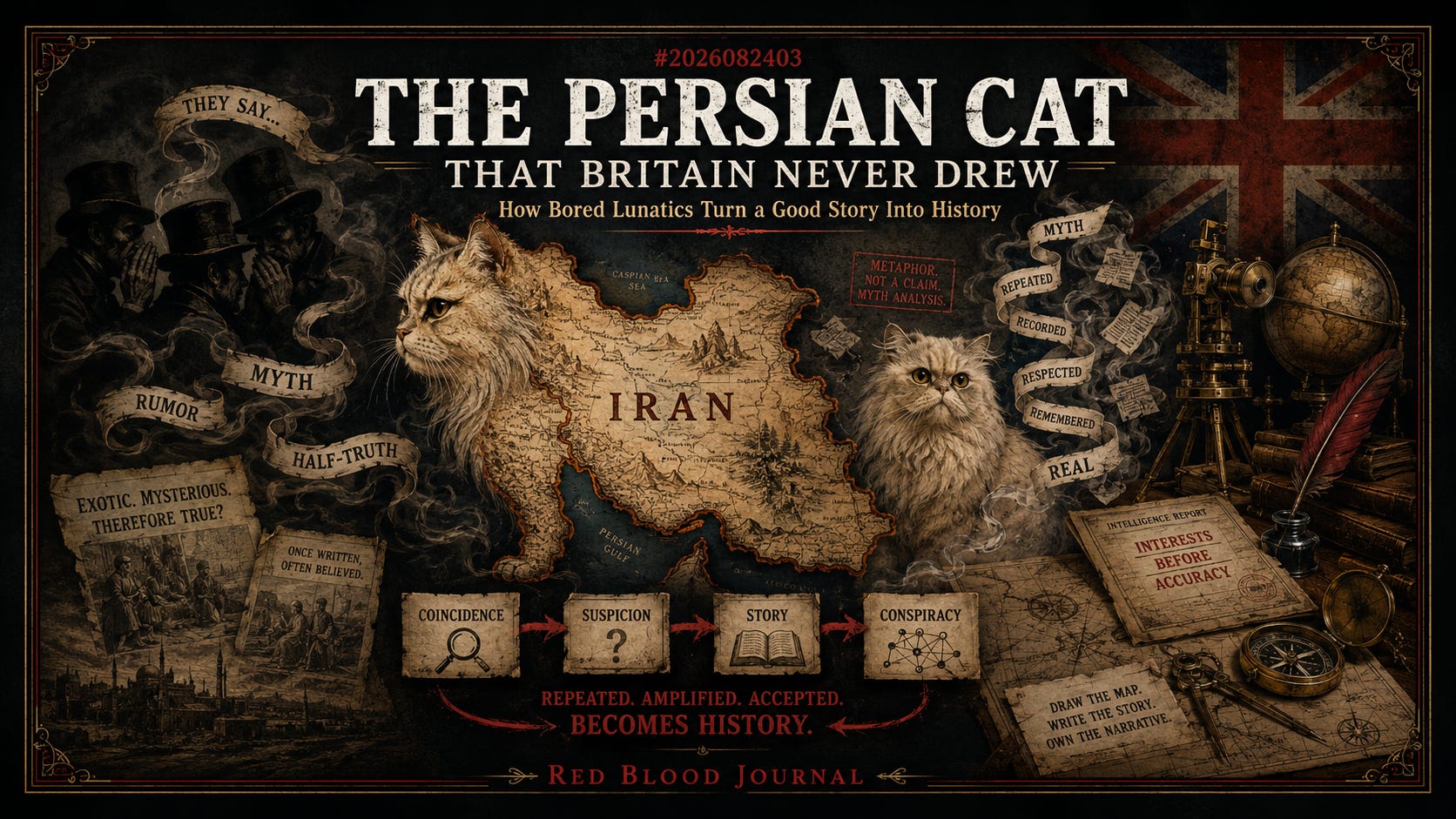
🩸 🐈 🇮🇷 🇬🇧 #2026082403 — The Persian Cat That Britain Never Drew: How Bored Lunatics Turn a Good Story Into History
Say something entertaining enough, repeat it long enough, and eventually somebody will call it history.
Red Blood Journal
Look at the map of Iran.
Once somebody tells you it resembles a sitting Persian cat, it becomes almost impossible not to see it.
There is the body.
There is the head.
There is something resembling a tail.
And then comes the wonderful story:
The British loved Persian cats so much that when they drew Iran’s borders, they deliberately shaped the country like one.
Fantastic story.
Memorable.
Funny.
Just enough British Empire in it to sound sinister.
And apparently unsupported by the historical evidence.
That last part rarely stops a good story.
First, the strange part that IS true
Britain really did develop a fascination with Persian cats.
Encyclopaedia Iranica records that long-haired cats associated with Persia reached England in the early nineteenth century and became highly fashionable in the West. British breeders subsequently played a major role in developing the modern Persian breed.
So the first ingredient of the legend is real:
The British really liked Persian cats.
And Iran really does have an outline in which people can see a cat.
Put those two facts next to each other and the human imagination takes over.
Britain likes Persian cats.
Iran looks like a Persian cat.
Britain interfered extensively in Persia.
Therefore:
Britain must have drawn Persia to look like its favorite cat.
There is only one inconvenience.
History.
Britain really DID interfere with Iran’s geography
The absurdity of the cat story should not be used to erase Britain’s very real role in Persian affairs.
British and Russian involvement in Persia’s frontiers is documented.
The Library of Congress, for example, preserves a massive survey titled “Map of the Turco-Persian Frontier,” produced from work by Russian and English officers between 1849 and 1855.
British and Russian competition over Persia was so significant that nineteenth-century British statesman George Curzon later described the “Persian question” largely through the rivalry of those two empires for influence over the country.
So suspicion toward imperial interference did not fall out of the sky.
Britain was there.
Russia was there.
Borders were surveyed.
Territories changed hands.
Foreign governments exerted enormous pressure over Persia.
That is real history.
But somewhere along the road, reality became too boring.
And somebody apparently decided:
Add a cat.
This Is How Nonsense Becomes Knowledge
The recipe is remarkably simple.
Step One: Start with two real facts.
Britain had enormous influence in Persia.
Britain loved Persian cats.
Step Two: Notice a coincidence.
Iran’s outline resembles a cat.
Step Three: Invent the bridge.
“The British intentionally made it that shape.”
Step Four: Remove the question mark.
Now it becomes:
“The British made Iran look like a Persian cat.”
Step Five: Repeat it.
One person tells another.
A relative repeats it.
A teacher mentions it.
Someone posts it online.
Someone else makes a video.
Then somebody says:
“Everybody knows this.”
And at that moment, fiction graduates into history.
No archive required.
No treaty required.
No cartographic evidence required.
Just repetition.
The Human Brain Loves the Cat More Than the Treaty
This is not really a report about cats.
It is a report about the human mind.
Ask somebody to remember this:
Persia’s modern territorial boundaries emerged through centuries of wars, dynastic changes, treaties, imperial rivalry, surveying commissions and negotiations involving Persia, Russia, Britain, the Ottoman Empire and neighboring territories.
That is difficult.
Now tell them:
England loved Persian cats, so the British drew Iran like a cat.
Gone.
Installed permanently.
Because the second story has everything the brain wants.
A villain.
A joke.
A visual.
An animal.
An empire.
An explanation requiring approximately eight seconds.
Real history does not stand a chance.
The Most Successful Lies Usually Borrow Something True
Completely ridiculous stories often die quickly.
The powerful ones contain a piece of reality.
That is what gives them traction.
The Persian-cat story works because Britain really was deeply involved in Persia.
English officers really did participate in frontier surveys.
The British really were fascinated by Persian cats.
Iran really does resemble a cat if the imagination is given a small push.
Everything needed to manufacture the story is sitting on the table.
Except evidence for the story itself.
That distinction is enormous.
The Bored-Lunatic Principle
Perhaps somewhere, sometime, someone was looking at the map.
They saw a cat.
They laughed.
Then they offered an explanation.
Maybe they were joking.
Maybe they genuinely believed it.
Maybe somebody misunderstood them.
Maybe the entire thing began over tea.
We may never know.
But civilization has produced an extraordinary number of “facts” this way.
A bored person connects two unrelated dots.
Another person improves the story.
A third person removes the uncertainty.
A fourth person adds authority:
“My grandfather told me.”
A fifth adds conspiracy:
“They don’t want you to know.”
And by the tenth generation of repetition, anybody asking for evidence becomes the suspicious one.
That is the masterpiece.
The person questioning the unsupported claim is suddenly accused of being naïve.
Imagine Designing an International Border Around a Cat
The theory becomes even more entertaining when taken literally.
Imagine the meeting.
British officials surround a giant map.
Diplomats are negotiating mountains, deserts, rivers, tribal territories, trade routes, military positions and imperial interests.
One gentleman suddenly interrupts:
“Excellent work, gentlemen. But the southeastern border needs adjustment.”
“Strategic reason?”
“No.”
“Oil?”
“No.”
“Russian influence?”
“No.”
“Then why?”
“Whiskers.”
The empire waits.
Another official carefully moves the frontier.
“Much better. Now it looks like Fluffy.”
History complete.
This would arguably be the most expensive piece of pet portraiture ever commissioned.
Unfortunately, nobody appears to have left the minutes.
But There Is a Serious Warning Here
Laugh at the cat story.
Then look around.
The same mental machinery operates today at enormous speed.
Take a photograph.
Remove context.
Add a dramatic sentence.
Repeat it ten thousand times.
Suddenly millions of people “know” something.
And algorithms make the problem worse because truth and entertainment compete under completely different rules.
Truth says:
“The available evidence is complicated.”
Nonsense says:
“THEY DREW IRAN LIKE A CAT.”
Which one gets shared?
The cat wins.
Almost every time.
We Do Not Need to Invent British Imperialism
There is an irony here.
Britain’s actual history in Persia provides plenty to investigate without manufacturing anything.
Real imperial competition occurred.
Real political pressure occurred.
Real frontier surveying occurred.
Real foreign intervention occurred.
There are archives.
Maps.
Treaties.
Government records.
Historical correspondence.
Why weaken legitimate criticism by attaching an unsupported cartoon explanation to it?
When reality already contains wrongdoing, mythology does the critic no favors.
It gives defenders an easy escape.
Find one exaggerated allegation.
Disprove it.
Then pretend everything surrounding it must also be false.
That is why accuracy matters especially when criticizing powerful institutions.
The Most Dangerous Sentence in History
Perhaps it is not:
“I don’t know.”
That sentence is healthy.
Perhaps the dangerous sentence is:
“They say...”
Who?
Nobody knows.
“They say Iran was deliberately shaped like a Persian cat.”
“They say the British did it.”
“They say it was because the Queen liked cats.”
“They say there is a secret map.”
“They say.”
A civilization can transport extraordinary quantities of nonsense inside those two words.
No author.
No evidence.
No date.
No document.
No responsibility.
Just:
They say.
The Red Blood Perspective
There is nothing wrong with folklore.
There is nothing wrong with jokes.
There is nothing wrong with noticing that Iran looks remarkably like a Persian cat.
The problem begins when entertainment puts on a necktie and introduces itself as history.
Iran’s past is complicated enough.
Britain’s role in Persia is complicated enough.
Russian imperial ambitions were complicated enough.
The country’s borders emerged from enough real conflict that no imaginary British cat designer is required.
The lesson is bigger than Iran.
Human beings are remarkably easy to play when a story is more satisfying than an explanation.
Give people something funny.
Give them something frightening.
Give them a villain.
Give them a secret.
Give them one strange coincidence.
Then repeat it.
Soon people will defend a story they have never investigated.
Sometimes entire populations can be moved that way.
That is when the bored lunatic stops being funny.
Ocean of Love and Positivity Perspective
There is a simple defense.
Curiosity.
Not cynicism.
Not automatically rejecting everything.
Not automatically believing everything.
Just asking:
How do we know?
A person who can comfortably say “I don’t know yet” is surprisingly difficult to manipulate.
That sentence leaves the door open for truth.
Maybe Iran looks like a Persian cat because geography produced an amusing coincidence.
Maybe that resemblance helped create a century of cartoons and jokes.
That is enough.
The cat does not need to become a conspiracy.
Sometimes a cat is simply a cat.
And sometimes the greatest freedom available to the human mind is refusing to let someone else’s entertaining story become our unquestioned reality.
In an Ocean of Love and Positivity.
🩸🌊✨ Fantastic!
🗺️
The Cartographic Cat: How Folklore Becomes History
Aug 24, 2026
This source examines how a popular historical myth—that British cartographers intentionally shaped Iran’s borders to resemble a Persian cat—evolved from a simple coincidence into a widely accepted “fact.” While the text acknowledges that imperial Britain significantly influenced Persian geography and admired the cat breed, it argues that there is no documented evidence to support the theory of an intentional design. Instead, the author uses this example to illustrate the psychology of misinformation, highlighting how the human brain prefers entertaining narratives over complex, dry historical realities. The piece serves as a warning about the power of repetition and the ease with which conspiracy theories are born when real historical grievances are blended with fiction. Ultimately, the text encourages a skeptical curiosity, urging readers to value verifiable evidence over satisfying but unproven stories.
#Iran #Persia #IranHistory #PersianHistory #PersianCat #Britain #BritishEmpire #UK #IranBorders #MapOfIran #History #HistoricalMyths #MythVsFact #UrbanLegends #Folklore #Propaganda #Misinformation #Disinformation #MediaLiteracy #CriticalThinking #FactChecking #ConspiracyTheories #TheySay #HumanPsychology #InformationWar #NarrativeControl #BritishPersia #Geopolitics #RedBloodJournal #PersianCatMyth


