


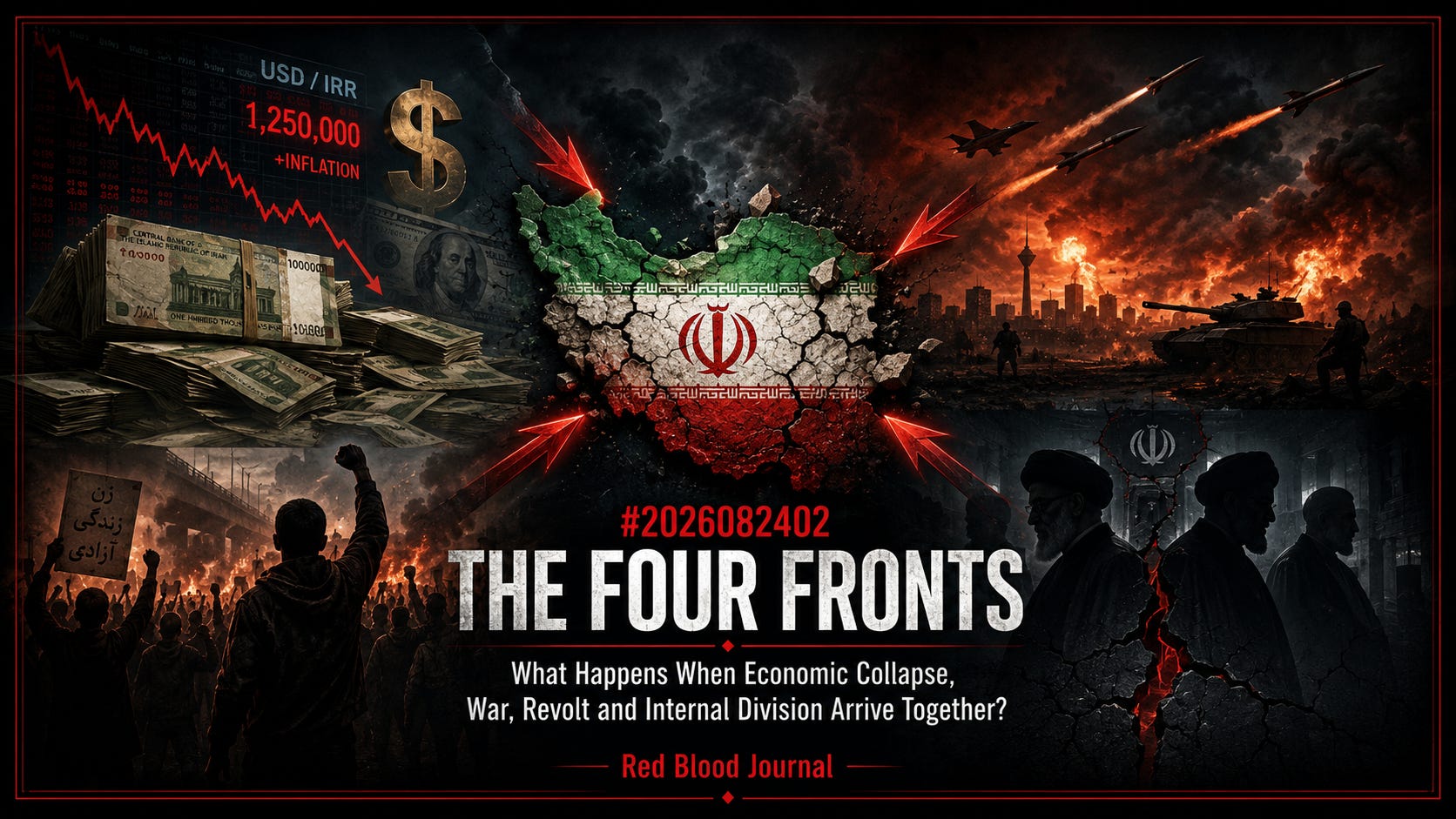
🩸 🇮🇷 💵 ⚔️ #2026082402 — The Four Fronts: What Happens When Economic Collapse, War, Revolt and Internal Division Arrive Together?
The Iranian system has survived every crisis separately. The dangerous question is what happens when they stop arriving separately.
Red Blood Journal
Iran crossed another psychological barrier.
According to the source material behind this report, the dollar moved beyond 200,000 toman, a level described as historic. Market commentators cited in the transcript were already discussing the possibility of stabilization closer to 220,000 or 230,000 toman.
Numbers eventually become too large to feel real.
So translate the number into paper.
At roughly 230,000 toman to the dollar, a U.S. $100 bill represents about 230 million Iranian rials.
That means one piece of American paper can represent roughly 23 Iranian 10-million-rial notes.
One bill on one side of the table.
Twenty-three on the other.
That image may explain the condition of the Iranian currency more effectively than a thousand economic speeches.
But the currency is only one front.
The larger story contained in this transcript is about convergence.
Front One: The Currency
A weak currency does not remain a currency story.
It enters the grocery store.
It enters rent.
It enters medicine.
It enters imported machinery.
It enters factory inputs.
It enters gasoline.
It enters electricity.
Eventually it enters politics.
The transcript notes that the dollar had been near approximately 90,000 toman around the same period a year earlier and had since more than doubled.
Whether every short-term market prediction in the source ultimately proves accurate is less important than the direction being described:
confidence in the rial is deteriorating.
And confidence is one of the few commodities a government cannot manufacture indefinitely.
A central bank can print currency.
It cannot print trust.
Front Two: Economic Encirclement
The most consequential claim in the source is not simply that Washington intends to impose another sanctions package.
Iran has lived with sanctions for decades.
The proposed change is the architecture of pressure.
The transcript describes a strategy aimed not only at Iran but potentially at the international infrastructure keeping Iranian commerce alive: oil buyers, shipping companies, financial intermediaries, exchange houses, free-trade zones, banks and governments that facilitate transactions.
Later, the transcript describes the objective even more starkly:
cut the economic arteries connecting Tehran to the outside world.
The source says the intended targets include petroleum revenue, financial transfers, shipping and commercial relationships simultaneously.
That distinction matters.
Traditional sanctions say:
We will make doing business with Iran expensive.
A genuine secondary-sanctions siege says:
Choose Iran or choose access to us.
For a country connected to the dollar-centered global financial system, those are radically different propositions.
Iran may be able to tolerate isolation.
Its trading partners must decide whether they are willing to share that isolation.
Front Three: The Negotiating Table May No Longer Mean What Tehran Thinks It Means
The transcript also describes reports of Pakistani Army Chief Asim Munir traveling to Tehran in connection with attempts to reduce tensions between Washington and the Islamic Republic.
Normally, the arrival of an intermediary would suggest possibility:
negotiation.
compromise.
an exit ramp.
But an important argument runs through the source:
What if Tehran is interpreting the existence of negotiations according to an old political model that no longer applies?
For decades, negotiations often meant:
pressure → talks → compromise → temporary relief → another crisis.
The transcript argues that some Iranian analysts now fear Washington may instead be seeking something closer to decisive strategic capitulation.
That interpretation may be overstated. It is still an interpretation, not an established outcome.
But Tehran must take the possibility seriously.
Because negotiating with an adversary seeking a bargain is very different from negotiating with an adversary who believes time is already on his side.
The Hudaybiyyah Problem
Perhaps the most revealing political argument in the transcript came through Hassan Khomeini’s invocation of the Treaty of Hudaybiyyah.
According to the source, he used the early Islamic agreement to argue that accepting peace or compromise today need not mean permanent defeat. The historical analogy suggests that a temporary settlement can provide the breathing room necessary for later strategic success.
That creates an extraordinary dilemma for Washington.
If American policymakers believe an agreement gives Iranian citizens relief and prevents war, compromise may be desirable.
But if they believe Tehran views compromise only as time to rebuild before the next confrontation, the same agreement appears dangerous.
And inside Iran, the reverse dilemma exists.
Hardliners may describe compromise as humiliation.
Others may consider it the only way to prevent ordinary Iranians from paying still more for a geopolitical confrontation they did not design.
The transcript captures that frustration directly.
Critics ask what Iran itself has gained from the confrontation while ordinary people experience inflation, scarcity and economic deterioration.
That may ultimately be the more powerful question.
Not:
Who won the argument?
But:
Who paid for it?
Front Four: The Internal System
For decades, the Islamic Republic has demonstrated remarkable capacity for survival.
War did not destroy it.
Sanctions did not destroy it.
Mass demonstrations did not destroy it.
Elite conflict did not destroy it.
Political isolation did not destroy it.
Economic crises did not destroy it.
Each shock was absorbed separately.
And that may explain why predictions of imminent collapse have failed repeatedly.
But the closing argument of the source makes a more sophisticated observation.
Perhaps the danger is not any individual pressure.
Perhaps the danger is synchronization.
The transcript explicitly describes a scenario involving:
war,
extraordinary economic pressure,
internal conflict among governing factions,
and popular uprising
arriving together.
That changes the equation.
A state can transfer resources from one crisis to another.
Police can contain demonstrations while the economy functions.
The economy can endure sanctions while political elites remain united.
Military pressure can be survived while the population remains passive.
Factional disputes can remain manageable while money continues flowing.
But what happens when every shock absorber is required at precisely the same moment?
That is the real question.
The Rumor That Explains the Information War
The transcript begins with another revealing episode.
An unverified claim circulated widely on Iranian social media alleging that children of judiciary chief Gholam-Hossein Mohseni-Ejei had been abducted.
The source itself acknowledges that the claim could not be properly verified.
That makes the episode important for a completely different reason.
The transcript asks whether such sensational information can overwhelm attention at precisely the moment when economically consequential developments are occurring.
Whether the rumor was spontaneous, genuine, false or manipulated cannot be established from this source.
But the lesson remains valuable:
when societies enter periods of extreme political stress, information itself becomes a battlefield.
The more frightened and emotionally exhausted a population becomes, the easier it is for an extraordinary claim to outrun verification.
That danger exists on every side.
A population desperate for good news can become vulnerable to false hope.
A government desperate for stability can become vulnerable to propaganda.
An opposition desperate for change can become vulnerable to stories confirming what it wants to believe.
A responsible observer must preserve one distinction above all others:
What do we know?
What do we suspect?
What do we merely hope is true?
Those three things are not interchangeable.
Iran’s Most Expensive Miscalculation May Have Been Intellectual
One of the strongest sections of the transcript is not about sanctions or missiles.
It concerns knowledge.
Iranian academic Ebrahim Fayaz is quoted arguing that the Islamic Republic never developed an adequate understanding of the United States and that decision-makers attempted to confront one of the world’s wealthiest and technologically most capable states without deeply understanding the society or system behind that power.
If true, that would represent something more serious than a military mistake.
It would be a civilizational intelligence failure.
Before fighting an enemy, a government must understand what produces its power.
America’s power is not simply an aircraft carrier.
It is universities.
Capital markets.
Immigration.
Technology.
Private enterprise.
Geography.
Energy.
Agriculture.
Financial networks.
Political institutions.
A huge internal consumer economy.
And the ability—however imperfectly—to replace leaders without replacing the entire state.
If policymakers reduce all of that to slogans, they are no longer analyzing another country.
They are arguing with a cartoon they created themselves.
That is dangerous when the cartoon has nuclear submarines, global capital markets and the world’s dominant reserve currency behind it.
The Most Dangerous Stage Is Not Necessarily War
The source employs extraordinarily aggressive language in describing remarks attributed to U.S. Treasury Secretary Scott Bessent.
It portrays the forthcoming economic campaign through a World War II analogy and describes a supposed “final stage” of pressure, comparing financial operations with the strategic logic surrounding D-Day.
Such rhetoric should not automatically be interpreted literally.
Economic warfare is not Normandy.
Banks are not beaches.
Sanctions are not artillery shells.
And historical metaphors can exaggerate as much as they illuminate.
But the choice of metaphor reveals something important about the political psychology described by the source:
Washington wants economic pressure to be perceived as strategic warfare, not accounting paperwork.
And Tehran appears increasingly to understand the message.
The Iranian Citizen Remains in the Middle
This is where any analysis of sanctions must resist becoming a scoreboard.
A collapsing currency does not punish an institution in the abstract.
It punishes the person whose salary remains fixed.
The pensioner.
The shopkeeper.
The father buying medicine.
The mother buying food.
The young person trying to marry.
The business importing spare parts.
The worker watching yesterday’s savings lose purchasing power today.
Governments speak about pressure.
Citizens experience prices.
Governments speak about strategy.
Citizens experience shortages.
Governments speak about resistance.
Citizens pay the bill.
That distinction matters whether one supports or opposes Washington’s strategy.
The Four-Front Test
The Islamic Republic has repeatedly survived because its enemies and its domestic crises rarely achieved perfect synchronization.
That may now be the question worth watching.
Economic front
Does the rial continue losing purchasing power while international financial access contracts?
External front
Does Washington escalate financial and military pressure simultaneously?
Internal political front
Do divisions inside the governing structure remain manageable?
Public front
Does economic exhaustion turn into organized political action?
Any one of these may be survivable.
Two may be survivable.
Perhaps even three.
The historic uncertainty begins when all four reinforce one another.
That is the thesis buried underneath nearly forty minutes of material in this transcript.
Not that collapse is guaranteed.
It is not.
Not that every dramatic prediction in the source will materialize.
It may not.
But that Iran may be entering a phase in which pressures that were previously sequential begin becoming simultaneous.
And systems usually fail not when they encounter a problem they have never encountered before.
They fail when too many familiar problems arrive at once.
The Red Blood Perspective
Do not confuse the collapse of a currency with the collapse of a people.
The Iranian people existed before the Islamic Republic.
They will exist after every government currently ruling, threatening or sanctioning them has disappeared into history.
The tragedy is that political systems repeatedly treat citizens as ammunition in battles between institutions.
Washington calculates leverage.
Tehran calculates survival.
Regional governments calculate risk.
Markets calculate profit.
Families calculate whether they can afford tomorrow.
That last calculation is the one that deserves to remain at the center of the story.
One American $100 bill beside approximately twenty-three pieces of Iran’s highest-value paper money is therefore more than a currency comparison.
It is a photograph of lost purchasing power.
And behind every zero stands a human being.
Ocean of Love and Positivity Perspective
There is another possibility beyond victory and defeat.
A country does not have to conquer another country to become strong.
A government does not have to manufacture enemies to justify itself.
A citizen does not have to hate Americans in order to love Iran.
An American does not have to hate Iranians in order to oppose the Islamic Republic.
The human beings on both sides have more in common with one another than political machinery wants them to remember.
The greatest victory available to Iran would not be the conquest of Washington.
It would not be the conquest of Jerusalem.
It would not be surviving another forty-seven years of confrontation.
It would be rebuilding a country where an Iranian does not have to count hundreds of millions of rials beside one American banknote and wonder how so much value disappeared.
That future does not require another battlefield.
It requires competent institutions, accountability, peace, productivity, knowledge and respect for the human being standing beneath the flag.
In an Ocean of Love and Positivity.
🩸🌊✨ Fantastic!
📉
The Four Fronts of Iranian Collapse
Aug 24, 2026
The provided text analyzes a critical turning point for Iran as it faces the simultaneous convergence of four major crises: economic collapse, international isolation, internal political division, and social unrest. While the Iranian government has historically survived these pressures individually, the report suggests that their unprecedented synchronization now threatens the state’s fundamental stability. Central to this analysis is the dramatic devaluation of the rial, illustrated by the staggering visual of twenty-three high-value Iranian notes equaling a single American hundred-dollar bill. The source argues that Washington is shifting toward a strategy of decisive strategic capitulation by targeting the global financial architecture that sustains Iranian commerce. Ultimately, the text highlights the profound human cost of this geopolitical friction, noting that ordinary citizens bear the burden of inflation and scarcity. The overview concludes that the system’s survival depends on whether it can withstand multiple overlapping shocks that exhaust its traditional defensive mechanisms.
#Iran #IranEconomy #IranianRial #Dollar #CurrencyCollapse #EconomicCollapse #Inflation #USSanctions #EconomicWarfare #MaximumPressure #Trump #ScottBessent #IranCrisis #IranWar #WarRisk #IranProtests #WomanLifeFreedom #RegimeCrisis #InternalDivision #PoliticalInfighting #IslamicRepublic #Tehran #IranPolitics #MiddleEast #Geopolitics #EconomicPressure #SecondarySanctions #OilSanctions #FinancialIsolation #RegimeChange #CivilUnrest #RedBloodJournal #TheFourFronts


