


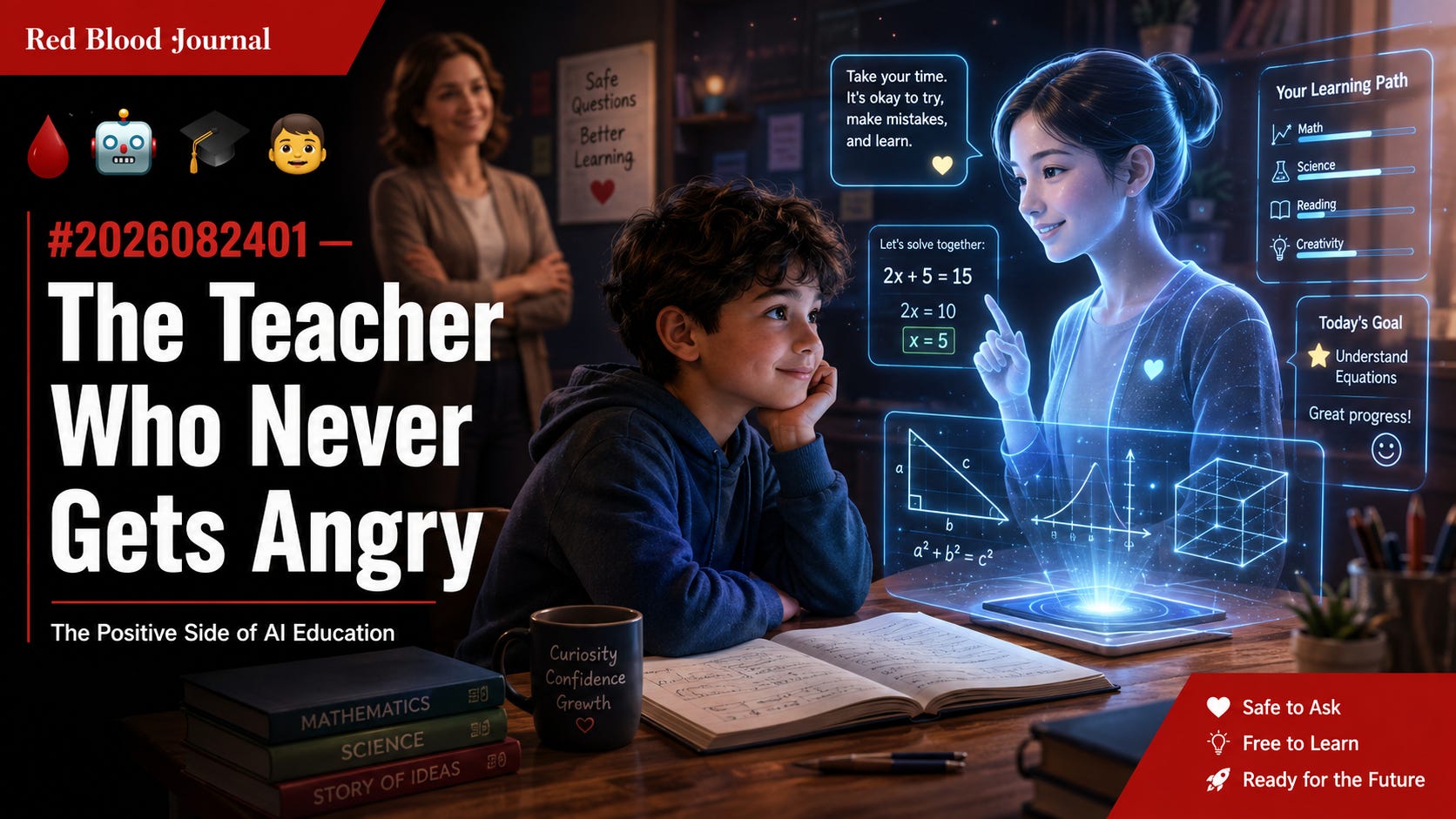
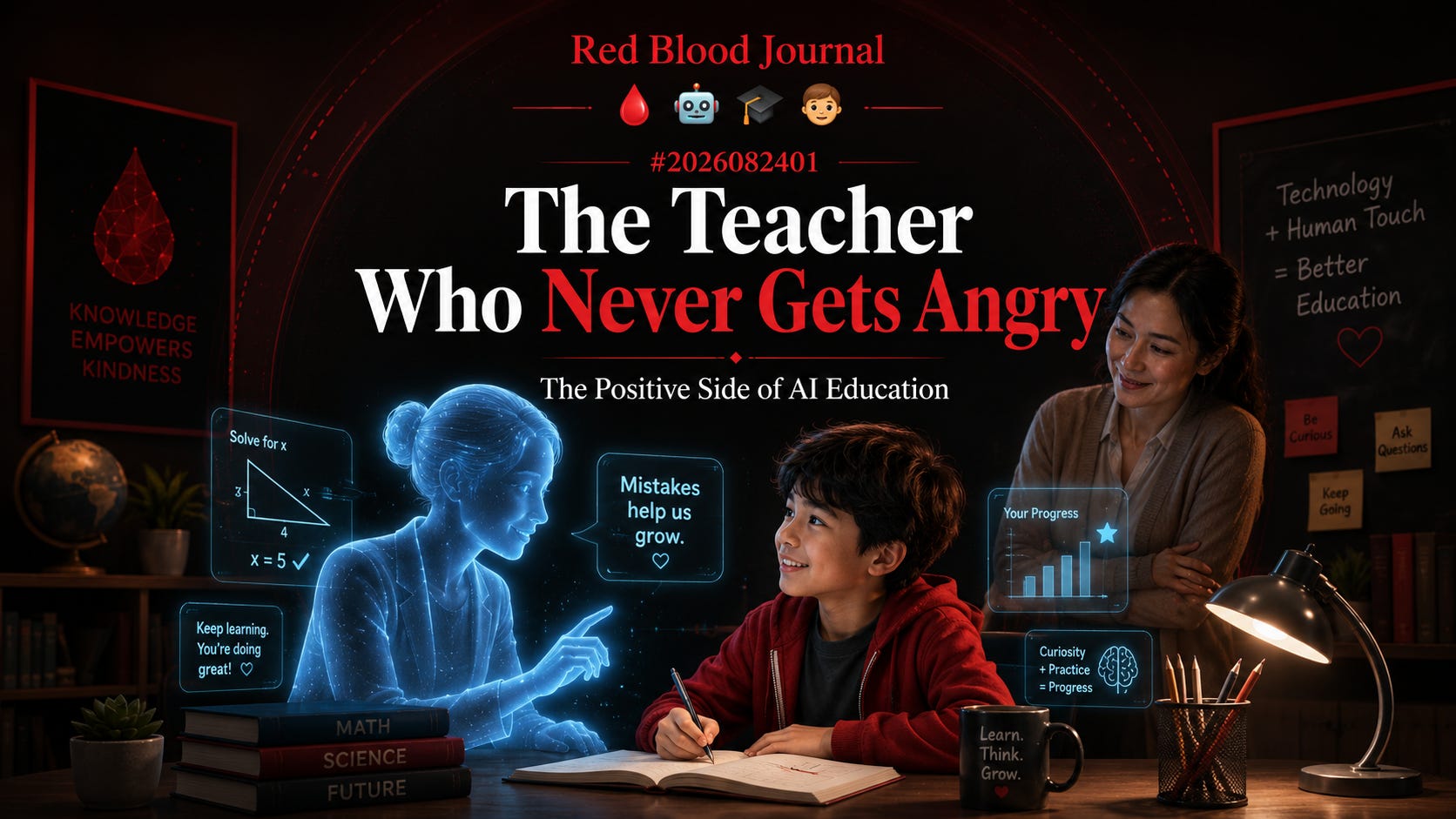
🩸 🤖 🎓 🧒 #2026082401 — The Teacher Who Never Gets Angry: The Positive Side of AI Education
What if one of AI’s greatest gifts is giving children permission to be wrong?
🩸 Red Blood Journal
For generations, education has depended on a simple arrangement:
One teacher.
A classroom full of children.
One lesson delivered at approximately one speed.
Some students understand immediately.
Some need to hear it again.
Some need a completely different explanation.
And some sit quietly pretending they understand because asking one more question has become more frightening than remaining confused.
Artificial intelligence may fundamentally change that equation.
Not because machines necessarily know more than good teachers.
Not because children should be raised by computers.
Not because human teachers have suddenly become unnecessary.
But because an AI tutor possesses one extraordinary characteristic:
It does not become frustrated with the student.
And before dismissing that as a small advantage, consider how much human learning has been shaped by one powerful emotion:
the fear of looking stupid.
The Child Who Is Afraid to Ask Again
Imagine a ten-year-old struggling with fractions.
The teacher explains the lesson.
The child does not understand.
The teacher explains it again.
Still nothing.
Around the child are twenty other students.
Time is passing.
The teacher has a curriculum to complete.
Eventually the child begins feeling something beyond confusion:
embarrassment.
The question changes from:
“How do fractions work?”
to:
“What is wrong with me?”
That second question can remain with a person much longer than the mathematics lesson.
Now imagine the same child working privately with an AI tutor.
The child says:
“I don’t understand.”
The AI explains it differently.
Still confused?
Another example.
Still confused?
Try pictures.
Still confused?
Use pizza slices.
Still confused?
Use money.
Still confused?
Start over.
The hundredth request can receive essentially the same patience as the first.
There is no sigh.
No raised eyebrow.
No irritated voice.
No clock-conscious teacher trying to move twenty-nine other students forward.
No classmate laughing from another desk.
No fear of appearing stupid.
Just:
Let’s try another way.
That may prove to be one of AI’s most important contributions to education.
Intelligence Without Impatience
Human beings have emotions.
That is one of our greatest strengths.
It is also sometimes a weakness in teaching.
Teachers become tired.
Teachers become overwhelmed.
Teachers have bad days.
Teachers can misunderstand children.
Teachers sometimes develop favorites.
They can become impatient.
Some intentionally or unintentionally embarrass students.
None of this requires believing teachers are bad people.
Quite the opposite.
Many teachers are doing an extraordinarily difficult job under conditions no machine has to endure.
An AI does not have thirty students simultaneously asking for attention.
It does not have paperwork waiting.
It does not have a meeting during lunch.
It does not have a mortgage.
It did not sleep badly.
It is not worried about something happening at home.
Comparing the patience of a machine with the patience of an exhausted human being is therefore not an accusation against teachers.
It is recognition of a technological advantage.
Children are extraordinarily sensitive to adult reactions.
A sentence spoken casually can remain in a child’s memory for decades.
“You should already know this.”
“Everyone else understands.”
“Why aren’t you paying attention?”
“You’re just not good at math.”
Those words can become identities.
A properly designed educational AI can instead respond:
You haven’t understood it yet. Let’s approach it differently.
There is an enormous difference between:
You can’t understand this
and:
We haven’t found the explanation that works for you yet.
“But AI Can Be Wrong”
Absolutely.
That objection is not a reason to reject AI education.
It is a reason to redesign education around verification.
AI can hallucinate.
AI can misunderstand a question.
AI can confidently provide an incorrect answer.
AI can reproduce errors or biases contained in its training and design.
That danger becomes serious if children are taught:
The computer knows.
But that should never be the lesson.
The lesson should be:
The computer proposes an answer. Now how do we check it?
Imagine the educational opportunity hidden inside AI’s imperfection.
The student asks a question.
The AI responds.
Then the student learns to verify the answer against:
a textbook,
a calculator,
an experiment,
a primary source,
another explanation,
or human expertise.
Suddenly education is no longer merely about remembering information.
It becomes training in epistemology:
How do you know what you think you know?
That skill will matter far beyond the classroom.
Every Child Gets Something Resembling a Private Tutor
Historically, personalized education has been expensive.
Wealthy families could hire tutors.
Everyone else generally received whatever individualized attention a school could provide.
AI has the potential to radically change that economics.
Not one tutor for thirty students.
Potentially:
one tutor for one student.
The lesson can move at the child’s speed.
If the student understands quickly, move forward.
If the student struggles, slow down.
If the child learns better visually, show diagrams.
If analogies work better, use analogies.
If the language is too advanced, simplify it.
If the student wants another example, provide another example.
And another.
And another.
Traditional classrooms are constrained by time.
AI tutoring can potentially become constrained primarily by curiosity.
That is a profound shift.
“But Children Will Become Dependent on AI”
They could.
Just as students can become dependent on calculators.
Or search engines.
Or answer keys.
Or tutors.
Or parents who complete their homework.
Every powerful educational tool can become a crutch.
The question is not whether dependence is possible.
The question is how the tool is designed and how the child is taught to use it.
A good AI tutor should not simply produce answers.
It should increasingly ask:
What do you think?
How would you begin?
Why did you choose that answer?
Can you explain it back to me?
Can you solve the next one without my help?
The goal should not be to make AI indispensable.
The goal should be to make the student progressively less dependent on assistance.
That is what good human tutoring already tries to do.
The best teacher does not create permanent dependence.
The best teacher creates independence.
AI should be judged by the same standard.
“But AI Will Make Cheating Easier”
Yes.
AI can write the essay.
Solve the equation.
Summarize the book.
Generate the homework.
But this exposes a deeper problem.
If a machine can complete an assignment in five seconds and the school has no way of determining whether the student understands the subject, perhaps the assignment was measuring the wrong thing.
Education may have to move away from:
Produce this answer at home
and toward:
Show me that you understand it.
Ask the student to explain the reasoning.
Defend the argument.
Solve a variation.
Critique the AI’s answer.
Find the mistake.
Apply the concept to a new situation.
Teach it to someone else.
AI does not merely create a cheating problem.
It may force education to distinguish between producing work and possessing understanding.
Those were never the same thing.
The End of the Embarrassing Question
Children often do not ask the questions they actually have.
They ask the questions they believe they are permitted to ask.
Imagine a student wondering:
“Why is zero multiplied by anything always zero?”
Perhaps everyone else appears to understand.
So the student remains silent.
AI removes the audience.
The child can ask:
“Explain that again.”
“Make it easier.”
“Explain it like I’m six.”
“Why?”
“But why?”
“I still don’t get it.”
“Show me another example.”
Those may be some of the most important sentences in education.
AI never has to say:
We don’t have time for that right now.
“Children Need Human Beings, Not Machines”
Correct.
Children need human beings.
They need parents.
Teachers.
Friends.
Mentors.
Coaches.
Conversation.
Conflict.
Cooperation.
Touch.
Laughter.
Play.
Compassion.
A machine should not replace childhood.
But that argument becomes distorted when it assumes that using AI for instruction requires eliminating human relationships.
It may do the opposite.
Imagine how much more human a teacher’s day could become if less time were spent repeatedly delivering standardized information.
A teacher could spend more time recognizing the student who has gone quiet.
Helping two children resolve a disagreement.
Leading a debate.
Supervising experiments.
Encouraging creativity.
Discussing ethics.
Developing teamwork.
Helping children become human beings rather than merely completing a syllabus.
Perhaps the future is not:
AI versus teachers.
Perhaps it is:
AI handles more repetitive instruction while teachers concentrate more heavily on human development.
That does not diminish teachers.
It could elevate their most uniquely human role.
“Then Teachers Will Lose Their Jobs”
Some educational jobs may undoubtedly change.
History suggests that technologies capable of automating tasks eventually alter employment.
Pretending otherwise would be dishonest.
But there is a difference between saying:
AI can automate part of teaching
and:
children no longer need adults.
Those are not remotely the same claim.
Calculators changed mathematics instruction.
Computers changed research.
The internet changed access to information.
None eliminated the need for people who can guide, motivate, supervise, challenge, and care for students.
The teacher of the future may spend less time acting as a human textbook and more time acting as:
a mentor,
a coach,
a discussion leader,
a project supervisor,
a counselor,
a mediator,
and a living example of adulthood.
Perhaps we have been using an extraordinarily human profession for too many mechanical tasks.
“But What About Screens?”
Another legitimate objection.
Children already spend enormous amounts of time interacting with screens.
Adding AI to education without limits could make that worse.
So the answer cannot simply be:
More technology everywhere.
AI tutoring should be a tool, not an environment in which childhood disappears.
A mathematics explanation on a screen can lead to pencils and paper.
A biology lesson can lead outside.
A history question can lead to books.
An AI discussion about plants can lead to planting one.
A physics lesson can lead to building something.
Technology should push children back into the world rather than permanently pulling them away from it.
The test should be simple:
Does the technology expand the child’s interaction with reality, or replace it?
That distinction matters.
“What About Privacy?”
This may be one of the strongest objections of all.
A child asking an AI tutor thousands of questions could generate an extraordinarily intimate educational profile.
What the child understands.
What the child struggles with.
What frightens the child.
What interests the child.
How quickly the child learns.
Possibly even emotional patterns.
That information should not become advertising inventory.
It should not become a permanent commercial dossier.
It should not quietly follow a child into adulthood.
If society adopts AI education, children’s educational data deserves unusually strong protection.
The promise of personalized learning cannot become an excuse for personalized surveillance.
A private tutor must actually be private.
“But Algorithms Have Bias”
They can.
So can textbooks.
Curricula.
Institutions.
Teachers.
Parents.
Governments.
Students.
Human bias is not eliminated by replacing humans with machines.
It can become encoded inside machines.
That means AI systems used in education should be challengeable.
A student should be able to ask:
“Why did you say that?”
“What is the opposing argument?”
“What evidence supports this?”
“Are there other interpretations?”
“Show me the source.”
“Could you be wrong?”
Perhaps one of the healthiest educational habits we can teach children is:
Never surrender your judgment to an authority merely because it speaks confidently.
That applies equally to a teacher, a politician, a textbook, a television screen, and an artificial intelligence.
AI Has No Ego to Protect
There is another subtle advantage.
A computer does not need the child to believe the computer is intelligent.
It does not lose social status when the student challenges it.
The student can say:
“I think you’re wrong.”
And a properly designed AI can respond:
Let’s check.
Imagine the educational power of that sentence.
The relationship changes from:
Authority tells you what is true
to:
Let’s investigate whether it is true.
That is a radically different intellectual environment.
The child learns that disagreement is not disrespect.
A question is not rebellion.
Changing your mind after seeing better evidence is not weakness.
And authority is not the same thing as truth.
“But AI Has No Feelings”
This is usually presented as a weakness.
Often it is.
A machine cannot love a child.
It cannot genuinely care whether the child grows into a good human being.
It cannot replace the emotional bond between human beings.
But absence of emotion has another side.
AI does not feel offended because the student disagrees.
It does not feel insulted because the student asks the same question repeatedly.
It does not become jealous of another student.
It does not need admiration.
It does not have to prove that it is the smartest person in the room.
It cannot have its feelings hurt by:
“I still don’t understand.”
In this particular context, emotional neutrality can become an advantage.
Perhaps the teacher who has no feelings can sometimes provide a space that protects the child’s feelings.
That is the paradox.
“But Children Need Struggle”
Absolutely.
Learning should not become effortless.
Difficulty has value.
Persistence has value.
Failure has value.
The purpose of AI should not be to remove every obstacle.
It should remove unnecessary humiliation from the obstacle.
There is an enormous difference between struggling with mathematics and struggling with mathematics while believing everyone else thinks you are stupid.
One builds resilience.
The other can build shame.
AI can allow the difficulty to remain while removing part of the social fear surrounding it.
The goal is not:
Never let the child struggle.
The goal is:
Let the child struggle safely enough to continue.
“Won’t Wealthy Children Get Better AI?”
Possibly.
And that danger deserves serious attention.
If excellent AI tutoring becomes expensive while low-income students receive inferior systems, technology could widen the educational divide rather than close it.
But the opposite possibility also exists.
For the first time, extremely capable individualized tutoring could become inexpensive enough to reach children whose families could never afford a private tutor.
That possibility is too important to dismiss.
The policy question therefore becomes:
Will AI education become another luxury product?
Or will high-quality individualized instruction increasingly become something every child can access?
Technology does not answer that question.
Society does.
The Classroom Could Become More Human, Not Less
Imagine a classroom twenty years from now.
Thirty children are not necessarily moving through exactly the same page at exactly the same moment.
One student is studying algebra.
Another is reviewing yesterday’s lesson.
Another has moved ahead.
Another is privately receiving remedial instruction without classmates knowing.
The AI notices that one explanation is failing and tries another.
The human teacher moves through the room.
But instead of spending most of the hour broadcasting information, the teacher observes.
Talks.
Listens.
Guides.
Encourages.
Challenges.
Organizes collaboration.
Helps children use what they are learning.
The technology handles some of what machines do well.
The human handles what humans do uniquely well.
That may not be the death of education.
It may be the beginning of a different kind of education.
The Real Danger Is Not AI
The deepest danger may not be that children use AI.
It may be that children are taught to obey AI.
A generation that asks a machine what to think about everything would not be educated.
It would be dependent.
So perhaps the most important curriculum of the AI age should contain four questions:
What does the AI say?
Why does it say it?
What evidence supports it?
What do you think?
If the fourth question disappears, education has failed.
The Red Blood Perspective
Much of the AI conversation understandably focuses on what machines may take away.
Jobs.
Privacy.
Human interaction.
Control.
Independence.
Those concerns deserve serious examination.
But intellectual honesty requires examining the other side too.
AI may democratize something once available primarily to wealthy families:
patient, individualized tutoring on demand.
A child who once disappeared quietly at the back of a classroom could someday have an educational companion available whenever needed—one willing to explain the same idea twenty different ways without humiliation.
That is not a small development.
It could transform education.
But only if we refuse the lazy extremes.
AI is neither:
the magical machine that will save education
nor:
the soulless machine that must destroy it.
It is a tool.
A remarkably powerful one.
Its value will depend on what humans ask it to do.
Use AI to replace thought, and education becomes weaker.
Use AI to stimulate thought, and education may become stronger.
Use AI to replace human relationships, and childhood becomes poorer.
Use AI to free human teachers for more human relationships, and the classroom may become richer.
Use AI as an unquestionable authority, and we create obedience.
Use AI as a challengeable partner, and we may teach a generation to investigate everything.
Perhaps the greatest educational revolution will not be that artificial intelligence knows everything.
It will be that a student finally feels comfortable saying:
“I don’t know.”
And instead of shame waiting on the other side, the answer is:
Good. Now let’s find out.
🌊 Ocean of Love and Positivity Perspective
Every child enters the world curious.
Before embarrassment teaches restraint, children ask endlessly:
Why?
Why?
Why?
They touch.
Explore.
Question.
Experiment.
Fall.
Get up.
Try again.
Perhaps education should protect that instinct instead of gradually training it away.
A child should never learn that ignorance is shameful.
Ignorance is the beginning of every discovery ever made.
Every scientist began with:
I don’t know.
Every inventor began with:
What if?
Every explorer began with:
What’s over there?
And nearly every child begins with:
Why?
If artificial intelligence can give a child a place where curiosity is never annoying, questions are never embarrassing, disagreement is permitted, and misunderstanding simply means we need another explanation, then technology may have created something unexpectedly humane.
Not because the machine has a soul.
Not because the machine loves the child.
Not because humanity should surrender education to computers.
But because a tool without ego can sometimes protect the fragile curiosity of a human being who is still discovering who they are.
The machine should never replace the heart of education.
Perhaps it can remove some of the friction surrounding it.
And perhaps the future classroom will finally teach us something we should have understood long ago:
The student who asks the question twice is not the problem.
The student who asks it twenty times is not the problem.
Maybe we simply have not found the explanation that opens the door.
And when that door finally opens, the child does not merely learn fractions.
The child learns something far more important:
There was never anything wrong with asking again.
In an Ocean of Love and Positivity.
🩸🌊✨ Fantastic!
🎓
The Infinite Patience of Artificial Intelligence in Education
Aug 24, 2026
The provided text explores how artificial intelligence could revolutionize the classroom by offering patient, individualized tutoring that removes the fear of social judgment. Unlike human educators who may become exhausted or impatient, an AI tutor can provide endless explanations without subjecting a struggling student to embarrassment or shame. The author argues that this technology should not replace teachers, but rather liberate them from repetitive tasks so they can focus on mentorship and human development. While addressing concerns regarding data privacy, algorithmic bias, and potential dependency, the source emphasizes that AI’s greatest gift is creating a safe space for curiosity. Ultimately, the text suggests that education’s future lies in using machines to foster student independence and protect the fragile confidence of learners.
#ArtificialIntelligence #AI #Education #AIinEducation #FutureOfEducation #FutureOfLearning #PersonalizedLearning #AITutor #EdTech #ChildrenAndTechnology #Learning #Teachers #ClassroomInnovation #DigitalEducation #CriticalThinking #StudentLearning #EducationTechnology #HumanCenteredAI #RedBloodJournal #2026082401


