


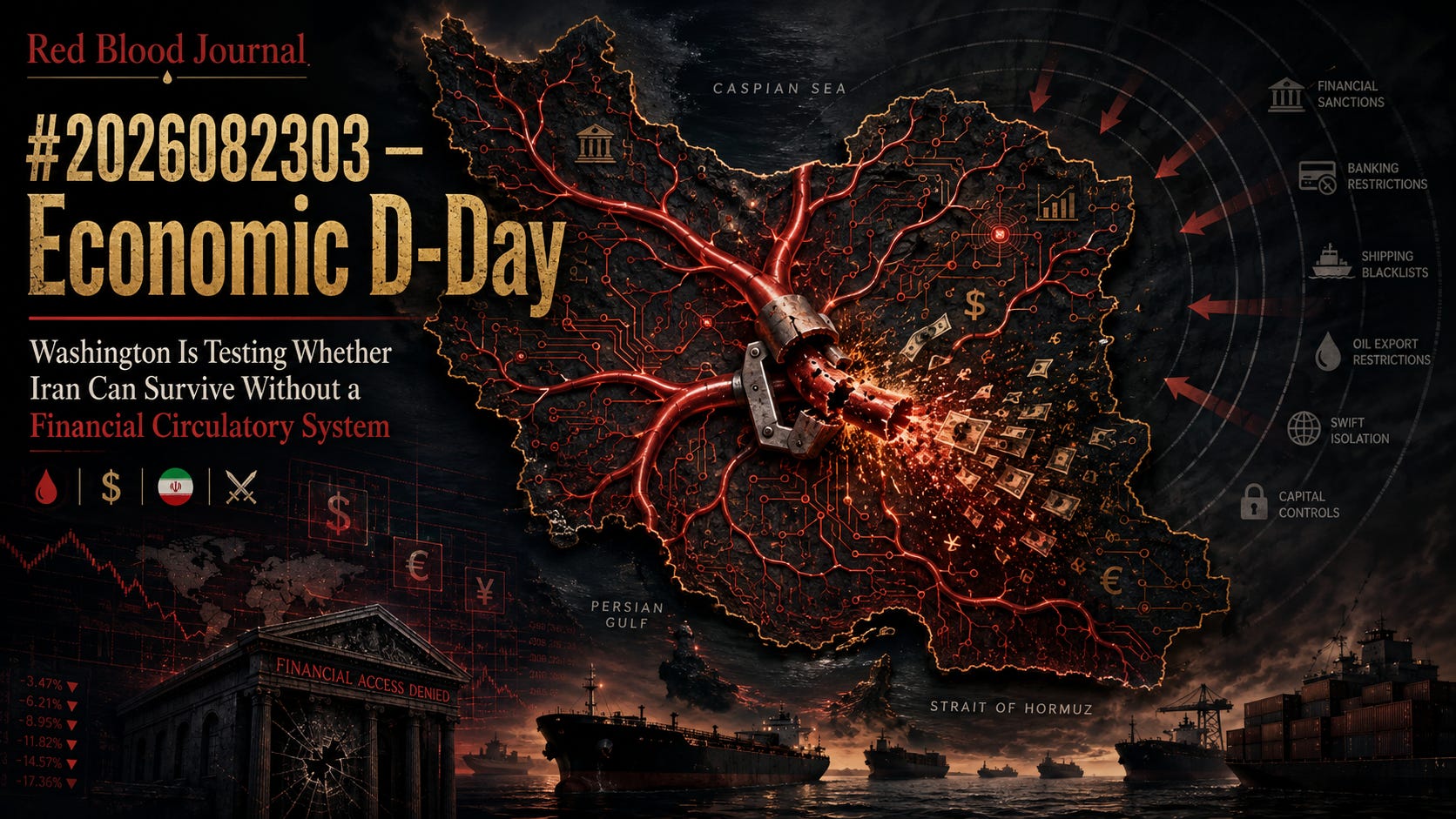
🩸 💰 🇮🇷 ⚔️ #2026082303 — Economic D-Day: Washington Is Testing Whether Iran Can Survive Without a Financial Circulatory System
The bombs were visible. The financial war may prove more dangerous.
🩸 Red Blood Journal — Predictive Investigative Report
For decades, sanctions against Iran have been described as pressure.
Pressure to negotiate.
Pressure to abandon nuclear ambitions.
Pressure to change regional behavior.
Pressure to release prisoners.
Pressure to return to diplomacy.
But the language coming from Washington is changing.
On August 23, 2026, U.S. Treasury Secretary Scott Bessent published an extraordinary article in the Financial Times under an equally extraordinary headline:
“An economic D-Day is coming for Iran.”
That is not the language of ordinary diplomacy.
It is the language of a campaign.
And when the individual responsible for the financial machinery of the United States invokes D-Day, the important question is no longer whether Iran is being sanctioned.
The question is:
Is Washington attempting to dismantle the financial system that keeps the Iranian state alive?
1. THE WAR AFTER THE WAR
Military attacks are easy to see.
Explosions produce photographs.
Destroyed facilities appear on satellite imagery.
Missile launches become television events.
Financial warfare is different.
There may be no explosion.
No crater.
No smoke.
No dramatic footage.
Yet an economy can be damaged just as effectively by preventing money from moving.
The emerging American strategy appears to operate in stages:
Stage One — Damage military capability
Reduce Iran’s ability to manufacture, rebuild and project military power.
Stage Two — Restrict revenue
Attack the country’s ability to sell oil and other commodities.
Stage Three — Attack transportation
Target the tankers, shipping companies and shadow fleets used to move Iranian products.
Stage Four — Attack payment
Prevent Iran from receiving, converting or transferring the money generated by those sales.
Stage Five — Attack intermediaries
Punish foreign companies, banks, currency exchanges and individuals willing to help Iran bypass sanctions.
Stage Six — Force economic isolation
Make doing business with Iran sufficiently dangerous that companies avoid Iran voluntarily.
That final stage is the most powerful.
The United States does not have to stop every transaction itself.
It only has to make everyone involved afraid of becoming the next target.
2. THE REAL TARGET MAY NOT BE IRANIAN OIL
For years, much of the discussion surrounding sanctions has focused on Iranian petroleum.
How many barrels are exported?
Who buys them?
How much discount does Iran offer?
How much revenue reaches Tehran?
But there is another question that may matter even more:
What happens after Iran sells the oil?
Selling a barrel of crude is only useful if the resulting money can ultimately purchase something.
Iran needs foreign currency for imports.
Industrial equipment.
Replacement parts.
Food.
Medicine.
Technology.
Military components.
Infrastructure.
Foreign suppliers.
International settlements.
A country can theoretically sell billions of dollars worth of commodities and still face enormous difficulty if the proceeds become trapped inside currencies, accounts or financial jurisdictions that it cannot freely access.
That appears to be one of Washington’s objectives.
Do not merely stop the oil.
Stop the money from becoming useful.
3. FOLLOW THE MONEY
The architecture can be simplified:
Iranian oil
↓
Tanker or shadow fleet
↓
Foreign intermediary
↓
Chinese or Asian purchaser
↓
Payment, frequently outside the dollar system
↓
Foreign exchange house
↓
Front company or offshore account
↓
Convertible foreign currency
↓
Iranian government, military or commercial network
Every arrow matters.
And Washington appears increasingly interested in attacking the arrows rather than merely the starting point.
Ships can be sanctioned.
Companies can be blacklisted.
Exchange houses can be targeted.
Banks can be threatened.
Executives can be designated.
Insurance can disappear.
Ports can refuse entry.
Customers can walk away.
Payments can become difficult.
This transforms sanctions from a wall around Iran into something more sophisticated:
A minefield surrounding anyone willing to help Iran cross the wall.
4. THE MOST POWERFUL WEAPON IS FEAR OF THE AMERICAN FINANCIAL SYSTEM
Imagine a foreign bank considering an Iranian transaction.
The bank does not have to love Washington.
It does not have to support American foreign policy.
It only needs to ask one question:
Is this Iranian transaction worth losing access to the American financial system?
A shipping company asks the same question.
A refinery asks it.
An insurance company asks it.
A commodity trader asks it.
A foreign-exchange house asks it.
An executive with international assets asks it.
This is the hidden force behind secondary sanctions.
America’s power does not come solely from controlling what American companies do.
It comes from convincing companies thousands of miles away that access to the United States is more valuable than access to Iran.
Iran may therefore discover that its greatest opponent is not an American Treasury official sitting in Washington.
It may be the risk department inside a Chinese, Emirati, Indian or European corporation.
5. CHINA IS THE GREAT UNANSWERED QUESTION
There is, however, a limit to this strategy.
And its name is China.
Iran has increasingly relied on Chinese economic channels, Chinese buyers and yuan-denominated transactions to reduce its dependence on the dollar-centered financial system.
That creates the greatest test of Bessent’s strategy.
Washington can sanction a small shell company.
It can sanction an obscure tanker.
It can sanction a trading network.
But what happens if enforcing the Iranian blockade eventually requires confronting major Chinese financial institutions?
That would elevate this beyond an Iran story.
It would become a direct contest between two economic systems.
American financial dominance
versus
Chinese willingness to build alternatives.
If China decides Iran is strategically important enough to protect aggressively, Washington may discover limits to its financial weapon.
If China decides Iran is expendable compared with access to Western financial markets, Tehran could find itself dramatically more isolated.
That decision may ultimately matter more than almost anything happening inside Iran.
6. THE STRAIT OF HORMUZ MAY BE BECOMING A DOUBLE-EDGED WEAPON
Iran has long treated the Strait of Hormuz as one of its ultimate strategic cards.
A significant portion of the world’s petroleum trade moves through this narrow passage.
The implied threat has always been simple:
If Iran is strangled, Iran can strangle the world.
But the weapon has a weakness.
Iran needs commerce too.
Iran needs ships.
Iran needs exports.
Iran needs imports.
Iran needs neighbors.
Iran needs financial intermediaries.
Iran needs regional ports and trading hubs.
Therefore every escalation around Hormuz can produce an unintended consequence:
More justification for Washington to tighten the financial campaign.
The sword may cut both directions.
Iran can threaten the world’s energy artery.
But threatening the artery may accelerate the construction of bypasses while simultaneously isolating Iran further.
That is why Hormuz may slowly be transforming from an Iranian trump card into a diminishing asset.
7. DUBAI AND THE ECONOMIC LUNGS
Iran does not survive through Iran alone.
Its economic survival depends partly on the world surrounding it.
Dubai.
The wider UAE.
Oman.
Turkey.
Iraq.
China.
Asian commodity markets.
Offshore companies.
Currency exchanges.
Shipping registries.
Trading companies.
Middlemen.
These locations and networks function like economic lungs.
Even when formal banking channels become restricted, commercial oxygen can still enter through informal or indirect pathways.
Washington appears increasingly interested in attacking those lungs.
And that changes the geography of the conflict.
The battlefield is no longer contained inside Iran.
It exists wherever Iranian money moves.
8. BUT ECONOMIC WARFARE DOES NOT ONLY HURT GOVERNMENTS
This is where every discussion of sanctions must become morally uncomfortable.
Governments announce sanctions against governments.
But governments do not stand in grocery-store lines.
Governments do not search pharmacies for medicine.
Governments do not watch salaries lose purchasing power.
Governments do not postpone marriages because housing became unaffordable.
Governments do not decide whether to buy meat or pay electricity bills.
People do.
The Iranian elite may find alternative channels.
Powerful institutions may obtain privileged exchange rates.
Connected businessmen may move money abroad.
Officials may retain access to resources unavailable to ordinary citizens.
The population has no such guarantee.
That produces the central contradiction of economic warfare:
How do you financially suffocate a government without financially suffocating the population trapped beneath it?
Washington may say the target is the state.
Iranian officials may say the sanctions target ordinary Iranians.
Both statements can contain truth simultaneously.
9. SANCTIONS ALSO CREATE CORRUPTION
Sanctions do not merely restrict an economy.
They can reorganize it.
When normal commerce becomes illegal or difficult, abnormal commerce becomes valuable.
Smuggling routes gain importance.
Middlemen become powerful.
Political connections become currency.
Licenses become valuable.
Foreign exchange becomes an opportunity for arbitrage.
People with access become wealthy.
People without access pay the bill.
This produces one of the greatest paradoxes of sanctions:
A policy intended to weaken a corrupt elite can sometimes enrich the insiders who control the mechanisms used to evade the policy.
The ordinary merchant struggles.
The politically connected importer survives.
The transparent company disappears.
The shadow company prospers.
The legal economy shrinks.
The underground economy grows.
Iran has lived inside this environment for decades.
That is one reason predicting sudden collapse is dangerous.
The system has adapted repeatedly.
10. IRAN HAS SURVIVED BEFORE
Anyone predicting immediate Iranian collapse should remember one fact:
Iran has been under extraordinary pressure for nearly half a century.
War.
Sanctions.
Isolation.
Currency crises.
Political unrest.
Assassinations.
Military confrontation.
Oil restrictions.
Banking restrictions.
Domestic corruption.
Regional wars.
Internal factional struggles.
Yet the state survived.
That means Tehran possesses substantial adaptive capacity.
New shell companies appear.
Tankers change names.
Ownership structures change.
Flags change.
Payments move through alternative currencies.
Gold is used.
Barter is used.
Cryptocurrency is used.
Intermediaries appear.
Goods are rerouted.
Networks regenerate.
Therefore the contest is not simply:
Can Washington close Iranian networks?
Of course it can close some of them.
The real contest is:
Can Washington destroy Iran’s replacement networks faster than Iran can rebuild them?
That is the economic war.
11. AMERICA HAS SOMETHING IRAN DOES NOT: SHOCK ABSORBERS
There is another reason Iran should not be compared casually with the United States.
Both countries can experience corruption.
Both can experience political dysfunction.
Both can experience elite privilege.
Both can experience enormous public distrust.
But the systems do not possess equal capacity to absorb damage.
America has extraordinary shock absorbers:
A giant diversified economy.
Deep capital markets.
The world’s dominant reserve currency.
Domestic agricultural capacity.
Domestic energy resources.
Massive technological industries.
Federalism.
Multiple centers of economic power.
Private capital.
International investment.
The ability to borrow in its own currency.
Political leadership that can change while the basic state survives.
Iran has considerably fewer shock absorbers.
And external sanctions deliberately attack the ones it still possesses.
This means two countries can suffer similar corruption yet experience radically different outcomes.
A wealthy system can carry enormous dysfunction for decades.
A constrained system can reach the breaking point much sooner.
12. WASHINGTON MAY BE TRYING TO REMOVE THE SHOCK ABSORBERS ONE BY ONE
That may be the deeper meaning of Bessent’s strategy.
Do not attempt to produce one dramatic collapse.
Instead remove the mechanisms that prevent collapse.
Oil revenue.
Foreign exchange.
Shipping.
Banking.
Insurance.
Investment.
Technology.
Trade finance.
Intermediaries.
Regional economic access.
One by one.
Eventually the question becomes not whether Iran possesses resources.
It becomes whether Iran can convert those resources into functioning state power.
Oil underground is not money.
Oil aboard a sanctioned tanker is not necessarily money.
Yuan sitting inside a restricted financial channel is not necessarily usable money.
Revenue that cannot purchase imports is not fully effective revenue.
The battlefield is therefore liquidity.
13. WATCH THE PEOPLE WHO PROTECT THE STATE
The most important indicator may not be public protests.
Populations can remain angry for decades.
Governments can survive astonishing levels of public dissatisfaction.
The more dangerous moment comes when the state’s own machinery begins malfunctioning.
Can salaries be paid?
Can subsidies continue?
Can pensioners be supported?
Can government employees be compensated?
Can the security forces be supplied?
Can patronage networks remain funded?
Can politically connected businesses still make money?
Can regional allies still receive assistance?
Can elites still move capital?
Can insiders still believe loyalty is safer than defection?
That last question may determine everything.
A state becomes truly vulnerable when members of the establishment stop asking:
“How do we protect the government?”
and begin asking:
“How do I protect myself if the government fails?”
That is when economic pressure becomes political instability.
14. THE REAL RED LINE MAY BE ELITE CONFIDENCE
Currencies can fall.
Inflation can rise.
People can become poorer.
Protests can erupt.
Governments can still survive.
But if the powerful begin losing confidence, the structure becomes much less stable.
Watch for:
Capital flight.
Property purchases abroad.
Families of officials leaving.
Unusual currency conversion.
Senior figures publicly distancing themselves.
Business elites transferring assets.
Security officials hedging politically.
Factional accusations intensifying.
Government ministries competing for shrinking resources.
Delayed salaries.
Cuts in patronage.
Reduced support for external allies.
Those signals may reveal more about the future of the Iranian state than official speeches.
15. ECONOMIC D-DAY MAY BE A MESSAGE TO IRAN’S ELITE
Perhaps Bessent’s article is aimed partly at Tehran.
But perhaps it is aimed even more directly at the people surrounding Tehran.
The message could be interpreted as:
Your money is no longer safe.
Your shipping networks are no longer safe.
Your exchange houses are no longer safe.
Your foreign partners are no longer safe.
Your intermediaries are becoming targets.
And anyone helping you may eventually have to choose between you and the international financial system.
That is economic pressure.
But it is also psychological warfare.
Washington is trying to change calculations inside the Iranian establishment.
16. THE PEOPLE MAY BREAK BEFORE THE GOVERNMENT
There is another possibility Washington must confront.
What if economic pressure works—
but works first on ordinary Iranians?
Food costs rise.
Medicine becomes more expensive.
Businesses close.
Unemployment rises.
The currency deteriorates.
Savings disappear.
Young people leave.
Birth rates decline.
Families postpone major life decisions.
The middle class shrinks.
And yet the government survives.
Then sanctions may have successfully damaged Iran without successfully changing Iran.
That would be the cruelest possible outcome.
A weakened population.
A damaged economy.
A stronger black market.
A wealthier sanctions-evading elite.
And essentially the same political structure.
This possibility cannot be ignored simply because it complicates the narrative.
17. THE THREE POSSIBLE BREAKING POINTS
Bessent’s strategy may ultimately test three systems simultaneously.
Breaking Point One — The Iranian government
Can Tehran continue financing the machinery of state?
Breaking Point Two — The Iranian people
How much inflation, unemployment and economic deterioration can society absorb?
Breaking Point Three — American enforcement power
How aggressively can Washington punish Iran’s trading partners before major countries decide to build alternative financial systems?
That creates the real predictive question:
Which breaks first?
Iranian state capacity?
Iranian social patience?
Or American ability to enforce global financial obedience?
18. WHY THIS MOMENT IS DIFFERENT
Iran has faced sanctions before.
But three conditions make the present situation more dangerous.
First, Iran is under simultaneous military, political and financial pressure.
Second, Washington is increasingly targeting the infrastructure surrounding Iranian trade rather than simply Iranian institutions themselves.
Third, alternative geopolitical arrangements are developing rapidly.
China is stronger.
Russia is more isolated from the Western financial system.
BRICS countries are discussing alternative settlement mechanisms.
Digital currencies are evolving.
Dollar avoidance is no longer a fringe topic.
Therefore Washington possesses enormous financial power—
but every aggressive use of that power also gives other countries another reason to construct systems designed to escape it.
That is the long-term American risk.
The financial weapon is devastating precisely because everyone uses the system.
Use the weapon too frequently and everyone begins wondering whether they need another system.
19. THE GREAT CONTRADICTION
America’s financial dominance gives Washington extraordinary leverage over Iran.
But exercising that leverage aggressively can accelerate the very movement that may eventually weaken American financial dominance.
Iran therefore becomes part of a much larger experiment.
Can one nation weaponize the world’s financial architecture indefinitely without encouraging the world to build an alternative?
Nobody yet knows.
20. THE RED BLOOD PREDICTION
The next phase of the Iran confrontation will probably be less visually dramatic than the military phase.
But it may be more consequential.
Watch:
Foreign-currency availability.
The rial.
Oil-payment channels.
Chinese financial institutions.
UAE intermediaries.
Tanker enforcement.
Government payrolls.
Subsidies.
Imports.
Capital flight.
Elite behavior.
Security-force compensation.
And the emergence of replacement sanction-evasion networks.
If these systems continue functioning, Iran can survive enormous pressure.
If several begin failing simultaneously, the situation changes quickly.
The greatest danger to Tehran may therefore not arrive as a bomb.
It may arrive as an unanswered transaction.
A payment that cannot clear.
A tanker that cannot unload.
A bank that refuses the transfer.
A merchant unable to obtain currency.
A government unable to meet an obligation.
One failed transaction means little.
Millions of them form an economic siege.
THE RED BLOOD PERSPECTIVE
Scott Bessent’s phrase “economic D-Day” should not be dismissed as ordinary political theater.
Neither should it be treated as proof that Iran’s collapse is imminent.
The statement should instead be understood for what it reveals:
Washington believes Iran’s financial architecture may now be more vulnerable than its military architecture.
That is a profound shift.
America is testing whether it can disconnect the Iranian state from the networks that transform oil, commerce and foreign relationships into usable power.
Iran is testing whether decades of sanctions have made it sufficiently adaptable to survive yet another escalation.
China is testing how much American financial coercion it is willing to tolerate.
And the Iranian population may once again be forced to absorb the consequences of decisions made far above them.
The coming struggle may therefore be decided not on a battlefield—
but inside banks, shipping registries, exchange houses, ministries, trading companies and private calculations inside the minds of Iran’s elite.
The key question is no longer merely:
Can Iran survive sanctions?
It is:
Can Iran survive when Washington begins systematically attacking the mechanisms Iran created to survive the sanctions?
That is the meaning of economic D-Day.
THE OCEAN OF LOVE AND POSITIVITY PERSPECTIVE
Economic warfare should never make ordinary suffering invisible.
Iran is not its government.
America is not its government.
China is not its government.
Behind every sanction, tariff, missile, currency collapse and political strategy are human beings trying to raise families, buy food, care for parents, educate children and live with dignity.
Governments calculate leverage.
People experience consequences.
The highest form of victory would therefore not be the collapse of another nation.
It would be the construction of a future in which governments no longer need to destroy economies, threaten populations or weaponize survival in order to resolve political disputes.
Accountability matters.
Freedom matters.
Justice matters.
But humanity must remain visible even when governments treat one another as enemies.
Because beneath the flags, currencies, ideologies and political systems, the blood is still red.
In an Ocean of Love and Positivity.
🩸🌊✨ Fantastic!
💸
Economic D-Day: The Financial Siege of Iran
1 source·Aug 24, 2026
The provided text examines a strategic shift in American foreign policy characterized as an “economic D-Day” aimed at dismantling Iran’s financial infrastructure. Rather than relying solely on traditional military force, Washington is increasingly targeting the underlying networks that allow the Iranian state to process payments, transport goods, and access foreign currency. This sophisticated campaign of financial isolation seeks to force a collapse by making international cooperation with Iran too risky for global banks and businesses. While the strategy tests the resilience of the Iranian elite and the strength of Chinese support, it also risks causing immense hardship for the general population. Ultimately, the report questions whether the United States can successfully weaponize the global financial system without inadvertently encouraging other nations to build alternative, non-Western economic structures.
#RedBloodJournal #Iran #EconomicDDay #ScottBessent #IranSanctions #EconomicWarfare #FinancialWarfare #MaximumPressure #USIran #TreasuryDepartment #OFAC #IranEconomy #IranOil #ShadowFleet #SanctionsEvasion #ForeignCurrency #ChineseYuan #ChinaIran #Hormuz #StraitOfHormuz #EconomicCollapse #RegimeSurvival #FinancialSystem #Geopolitics #MiddleEast #EconomicPressure #SecondarySanctions #DollarDominance #GlobalFinance #IranCrisis


