


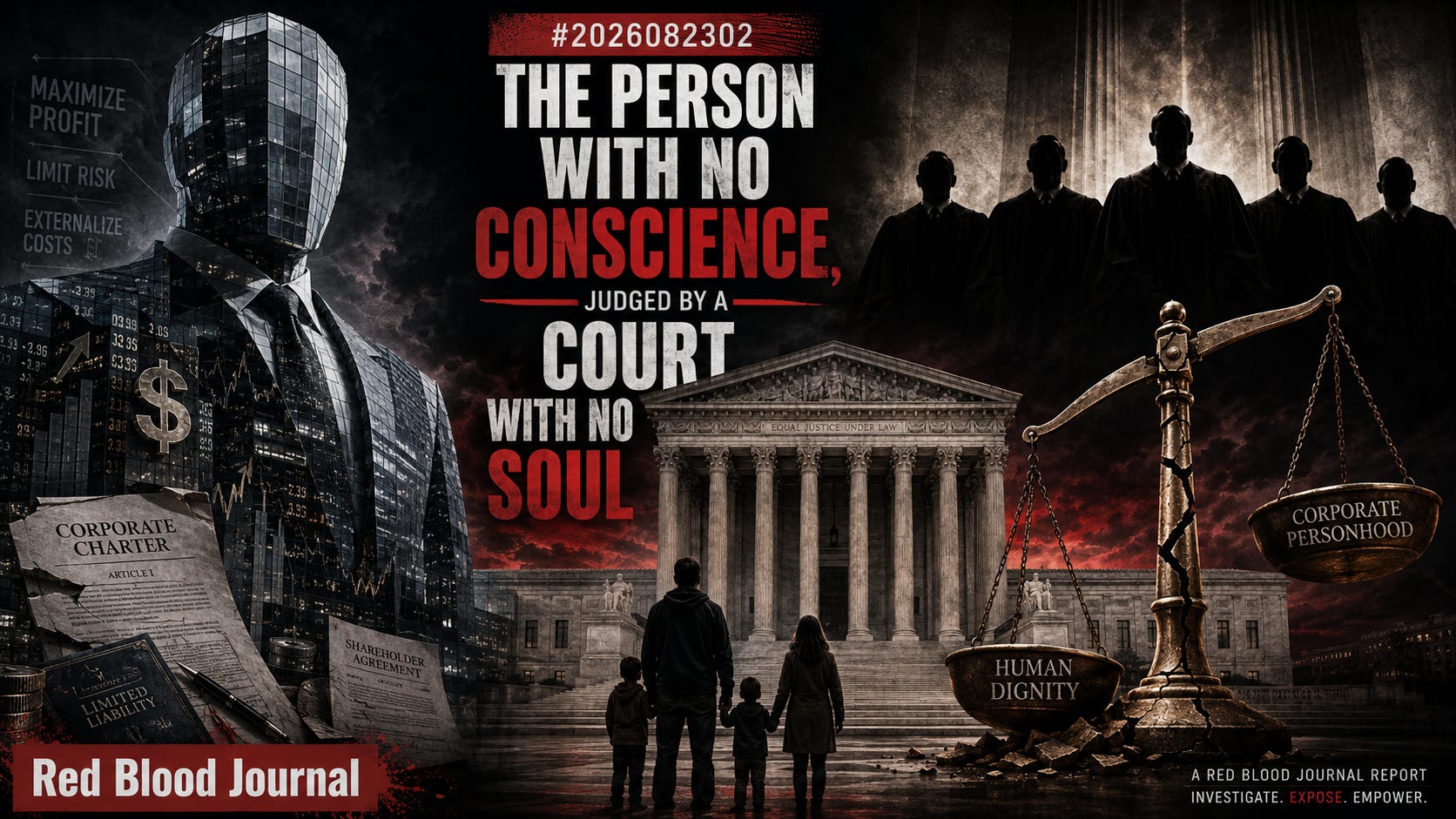
🩸 🏢 ⚖️ 👤 🧭 #2026082302 — The Person With No Conscience, Judged by a Court With No Soul
When corporations become “persons,” judges become the final referees, and ordinary human beings are told to trust the system
RED BLOOD JOURNAL — EDUCATIONAL SUPER REPORT
There is a question so simple that it becomes uncomfortable:
Who is the law actually protecting?
A human being?
A corporation?
The government?
The institution?
Or whoever has enough power to convince five Supreme Court justices?
That question becomes disturbing when several perfectly legal pieces of the American system are placed beside one another.
A corporation is not a human being.
Yet corporations can possess important constitutional protections.
A corporation cannot feel guilt.
It cannot love.
It cannot die of heartbreak.
It cannot watch its child suffer.
It cannot sit awake at night wondering whether it ruined another person’s life.
Yet it can accumulate billions of dollars, purchase influence, litigate for years and potentially survive for centuries.
Then comes the institution assigned to determine the boundaries of those rights:
Nine human beings.
They are nominated by presidents.
Confirmed by senators.
Installed for life.
And asked to provide the final constitutional judgment in disputes affecting hundreds of millions of people.
The Constitution created judicial independence for good reason.
But common sense should still permit one uncomfortable question:
Who protects the population from the protectors?
1. NO, THE SUPREME COURT DID NOT SIMPLY DECLARE “CORPORATIONS ARE HUMANS”
Accuracy matters.
The phrase “corporations are people” compresses more than a century of law into a slogan.
Corporations are treated as legal persons for various purposes.
That allows an organization to:
own property,
sign contracts,
borrow money,
sue,
be sued,
employ people,
and continue functioning despite changes in ownership.
Modern commerce would be extraordinarily difficult without legal personality.
The controversy begins somewhere else.
It begins when an artificial entity starts receiving protections originally expressed in constitutional language concerning persons and speech.
2. THE ROAD DID NOT BEGIN WITH CITIZENS UNITED
One famous milestone was Santa Clara County v. Southern Pacific Railroad Company in 1886.
The case concerned railroad taxation.
It is often described as the moment the Supreme Court “made corporations people,” but that description goes too far. The decision is part of the historical development of corporate constitutional protections, and the case became associated with applying Fourteenth Amendment equal-protection principles to corporations, although the Court’s written opinion resolved the dispute without explicitly deciding that constitutional issue.
That distinction matters.
Red Blood Journal does not need mythology when the reality is interesting enough.
The real historical story is more powerful:
Corporate constitutional protection developed piece by piece.
Not with a magician’s wand.
With precedent.
Case after case.
Generation after generation.
3. THEN FOLLOW THE LOGIC
A corporation needs property rights.
Reasonable.
It needs access to courts.
Reasonable.
Government should not arbitrarily confiscate its property.
Reasonable.
Organizations consisting of humans should possess some speech protections.
Also reasonable.
A newspaper corporation must obviously be able to criticize government.
A nonprofit must be able to advocate.
A religious organization must be able to express beliefs.
Every individual step can sound logical.
Then stand thirty feet away and look at what was constructed.
An entity that:
does not breathe,
does not age,
does not fear prison,
does not bury children,
does not experience shame,
and does not possess a conscience
can nevertheless possess tremendous wealth and significant constitutional protection.
That does not automatically make the law wrong.
But it should make us ask:
What was built on the other side of the equation to guarantee comparable responsibility?
And that is where the silence becomes noticeable.
4. CITIZENS UNITED MADE THE CONTRADICTION IMPOSSIBLE TO IGNORE
In Citizens United v. Federal Election Commission, the Supreme Court held that government could not suppress independent political expenditures simply because the speaker was a corporation.
The Court emphasized the First Amendment and rejected restrictions based on the speaker’s corporate identity.
There is an important constitutional argument behind that decision.
If government can silence corporations merely because they are corporations, what happens to:
newspapers,
documentary producers,
nonprofits,
political associations,
religious organizations?
Those concerns are real.
But now introduce reality.
One citizen may have $100 left after paying rent.
Another political speaker may control billions of dollars.
Both possess freedom of speech.
Only one possesses an industrial amplifier.
Equal permission to speak does not necessarily produce equal ability to be heard.
That isn’t communism.
It isn’t socialism.
It isn’t anti-business.
It is arithmetic.
5. NOW MEET THE STRANGEST “PERSON” IN THE ROOM
Imagine introducing a new individual into society.
He can own billions of dollars.
He can purchase advertising.
He can hire lobbyists.
He can finance litigation.
He can operate across continents.
He can employ hundreds of thousands of people.
He may survive for generations.
But there is something unusual about him.
He cannot feel guilt.
He cannot feel compassion.
He cannot be afraid of dying.
He cannot spend twenty years inside a prison cell.
He cannot experience the pain he causes.
He cannot stand over a hospital bed.
He cannot look into another human being’s eyes.
He cannot ask God for forgiveness.
Would you give this creature enormous power without carefully designing equally enormous accountability?
Probably not.
Yet we have essentially built that creature.
We call it:
the corporation.
6. “BUT CORPORATIONS ARE RUN BY PEOPLE.”
Exactly.
And that may be the most important sentence in this entire report.
Corporations contain human beings.
Human beings possess morality.
Human beings possess conscience.
Human beings make decisions.
Human beings sign documents.
Human beings approve products.
Human beings conceal information.
Human beings order recalls.
Human beings refuse recalls.
Human beings decide whether another person’s suffering is a tragedy—
or a liability estimate.
Therefore, if corporate rights ultimately protect human beings operating through organizations, then common sense suggests something equally important:
Corporate responsibility should ultimately be traceable back to human beings too.
Rights should not become personal when beneficial—
and responsibility become abstract when inconvenient.
7. THE CORPORATION CAN TURN HUMAN SUFFERING INTO A NUMBER
This is where the logical reader should become uncomfortable.
Imagine that a company discovers a defective product.
The human question is:
“Could somebody die?”
The institutional question may become:
How many failures are expected?
What will a recall cost?
What is projected litigation exposure?
What will insurance cover?
What is the reputational impact?
Those calculations have legitimate business purposes.
Companies must measure risk.
But something dangerous happens when calculation replaces conscience.
A dead parent can become:
$X settlement exposure.
A poisoned community:
$Y remediation reserve.
A sick child:
$Z litigation probability.
Accounting did not murder morality.
But accounting can make suffering look remarkably clean.
There are no tears in a spreadsheet.
8. NOW ADD LIMITED LIABILITY
One of capitalism’s most useful inventions is limited liability.
It encourages investment.
It allows people to invest without generally risking every personal possession because of every corporate debt.
It helped make enormous economic development possible.
But again:
Follow the logic all the way to the end.
A corporation can accumulate extraordinary power.
Its shareholders receive protection.
Its organization receives legal protection.
Its speech may receive constitutional protection.
Its existence may continue indefinitely.
And when something catastrophic happens?
Responsibility may divide among:
the corporation,
the board,
the CEO,
a vice president,
a subsidiary,
a contractor,
an insurer,
a compliance department,
outside counsel,
a regulator.
Eventually an astonishing sentence appears:
“Mistakes were made.”
By whom?
The building?
The logo?
The incorporation documents?
At some point a human being made the decision.
9. NOW WE ARRIVE AT THE SUPREME COURT
Who determines the boundaries of these rights?
Ultimately, constitutional controversies may reach the Supreme Court.
And here comes another perfectly legal structure that deserves examination.
Supreme Court justices are nominated by the president and confirmed with the advice and consent of the Senate. Federal judges receive life tenure absent resignation, retirement, death, or removal through impeachment.
Why life tenure?
Partly to protect judicial independence.
A justice should not have to ask:
“Will I lose my job if the president dislikes my ruling?”
That is an intelligent safeguard.
But notice the paradox.
We attempt to remove politics from judging by selecting judges through politics.
The president is political.
The Senate is political.
Confirmation hearings are political.
Advocacy organizations organize around nominations.
Voters are repeatedly told that presidential elections will determine the future of the Supreme Court.
Then confirmation occurs.
The robe goes on.
And society is expected to believe that politics has disappeared.
Maybe sometimes it does.
Maybe principled judging frequently transcends politics.
But asking whether the transformation is always complete is not disrespectful.
It is democracy.
10. NINE PEOPLE
Approximately 340 million Americans.
One Supreme Court.
Nine seats.
Sometimes five votes determine the constitutional outcome.
Five human beings can become the decisive majority on questions involving:
speech,
religion,
privacy,
criminal procedure,
executive power,
federal authority,
elections,
corporations,
discrimination,
and individual liberty.
That is not evidence of corruption.
It is the constitutional structure.
But because the structure concentrates extraordinary interpretive power, skepticism should not be treated as sacrilege.
Quite the opposite.
The more powerful an institution becomes, the more legitimate careful scrutiny becomes.
11. THEN CAME A QUESTION THAT SOUNDED LIKE COMEDY
During Supreme Court nominee Ketanji Brown Jackson’s March 22, 2022 confirmation hearing, Sen. Marsha Blackburn asked her to define the word “woman.”
Jackson declined to provide a definition in that context and said:
“I’m not a biologist.”
The exchange occurred during the official confirmation hearing.
Now fairness requires something important.
There are at least two ways to interpret her response.
The defense
A judicial nominee should avoid prejudging questions that could someday arrive before the Court.
Words can acquire specialized legal meanings depending on statutes and constitutional disputes.
A cautious nominee might therefore resist answering a politically loaded hypothetical.
That is a legitimate argument.
The criticism
A Supreme Court nominee was asked to define one of humanity’s oldest and most ordinary categories and declined.
That is also a fact.
And for the ordinary citizen watching at home, the moment created a bewildering contradiction.
The government tells citizens:
Trust these people with extremely complicated questions involving constitutional law.
But when an extremely ordinary question is asked:
The answer suddenly requires qualifications, context and professional expertise.
12. COMEDY OR JUSTICE?
That is not really a question about Justice Jackson.
It is a question about the system.
Because confirmation hearings often produce a strange ritual.
Senators ask questions they know nominees may avoid.
Nominees provide careful answers designed not to create future problems.
Everyone knows why everyone else is doing it.
The cameras record it.
The public watches.
Then the nominee may spend decades deciding questions far harder than the ones they refused to discuss during confirmation.
At some point the logical citizen is permitted to ask:
Is this an examination—or theater?
If the nominee cannot meaningfully discuss the issues most likely to concern the public because those issues could come before the Court, then what exactly is the public learning from the hearing?
Temperament?
Biography?
Endurance?
Ability to evade traps?
Maybe all of those things matter.
But do not call every ritual accountability merely because it occurs inside a government building.
13. NOW THINK ABOUT THE VULNERABLE PERSON
This is where the argument stops being academic.
Imagine someone with almost nothing.
No lobbying organization.
No corporate legal department.
No political action committee.
No millions for litigation.
No television network.
No influential friends.
Perhaps an elderly person.
A disabled worker.
A poor family.
A prisoner.
A child.
A small business owner.
A whistleblower.
Someone whose entire life may turn on one government action.
For such people, constitutional protection is not a seminar topic.
It may be the final wall between them and enormous institutional power.
And eventually the interpretation of that wall may depend on judges selected through a political process.
So the question becomes:
How can vulnerable people safely depend upon an institution whose membership itself becomes one of the most politically fought-over prizes in America?
There is no simple solution.
Abolishing judicial independence would probably make matters worse.
Allowing elected majorities unlimited power would endanger minorities.
Making judges directly responsive to politicians could destroy impartial justice.
But refusing to acknowledge the contradiction does not solve it either.
14. THE COURT HAS NO CONSCIENCE EITHER
Here is the connection the previous report was missing.
We said:
A corporation has no conscience.
Correct.
But neither does the Supreme Court.
A marble building does not possess morality.
The Constitution does not physically stand up and speak.
A corporation’s morality comes from the humans inside it.
A court’s morality comes from the humans inside it.
A government agency’s morality comes from the humans inside it.
Every institution eventually reduces to:
people making decisions about other people.
That is why institutional titles must never substitute for thought.
“Supreme Court” does not automatically mean wisdom.
“Corporation” does not automatically mean greed.
“Government” does not automatically mean compassion.
“Expert” does not automatically mean truth.
“Majority” does not automatically mean justice.
Each deserves examination.
15. HISTORY ALREADY WARNED US
If Supreme Court decisions were automatically synonymous with morality, history would be much easier to read.
The Supreme Court upheld racial segregation in Plessy v. Ferguson.
It upheld the forced wartime exclusion of Japanese Americans in Korematsu v. United States.
And in Dred Scott v. Sandford, the Court produced one of the most infamous decisions in American history regarding Black citizenship and slavery.
The institution did not become illegitimate forever because it made terrible decisions.
But those decisions demonstrate something crucial:
“The Supreme Court ruled” and “justice was done” are not synonyms.
Sometimes they overlap.
Sometimes history eventually condemns what the Court once declared lawful.
That fact alone should permanently cure society of judicial worship.
16. LAW IS NOT THE SAME THING AS MORALITY
Slavery was once legal.
Segregation was once legal.
Women were once denied the vote.
Japanese Americans were once forcibly relocated under government authority.
Children once worked legally under conditions now considered intolerable.
Law changes.
Human conscience often forces it to change.
Therefore:
Legality tells us what the system currently permits.
Morality asks whether the system should permit it.
Confusing the two is one of civilization’s oldest mistakes.
17. SO WHERE IS THE FINAL COURT OF APPEAL?
If corporations can fail us—
and governments can fail us—
and courts can fail us—
and experts can fail us—
and political parties can fail us—
where does a human being finally go?
This is where the report turns inward.
Not because society doesn’t matter.
Not because laws don’t matter.
Not because courts should be ignored.
But because there is one responsibility that cannot safely be outsourced.
Your conscience.
18. THE FRIEND WHO STAYS
Governments change sides.
Political parties change principles.
Corporations change leadership.
Friends sometimes disappear.
Institutions rewrite policies.
Experts revise conclusions.
Public opinion turns.
Judges retire.
Presidents leave office.
Money disappears.
Status disappears.
Eventually even the body disappears.
But throughout the human journey there is one witness present for every moment:
the consciousness within.
It knows when we lied.
It knows when we acted from greed.
It knows when we were cruel.
It knows when we were afraid.
It knows when we showed courage.
It knows when we helped someone nobody else could see.
You can fool an audience.
You can fool shareholders.
You can fool voters.
You can sometimes fool a court.
You can even fool yourself temporarily.
But the deeper witness keeps the record.
19. THIS IS NOT A CALL TO WITHDRAW
Turning inward does not mean:
ignore elections,
ignore injustice,
ignore corporations,
ignore courts,
or abandon society.
It means something much more demanding.
Participate without surrendering your mind.
Read the ruling.
Question the headline.
Examine the evidence.
Challenge your own side.
Challenge the other side.
Ask who benefits.
Ask who pays.
Ask who is missing from the conversation.
And after all of that:
Ask your conscience whether the answer still makes sense.
20. THE COMMON-SENSE TEST
Forget politics for one minute.
Imagine explaining the system to a child.
We created artificial entities that can possess enormous wealth and important legal rights.
Those entities have no consciousness.
We then created a Supreme Court to decide the boundaries of those rights.
Those judges are selected by political leaders.
They receive extraordinary independence after appointment.
Some decisions can reshape the lives of hundreds of millions of people.
And history demonstrates that the Court can be profoundly wrong.
The child may ask:
“So who makes sure everybody is doing the right thing?”
And that may be the hardest question in American government.
Because eventually the honest answer is:
We do.
Citizens.
Jurors.
Journalists.
Workers.
Voters.
Parents.
Judges.
Executives.
Neighbors.
Individual human beings with consciences.
The Constitution can create structure.
It cannot manufacture character.
21. THE RED BLOOD PERSPECTIVE
Perhaps America’s deepest problem is not corporate personhood.
It is not the Supreme Court.
It is not Democrats.
It is not Republicans.
The deeper danger begins whenever humans give an institution so much psychological authority that they stop asking whether what it is doing still makes sense.
A corporation may have legal rights.
Fine.
But never confuse legal personality with humanity.
A Supreme Court ruling may be binding law.
Fine.
But never confuse judicial authority with infallibility.
A judge may wear a robe.
A CEO may command billions.
A president may command armies.
None has been issued a monopoly on conscience.
And none escapes the basic human question:
Was what you did right?
That question existed before the Supreme Court.
Before the corporation.
Before America.
Before political parties.
Before written law.
And it will remain after all of them are gone.
🌊 THE OCEAN OF LOVE AND POSITIVITY PERSPECTIVE
Perhaps this is why the chaos outside can eventually become a teacher.
Every disappointment with institutions pushes us toward a discovery:
Stop searching exclusively outside yourself for the authority to tell you what is true and right.
Listen.
Learn.
Read.
Question.
Debate.
Use science.
Use courts.
Use experts.
Use institutions.
But do not hand them the steering wheel of your conscience.
The corporation cannot love you.
The government does not personally know you.
The political party will change.
The judge will eventually leave the bench.
The crowd can cheer you today and condemn you tomorrow.
But the awareness traveling through this life with you has witnessed every mile.
Through victory.
Through humiliation.
Through abundance.
Through loss.
Through betrayal.
Through fear.
Through awakening.
When everything external becomes contradictory, perhaps the invitation is not to become hopeless.
Perhaps it is to turn inward and rediscover the compass that was there before anyone told us which direction to walk.
Then return to the world.
Stronger.
Kinder.
Harder to manipulate.
More difficult to frighten.
More willing to admit when your own side is wrong.
More capable of seeing another human being before seeing a political label.
Because maybe the ultimate protection of civilization was never supposed to rest entirely with nine justices.
Or Congress.
Or a president.
Or a corporation.
Maybe all of those institutions were always dependent upon something much smaller—
and much more powerful.
One human being who still has a conscience and refuses to surrender it.
When every external friend can change sides,
the consciousness within remains the companion that travels through thick and thin.
Protect it.
Educate it.
Question it.
And never sell it.
In an Ocean of Love and Positivity.
🩸🌊✨ Fantastic!
⚖️
The Conscience of the Machine and the Court
Aug 23, 2026
This text explores the ethical and legal tensions surrounding corporate personhood and the immense power wielded by the Supreme Court. It highlights the paradox of granting constitutional protections to artificial entities that lack a human conscience, while simultaneously entrusting a small group of politically appointed judges with final authority. The author argues that while legal structures like limited liability drive commerce, they often obscure individual accountability for human suffering. Ultimately, the piece serves as a call for citizens to look beyond institutional authority and rely on their own moral compass. It suggests that the true safeguard of justice is not found in a courtroom or a boardroom, but in the personal integrity of the individual.
#CorporatePersonhood #SupremeCourt #CitizensUnited #JudicialPower #ConstitutionalRights #CorporatePower #PoliticalInfluence #JudicialIndependence #RuleOfLaw #CivilLiberties #GovernmentPower #CorporateAccountability #LegalPersonhood #Conscience #MoralResponsibility #Justice #PoliticalCorruption #ChecksAndBalances #HumanRights #RedBloodJournal


