


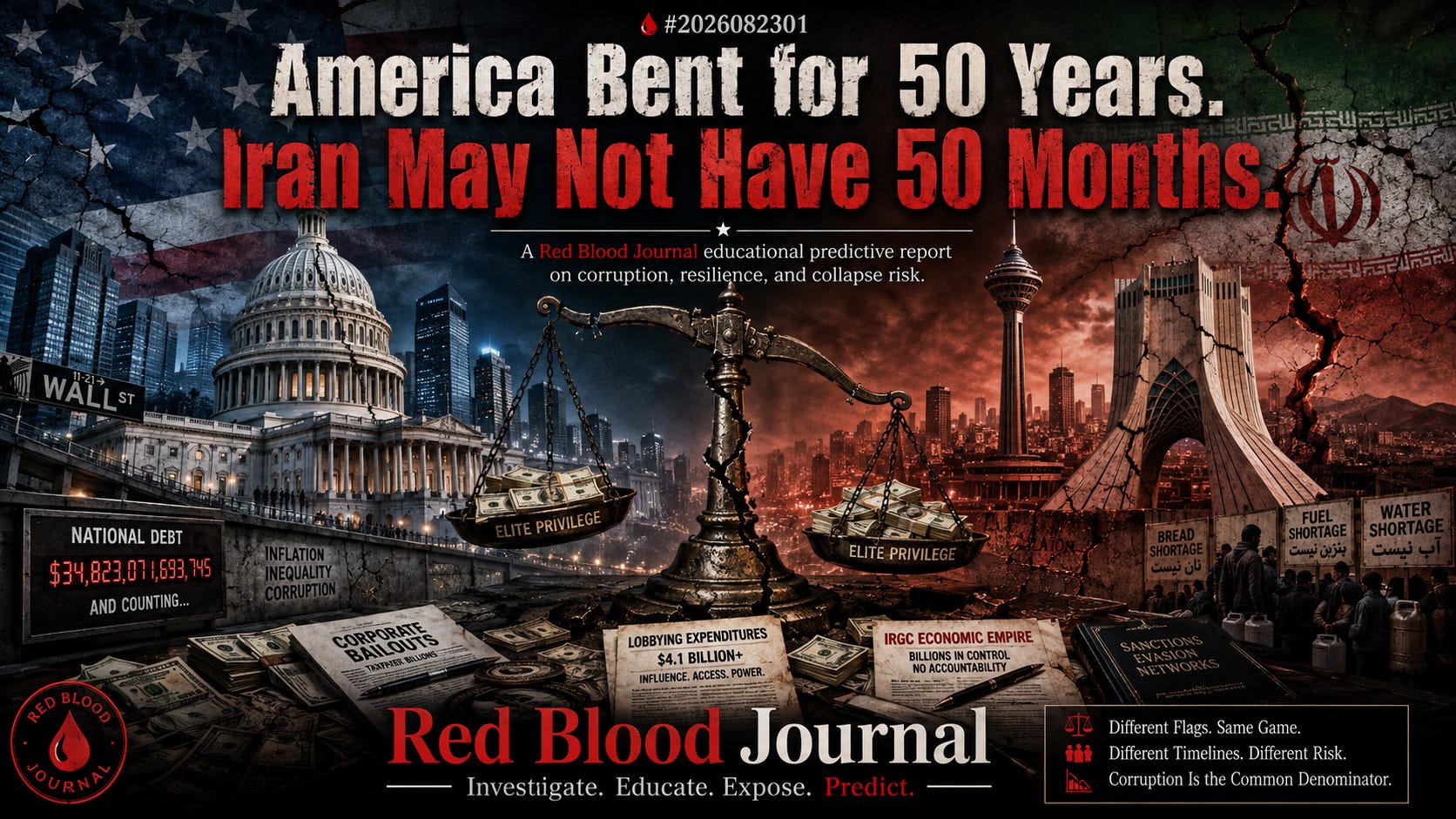
🩸 🇺🇸 🇮🇷 💰 ⚖️ #2026082301 — America Bent for 50 Years. Iran May Not Have 50 Months.
The Same Disease. Two Different Bodies. Why Corruption Has Weakened Both Countries — but May Break Iran First
🩸 RedBloodJournal.com 🩸
There is a dangerous mistake in comparing Iran with the United States.
It is easy to look at Iran’s corruption, privileged families, political insiders, disappearing money and unequal justice and conclude:
America is completely different.
It isn’t.
The United States has spent much of the last half-century developing its own version of the same disease:
money moving toward political influence;
political influence protecting money;
public institutions becoming intertwined with private interests;
well-connected people enjoying access unavailable to ordinary citizens;
government failures being socialized while private gains remain private;
and citizens increasingly concluding that there are two systems—one for insiders and another for everyone else.
The mechanisms are different.
The scale is different.
The legal systems are different.
The degree of repression is dramatically different.
But underneath those differences is an uncomfortable similarity:
Power seeks money, and money seeks power.
That relationship exists in Washington.
It exists in Tehran.
The real question is not whether corruption exists.
The real question is:
Why has America survived decades of it while Iran may be approaching the point where corruption becomes structurally fatal?
🔻 THE AMERICAN MYTH: CORRUPTION ONLY HAPPENS SOMEWHERE ELSE
Americans often picture corruption as an envelope filled with cash handed secretly to a government official.
Sometimes corruption does look like that.
But modern influence can be much more sophisticated.
It can involve:
campaign financing;
lobbying;
government contracts;
regulatory capture;
political appointments;
revolving doors between government and industry;
former officials becoming consultants;
corporations writing or heavily influencing legislation;
financial institutions receiving government protection during crises;
connected industries obtaining favorable rules;
wealthy donors gaining access ordinary citizens could never purchase.
Much of this can happen within the law.
That is precisely why the American version is difficult to confront.
Something does not need to meet the criminal definition of bribery to produce a government that increasingly responds to concentrated money.
Transparency International’s latest Corruption Perceptions Index gave the United States 64 out of 100, continuing a long deterioration in its score and describing concerns about democratic backsliding and the use of public office for private advantage.
At the same time, confidence in Washington has collapsed.
In Pew’s latest long-term measurement, only 17% of Americans said they trusted the federal government to do what is right always or most of the time.
In 1958, that figure was 73%.
Something happened during those decades.
Vietnam.
Watergate.
Economic shocks.
Iraq.
The financial crisis.
Corporate bailouts.
Partisan warfare.
Endless spending.
Lobbying.
Government secrecy.
And the repeated experience of watching people at the top escape consequences that would destroy an ordinary person’s life.
America survived all of it.
But trust did not.
🔻 IRAN DID NOT INVENT THE TWO-TIER SYSTEM
This is where the similarities become uncomfortable.
In Iran, citizens see politically connected families, security-linked commercial networks, favored importers, opaque foundations, privileged access to foreign currency and insiders whose lifestyle appears detached from the economic reality experienced by ordinary people.
In America, the structure is different—but citizens increasingly describe the same psychological experience:
The connected live under different rules.
A corporation can spend millions influencing Washington.
A citizen cannot.
A large financial institution can hire armies of lawyers and lobbyists.
A family facing bankruptcy cannot.
Former officials move into industries they once regulated.
Industries recruit people who understand precisely how government works.
Huge companies help shape rules governing their own sectors.
Politicians leave office and can become highly paid advisers, consultants, board members or speakers.
None of that proves a criminal conspiracy.
But it does reveal a political economy where access itself has tremendous monetary value.
That is one of the deepest similarities between Washington and Tehran:
Proximity to power becomes an economic asset.
🔻 THE DIFFERENCE BETWEEN A BRIBE AND A SYSTEM
Iran’s corruption is easier to recognize because it can be more direct.
A politically connected intermediary receives access to oil.
A relative of an official receives an opportunity.
A security-linked network controls an economic sector.
Money disappears.
Investigators encounter political protection.
An insider moves wealth abroad.
An August investigation by Iran International alleged that a network involving relatives of powerful Iranian security and political figures was connected to roughly $11 billion in oil-sale proceeds that were not returned to the state. Those allegations have not been fully adjudicated and should therefore be treated as investigative claims, but they illustrate the enormous scale of the accusations circulating inside Iran itself.
Iran’s National Iranian Oil Company is also reported to be carrying more than $80 billion in combined bank debt and sovereign-fund obligations while publishing no full audited accounts accessible to the public.
Now consider the American model.
The money usually does not need to disappear.
It can move legally.
That is a more sophisticated system.
A company spends millions lobbying.
Government makes a policy.
The company benefits.
Officials eventually leave government.
Some enter industries affected by policies they helped create.
Nobody necessarily hands anybody a suitcase.
Nobody necessarily violates a criminal statute.
Yet the ordinary citizen can still reasonably ask:
Who was government actually working for?
That is the important comparison.
Iran often has corruption operating outside or around the rules.
America can experience influence operating through the rules themselves.
Those are not identical.
But the citizen standing outside the circle experiences something remarkably similar:
Access produces advantage.
🔻 THE BANKER AND THE BAZAARI MAY SPEAK DIFFERENT LANGUAGES. THE INCENTIVE IS THE SAME.
Strip away the flags.
Strip away the religion.
Strip away the slogans.
Strip away Republican and Democrat.
Strip away reformist and hardliner.
Then look at the machinery.
A powerful person wants access.
A businessman wants protection.
A politician needs money.
A government institution controls licenses, regulations, contracts or currency.
The economic actor wants political favor.
The political actor wants economic support.
They discover that cooperation benefits both.
That is how systems slowly fuse.
It does not require everyone to sit in a secret room and plan corruption.
In fact, systems are often more dangerous when nobody needs to plan anything.
The incentives do the planning.
🔻 AMERICA HAS BEEN BLEEDING TRUST FOR FIFTY YEARS
Look again at that number:
73% trusted Washington in 1958.
17% do now.
That is not a minor statistical movement.
That is a civilization-level change in public psychology.
Americans have not necessarily stopped believing in America.
But millions have stopped believing that Washington consistently represents them.
And notice something even more revealing.
When the White House changes parties, trust often changes with it.
Republicans become more trusting under Republican presidents.
Democrats become more trusting under Democratic presidents.
The institution stays essentially the same.
The perception changes depending on which team controls it.
That is politically useful.
Because people who distrust the system can be persuaded that the real problem is simply:
the other party.
Change the jerseys.
Keep much of the machinery.
Then repeat four years later.
🔻 IRAN HAS ITS OWN VERSION
Iran has reformists.
Iran has conservatives.
Iran has hardliners.
Iran has pragmatists.
Iran has presidential elections.
Iran has parliamentary battles.
Iran has political theater.
Yet key centers of authority remain outside ordinary electoral turnover.
That produces a similar public distraction with a much more concentrated power structure.
One faction blames another.
One administration inherits the failures of the previous one.
Politicians argue about inflation.
Politicians argue about corruption.
Politicians promise reform.
But structural centers of power remain.
Recent reporting describes Iran’s parliament as increasingly marginalized while major decisions move toward security and military institutions.
This produces one of the most important similarities between the two systems:
Political competition can become a pressure-release mechanism without necessarily threatening the deeper relationships between money and power.
America does this far more openly and democratically.
Iran does it inside a much narrower political system.
But the behavioral effect can rhyme.
Keep the population watching the fight.
Meanwhile ask:
Who owns the assets?
Who receives the contracts?
Who gains from regulation?
Who controls the money?
Who receives exceptions?
Who is rescued?
Who is prosecuted?
Who never seems to be?
Those questions matter more than the campaign slogans.
🔻 THEN WHY HAS AMERICA NOT COLLAPSED?
Because corruption does not automatically destroy a country.
A country collapses when corruption overwhelms its ability to continue producing, borrowing, governing and adapting.
America has enormous shock absorbers.
Iran increasingly does not.
1. 🇺🇸 AMERICA CAN AFFORD MORE CORRUPTION
This sounds terrible.
But economically it matters.
Imagine a system producing 100 units of wealth.
Insiders extract 10.
The remaining 90 still sustains society.
Now imagine the economy produces 1,000.
Insiders can extract 100—ten times as much—and society still has 900 remaining.
America possesses extraordinary productive capacity.
Technology.
Agriculture.
Energy.
Finance.
Medicine.
Aerospace.
Software.
Universities.
Manufacturing.
Entertainment.
Real estate.
Professional services.
Capital markets.
America can therefore tolerate breathtaking inefficiency before the entire machine stops.
Iran cannot.
When the economic pie is already shrinking, every corrupt extraction becomes more visible and more destructive.
2. 🇺🇸 THE DOLLAR BUYS TIME
America possesses perhaps the greatest financial shock absorber in modern history:
the world’s dominant reserve currency.
When America has trouble, global investors often still buy American assets.
When Iran has trouble, Iranians themselves may try to escape the rial.
That is a staggering difference.
America has now crossed $40 trillion in federal debt.
The number is so large it almost loses meaning.
Interest costs have become one of the largest items in the federal budget.
Yet America still borrows.
Treasury markets still function.
The dollar remains central to global finance.
That does not eliminate the consequences.
It delays them.
America’s greatest political skill over the last half-century may have been:
turning today’s problem into tomorrow’s bill.
Iran has much less ability to do that.
3. 🇺🇸 AMERICA DECENTRALIZES FAILURE
Washington can fail spectacularly.
California still operates.
Texas still operates.
New York still operates.
Businesses continue.
Cities continue.
Courts continue.
Universities continue.
Banks continue.
Factories continue.
Private industry continues.
America has thousands of centers of independent activity.
That means corruption at the center does not automatically shut down the whole organism.
Iran is much more centralized.
When economic, political and security power converge near the center, damage there travels farther.
That makes the system efficient for control.
It also makes it fragile.
🔻 HERE IS THE MOST IMPORTANT CORRUPTION DIFFERENCE
America has made corruption survivable.
Iran may have made corruption parasitic.
That is the distinction.
America’s system often allows powerful interests to take a disproportionate share while the economic machine continues generating enormous new wealth.
Iran’s politically connected networks increasingly appear to be extracting wealth from a system that is struggling to replace what is being taken.
That is how a parasite eventually kills its host.
🔻 THE IRANIAN COLLAPSE EQUATION
Iran’s current economic situation is not merely corruption.
It is corruption operating simultaneously with:
war damage;
sanctions;
weak investment;
isolation from global finance;
inflation;
currency depreciation;
energy shortages;
damaged infrastructure;
food-price pressure;
declining purchasing power;
political repression;
capital flight.
Reuters reported Iranian inflation reached roughly 66% in July 2026, while food prices had risen dramatically faster and ordinary households were cutting consumption.
This is where corruption becomes explosive.
Imagine telling a family:
Eat less.
Pay more.
Your currency is worth less.
Your electricity may fail.
Your gasoline costs more.
Your salary cannot keep up.
Then the same citizen sees:
luxury automobiles;
villas;
politically connected businessmen;
children of officials abroad;
mysterious oil intermediaries;
billions allegedly missing.
That is no longer merely an economic problem.
It becomes a question of morality.
Why should I sacrifice for a system whose insiders do not sacrifice?
That may be one of the most dangerous sentences any government can hear.
🔻 AMERICA EXPERIENCES THE SAME QUESTION — BUT WITH A BUFFER
Americans asked versions of it after 2008:
Why did major banks receive extraordinary government assistance?
Why did executives remain wealthy?
Why did millions lose homes?
Why are large corporations able to influence Congress?
Why can enormous companies negotiate government policy while an ordinary citizen cannot even get a phone call returned?
Why does Wall Street recover faster than Main Street?
Those frustrations did not destroy America.
Why?
Because the machine restarted.
Employment eventually recovered.
Markets recovered.
Homes recovered.
401(k)s recovered.
Technology created new fortunes.
Businesses opened.
Credit returned.
Economic growth returned.
Millions of citizens still had enough reason to remain invested in the system.
That is America’s hidden superpower:
It can disappoint people enormously and then give them another opportunity to participate.
Iran’s danger is that the second part disappears.
🔻 CORRUPTION BECOMES FATAL WHEN THE LOYALISTS NOTICE
The poorest citizen is not necessarily the person who determines whether an authoritarian system survives.
The crucial moment comes when the people protecting the system begin asking:
What am I protecting?
A policeman sees officials becoming rich.
A Basij member sees connected families living abroad.
A soldier’s salary loses value every month.
A civil servant cannot afford food.
A Revolutionary Guard officer sees politically protected networks taking money.
A provincial official sees Tehran demanding loyalty while failing to deliver resources.
Then the calculation changes.
Authoritarian governments survive not because everyone loves them.
They survive because enough insiders believe:
staying loyal remains profitable,
defection remains dangerous,
and the system will still exist tomorrow.
Once those assumptions reverse, collapse can accelerate with astonishing speed.
🔻 THIS IS WHY THE NEXT IRANIAN CRISIS MAY NOT BEGIN IN THE STREET
The television camera will look for protesters.
Red Blood would look somewhere else.
Watch:
government payrolls;
military compensation;
provincial obedience;
elite capital flight;
oil revenues;
foreign currency reserves;
security defections;
unpaid contractors;
businesses refusing rial exposure;
officials moving families abroad;
competing centers of political authority.
A crowd tells us the public is angry.
An insider moving his family and money tells us something more dangerous:
the insider no longer believes the structure is permanent.
🔻 THE EIGHT SHOCK ABSORBERS
The comparison can be reduced to eight structural protections:
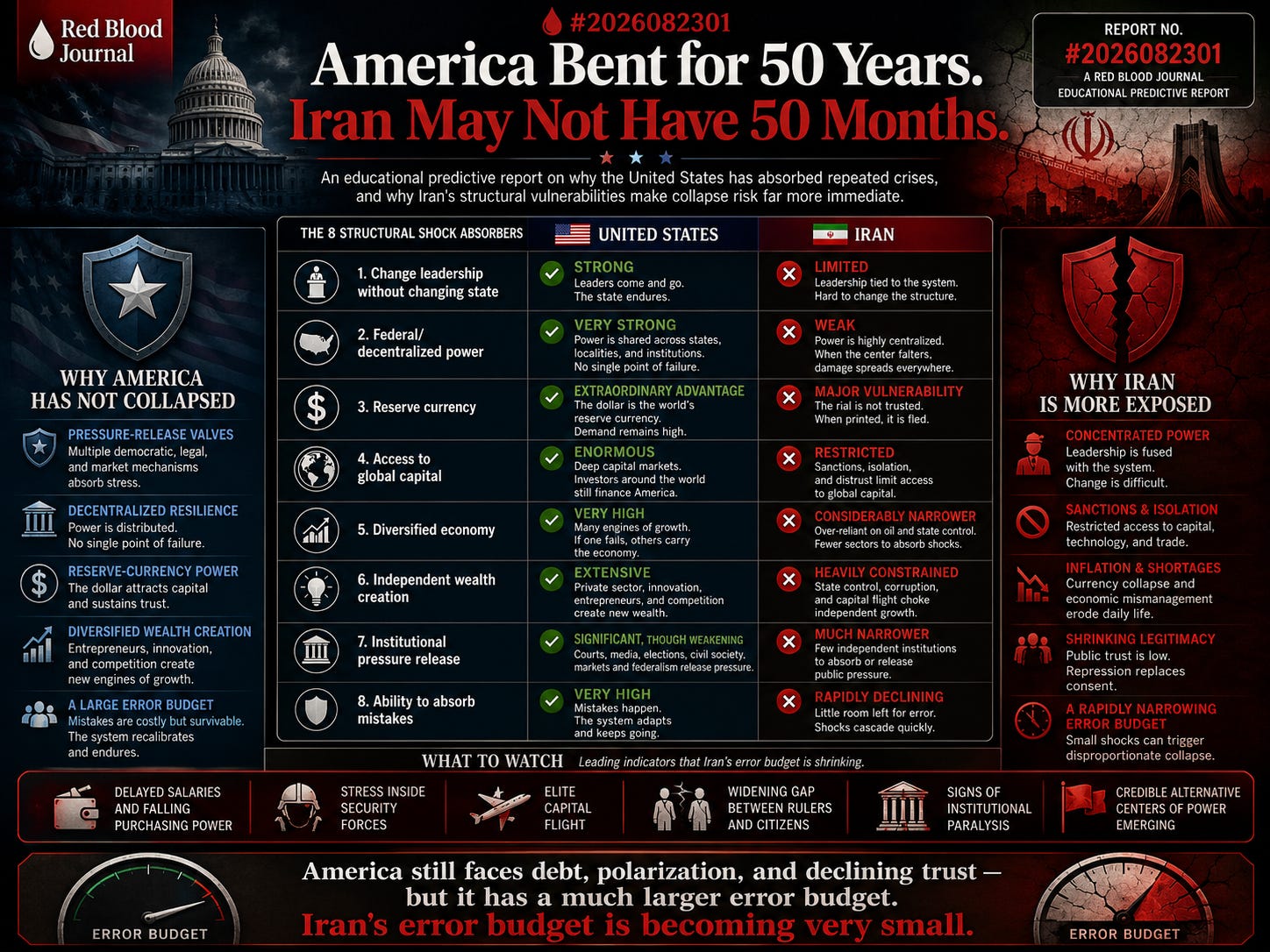
This is the crucial point:
Corruption alone does not determine collapse.
Corruption divided by resilience does.
America has enormous corruption risks but enormous resilience.
Iran has corruption layered onto shrinking resilience.
That mathematical difference may determine everything.
🔮 THE RED BLOOD PREDICTION
Iran does not collapse simply because inflation reaches another record.
It does not collapse because people demonstrate.
It does not collapse because another official is exposed.
It does not collapse because Washington imposes another sanction.
Iran enters true systemic danger when several events happen together:
1. Salaries lose practical meaning.
The government may technically pay workers, but inflation destroys the value before families can use it.
2. Security personnel begin feeling economically betrayed.
Not isolated complaints.
A pattern.
3. Elite capital flight accelerates.
The people closest to power quietly begin betting against the country’s political future.
4. Provinces begin ignoring Tehran.
Orders are delayed, modified or quietly disregarded.
5. Rival centers of power begin forming.
Officials start asking which leader they should obey.
6. A credible post-regime structure emerges.
Not a slogan.
Not a celebrity.
A structure capable of operating banks, airports, power plants, hospitals, police and ministries.
If those six conditions begin appearing together, the word collapse stops being rhetoric.
It becomes analysis.
🔻 AND WHAT ABOUT AMERICA?
America should not congratulate itself.
Its resilience has hidden problems rather than eliminated them.
The national debt has crossed $40 trillion.
Government trust remains near historic lows.
Transparency International’s measure of perceived corruption has deteriorated.
Political polarization is increasingly severe.
Federal finances are under growing pressure.
The Treasury market is beginning to demand higher compensation for long-term risk.
America’s error budget is huge.
It is not infinite.
And this is the warning Americans should take from Iran:
A country rarely realizes it has consumed its final shock absorber until the next shock arrives.
🩸 THE RED BLOOD PERSPECTIVE
The easiest propaganda is always:
We are good. They are corrupt.
Reality is more uncomfortable.
Iran has corruption.
America has corruption risks.
Iran has privileged networks.
America has privileged networks.
Iran has politically connected money.
America has politically connected money.
Iran has revolving relationships between state power and economic interests.
America has revolving relationships between government and private industry.
Iran has citizens who believe insiders receive preferential treatment.
America has millions of citizens expressing essentially the same fear.
The difference is not purity.
The difference is capacity.
America is wealthy enough to survive enormous extraction.
Decentralized enough to survive bad leadership.
Productive enough to replace lost wealth.
Financially powerful enough to borrow tomorrow’s money.
Politically flexible enough to replace administrations.
And institutionally diverse enough to keep functioning when Washington fails.
Iran has far fewer escape routes.
That is why the same disease can produce two different outcomes.
America has spent fifty years bending.
Iran may discover that it does not have fifty months.
🌊 THE OCEAN OF LOVE AND POSITIVITY PERSPECTIVE
The purpose of exposing corruption should never be hatred.
It should be restoration.
Governments are abstractions.
Countries are people.
An Iranian worker struggling to buy food and an American worker watching his paycheck disappear into rent, insurance, debt and taxes are not natural enemies.
They are living different versions of the same human question:
Does the system serve the citizen—or has the citizen become fuel for the system?
The answer does not have to be revolution.
It can be awareness.
Transparency.
Accountability.
Competition.
Decentralization.
Honest law.
Equal justice.
And the recovery of a principle far older than any government:
Power exists to serve life. Life does not exist to feed power.
Iran does not need to become America.
America does not need to pretend it has solved corruption.
Both societies can learn the same lesson.
When power and wealth become too closely married, the public eventually pays the dowry.
The path forward is not another ruling class.
It is separating political power from private enrichment and restoring the citizen to the center of government.
In an Ocean of Love and Positivity.
🩸🌊✨ Fantastic!
⚖️
The Mechanics of Decay: Comparing Corruption in America and Iran
Aug 23, 2026
The provided text examines the parallel structures of corruption within the United States and Iran, arguing that while the mechanisms differ, both nations suffer from a toxic marriage of money and political power. Although the American system operates through legal channels like lobbying and regulatory capture, Iran’s version is more direct, involving the extraction of state resources by security-linked networks. The author highlights that the primary distinction lies in economic resilience, as America’s status as a global reserve currency and its decentralized industry act as shock absorbers against systemic decay. Conversely, Iran lacks these financial buffers, leaving it vulnerable to a structural collapse as public trust vanishes and the cost of corruption outweighs the country’s productive capacity. Ultimately, the source warns that while the United States has tolerated internal rot for decades due to its immense wealth, no nation has an infinite capacity to survive the erosion of institutional integrity.
#RedBloodJournal #2026082301 #America #Iran #USIran #Corruption #PoliticalCorruption #SystemicCorruption #GovernmentAccountability #FollowTheMoney #MoneyAndPower #ElitePrivilege #TwoTierJustice #InstitutionalTrust #PoliticalPower #EconomicCrisis #Inflation #NationalDebt #DollarPower #ReserveCurrency #Sanctions #CapitalFlight #StateFailure #RegimeStability #IranEconomy #USEconomy #PoliticalSystems #InstitutionalDecay #PublicTrust #RuleOfLaw #EconomicResilience #GovernmentFailure #EliteCapture #Cronyism #RegulatoryCapture #Lobbying #RevolvingDoor #WealthAndPower #EconomicInequality #CollapseRisk #IranCollapse #AmericanResilience #ErrorBudget #Geopolitics #PredictiveAnalysis #InvestigativeJournalism


