


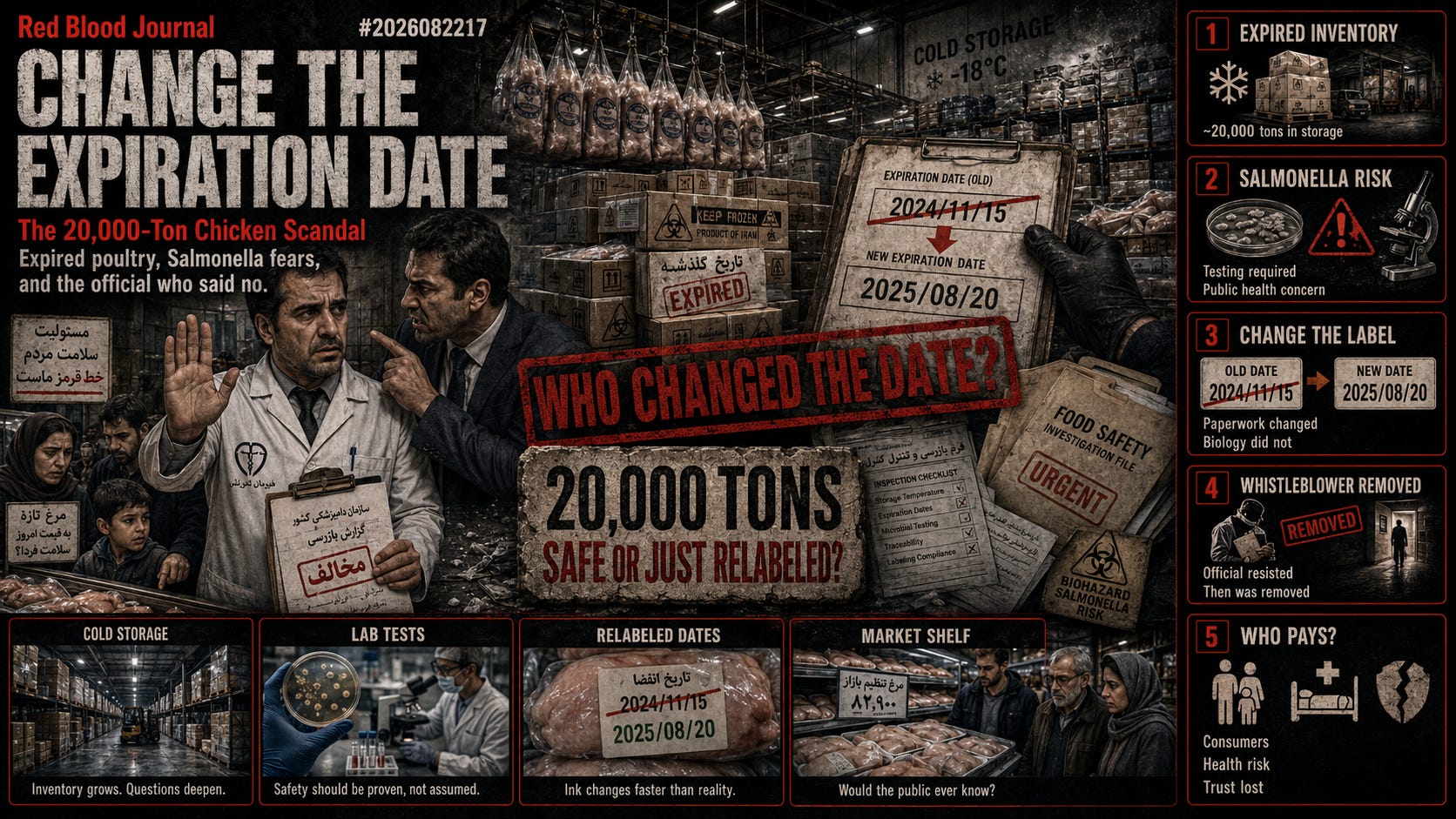
🩸 🍗 ☣️ 🇮🇷 #2026082217 — Change the Expiration Date: The 20,000-Ton Chicken Scandal
Expired Poultry, Salmonella Questions, a Removed Official—and What Happens When Protecting the Public Becomes the Problem
🩸 RedBloodJournal.com 🩸
Sometimes corruption is hidden behind offshore accounts.
Sometimes it hides inside government contracts.
Sometimes it arrives in an envelope.
And sometimes, according to the source behind this report, it may be as simple as changing a date printed on a package.
The allegation is extraordinary.
Roughly 20,000 to 20,500 tons of chicken had reportedly reached or passed its expiration date while sitting in cold storage.
Instead of immediately destroying the product or conducting the necessary safety testing, the source says pressure emerged to extend the expiration dates so the poultry could still enter the market.
Then comes the part that turns a food-safety dispute into something much larger:
An official who reportedly resisted changing those dates was removed.
If accurately described, this is not merely a story about expired chicken.
It is a story about what happens when the person trying to enforce the safety rule becomes more inconvenient than the unsafe product itself.
🔻 20,000 TONS IS NOT A SMALL ERROR
Twenty thousand tons is difficult to visualize.
It is not one supermarket.
Not one warehouse.
Not one truck.
It represents a massive quantity of food potentially moving through a national distribution system.
According to the transcript, the figure discussed was approximately 20,000 to 20,500 tons of poultry whose expiration dates had become an issue.
At that scale, every decision matters.
Who owned the product?
Who stored it?
Why had such a large quantity remained unsold?
Who would absorb the financial loss if it had to be destroyed?
Who stood to benefit if the dates were extended?
Those questions are as important as the food itself.
🔻 THE MOST IMPORTANT WORD MAY BE “SALMONELLA”
The source specifically discusses concerns that the chicken should have undergone appropriate testing, including testing for Salmonella, before any extension of its usable life was considered.
That changes the issue completely.
Expiration dates are not decorative.
Food-safety standards exist because microorganisms do not care about accounting losses.
If poultry has passed the period in which its safety can be reliably guaranteed, the question is not:
Can we still sell it?
The question is:
Can we prove it is safe?
If the answer is not known, the burden should fall on protecting the consumer.
Not protecting the inventory.
🔻 CHANGE THE DATE—CHANGE THE REALITY?
The allegation described in the transcript is almost surreal.
The product has aged.
The storage period has passed.
The safety question remains unresolved.
And the proposed solution is allegedly:
Change the expiration date.
But changing ink does not change biology.
A new label cannot reverse time.
It cannot remove bacteria.
It cannot repair a broken cold chain.
It cannot transform questionable food into fresh food.
A government document may recognize a new date.
A microorganism will not.
🔻 THIS MAY BE THE PERFECT METAPHOR FOR A FAILING SYSTEM
The chicken expires.
Change the date.
Inflation rises.
Change the statistic.
Air becomes polluted.
Change the standard.
The economy contracts.
Change the definition.
The institution fails.
Change the official.
Reality remains exactly where it was.
That is why this allegation matters beyond food.
It illustrates a deeper political temptation:
When reality becomes inconvenient, alter the paperwork instead of fixing the problem.
🔻 THEN SOMEONE SAID NO
According to the source, a veterinary or food-safety official resisted pressure to extend the dates without the required testing.
The transcript says that official was subsequently removed.
If accurate, that is the real scandal.
Because bad inventory can happen.
Poor planning can happen.
Storage mistakes can happen.
But an institution reveals its character through what happens next.
Does it reward the person who identifies the risk?
Or remove them?
🔻 THE WHISTLEBLOWER TEST
There is a simple way to judge the health of an institution.
Ask what happens to the person who says:
Stop. This is unsafe.
In a healthy system:
That person is heard.
Evidence is tested.
The product is quarantined.
Independent laboratories are involved.
Records are preserved.
Responsibility is established.
In a corrupt system:
The person becomes inconvenient.
The warning becomes the problem.
The official is pressured.
The paperwork changes.
The product keeps moving.
🔻 WHEN THE SAFETY OFFICIAL BECOMES THE OBSTACLE
This is how regulatory failure becomes systemic.
At first, the regulator protects the public.
Then commercial or political pressure increases.
Eventually the regulator is viewed as obstructing:
Distribution.
Revenue.
A politically important company.
A ministry.
A procurement contract.
A politically embarrassing loss.
Once the person enforcing the rule is treated as the problem, the protective institution has been inverted.
Its purpose has changed.
🔻 FOLLOW THE MONEY
If 20,000 tons of chicken must be destroyed, someone takes a huge loss.
That fact alone creates motive.
Who purchased it?
Who financed it?
Who insured it?
Was it government-owned?
Was it imported?
Was it held by a private supplier?
Was it bought with subsidized foreign currency?
Was a politically connected entity involved?
The uploaded source does not answer those questions.
But they are precisely the questions an investigation should ask.
Because the larger the inventory, the larger the incentive to avoid writing it off.
🔻 FOOD SAFETY VERSUS FINANCIAL LOSS
This conflict exists everywhere.
A company has millions tied up in inventory.
Testing reveals a potential problem.
Destroying the product is expensive.
Recalling it is embarrassing.
Managers begin searching for another interpretation.
Another laboratory.
Another extension.
Another signature.
Another rule.
That is why independent regulation matters.
The person deciding whether food is safe cannot be financially dependent on the person who loses money if it is unsafe.
🔻 WHAT DOES SALMONELLA MEAN FOR THE PUBLIC?
The transcript discusses Salmonella as a central food-safety concern associated with improperly handled poultry.
The important point is not to dramatize every expired package as lethal.
It is that poultry can carry pathogens, and storage history matters.
Safety depends on factors such as:
Temperature.
Handling.
Time.
Packaging.
Contamination.
Cold-chain integrity.
Testing.
Without evidence showing the product remained safe, mass redistribution would create an unacceptable question mark.
And consumers would have no way to know which package came from which inventory.
🔻 THE POOR WOULD PROBABLY EAT IT FIRST
This is where the story becomes socially disturbing.
Who is most likely to buy discounted or government-distributed poultry?
The wealthy?
Probably not.
The people most exposed would likely be the same families already struggling with food inflation.
The same households buying whatever protein remains affordable.
The same citizens whose purchasing power has been collapsing.
That means a decision made to avoid a financial loss could potentially transfer health risk downward.
Once again:
Profit is protected above. Risk is distributed below.
🔻 THE PEOPLE CANNOT INSPECT THE WAREHOUSE
Consumers depend on institutions.
A mother buying chicken cannot perform bacterial testing at home.
A restaurant owner cannot reconstruct the product’s entire storage history.
A worker in a supermarket cannot know what government official approved an extension.
People rely on:
Veterinary authorities.
Food inspectors.
Laboratories.
Health ministries.
Expiration rules.
Cold-chain standards.
That trust is invisible until it disappears.
🔻 ONCE FOOD TRUST DISAPPEARS, EVERYTHING BECOMES SUSPECT
Was this meat relabeled?
Is this milk actually fresh?
Was this medicine stored properly?
Was this gasoline altered?
Was this expiration date changed?
Was this laboratory pressured?
Was this inspector removed?
One scandal can contaminate confidence in an entire system.
That is why transparency matters enormously.
🔻 THE SOURCE CONNECTS THIS TO A LARGER CORRUPTION STORY
The transcript does not present the chicken allegation in isolation.
It places it beside:
Fuel-quality concerns.
Vehicle damage.
Extreme inequality.
Babak Zanjani.
Elite privilege.
Economic desperation.
And broader claims that corruption has become institutional rather than exceptional.
That framing matters.
The chicken becomes another example in the source’s argument that ordinary citizens repeatedly absorb risks while politically or economically powerful interests are protected.
🔻 ONE BAD OFFICIAL OR A BAD INCENTIVE SYSTEM?
Every scandal invites a convenient explanation:
One corrupt manager.
One incompetent department.
One dishonest supplier.
Perhaps.
But if the person resisting the questionable decision is removed, the problem may be larger.
Then the question becomes:
What behavior does the institution reward?
Compliance with safety standards?
Or compliance with pressure?
Systems become corrupt not simply because bad people exist.
They become corrupt when doing the right thing becomes professionally dangerous.
🔻 THE MOST DANGEROUS MESSAGE TO A CIVIL SERVANT
Imagine being another food inspector watching this case.
You see an official refuse.
You see what happens next.
What lesson do you learn?
Next time you discover a problem, do you insist?
Or sign?
That is how one removal can affect thousands of future decisions.
People respond to incentives.
Fear is an incentive.
Career survival is an incentive.
Silence becomes rational.
🔻 THIS IS HOW PUBLIC INSTITUTIONS ROT QUIETLY
There is rarely an announcement:
Today we are ending food-safety enforcement.
Instead:
One exception.
One signature.
One extension.
One transfer.
One dismissal.
One compromised test.
One politically inconvenient report disappears.
Eventually the rules still exist on paper.
But everyone inside the institution understands when they are expected not to enforce them.
That is institutional decay.
🔻 THE ANSWER IS DOCUMENTATION
This allegation should be extraordinarily easy to investigate if authorities release the records.
Publish:
The exact quantity of poultry involved.
Ownership.
Purchase dates.
Slaughter dates.
Storage locations.
Temperature records.
Original expiration dates.
Requested revised dates.
Laboratory results.
Salmonella testing.
Names of responsible agencies.
Correspondence ordering extensions.
The administrative record explaining the removal of the official.
Then let independent experts examine it.
🔻 IF THE CHICKEN WAS SAFE, PROVE IT
This is important.
An expiration date by itself does not establish that every kilogram was contaminated.
The source does not provide laboratory evidence showing that all 20,000 tons were unsafe.
That distinction must remain clear.
But if officials wanted to extend the product’s life, the burden should have been:
Demonstrate safety scientifically.
Not:
Assume safety administratively.
Testing resolves uncertainty.
Paperwork only hides it.
🔻 IF THE CHICKEN WAS NOT SAFE, WHO WAS GOING TO RECEIVE IT?
This should be one of the first investigative questions.
Supermarkets?
Government distribution programs?
Restaurants?
Institutional kitchens?
Schools?
Military facilities?
Low-income food programs?
Processing plants?
If relabeling was contemplated, there was presumably an intended destination.
The public deserves to know what it was.
🔻 FOOD SCANDALS ARE DIFFERENT FROM FINANCIAL SCANDALS
If public money disappears, citizens lose wealth.
If unsafe food enters circulation, citizens can lose health.
The consequences are immediate and personal.
A corruption case involving poultry can arrive at the dinner table before the public even knows the corruption occurred.
That makes preventive regulation essential.
🔻 THE SIGNATURE MATTERS
At some point, somebody must authorize the decision.
This is why bureaucracy creates documents.
Who requested the date extension?
Who approved it?
Who opposed it?
Who ordered the official removed?
What justification was given?
Was a laboratory consulted?
Those signatures tell the story.
And if the signatures cannot be produced, that itself tells another story.
🔻 NEVER PUNISH THE PERSON WHO SAYS THE FOOD MAY BE UNSAFE
This should not be controversial.
Governments need employees who are willing to stop systems.
Airline inspectors.
Nuclear inspectors.
Doctors.
Engineers.
Food-safety officers.
Auditors.
The easiest organization to manage is one where everyone says yes.
It is also the most dangerous.
The person saying no may be the final safety mechanism left.
🔻 THE IRONY OF “NATIONAL SECURITY”
Governments often define national security through:
Weapons.
Borders.
Missiles.
Intelligence.
Military readiness.
But what is national security if citizens cannot trust the food supply?
If contaminated food reaches millions, no foreign enemy is required.
Public health is national security.
Food safety is national security.
Clean water is national security.
Reliable energy is national security.
The health of the population is the foundation beneath everything else.
🔻 A GOVERNMENT THAT CANNOT PROTECT DINNER CANNOT CLAIM TOTAL COMPETENCE
This may be the deeper political danger.
The Islamic Republic presents itself as capable of managing enormous questions:
Regional war.
Nuclear strategy.
Global diplomacy.
Intelligence.
Sanctions.
Military operations.
But citizens encounter the state through smaller things.
Is the chicken safe?
Is the gasoline safe?
Is the medicine real?
Does the electricity stay on?
Can the salary buy food?
Government legitimacy lives at that level too.
🔻 THE 20,000-TON QUESTION
If the transcript’s account is accurate, someone faced a choice.
Take an enormous financial loss.
Or find a way to preserve the inventory.
The alleged solution was to preserve the inventory.
The person objecting was reportedly removed.
That sequence must be explained.
Because it raises one devastating question:
Was the system protecting the consumer—or protecting the chicken?
🩸 THE RED BLOOD PERSPECTIVE
This allegation should not be exaggerated beyond what the source establishes.
The transcript reports claims involving roughly 20,000–20,500 tons of expired poultry, pressure to extend expiration dates, inadequate or disputed testing, Salmonella concerns, and the removal of an official who allegedly resisted the process.
That is already serious enough.
No additional conspiracy is required.
The investigation should be straightforward:
Who owned it?
Who ordered the date change?
Who tested it?
What did the tests show?
Who removed the official?
Where was the chicken supposed to go?
And most importantly:
Did any of it reach consumers?
If the answer is no, publish the records and restore confidence.
If the answer is yes, trace every kilogram.
Because food safety cannot operate on political convenience.
A date can be changed.
Reality cannot.
🌊 OCEAN OF LOVE AND POSITIVITY PERSPECTIVE
There is nothing ideological about feeding people safely.
A child should not care whether a food inspector is conservative, reformist, monarchist, secular, religious, American, Iranian, or anything else.
The chicken should simply be safe.
That is what healthy government looks like.
Quiet competence.
Honest testing.
Inspectors protected when they speak.
Products removed when they fail.
Citizens informed when mistakes happen.
No minister should fear admitting that food must be destroyed.
Money can be replaced.
Health cannot always be.
And a society becomes stronger when the person who says “This may hurt someone” is treated as a guardian rather than an enemy.
Iran deserves institutions where honesty is rewarded.
Where regulators protect families.
Where labels mean what they say.
Where a parent can put dinner on the table without needing to investigate the government first.
That is dignity.
That is public service.
That is security.
In an Ocean of Love and Positivity.
🩸🌊✨ Fantastic!
🍗
The 20,000-Ton Chicken Scandal: Corruption and Food Safety
Aug 23, 2026
This source investigates a significant corruption scandal involving the alleged attempt to sell 20,000 tons of expired chicken by falsifying expiration dates. The report claims that rather than destroying the potentially hazardous poultry, officials faced pressure to bypass safety testing for pathogens like Salmonella to avoid financial losses. Central to the controversy is the reported removal of a food-safety official who resisted these unethical changes, suggesting a systemic failure in regulatory oversight. The text argues that this incident serves as a broader metaphor for a collapsing institutional framework where paperwork is altered to mask inconvenient realities. Ultimately, the narrative highlights the grave public health risks created when political and commercial interests are prioritized over the safety of vulnerable consumers. Underpinning the report is a call for transparency and accountability to restore trust in national food distribution systems.
#RedBloodJournal #2026082217 #Iran #ChickenScandal #ExpiredChicken #FoodSafety #FoodSecurity #PublicHealth #Salmonella #FoodContamination #ExpirationDate #Relabeling #ConsumerSafety #AgricultureMinistry #VeterinaryAuthority #Whistleblower #WhistleblowerRetaliation #Corruption #SystemicCorruption #GovernmentAccountability #RegulatoryFailure #InstitutionalFailure #PublicTrust #HealthRisk #ColdChain #FoodTesting #LaboratoryTesting #FoodInspection #Transparency #Accountability #IranianPeople #CostOfLiving #EconomicCrisis #FoodPrices #ConsumerProtection #QuestionEverything #OceanOfLoveAndPositivity #RedBlood


