


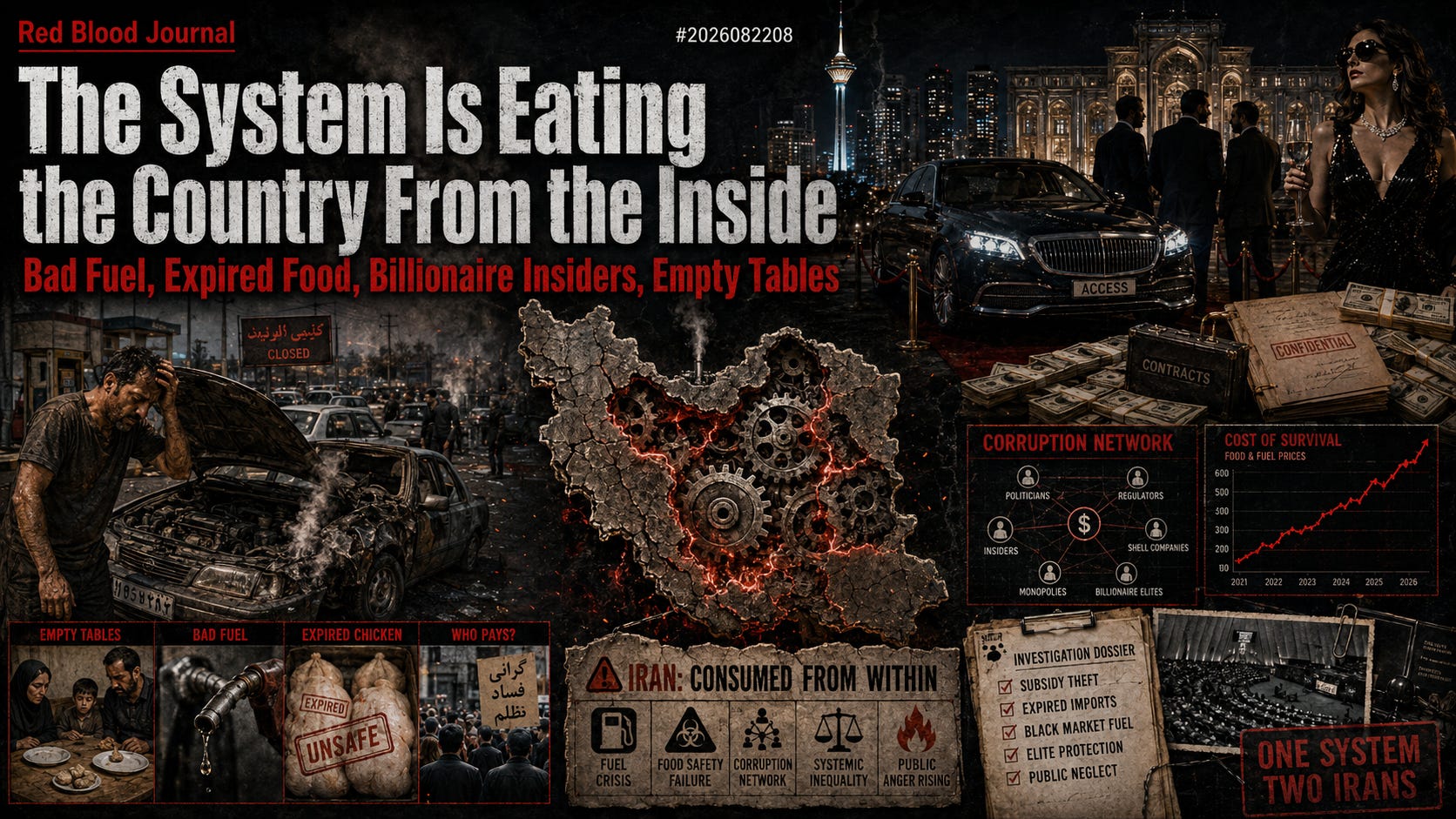
🩸 💸 🍗 🚗 🇮🇷 #2026082208 — The System Is Eating the Country From the Inside
Bad Fuel, Expired Food, Billionaire Insiders, Empty Tables—and the Economics of a State Losing Control
🩸 RedBloodJournal.com 🩸
A country does not collapse all at once.
It collapses in pieces.
First, the gasoline becomes questionable.
Then the cars begin overheating.
Then food expires inside warehouses while families struggle to afford dinner.
Then someone connected to power drives a vehicle worth more than entire neighborhoods.
Then a man accused of taking billions from public resources walks free while poor protesters face brutal punishment.
Then officials themselves begin warning:
If the people remain hungry, this system will not survive.
That is the Iran described in the source behind this report.
Not a single crisis.
A chain reaction.
Fuel.
Food.
Corruption.
Inequality.
Sanctions.
Privilege.
Public anger.
And perhaps most importantly:
A government increasingly unable to hide the connection between them.
🔻 THE CAR AT THE SIDE OF THE ROAD IS AN ECONOMIC REPORT
Economics usually arrives disguised as numbers.
Inflation.
GDP.
Exchange rates.
Budget deficits.
But ordinary people experience economics differently.
A driver turns the key.
The engine knocks.
The temperature rises.
The car begins overheating.
The family suddenly faces a repair bill.
The uploaded source describes reports of large numbers of vehicles overheating and becoming stranded along Iranian roads, with drivers standing beside open hoods and trying to cool engines with water.
The cause remains unresolved.
Fuel quality has been questioned.
Methanol has been discussed.
Kerosene has been alleged.
Sabotage has even been speculated about.
But whichever explanation ultimately proves correct, the citizen experiences the same result:
Another cost.
And in an economy already under pressure, another cost can be catastrophic.
🔻 THE POOR BUY THE FAILURE
One of the most brutal characteristics of dysfunctional economies is that the people with the least money often pay the highest price for institutional failure.
The wealthy can replace the car.
The poor repair it.
The wealthy can buy premium fuel.
The poor buy whatever reaches the station.
The wealthy can import parts.
The poor wait.
The wealthy absorb inflation.
The poor eliminate meals.
When infrastructure deteriorates, inequality becomes a multiplier.
A bad batch of fuel is irritating to someone with three cars.
It can be financially devastating to someone whose only vehicle is also the way they earn their living.
🔻 THEN THE ROLLS-ROYCE APPEARS
The transcript shifts from overheated Iranian cars to an image almost designed to create anger.
Celebrity Mohammad Reza Golzar is described showing off an exceptionally expensive Rolls-Royce.
The source estimates the vehicle at roughly $500,000, or about 100 billion toman, and says it requires extremely expensive premium gasoline.
The point is not that owning an expensive car is inherently wrong.
The point is contrast.
One Iran is standing beside an overheated engine.
Another Iran is displaying a Rolls-Royce.
One Iran worries about repair costs.
Another Iran demonstrates access.
That is where luxury stops being merely luxury.
It becomes political imagery.
🔻 WHEN WEALTH LOOKS CONNECTED TO POWER
The source makes a broader accusation.
It argues that Iran’s political economy has moved capital away from productive investment and toward:
Rent-seeking.
Monopoly.
Imports.
Middlemen.
Nonproductive financial activity.
The result, according to the transcript, is enormous private wealth existing beside increasingly empty household tables.
That distinction matters.
People are often willing to tolerate wealth when they believe it came from innovation, work, risk or productivity.
They become far less tolerant when wealth appears to come from:
Political access.
Exclusive licenses.
Sanction arbitrage.
Protected monopolies.
Government contracts.
Connections.
Or exemption from rules everyone else must follow.
Then inequality becomes something more dangerous than economics.
It becomes a question of legitimacy.
🔻 THE BABAK ZANJANI QUESTION
The transcript then turns to Babak Zanjani.
It portrays him as someone accused of diverting billions of dollars in public resources, receiving a death sentence, later avoiding execution, and eventually reappearing in commercial life.
The source contrasts that treatment with impoverished young protesters who can face extreme punishment for taking to the streets.
The narrator asks a simple question:
Why does the system find mercy for the wealthy insider but not for the hungry child protesting in the street?
That is not merely a legal question.
It is a political one.
Because justice cannot survive indefinitely if citizens believe punishment depends upon proximity to power.
🔻 THE STATE CAN SURVIVE POVERTY LONGER THAN IT CAN SURVIVE PERCEIVED INJUSTICE
Poverty is dangerous.
But inequality plus visible favoritism can be even more destabilizing.
A poor person may tolerate hardship if everyone is sacrificing.
But sacrifice becomes explosive when people see:
Their wages collapsing.
Their cars deteriorating.
Their food becoming unsafe.
Their currency losing value.
While another class continues consuming luxury goods.
Then hardship stops feeling accidental.
It begins feeling organized.
Someone is benefiting from this.
That belief can destroy trust faster than inflation itself.
🔻 THEN COMES THE CHICKEN
Of all the allegations in the transcript, one of the most disturbing involves food.
The source quotes the head of parliament’s Agriculture Commission describing roughly 20,000 to 20,500 tons of expired chicken held in cold storage.
According to that account, there was pressure to extend expiration dates without adequate testing, including Salmonella testing, and an official who resisted changing the dates was removed from his position.
The source then describes concerns about Salmonella contamination and the risks associated with distributing expired poultry without proper testing.
If accurately reported, this moves beyond economic mismanagement.
It becomes a public-health and accountability issue.
🔻 CHANGE THE LABEL, NOT THE REALITY
There is something symbolic about the allegation involving expiration dates.
The chicken is expired.
The solution is allegedly not:
Destroy it.
Investigate it.
Replace it.
Protect the consumer.
The proposed solution is:
Change the date.
That is almost a metaphor for failing governments.
Inflation?
Change the calculation.
Unemployment?
Change the definition.
Pollution?
Change the standard.
Food expired?
Change the label.
Economic crisis?
Change the speech.
The underlying reality remains.
Only the packaging changes.
🔻 THE WHISTLEBLOWER PROBLEM
The transcript claims that the veterinary official who refused to cooperate with altering the dates came under pressure and was eventually removed.
If true, that is perhaps the most important part of the story.
Because corruption becomes systemic when the institution punishes the person trying to stop it.
One dishonest official is corruption.
A system that removes the honest official is something larger.
It means the incentive structure itself may be inverted.
Do the wrong thing?
You survive.
Refuse?
You become the problem.
🔻 THIS IS HOW CORRUPTION BECOMES INFRASTRUCTURE
People often imagine corruption as cash passed under a table.
That is the smallest version.
Structural corruption is different.
It can become embedded into:
Procurement.
Licensing.
Energy.
Banking.
Food distribution.
Imports.
Vehicle markets.
Currency access.
Sanctions.
Government appointments.
Regulation.
At that stage, corruption is no longer stealing from the system.
Corruption is the system.
That is essentially the argument made by the source when it describes a political-economic structure that protects wealthy insiders while ordinary citizens carry the consequences.
🔻 SANCTIONS CREATE SUFFERING—AND OPPORTUNITY
Sanctions are normally discussed as pressure on governments.
But heavily sanctioned economies often develop strange internal markets.
Someone gains privileged access to foreign currency.
Someone receives permission to import.
Someone transports sanctioned goods.
Someone becomes the intermediary.
Someone earns a commission.
Someone gets the waiver.
Someone knows the right official.
That creates a paradox.
The sanctions hurting millions may simultaneously enrich a small number of people positioned to navigate them.
The transcript repeatedly attacks what it describes as “کاسبان تحریم” — the profiteers of sanctions.
The ordinary Iranian pays more.
The connected intermediary earns more.
And the longer the crisis lasts, the stronger the intermediary can become.
🔻 THEN ASK THE MOST DANGEROUS QUESTION
Who benefits from normality?
Normality is bad for war profiteers.
Normality is bad for black markets.
Normality is bad for privileged importers.
Normality is bad for sanctioned middlemen.
Normality is bad for anyone whose importance depends upon crisis.
That does not prove that every crisis is deliberately maintained.
But it creates an obvious structural problem:
Some people can make more money from dysfunction than from reform.
And if those people gain political influence, reform threatens their income.
🔻 THE PEOPLE SEE THE CONTRADICTIONS
The transcript captures a series of questions reportedly circulating among Iranians.
Why should an Iranian pay multiples of the global price for a vehicle?
Why are foreign platforms filtered?
Why are imported electronics so expensive?
Why are workers earning salaries that amount to only a small fraction of wages elsewhere?
Why should a resource-rich nation produce such widespread household poverty?
Those questions attack the basic justification of the political economy.
Iran has:
Oil.
Gas.
Minerals.
Industry.
Agriculture.
A large educated population.
Strategic geography.
Enormous human capital.
So why does everyday life feel increasingly difficult?
That is the question no propaganda slogan can answer indefinitely.
🔻 GHALIBAF SAID THE QUIET PART OUT LOUD
The most politically significant passage may come from Mohammad Bagher Ghalibaf.
The transcript quotes him arguing that military strength is not enough.
If people are hungry, if economic circulation collapses, if production and growth disappear:
The system cannot endure.
That statement matters because it recognizes something missiles cannot solve.
You cannot bomb inflation.
You cannot arrest a collapsing currency.
You cannot censor an empty refrigerator.
You cannot deploy the Revolutionary Guard against a broken engine.
You cannot imprison the price of chicken.
Eventually economics reaches the kitchen table.
And the kitchen table votes every day.
🔻 HUNGER IS STRONGER THAN PROPAGANDA
Governments can control television.
They can filter websites.
They can arrest journalists.
They can restrict demonstrations.
But hunger creates its own information network.
The grocery store tells the truth.
The gas station tells the truth.
The paycheck tells the truth.
The rent tells the truth.
The mechanic tells the truth.
The refrigerator tells the truth.
No communications ministry can block those messages.
🔻 THIS IS WHY ECONOMIC COLLAPSE BECOMES POLITICAL COLLAPSE
Political systems often assume citizens rebel because of ideology.
Sometimes they do.
But often rebellion begins much closer to home.
A father cannot feed his children.
A worker’s salary becomes worthless.
A young person cannot afford housing.
A driver loses his engine.
A pension disappears into inflation.
A patient cannot buy medication.
Then one day the population realizes that millions of private struggles are actually the same public problem.
That is when economics becomes politics.
🔻 THE DANGER OF TWO IRANS
The transcript repeatedly presents two Irans living beside one another.
Iran One
Old cars.
Bad fuel.
Low wages.
Expensive food.
Unsafe products.
Inflation.
Protest.
Punishment.
Iran Two
Luxury cars.
Political access.
Imported goods.
Sanction profits.
Protected fortunes.
Legal leniency.
Connections.
The greater the distance between those two Irans becomes, the more difficult it becomes to convince one that the other deserves protection.
🔻 A GOVERNMENT CAN SURVIVE AN ENEMY. CAN IT SURVIVE ITS OWN ECONOMY?
The Islamic Republic has spent decades preparing for external enemies.
America.
Israel.
Sanctions.
Espionage.
War.
Cyberattacks.
But the source raises another possibility.
Perhaps the greatest threat is not entering Iran from outside.
Perhaps it has been growing inside for years.
Corruption.
Economic exclusion.
Privilege.
Unaccountable institutions.
Declining purchasing power.
Public exhaustion.
If that is true, then military defense cannot solve the central problem.
Because the enemy is not crossing the border.
It is sitting inside the balance sheet.
🩸 THE RED BLOOD PERSPECTIVE
It is easy to blame every Iranian economic problem on sanctions.
Sanctions absolutely matter.
War matters.
Isolation matters.
Foreign pressure matters.
But those explanations cannot become permanent immunity for domestic failure.
Bad fuel requires investigation.
Expired food requires investigation.
Protected billionaires require accountability.
Monopolies require scrutiny.
Sanctions profiteering requires transparency.
And when an official warns that hunger itself threatens the survival of the political system, that warning should be taken literally.
Because the central question is becoming impossible to avoid:
How can one of the world’s most resource-rich countries repeatedly produce scarcity for its own people?
If the answer is corruption, expose it.
If the answer is sanctions, document it.
If the answer is mismanagement, replace it.
If it is all three, admit it.
But stop asking ordinary Iranians to pay the bill while privileged insiders remain protected from the consequences.
🌊 OCEAN OF LOVE AND POSITIVITY PERSPECTIVE
Iran’s wealth was never only oil.
Its greatest resource has always been its people.
Engineers.
Doctors.
Farmers.
Workers.
Teachers.
Artists.
Drivers.
Scientists.
Entrepreneurs.
Families.
A healthy nation does not ask those people to survive an economy built around crisis.
It builds an economy around them.
Safe food should be ordinary.
Clean fuel should be ordinary.
A decent wage should be ordinary.
Justice should be ordinary.
Accountability should be ordinary.
The dream does not have to be extravagant.
A family should be able to work, eat, travel, raise children and plan for tomorrow without wondering which institution will fail next.
That is not capitalism.
That is not socialism.
That is not monarchy.
That is not clerical rule.
That is simply human dignity.
And whatever Iran becomes next, that should be the economic system’s first responsibility.
In an Ocean of Love and Positivity.
🩸🌊✨ Fantastic!
⚖️
The Fault Lines of a Fragile State
Aug 22, 2026
The provided text outlines a systemic collapse within Iran, where everyday economic hardships for the masses contrast sharply with the lavish lifestyles of a protected elite. Ordinary citizens grapple with failing infrastructure, such as tainted fuel and expired food supplies, while politically connected individuals thrive through monopolies and sanction-profiteering. This widening gap between the impoverished public and wealthy insiders suggests that institutional corruption has become the foundation of the state rather than a mere byproduct. High-level warnings indicate that public hunger and perceived injustice pose a greater threat to the government’s survival than external enemies. Ultimately, the source argues that a nation’s legitimacy fails when it prioritizes the security of the privileged over the basic human dignity of its people.
#RedBloodJournal #2026082208 #Iran #IranEconomy #EconomicCrisis #Corruption #SystemicCorruption #CostOfLiving #Inflation #Poverty #Inequality #WealthGap #ElitePrivilege #Sanctions #SanctionsProfiteers #BadFuel #FuelCrisis #CarBreakdowns #ExpiredFood #FoodSafety #ExpiredChicken #PublicHealth #BabakZanjani #MohammadRezaGolzar #Ghalibaf #IranianPeople #WorkingClass #EconomicJustice #Cronyism #RentSeeking #Monopoly #Accountability #GovernmentFailure #RegimeCrisis #PublicAnger #MiddleEast #Geopolitics #QuestionEverything #OceanOfLoveAndPositivity #RedBlood


