


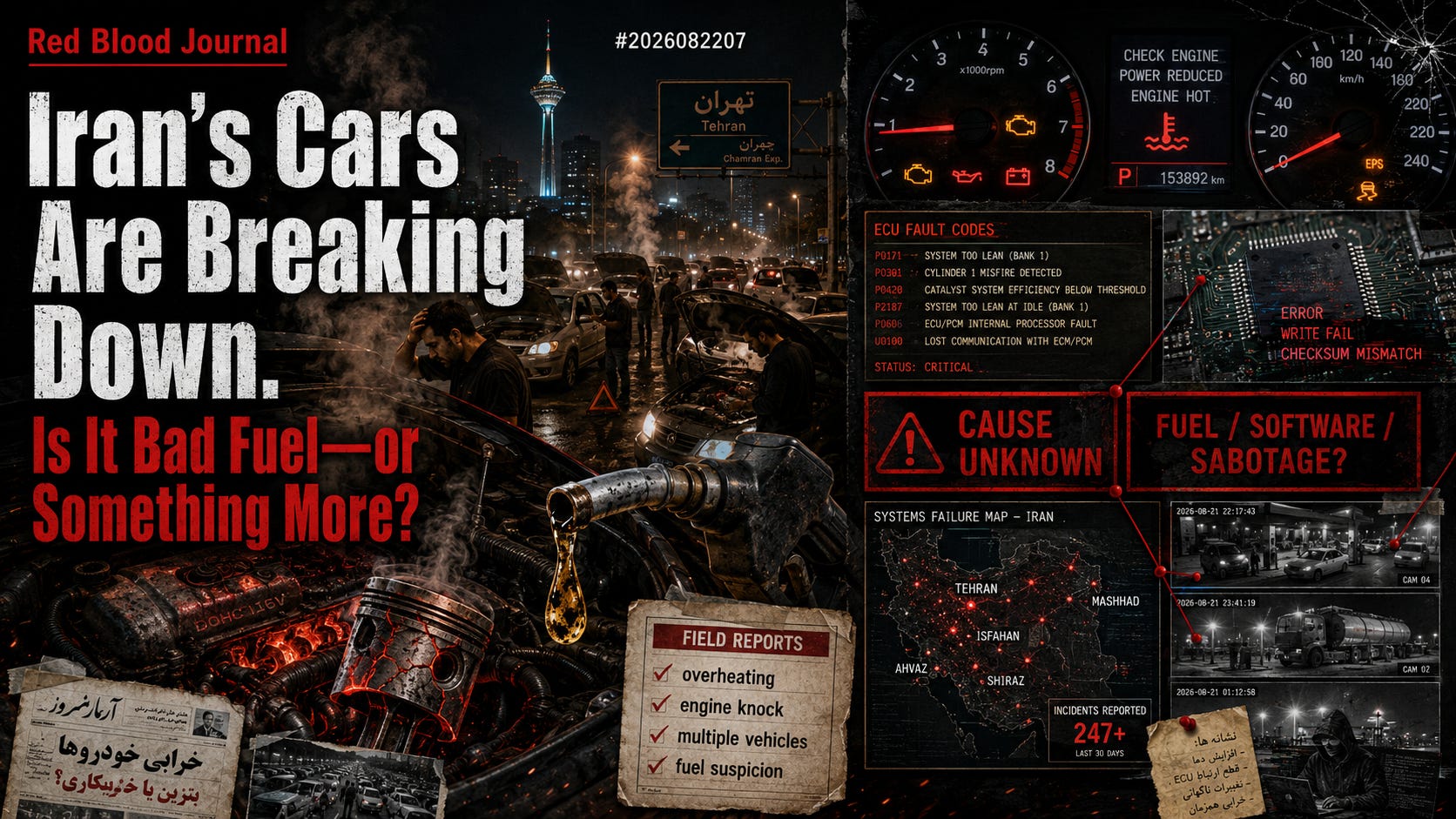
🩸 🚗 ⛽ 🕵️ #2026082207 — Iran’s Cars Are Breaking Down. Is It Bad Fuel—or Something More?
The Fuel Crisis, the “Pager Operation” Theory, and the New Fear of Invisible Sabotage
🩸 RedBloodJournal.com 🩸
Something strange began appearing in reports from Iran.
Cars overheating.
Engines knocking.
Vehicles losing power.
Drivers pulled over with their hoods raised.
Repair shops reportedly seeing multiple customers arrive with similar complaints.
And suddenly a question that would once have sounded extraordinary began circulating:
Is Iran experiencing a fuel-quality disaster—or could someone be sabotaging the cars themselves?
The uploaded source presents both possibilities.
One is mundane, measurable and technically plausible:
Contaminated or poor-quality gasoline.
The other is much more dramatic:
An operation resembling the Lebanon pager sabotage—only this time involving automobiles.
The source does not prove that such an intelligence operation exists.
But the fact that people are even considering it tells us something important about the climate inside Iran.
After repeated stories of infiltration, cyber operations and security penetrations, ordinary mechanical failure is no longer automatically interpreted as ordinary.
🔻 THE ROADSIDE REPORTS
The transcript describes social-media accounts claiming unusually high numbers of vehicles were becoming disabled.
One field report cited in the source allegedly described more than 30 stopped vehicles along roughly 15 kilometers of roadway, many with their hoods open.
The vehicles reportedly included domestic Iranian models as well as Chinese-made cars.
Drivers were described pouring water onto radiators and trying to cool overheated engines.
The person providing the report also claimed their own temperature gauge was running above normal.
That alone does not establish a nationwide phenomenon.
Social-media reports are not a controlled sample.
But if the pattern is as widespread as described, there is a legitimate technical question:
What changed?
🔻 THE FIRST SUSPECT: THE GASOLINE
The transcript itself initially points toward fuel quality.
It discusses concerns about additives and specifically mentions methanol.
It also quotes mechanics claiming that combustion characteristics had changed and that unusually high temperatures were damaging pistons.
One mechanic in the source describes a damaged Mercedes M254 engine and claims excessive combustion temperature caused the piston to melt at its weakest point.
That is a serious allegation.
But the transcript also contains an important qualification:
A technical inspection of damaged vehicles and laboratory testing of the fuel would be necessary before blaming gasoline conclusively.
That caution is essential.
Without fuel samples, chemical analysis, engine diagnostics and a meaningful statistical dataset, coincidence can easily become a national theory.
🔻 WHAT BAD FUEL CAN DO
If gasoline chemistry changes substantially, modern engines can react badly.
Octane characteristics matter.
Combustion timing matters.
Fuel volatility matters.
Contamination matters.
Modern engines continuously adjust ignition timing, fuel delivery and air mixture according to sensor data.
If the fuel behaves differently from what the engine-control system expects, symptoms can include:
Knocking.
Misfires.
Loss of power.
Higher temperatures.
Catalytic-converter damage.
And, under severe conditions, mechanical engine damage.
So the gasoline hypothesis does not require a conspiracy.
It requires chemistry.
🔻 THEN CAME THE KEROSENE THEORY
Later in the transcript, another allegation appears.
A social-media user claims that kerosene may be getting mixed into Iran’s gasoline supply.
The proposed explanation is geopolitical.
According to the claim, Russia has experienced pressure on its refining capacity because of Ukrainian strikes, and Iran may therefore be attempting to stretch fuel supplies or redirect resources.
The user argues that adding kerosene could increase combustion temperatures and damage engines while also increasing pollution.
Again:
This is an allegation contained in the source, not proof.
The transcript provides no laboratory fuel analysis demonstrating that Iranian gasoline has been systematically blended with kerosene at the claimed scale.
That distinction is crucial.
But the theory reveals another major issue.
Iran’s fuel system is no longer viewed simply as an energy problem.
It is increasingly being interpreted through war, sanctions, Russia and regime survival.
🔻 AND THEN SOMEONE SAID “PAGERS”
That word changes the entire psychological atmosphere.
The transcript quotes users comparing the mysterious car failures to the Israeli operation involving pagers in Lebanon.
The logic is simple:
If communications equipment can be compromised before reaching its users, could modern automobiles also contain exploitable vulnerabilities?
One user cited by the source claims:
“The computers in the cars are broken.”
Another suggests Israel could potentially trigger faults in vehicle computers.
There is no evidence in the source establishing that Israel has done this.
None.
But the idea is worth examining as a fear, because that fear itself may now shape Iranian public perception.
🔻 MODERN CARS ARE COMPUTERS WITH ENGINES
The suspicion is not entirely born from fantasy.
Modern vehicles contain numerous electronic control units.
They monitor:
Engine timing.
Fuel injection.
Throttle position.
Transmission.
Braking.
Temperature.
Emissions.
Security.
Sensors.
And sometimes cellular or internet-connected systems.
A sophisticated adversary can theoretically exploit vulnerabilities in connected or compromised vehicle systems.
But “theoretically possible” is very different from:
“That is what happened in Iran.”
To prove coordinated electronic sabotage, investigators would need evidence such as:
Common electronic fault codes.
Identical firmware anomalies.
Compromised update mechanisms.
Malware.
Manipulated components.
A shared supply-chain vulnerability.
Or some identifiable external command-and-control mechanism.
The uploaded source provides none of those.
So at this stage, the pager comparison remains a theory.
🔻 BUT THE PAGER OPERATION CHANGED WHAT PEOPLE THINK IS POSSIBLE
That may be the deeper story.
Before the Lebanon pager operation, the idea of thousands of ordinary-looking electronic devices being weaponized through a compromised supply chain sounded like something from fiction.
Afterward, people understood that an adversary did not necessarily need to destroy infrastructure from the outside.
Sometimes the weapon could already be inside the system.
That changes how future anomalies are interpreted.
Phone fails?
Cyberattack.
Car dies?
Sabotage.
Equipment catches fire?
Foreign intelligence.
Fuel behaves strangely?
Supply-chain operation.
This creates an enormous strategic advantage for any intelligence service whose capabilities are feared.
The adversary no longer has to be responsible for every malfunction.
People begin imagining the adversary themselves.
🔻 THE MOST POWERFUL OPERATION MAY BE THE ONE THAT NEVER HAPPENED
Consider the psychological effect.
If Iranian officials believe vehicle computers may be compromised, they must investigate them.
If they believe gasoline may be contaminated, they must investigate refineries.
If they suspect supply-chain infiltration, they must investigate suppliers.
If they suspect insiders, they must investigate personnel.
Every unexplained failure expands the security problem.
And eventually the government begins consuming enormous resources trying to distinguish:
Accident.
Corruption.
Negligence.
Poor manufacturing.
Bad maintenance.
Bad fuel.
Cyberattack.
Espionage.
Sabotage.
That is how uncertainty becomes a weapon.
🔻 THE OTHER POSSIBILITY IS EVEN MORE DAMAGING
Imagine there is no foreign sabotage at all.
Imagine the cars are failing because of bad gasoline.
That may actually be worse politically.
Because then the enemy is not Mossad.
The enemy is incompetence.
Corruption.
Mismanagement.
Poor refining.
Bad regulation.
A failing supply chain.
And ordinary citizens would once again be paying for a crisis created inside their own country.
The transcript itself repeatedly connects the vehicle breakdowns to a much broader economic picture in which ordinary Iranians struggle with old vehicles, expensive products and deteriorating infrastructure while connected elites display enormous wealth.
That is the political danger.
If the gasoline is bad, citizens ask:
Who sold it to us?
If it was sabotage, they ask:
How did the enemy penetrate the system again?
Either answer is damaging.
🔻 TWO PATHS. BOTH LEAD TO THE SAME QUESTION.
Scenario A: Fuel-quality failure
Then Iran has a serious industrial, regulatory or corruption problem.
Who altered the fuel?
Why?
Who approved it?
Who tested it?
Who profited?
Who knew?
Scenario B: Electronic or supply-chain sabotage
Then Iran has another extraordinary counterintelligence problem.
How were vehicles compromised?
Which manufacturers?
Which components?
Which networks?
How many vehicles?
How long has the vulnerability existed?
Who failed to detect it?
Two completely different explanations.
One common conclusion:
The system may not be in control of the systems people depend upon.
🔻 IRAN’S DRIVER BECOMES THE FINAL TEST LABORATORY
The citizen does not experience fuel policy as a government spreadsheet.
He experiences it when his engine begins knocking.
When his temperature gauge rises.
When his car stops.
When a mechanic says the piston is damaged.
When a family suddenly faces a repair bill they cannot afford.
This is what makes fuel quality politically explosive.
A defective gasoline policy transfers government failure directly into private property.
The refinery makes the decision.
The driver buys the engine.
🔻 NOW ADD SANCTIONS
Iranian motorists already operate inside an unusual economic environment.
Imported vehicles can be extraordinarily expensive.
Parts can be difficult to obtain.
International manufacturers may not have normal dealer networks.
Sanctions complicate procurement.
Currency weakness raises replacement costs.
And older vehicles remain on the road longer because replacement is unaffordable.
Now introduce questionable fuel.
Even a modest deterioration in quality can become financially devastating.
The car is not merely transportation.
For many families it is one of their most valuable possessions.
Destroy the engine and you may destroy years of savings.
🔻 THE RUSSIA CONNECTION NEEDS PROOF
The transcript links some fuel concerns to Russia and Ukrainian attacks on Russian refining capacity.
That connection should be investigated separately rather than assumed.
Questions worth asking include:
How much fuel is Iran exporting?
To whom?
Has the composition of domestic gasoline changed?
Have refinery output specifications changed?
Are additives being used differently?
Have imports changed?
Have government fuel standards been temporarily relaxed?
Those answers could convert rumor into evidence.
Until then, the Russia explanation remains another hypothesis.
🔻 THE DATA THAT WOULD SOLVE THIS
This mystery does not require political speeches.
It requires samples.
Independent laboratories could test gasoline collected from different Iranian cities.
Mechanics could document failure patterns.
Engine-control units could be scanned.
Damaged pistons could be examined metallurgically.
Fuel injectors could be inspected.
Fault codes could be compared.
Vehicle models could be mapped.
Dates could be mapped.
Fuel stations could be mapped.
If the same chemical contamination appeared across multiple samples, that would support the fuel hypothesis.
If identical software or electronic anomalies appeared across unrelated vehicles, that would justify deeper cyber investigation.
This is how the mystery moves from Telegram to evidence.
🩸 THE RED BLOOD PERSPECTIVE
The most dramatic headline would be:
“Mossad Is Hacking Iranian Cars.”
But the uploaded evidence does not establish that.
Not yet.
The responsible investigative position is more interesting:
Something may be happening to Iranian vehicles.
Reports of overheating and engine trouble deserve examination.
Fuel quality deserves testing.
Claims involving methanol or kerosene deserve laboratory verification.
The pager-operation theory deserves technical evidence before being treated as fact.
And government transparency would solve much of the speculation.
Release the fuel specifications.
Release the test results.
Release the failure data.
Let independent laboratories test the product.
Because when governments hide information, rumor fills the vacuum.
And after years of covert operations, infiltration stories and intelligence failures, Iran has become an environment where almost any malfunction can plausibly generate the same terrifying question:
Was this another operation?
🌊 OCEAN OF LOVE AND POSITIVITY PERSPECTIVE
Behind every geopolitical theory is an ordinary human being trying to get home.
A parent.
A worker.
A taxi driver.
A delivery driver.
A family.
They should not have to wonder whether the gasoline entering their car will destroy their engine.
They should not have to wonder whether their vehicle has somehow become part of an intelligence battlefield.
And they should not have to pay for the failures of governments, corporations or wars they did not create.
A healthy society makes the basic machinery of life boring.
Clean fuel.
Safe roads.
Reliable cars.
Transparent testing.
Accountable institutions.
No mystery.
No fear.
No hidden war inside the gas tank.
That is not a small ambition.
It is what normal life is supposed to look like.
In an Ocean of Love and Positivity.
🩸🌊✨ Fantastic!
🚗
Phantom Failures: Sabotage and Fuel Crisis in Iran
Aug 22, 2026
The source examines a surge in vehicular failures across Iran, characterized by widespread engine overheating and mechanical damage. It analyzes two primary theories: a fuel quality crisis involving contaminated or diluted gasoline and a more speculative theory of electronic sabotage inspired by recent intelligence operations. This discourse highlights how geopolitical tensions and previous security breaches have caused Iranian citizens to view ordinary mechanical issues through the lens of international espionage. Beyond the technical possibilities of poor refining or supply-chain infiltration, the text underscores a deep-seated distrust in government infrastructure. Ultimately, the situation illustrates how economic mismanagement and psychological warfare can turn a routine industrial problem into a source of national anxiety. This overview suggests that whether the cause is corruption or foreign interference, the burden falls heavily on ordinary motorists.
#RedBloodJournal #2026082207 #IranCars #Iran #FuelCrisis #Gasoline #BadFuel #FuelQuality #CarBreakdowns #EngineDamage #Overheating #AutomotiveCrisis #Methanol #Kerosene #FuelContamination #Sabotage #PagerOperation #ElectronicSabotage #CyberSabotage #VehicleComputers #Mossad #Israel #IranIsrael #IntelligenceOperations #Espionage #SupplyChain #Infrastructure #EconomicCrisis #Sanctions #Russia #UkraineWar #IranianEconomy #PublicSafety #Geopolitics #MiddleEast #QuestionEverything #OceanOfLoveAndPositivity #RedBlood


