


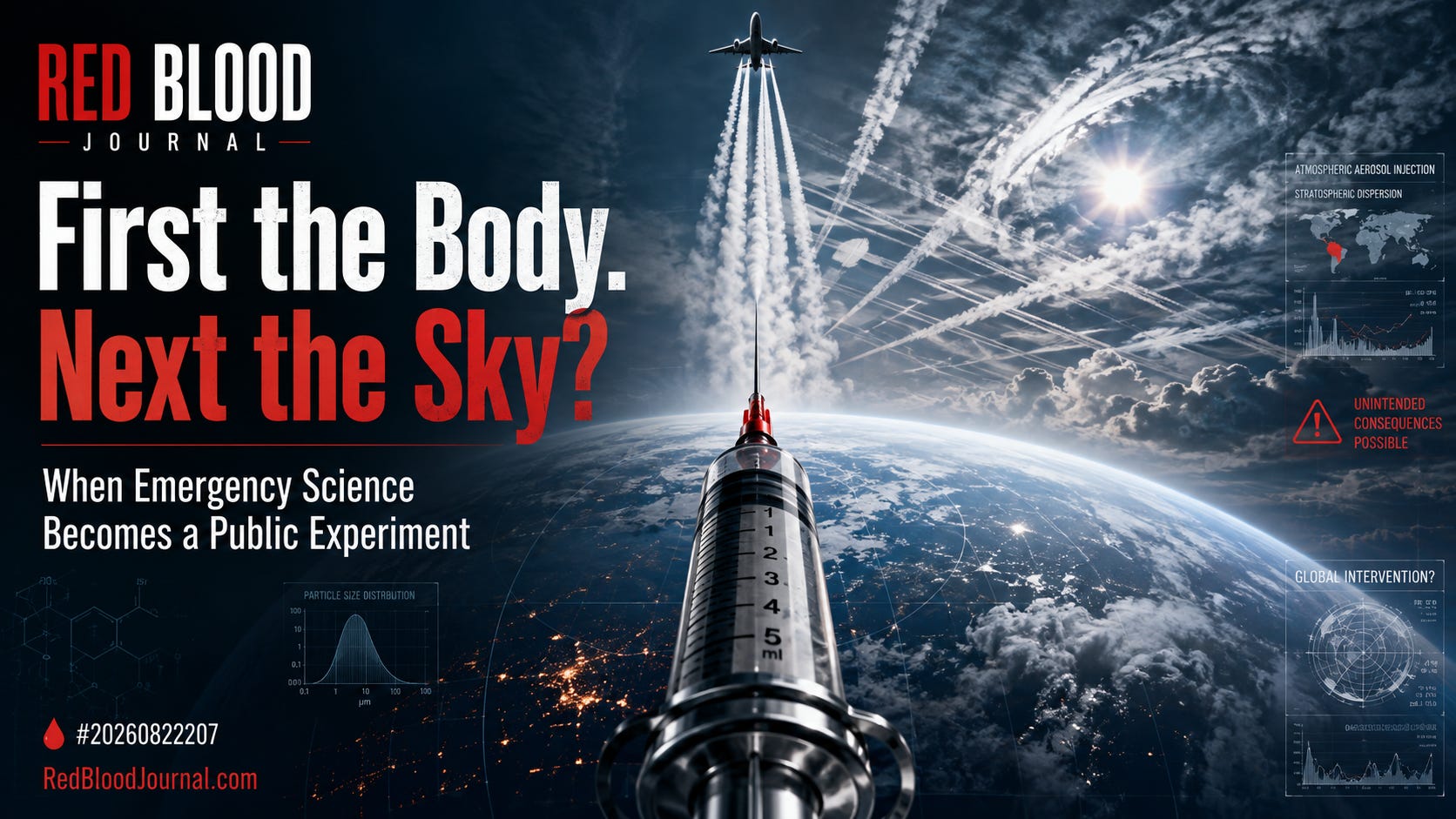
🩸 ☁️ 💉 🌎 #2026082207 — First the Body. Next the Sky? When Emergency Science Becomes a Public Experiment
RedBloodJournal.com
There may be no modern comparison more useful for understanding the coming geoengineering debate than the COVID-19 vaccine era.
Not because a vaccine and atmospheric engineering are scientifically the same.
They are not.
One enters the human body.
The other proposes changing the physical environment surrounding billions of human bodies.
But politically, ethically, and psychologically, they raise an eerily similar question:
What happens when authorities conclude that an emergency is so dangerous that society must accept an intervention before every long-term uncertainty can possibly be known?
That is where COVID becomes a warning worth studying.
And where geoengineering may become an even larger test.
🔻 COVID CHANGED THE MEANING OF “WE KNOW ENOUGH”
One claim needs to be corrected at the beginning.
The COVID vaccines were not literally untested.
Pfizer’s original Phase 2/3 program enrolled more than 43,000 participants, while Moderna’s Phase 3 trial involved roughly 30,000 participants. Both included randomized vaccine and placebo groups.
But that does not mean every question was answered when mass vaccination began.
It couldn’t have been.
The Pfizer vaccine received its first U.S. Emergency Use Authorization on December 11, 2020. Moderna followed on December 18. The available safety follow-up at that point was measured primarily in months—not years.
That distinction matters enormously.
There is a difference between:
“This intervention was never tested.”
and:
“This intervention was tested, but society began using it before long-term real-world information could possibly exist.”
The second statement is both more accurate and more important.
Because nearly every new technology eventually leaves the controlled environment of trials and enters the uncontrolled laboratory called the real world.
🔬 THE LARGEST STUDY ALWAYS COMES AFTER RELEASE
Clinical trials can identify common problems.
They can estimate effectiveness.
They can compare outcomes between groups.
But rare adverse events may not appear until millions of people have been exposed.
That happened.
The CDC now states that evidence from multiple monitoring systems supports a causal association between mRNA COVID-19 vaccines and rare myocarditis and pericarditis, particularly among adolescent and young adult males.
That does not prove the vaccines were worthless.
It proves something much more fundamental:
Reality can reveal information that the original trial could not.
Once tens or hundreds of millions of people participate, rare signals become visible.
Different age groups behave differently.
Different medical histories matter.
Different dosing intervals matter.
Longer observation changes understanding.
Science continues after authorization.
It does not end there.
And this lesson should be tattooed onto the geoengineering debate.
☁️ NOW REPLACE THE BODY WITH THE ATMOSPHERE
Solar Radiation Modification—often called solar geoengineering—includes proposed techniques intended to reduce warming by reflecting a portion of incoming sunlight.
One of the best-known concepts is Stratospheric Aerosol Injection, or SAI.
The concept involves deliberately introducing reflective material into the stratosphere.
The basic cooling principle is not imaginary. Large volcanic eruptions have demonstrated that stratospheric aerosols can temporarily reduce global temperature.
But knowing that something can cool Earth is not the same as knowing everything that happens afterward.
UNEP says SRM remains poorly understood and carries major unresolved environmental, societal, geopolitical, ethical, and governance questions. Its 2025 assessment describes SRM as speculative, notes that it remains largely confined to models and theory, and warns of possible disruptions involving climate patterns, biodiversity, ozone, and regional hydrology.
That sounds remarkably familiar:
We understand enough to know that an intervention may produce the desired primary effect.
But:
We do not understand every secondary consequence.
🌎 EXCEPT THIS TIME THERE IS NO PLACEBO GROUP
This is where the COVID analogy becomes inadequate.
A vaccine trial can divide participants.
One group receives the vaccine.
Another receives placebo.
Researchers compare the results.
But how exactly would humanity conduct a controlled experiment on the atmosphere?
Where is Earth Number Two?
Where is the placebo planet?
Where is the population that breathes under the untreated sky?
There isn’t one.
UNEP summarized the problem with extraordinary simplicity:
“One atmosphere.”
Deployment in one location could potentially create regional or global consequences. UNEP therefore says that everyone is a stakeholder.
Think about what those words actually mean.
Everyone.
The farmer.
The child.
The billionaire.
The village in Africa.
The family in Iran.
The rancher in Texas.
The fisherman in Indonesia.
The citizen who believes climate change requires emergency intervention.
And the citizen who wants nothing injected into the atmosphere.
They all share the same experimental chamber.
💉 WITH A VACCINE, AT LEAST THE BODY HAS A BORDER
However controversial COVID mandates became, there remained a physical distinction between one person’s body and another person’s body.
Atmospheric intervention eliminates even that boundary.
A person might decline a medicine.
A person cannot decline tomorrow’s atmosphere.
They cannot say:
Give my neighbor the modified sunlight, but leave mine unchanged.
Weather does not stop at property lines.
The stratosphere does not recognize passports.
Rainfall does not apply for a visa before crossing borders.
That makes the issue of consent radically different.
And potentially much more serious.
🚨 THE MOST DANGEROUS WORD MAY BE “EMERGENCY”
Here is where history deserves careful attention.
COVID policy operated under emergency conditions.
Speed became essential.
Emergency Use Authorization exists specifically because emergencies sometimes require decisions using less complete information than would exist after years of ordinary observation.
That can be defensible.
But emergency reasoning contains an inherent danger:
Once an emergency becomes large enough, uncertainty itself can become an argument for acting rather than waiting.
Now listen to the language appearing around geoengineering.
UNEP notes that solar radiation modification is sometimes discussed as an emergency or temporary measure if conventional climate efforts prove insufficient. At the same time, its expert panel concluded that SRM was not ready for large-scale deployment and required far more investigation into risks and benefits.
There is the tension.
Too uncertain to consider safe.
Yet perhaps someday:
Too urgent not to consider.
That is exactly the moment when public scrutiny must become stronger—not weaker.
🧪 THE EXPERIMENT DOES NOT HAVE TO BE A CONSPIRACY
There is a mistake both sides can make.
Critics sometimes jump immediately from legitimate geoengineering research to the conclusion that ordinary aircraft contrails prove a secret worldwide spraying program.
Evidence currently available does not establish that.
And making claims stronger than the evidence allows creates an escape route for anyone who does not want to discuss the real issue.
The real issue is already enormous without exaggeration.
Solar geoengineering is openly researched.
International institutions openly debate it.
Outdoor experiments have been proposed.
Governance remains unsettled.
UNEP says there is still a profound shortage of empirical knowledge concerning potential risks, impacts, and unintended consequences.
No hidden conspiracy is required to ask:
Who has the authority to authorize an experiment whose consequences might cross every national border?
That question stands on its own.
🧠 COVID SHOWED ANOTHER DANGER: THE COLLAPSE OF TRUST
COVID was not merely a medical event.
It became a crisis of institutional trust.
Government agencies spoke.
Pharmaceutical companies spoke.
Doctors disagreed.
Researchers disagreed.
Politicians chose sides.
Social-media companies moderated claims.
Some predictions proved correct.
Others didn’t.
Guidance changed as evidence changed.
And every change was interpreted differently depending on whom people already trusted.
That is precisely the environment geoengineering must avoid.
Because atmospheric engineering cannot survive politically if the public first discovers important decisions after they have already been made.
Transparency cannot begin after deployment.
It must precede experimentation.
⚖️ WHO GETS TO DEFINE ACCEPTABLE DAMAGE?
Suppose an atmospheric intervention lowered average global temperature.
Now suppose it also changed precipitation patterns somewhere.
What happens if one region benefits while another experiences drought?
What if global crop yields improve overall while one nation’s agriculture worsens?
What if wealthy countries decide the planetary benefit outweighs local losses suffered elsewhere?
Who calculates the acceptable sacrifice?
UNEP has already identified these equity and justice questions as central to the debate and has warned about the possibility of geopolitical tensions, unilateral deployment, and consequences unevenly distributed between regions.
That is not merely climate science.
That is power.
💰 THEN FOLLOW THE MONEY
A second lesson from COVID should never be forgotten.
Whenever enormous public emergencies collide with enormous private industries, citizens should demand extraordinary transparency.
Not because profit automatically proves corruption.
It doesn’t.
But because conflicts of interest become more consequential when billions of dollars and billions of human beings are involved.
The same standard must apply to geoengineering.
Who funds the research?
Who owns the intellectual property?
Who manufactures the equipment?
Who supplies the material?
Who controls deployment?
Who receives government contracts?
Who measures environmental consequences?
Who decides whether the experiment succeeded?
And perhaps most importantly:
Is the institution benefiting from deployment also responsible for evaluating whether deployment caused damage?
That arrangement should make every citizen uncomfortable regardless of political affiliation.
🔍 THE QUESTION OF ALTERNATIVES
Another parallel deserves examination.
During COVID, ferocious battles developed over treatments, prevention strategies, pharmaceutical interventions, lockdowns, natural immunity, and competing interpretations of the evidence.
Some proposed treatments ultimately failed rigorous testing.
Others found narrower uses.
Some debates became more political than scientific.
The lesson is not that every rejected remedy was secretly effective.
The lesson is:
Emergency science becomes dangerous when competing hypotheses cannot be openly tested and challenged.
Geoengineering needs precisely the opposite environment.
Advocates must be challenged.
Critics must be challenged.
Climate models must be challenged.
Claims of harmlessness must be challenged.
Claims of catastrophe must also be challenged.
No idea should receive immunity simply because it carries the label science.
Science is not obedience.
Science is structured doubt.
🌐 IMAGINE THE NEXT GLOBAL EMERGENCY
Imagine the year when several climate disasters strike simultaneously.
Food prices explode.
Heat records fall.
Wildfires dominate television.
Political leaders announce:
We have reached the emergency threshold.
Scientists appear before Congress.
International organizations convene emergency meetings.
A proposal is introduced for temporary stratospheric aerosol deployment.
Officials say the intervention is reversible.
They say computer modeling supports it.
They say waiting could cost millions of lives.
They say opponents are spreading misinformation.
Corporations announce that delivery infrastructure is ready.
Governments insist there is no time for years of debate.
And the public hears the sentence heard in almost every emergency:
We have to do something.
That is precisely when humanity must already have answered the questions.
Not afterward.
☁️ THE SKY CANNOT BECOME THE NEXT EMERGENCY AUTHORIZATION
COVID showed how fast an emergency can transform what society considers acceptable.
Geoengineering could test the same principle on an unprecedented scale.
Except this time the intervention would not stop at the skin.
It would surround the skin.
There would be no unvaccinated atmosphere.
No control planet.
No neighboring civilization available for comparison.
No way for California to participate while Nevada opts out.
No way for America to alter its sky without potentially involving Mexico, Canada, Europe, Asia, Africa, and everyone else sharing atmospheric circulation.
That is why geoengineering may require a standard of democratic consent higher than anything humanity has previously attempted.
🩸 THE RED BLOOD PERSPECTIVE
The lesson of COVID should not be reduced to:
Vaccines good.
or:
Vaccines bad.
That argument is already exhausted.
The deeper lesson is about the relationship between citizens, experts, corporations, governments, uncertainty, and emergency power.
Human beings learned that clinical trials do not reveal everything.
They learned that post-deployment surveillance matters.
They learned that rare adverse effects can emerge after widespread use.
They learned that censorship—or even the perception of censorship—destroys trust.
They learned that changing scientific guidance without clearly explaining why creates suspicion.
And they learned how difficult meaningful consent becomes when employment, travel, education, politics, fear, and public pressure enter the equation.
Those lessons should not be forgotten when the laboratory expands from the human body to the planet itself.
🌊 THE OCEAN OF LOVE AND POSITIVITY PERSPECTIVE
Questioning geoengineering does not require hatred of scientists.
Questioning vaccines does not require hatred of doctors.
Questioning governments does not require hatred of government workers.
The answer is not another tribal battlefield.
The answer is transparency.
Open data.
Open disagreement.
Independent research.
No ridicule.
No manufactured consensus.
No silencing inconvenient questions.
No corporate immunity from scrutiny.
No government immunity from scrutiny.
And no citizen asked to surrender curiosity because an authority has declared the matter settled.
Humanity shares one atmosphere.
That fact should unite us rather than frighten us.
If humans are ever asked to alter the sky deliberately, the decision must belong not merely to laboratories, corporations, billionaires, military planners, or governments.
The people living beneath that sky deserve a voice before the experiment begins.
Not after consequences appear.
Not after contracts are signed.
Not after deployment becomes too politically expensive to reverse.
Because perhaps the greatest lesson left behind by COVID is very simple:
Emergency does not eliminate the need for consent.
Emergency makes consent more important.
And before humanity begins experimenting with the only atmosphere it possesses, every question imaginable should be asked while there is still time to ask it.
In an Ocean of Love and Positivity.
🩸🌊✨ Fantastic!
⚖️
One Atmosphere: Emergency Science from COVID to Geoengineering
Aug 23, 2026
This text explores the ethical and political parallels between the global response to COVID-19 and the emerging debate over solar geoengineering. The author argues that both scenarios involve emergency interventions where authorities may prioritize rapid action over a complete understanding of long-term consequences. A central concern is the lack of a “placebo planet,” meaning atmospheric experiments would impact every living being without the possibility of individual withdrawal or a controlled comparison. The source emphasizes that public trust and transparency are vital, warning that scientific labels should not be used to bypass meaningful democratic consent. Ultimately, the passage serves as a call for rigorous scrutiny of the corporations and institutions that stand to lead these planetary-scale experiments. While acknowledging the potential urgency of climate change, it insists that emergency conditions increase, rather than eliminate, the necessity for open disagreement and ethical oversight.
#RedBloodJournal #2026082207 #FirstTheBodyNextTheSky #Geoengineering #SolarGeoengineering #StratosphericAerosolInjection #SRM #COVID19 #COVIDVaccine #VaccineDebate #PublicExperiment #EmergencyScience #EmergencyPowers #InformedConsent #MedicalEthics #ClimateEngineering #WeatherModification #AtmosphericEngineering #ScientificTransparency #PublicTrust #RiskAssessment #LongTermEffects #ExperimentalTechnology #ClimatePolicy #GlobalGovernance #EnvironmentalJustice #CorporateAccountability #GovernmentTransparency #FollowTheMoney #OneAtmosphere #ScienceAndPower #QuestionEverything #OceanOfLoveAndPositivity #RedBlood


