


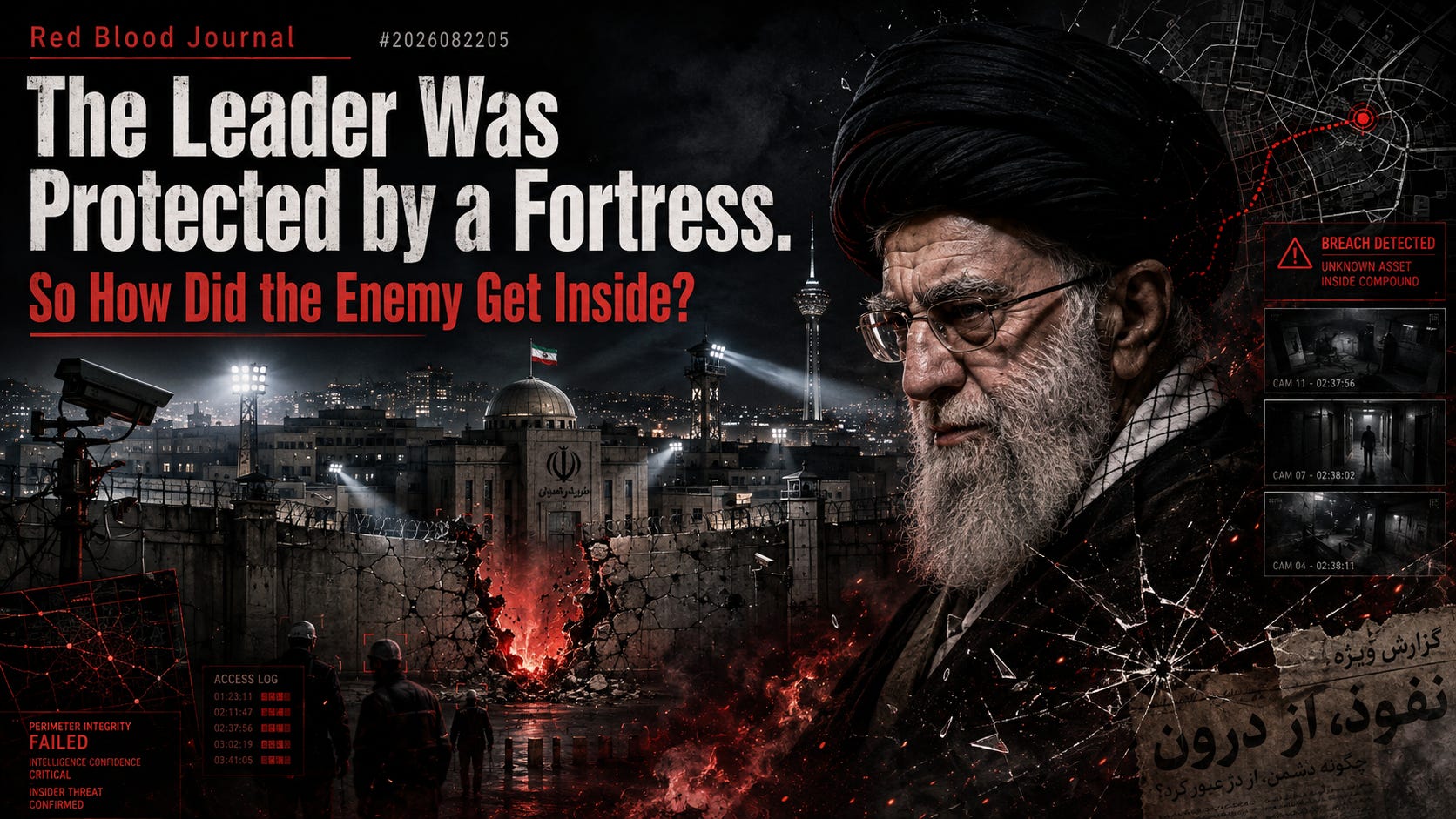
🩸 🕵️♂️ 🔥 🇮🇷 #2026082205 — The Leader Was Protected by a Fortress. So How Did the Enemy Get Inside?
Khamenei’s Death, Alleged Mossad Penetration, and the Humiliation of Iran’s Security Establishment
🩸 RedBloodJournal.com 🩸
For decades, the Islamic Republic built its legitimacy around a simple image:
The system was penetrative abroad and impenetrable at home.
Its intelligence services could supposedly reach enemies across borders.
Its security apparatus could identify dissidents inside apartment buildings.
Its surveillance network could find a protester from a video clip.
Its Revolutionary Guard could boast about missiles, drones, proxies and underground facilities.
And at the center of that machine sat the most protected man in Iran.
Ali Khamenei.
Yet the account examined here presents an extraordinary reversal:
The man surrounded by layers of intelligence, military protection, secrecy and counterintelligence was allegedly killed inside the very security architecture designed to make such an operation impossible.
That is why the larger story is not merely the death of a leader.
It is the collapse of the mythology surrounding the security state.
🔻 THE MOST IMPORTANT QUESTION IS NOT HOW KHAMENEI DIED
The more consequential question is:
How could anyone get close enough to do it?
A state can survive the death of a leader.
It has a much harder time surviving the realization that its most sensitive systems may have been penetrated.
The uploaded account describes a cleric publicly speaking about the destruction surrounding Khamenei’s residence and claiming that even months later the smell of burned flesh remained around the site. The narrator interprets those remarks not simply as mourning, but as an unintended admission of the scale of the security failure.
The symbolism is devastating.
For years, Iran’s security establishment projected an image of omniscience.
Yet according to this narrative, its enemies did not merely strike Iran.
They allegedly reached the center of the center.
🔻 WHEN SECURITY BECOMES THE STORY
There are two different types of military defeat.
One is losing a battlefield.
The other is discovering that the enemy knew where you were before you knew where the enemy was.
That second form of defeat is far more dangerous for an intelligence state.
Because it raises questions that missiles cannot answer:
Who knew Khamenei’s movements?
Who knew which locations were secure?
Who knew which communications could be trusted?
Were insiders compromised?
Were surveillance systems penetrated?
Were communications monitored?
Were operational schedules exposed?
How deep would an intelligence penetration have to go to reach the leadership itself?
The source does not provide evidence answering those questions.
But that absence is precisely why they matter.
The report repeatedly frames the episode as evidence of possible Israeli intelligence penetration, while some of its more dramatic Mossad conclusions are explicitly speculation rather than established fact.
The distinction matters.
A spectacular security failure is one question.
A Mossad infiltration operation is another.
The first can be examined from what happened.
The second requires evidence.
🔻 THE HUMILIATION IS BIGGER THAN THE ASSASSINATION
Imagine spending decades telling the population:
We know where everyone is.
Then discovering that someone else apparently knew where you were.
That changes the psychological balance.
An authoritarian security system depends heavily upon perception.
People obey not only because the government possesses force.
They obey because they believe the government sees everything.
The regime’s intelligence services become almost mythological:
They know.
They are watching.
They will find you.
Once that image fractures, fear can begin moving in the opposite direction.
The citizen begins asking:
If they could not protect the most protected person in the country, how powerful are they really?
That question may be more politically dangerous than the physical attack itself.
🔻 THE SECOND EXPLOSION: THE POEM
Then comes one of the strangest portions of the entire story.
According to the transcript, pro-government outlets circulated a poem attributed to Khamenei and portrayed it as though he had somehow anticipated his own death.
The poem reportedly referenced death, martyrdom and the month of Esfand.
That could have become powerful posthumous propaganda:
The leader knew his destiny.
The leader foresaw his martyrdom.
The leader walked knowingly toward death.
But then something went very wrong.
The transcript alleges that the opening letters of the poem’s lines formed a hidden insult:
«من علی خامنهای زاده شیطانم»
The source further claims that some government-aligned outlets subsequently removed the poem after the acrostic became widely noticed.
If accurate, the irony would be remarkable.
A propaganda artifact intended to elevate Khamenei into something nearly mystical would instead become an instrument of ridicule.
🔻 WAS IT SABOTAGE?
This is where evidence and speculation must be separated carefully.
The transcript proposes several possibilities.
Perhaps the poem was simply misattributed.
Perhaps it was composed after Khamenei’s death.
Perhaps someone commissioned it without noticing the hidden message.
Perhaps the poet intentionally embedded the insult.
And then comes the most dramatic possibility proposed by the narrator:
Was the author or someone inside the chain of transmission an intelligence infiltrator?
The source itself offers no documentary proof establishing Mossad authorship or involvement. It presents that possibility as speculation.
But even without Mossad, there is still a fascinating intelligence question:
How did material allegedly containing a humiliating hidden message pass through a propaganda system that was supposed to protect the image of the supreme leader?
Someone failed.
Possibly many people failed.
Editors.
Clerics.
Media organizations.
Political operatives.
Security reviewers.
Or perhaps someone did not fail at all.
Perhaps someone succeeded.
That is the unanswered question.
🔻 THE MOSAAD QUESTION IS REALLY AN INSIDER QUESTION
When people hear “Mossad penetration,” they often imagine secret agents climbing walls or sneaking through tunnels.
Modern intelligence penetration can be much less cinematic.
It may involve:
Human sources.
Compromised communications.
Technical surveillance.
Cyber access.
Supply chains.
Corrupted insiders.
Routine behavior.
Predictable movements.
Or individuals who do not even realize the information they provide is useful.
The deepest intelligence operation is not necessarily the one where an enemy inserts thousands of agents.
It is the one where a government can no longer determine which information is still secure.
That creates paralysis.
Every officer becomes suspicious.
Every communication becomes questionable.
Every unexplained malfunction becomes sabotage.
Every mistake begins looking like infiltration.
And once that psychological stage is reached, the intelligence penetration has achieved something even greater than collecting secrets:
It has made the institution distrust itself.
🔻 THEN CAME THE CARS
The transcript moves from the Khamenei story into another extraordinary development: reports of unusually large numbers of vehicles overheating or breaking down in Iran.
Users reportedly described vehicles stopped along roadsides, elevated engine temperatures, knocking, misfiring and repair shops receiving multiple customers with similar complaints.
One explanation discussed in the source is straightforward:
Bad gasoline.
The transcript cites speculation about methanol and other adulterants, along with mechanics claiming unusual combustion characteristics could damage pistons and engines. Importantly, the source itself acknowledges that fuel testing and technical examination of damaged vehicles would be necessary before assigning causation.
That caveat cannot be ignored.
But another theory appeared online.
And it immediately awakened memories of Lebanon.
🔻 THE SHADOW OF THE PAGER OPERATION
Some social-media users began asking whether the vehicle failures might represent a new kind of sabotage.
Could electronics be manipulated?
Could vehicle computers be disrupted?
Could an adversary create widespread failures without bombing infrastructure?
The transcript compares this speculation to the famous pager operation and quotes users suggesting that vehicle computers could potentially be targeted.
There is currently nothing in the uploaded material proving that such an operation occurred.
That must be stated clearly.
But the fact that Iranians are even entertaining the possibility tells us something important.
Trust in the security environment has been shattered.
Once an adversary demonstrates an ability to penetrate supposedly secure systems, ordinary failures stop looking ordinary.
A bad engine becomes suspicious.
A communications failure becomes suspicious.
A compromised official becomes suspicious.
A strange poem becomes suspicious.
Everything begins carrying the smell of intelligence operations.
🔻 THE REAL WEAPON MAY BE UNCERTAINTY
Imagine being responsible for protecting a government after such events.
Your problem is no longer simply discovering where the enemy is.
Your problem becomes discovering whether the enemy is already inside the process.
Did the mechanic make a mistake?
Was the gasoline contaminated?
Was an official bribed?
Was the computer compromised?
Was the poem malicious?
Was the cleric manipulated?
Was a security officer leaking information?
Was someone deliberately feeding false intelligence?
Or is everyone becoming paranoid?
That final possibility is itself strategically useful to an adversary.
Because a system that distrusts everything becomes slower.
More centralized.
More suspicious.
More frightened.
And often more prone to mistakes.
🔻 A SECURITY STATE CAN BECOME ITS OWN PRISON
The Islamic Republic spent decades building enormous security institutions to monitor the population.
But eventually there is a paradox.
The larger the secret apparatus becomes, the more secrets it creates.
The more secrets it creates, the more people gain access to those secrets.
The more people gain access, the larger the attack surface becomes.
A state can imprison dissidents.
It cannot imprison information.
A state can censor newspapers.
It cannot guarantee loyalty inside every server room, military compound, ministry, communications center and intelligence bureau.
The attempt to create absolute security can produce an enormous machine containing thousands of potential vulnerabilities.
🔻 THE IMAGE THAT MAY NEVER BE REPAIRED
Khamenei’s legacy in the transcript is described in overwhelmingly negative terms: war, sanctions, poverty, repression and a political crisis that did not disappear with his death.
But his security legacy may prove equally important.
For decades the system told Iran:
We are everywhere.
The events described in this source invite a devastating reply:
Apparently, so was your enemy.
And that may be the deepest humiliation of all.
Not merely that Khamenei could be killed.
Not merely that a supposedly prophetic poem could become an embarrassment.
Not merely that Iranians now suspect sabotage whenever something inexplicable happens.
But that a government built upon surveillance and secrecy may have discovered that secrecy works both ways.
🩸 THE RED BLOOD PERSPECTIVE
The strongest conclusion does not require claiming that every strange event was Mossad.
That would turn investigation into mythology.
The more important story is already visible:
A system that spent decades demonstrating its power over ordinary citizens apparently suffered an extraordinary failure at the level where its own power was supposed to be strongest.
That demands questions.
Who knew?
Who failed?
Who penetrated what?
Which stories are propaganda?
Which are genuine intelligence operations?
Which are ordinary failures now being interpreted through the trauma of previous penetration?
And perhaps most importantly:
Does Iran’s security establishment itself know the answers?
Because if it does not, then the crisis is much larger than the death of one leader.
It means the guards no longer know who is guarding the guards.
🌊 OCEAN OF LOVE AND POSITIVITY PERSPECTIVE
There is another lesson buried underneath the intelligence operations, wars and humiliation.
No nation becomes healthy through permanent fear.
Not fear of its own government.
Not fear of foreign intelligence agencies.
Not fear of neighboring countries.
Not fear of war.
Security should protect human life.
It should not become the reason human life is controlled.
Iran does not need another generation trapped between internal repression and external warfare.
It needs institutions strong enough to protect the country while remaining accountable to the people they serve.
Because the ultimate purpose of national security should never be protecting a ruler from the population.
It should be protecting the population itself.
And perhaps one day the people of Iran can replace the architecture of suspicion with something far more powerful:
Trust.
Accountability.
Dignity.
Peace.
In an Ocean of Love and Positivity.
🩸🌊✨ Fantastic!
🕵️♂️
The Infiltration of Iran: The Collapse of a Security State
Aug 22, 2026
The provided text examines the thematic and psychological collapse of Iran’s security apparatus following the alleged assassination of Ali Khamenei. It argues that the true damage to the regime is not just the loss of its leader, but the shattering of its image as an omniscient and impenetrable force. The narrative highlights several humiliations, including a propaganda poem containing a hidden insult and widespread mechanical failures in vehicles that citizens now attribute to foreign sabotage. These events have fostered a climate of pervasive paranoia, where the government can no longer distinguish between genuine intelligence penetrations and routine errors. Ultimately, the source suggests that a state built on total surveillance becomes vulnerable to its own architecture of secrecy when it loses the trust of its people and the loyalty of its insiders.
#RedBloodJournal #2026082205 #TheLeaderWasProtectedByAFortress #Iran #AliKhamenei #Khamenei #Mossad #Israel #IranIsrael #IranWar #Intelligence #Espionage #Counterintelligence #IntelligenceFailure #SecurityState #SecurityBreach #RegimeSecurity #IranianRegime #IRGC #RevolutionaryGuard #Tehran #PoliticalPower #StateSurveillance #Propaganda #KhameneiPoem #HiddenMessage #Infiltration #InsiderThreat #PsychologicalWarfare #InformationWar #MiddleEast #Geopolitics #IranCrisis #NationalSecurity #QuestionEverything #OceanOfLoveAndPositivity #RedBlood


