


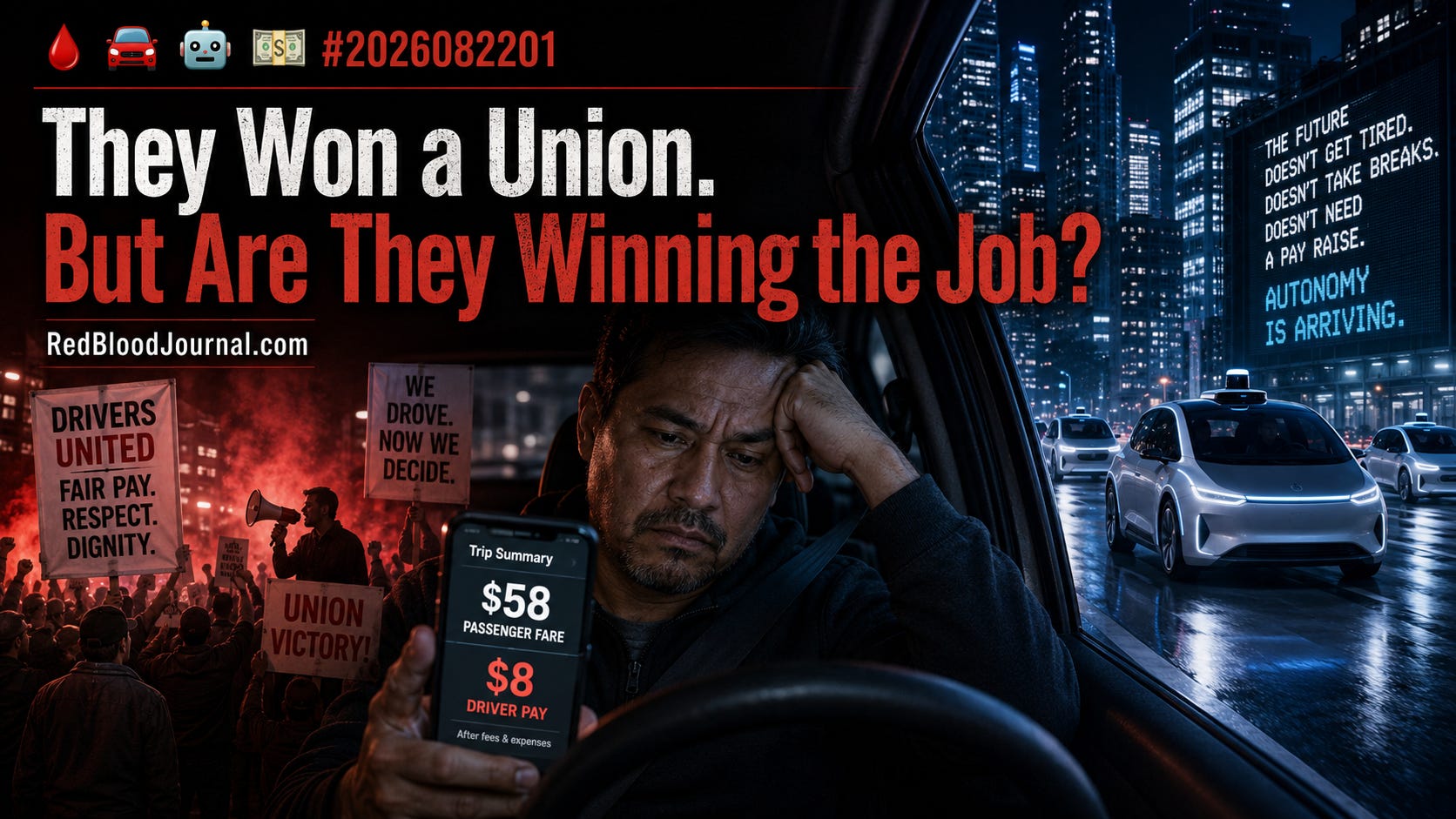
🩸 🚗 🤖 💵 #2026082201 — They Won a Union. But Are They Winning the Job?
California Rideshare Drivers Finally Have a Seat at the Table — Just as Silicon Valley Is Preparing to Remove the Driver’s Seat
RedBloodJournal.com
California rideshare drivers have just achieved something historic.
The California Gig Workers Union announced on August 7, 2026 that it had secured enough support to become the statewide bargaining representative for Uber and Lyft rideshare drivers.
The announcement described it as the creation of the largest union of rideshare drivers in the world.
After more than a decade of organizing, drivers finally appear to have what they have repeatedly demanded:
a collective voice.
But Red Blood Journal has a different question.
What if the victory arrived just as the battlefield was disappearing?
Because while drivers are organizing to negotiate better compensation for operating cars, Uber and the rest of the transportation industry are rapidly investing in cars that need no driver at all.
And underneath that technological transformation sits another issue that received far less attention:
The economic relationship between what the passenger pays and what the driver receives has already been fundamentally changed.
THE $58 RIDE
Consider a real-world example reported to Red Blood Journal:
Passenger charge: approximately $58
Driver compensation: approximately $8
That means the driver’s payment represented roughly:
13.8% of the passenger’s total charge.
It would be inaccurate to automatically conclude that Uber pocketed the other $50.
Taxes, airport charges, insurance-related costs and other fees can be included in what passengers pay.
But that misses the larger point.
The driver performed the transportation.
The passenger paid $58 for that transportation.
The driver received $8.
Whatever accounting exists between those two numbers, the economic relationship deserves scrutiny.
Because modern rideshare compensation has increasingly separated two prices that were once naturally connected:
The price charged to the passenger.
and
The amount offered to the driver.
Those are no longer necessarily percentages of the same transaction.
They can effectively become two independently optimized numbers.
THE GREAT SEPARATION
In the simpler rideshare model, drivers generally understood their compensation as a share of the fare.
The logic was easy.
If the customer paid more, the driver generally received more.
There was at least some alignment between the success of the platform and the success of the person performing the ride.
Then came increasingly complex formulas:
upfront pricing
engaged-time guarantees
engaged-mile guarantees
incentives
surges
bonuses
algorithmic offers
and individualized trip pricing.
The driver stopped asking:
What percentage of this fare am I receiving?
The system gradually trained drivers to ask:
Is this particular offer worth accepting?
That distinction may have been one of the most important economic transformations in the history of rideshare.
Because once passenger price and driver compensation are separated, a platform can theoretically optimize both sides independently.
The passenger side asks:
How much is this passenger willing to pay?
The driver side asks:
How little does the marketplace require us to offer before someone accepts?
Between those two numbers lies the spread.
And algorithms can search that spread continuously.
THE MINIMUM-PAY VICTORY
California’s Proposition 22 established compensation protections for rideshare drivers.
Uber describes its California earnings guarantee as based on 120% of the applicable minimum wage for engaged time, plus compensation for engaged miles.
But notice the critical word:
Engaged.
The clock does not necessarily represent every minute a driver spends logged into the platform waiting for work.
A driver may sit.
A driver may reposition.
A driver may return from an unproductive destination.
A driver may wait in an airport queue.
The human being is working around the marketplace even when the legal earnings formula does not necessarily recognize every minute as compensated labor.
That creates an unusual situation.
A platform can advertise an earnings guarantee while drivers can simultaneously experience declining real hourly income after unpaid waiting time and vehicle expenses are considered.
The minimum can therefore become psychologically powerful.
It establishes a floor.
But it can also quietly replace the previous question:
Why isn’t the driver receiving a meaningful percentage of what the customer paid?
THEN THE UNION ARRIVES
California passed AB 1340, giving rideshare drivers collective bargaining rights.
That is important.
Drivers may bargain over subjects including earnings, benefits, deactivation standards and working conditions.
A single driver negotiating against Uber has almost no leverage.
Hundreds of thousands of drivers bargaining collectively potentially have much more.
That deserves recognition.
But AB 1340 also contains language that deserves just as much attention.
The law provides that transportation network companies retain exclusive control over areas including:
product development
software
pricing
algorithms
operations
and implementation of their services.
That produces an extraordinary labor relationship.
The drivers may negotiate over the economic consequences of the machine.
But the company retains substantial control over the machine itself.
The union gets a chair.
Uber keeps the control panel.
AND NOW COME THE DRIVERLESS CARS
This is where the celebration becomes complicated.
The autonomous-vehicle revolution is no longer a science-fiction prediction.
Waymo already operates driverless passenger vehicles in multiple American markets.
California has approved autonomous operations across expanding geographic areas.
Uber has been building partnerships across the autonomous-vehicle industry and announced plans to invest billions of dollars into robotaxi operations and autonomous transportation.
The long-term direction is unmistakable.
Today’s driver is not merely negotiating against another driver willing to accept a cheaper ride.
Tomorrow’s driver may be competing against:
no driver at all.
A robotaxi does not demand:
health insurance.
paid leave.
minimum earnings.
bathroom breaks.
workers’ compensation.
retirement benefits.
collective bargaining.
or a share of the passenger fare.
Once the vehicle has been purchased, financed, maintained and operated, the labor economics fundamentally change.
That means the transportation company has an enormous structural incentive to eventually reduce its dependence on human labor.
THE UNION’S MOST DANGEROUS POSSIBLE VICTORY
Imagine a future agreement produces a meaningful increase in driver compensation.
Headlines appear:
DRIVERS WIN 15% PAY INCREASE
Everyone celebrates.
But imagine simultaneously that autonomous vehicles capture 40% of rides.
Then 60%.
Then 80%.
A driver could theoretically earn more per human-driven ride while taking home dramatically less money overall.
Both statements could simultaneously be true:
Drivers won higher pay.
and
Drivers lost their livelihood.
That is why the future of rideshare cannot be measured only by dollars per engaged hour.
It must also measure:
total trips available to human drivers
total online hours
unpaid waiting time
passenger price
driver compensation
vehicle expenses
platform deductions
autonomous trips
and the number of human drivers competing for what remains.
Without those numbers, an improving wage rate can hide a collapsing occupation.
THE QUESTION THE UNION SHOULD ASK NOW
The biggest negotiation may therefore not be:
How much should Uber pay a driver?
The bigger negotiation may be:
What happens to drivers when Uber no longer needs them?
That question belongs at the bargaining table today—not five years after autonomous vehicles have captured the market.
Possible protections deserve debate now:
Full fare transparency
Drivers should know what the passenger paid.
Driver-pay transparency
Drivers should understand exactly how each offer was calculated.
Platform-margin disclosure
Drivers and regulators should be able to distinguish company revenue from genuine third-party expenses.
Autonomous-trip disclosure
How many rides are being diverted from human drivers to autonomous fleets?
Transition assistance
If technology eliminates the occupation, should companies benefiting from that transition contribute to retraining or displacement assistance?
Algorithmic auditing
Can aggregate driver compensation be independently examined rather than simply accepted from company-controlled dashboards?
These are no longer theoretical labor-policy questions.
The technology is already on the road.
THE DRIVERLESS PARADOX
There is something almost poetic about the timing.
For more than a decade, rideshare drivers fought to prove they were workers deserving a voice.
Now they may finally receive that voice at exactly the moment Silicon Valley is working to prove it no longer requires them.
Drivers fought for recognition.
Technology may be preparing their replacement.
That does not make the union meaningless.
It makes the union’s first negotiations far more important than the celebration surrounding its creation.
Because if the union spends the next several years negotiating only minimum compensation while autonomous vehicles consume increasing portions of the market, drivers may discover that they successfully negotiated the price of labor after the market stopped buying very much labor.
THE RED BLOOD PERSPECTIVE
This investigation is not an argument against unions.
It is an argument against celebrating before reading the contract.
The California Gig Workers Union may become one of the strongest protections rideshare drivers have ever had.
Or it may become an institution negotiating over progressively smaller pieces of a disappearing occupation.
The outcome depends on what drivers demand.
A minimum wage cannot answer every question.
A benefits package cannot answer every question.
A bargaining seat cannot answer every question.
The central economic question remains remarkably simple:
The passenger paid what?
The driver received what?
Who received the difference?
And now one more question must be added:
How many of tomorrow’s passengers will still have a human driver at all?
Those four numbers may tell the future of rideshare more clearly than any press release.
🌊 THE OCEAN OF LOVE AND POSITIVITY PERSPECTIVE
Technology itself is not the enemy.
A self-driving vehicle can reduce crashes, increase mobility for elderly and disabled passengers, reduce transportation costs and transform cities.
Progress should not be feared simply because it changes work.
But progress becomes unjust when the people who built an industry are treated as disposable the moment they are no longer required.
Millions of drivers supplied their cars.
Their fuel.
Their insurance.
Their maintenance.
Their time.
Their patience.
And their human interaction.
They taught society to trust rides ordered from a phone.
They helped build the marketplace that autonomous vehicles may eventually inherit.
If automation produces enormous new wealth, wisdom asks whether the transition must create winners on one side and abandoned workers on the other.
Perhaps the real opportunity is larger.
A union should not merely fight to preserve yesterday’s job forever.
It can fight to make tomorrow’s transformation humane.
There is room in the Ocean of Love and Positivity for technology.
There is room for companies.
There is room for investors.
There is room for passengers.
And there must also remain room for the human beings whose labor made the revolution possible.
In an Ocean of Love and Positivity.
🩸🌊✨ Fantastic!
🤖
The Human Cost of the Autonomous Rideshare Revolution
Aug 22, 2026
California rideshare drivers recently achieved a historic milestone by forming the world’s largest driver union, yet this victory faces an uncertain future. While the California Gig Workers Union now possesses the legal right to bargain for better pay and conditions, the industry is simultaneously shifting toward autonomous vehicle technology that could eventually eliminate human roles. Current economic models have already separated passenger fares from driver compensation, allowing platforms to use algorithms to maximize corporate margins while offering drivers only a fraction of the total ride cost. Furthermore, legislation grants companies exclusive control over the software and pricing algorithms, meaning the union may struggle to influence the very machines that dictate their earnings. The text argues that unless the union addresses automation and transparency immediately, they risk negotiating for a livelihood that is rapidly disappearing. Ultimately, the source suggests that the true test of this labor movement is whether it can ensure a humane transition for workers as Silicon Valley moves toward a driverless future.
#RedBloodJournal #2026082201 #GigDrivers #UberDrivers #LyftDrivers #Rideshare #GigEconomy #Union #DriverPay #FairPay #AutonomousVehicles #SelfDrivingCars #Robotaxi #FutureOfWork #WorkersRights #TechAndLabor


