


🩸 RED BLOOD JOURNAL TRANSMISSION
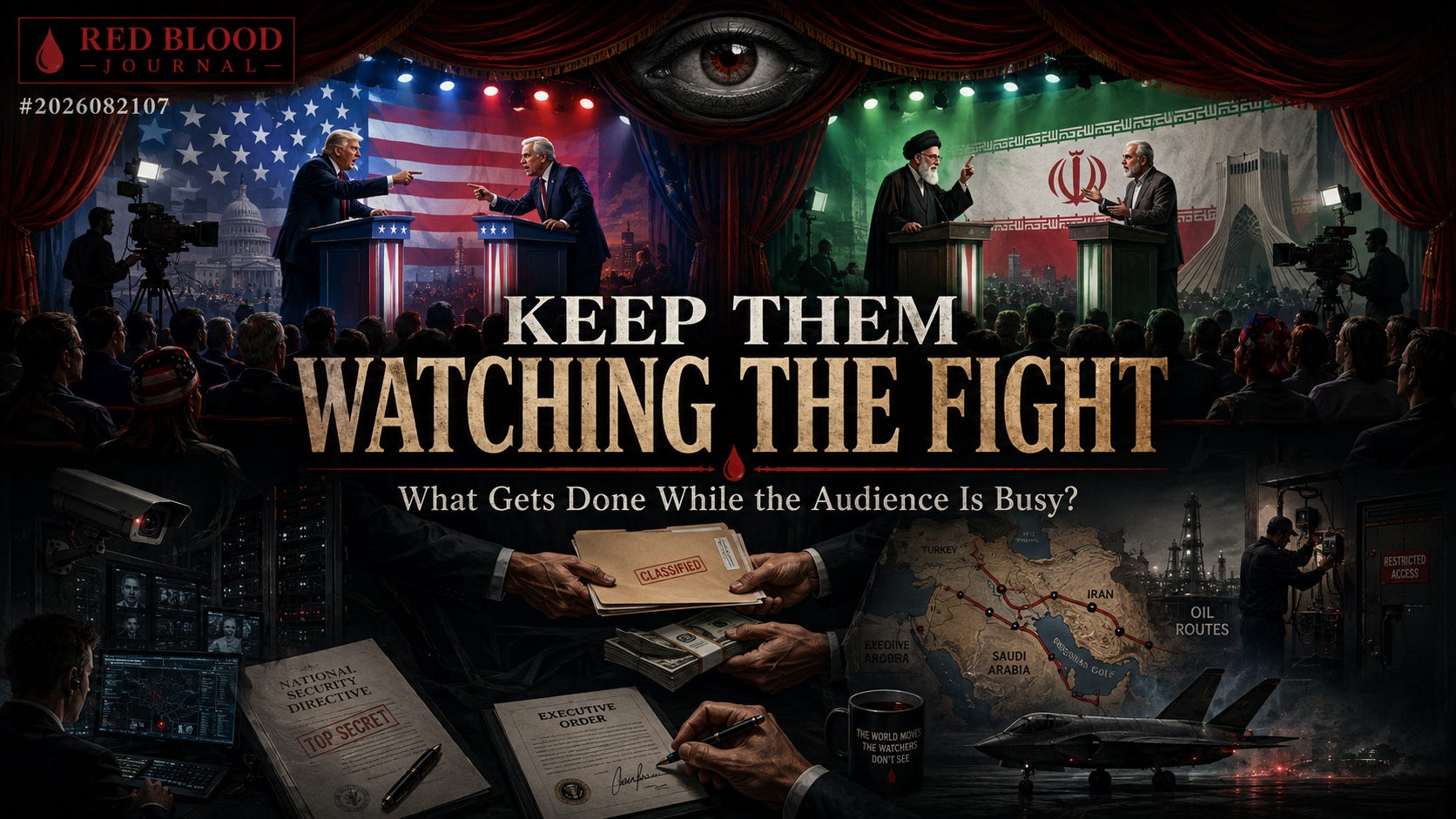
🩸 🎭 👁️ 🇺🇸 🇮🇷 #2026082107 — Keep Them Watching the Fight: What Gets Done While the Audience Is Busy?
Enemies for the Audience. The System Continues Behind the Curtain.
There is a mistake people make when studying politics.
They assume that because two sides are genuinely fighting, the fight must therefore be the most important thing happening.
It does not have to be.
Two politicians can genuinely hate each other.
Two political parties can genuinely want to defeat each other.
Two governments can genuinely threaten one another.
Iran and the United States can genuinely be adversaries.
And yet the spectacle created by that conflict can still perform another function:
It can keep millions of people staring at the fight while developments receiving far less attention continue underneath it.
That is the question examined here.
Not:
“Is every political conflict fake?”
That would be simplistic.
The better question is:
What gets accomplished while everybody is watching the conflict?
🔻 THE TWO DOORS
Look first at domestic politics.
America presents:
Left versus Right.
Iran presents its own version:
Reformist versus Hardliner.
The systems are obviously not identical. American elections, institutions, civil liberties, and political competition differ fundamentally from the structure of the Islamic Republic.
But the psychology of the audience can still look remarkably similar.
One camp says:
The other side will destroy the country.
The other replies:
No. They will destroy the country.
The public is then invited to spend enormous emotional energy choosing between the two.
Every election becomes existential.
Every speech becomes a crisis.
Every scandal becomes proof that civilization itself hangs in the balance.
And while citizens stare at the two doors, almost nobody asks:
Where do both doors lead?
🔻 IRAN PROVIDES A USEFUL EXAMPLE
The source material behind this report describes an increasingly visible argument inside Iran’s political establishment.
One faction favors accommodation, negotiation, or what opponents describe as surrender.
Another demands resistance.
Figures such as Mohammad Javad Zarif, Mohammad Khatami, Masoud Pezeshkian, Mohammad Bagher Ghalibaf, and various hardline voices appear in very different political positions.
To the audience, this can look like an enormous ideological battle.
And it may indeed be one.
But something more important sits underneath it.
For much of this argument, the question remains:
How should the Islamic Republic respond?
Rather than:
Why should the existing political structure retain control over Iran at all?
That distinction matters.
The argument can be furious while the underlying architecture survives.
🎭 THE ARGUMENT BECOMES THE PROGRAM
Imagine a theater.
Two actors walk onto the stage.
They scream.
They accuse each other.
They threaten one another.
The audience becomes emotionally invested.
Half the theater cheers for Actor A.
Half cheers for Actor B.
People begin arguing with strangers.
Friendships end.
Families divide.
Television networks spend every evening discussing which actor won today’s confrontation.
Meanwhile, behind the stage, workers quietly change the building.
A wall disappears.
A new security system is installed.
Money changes hands.
A door is permanently locked.
Another room is sold.
Nobody notices.
Because everyone is watching the actors.
That does not mean the actors are secretly friends.
It means:
The audience’s attention has become occupied.
🔻 AMERICA’S VERSION
The same question deserves to be asked in the United States.
Democrats and Republicans disagree on many real issues.
Their voters are different.
Their policies can have radically different consequences.
Their battles are not merely fictional theater.
But an investigative journalist should still ask another question:
What remains remarkably durable regardless of which party occupies the White House?
Which institutions continue expanding?
Which spending survives?
Which emergency authorities remain after the emergency?
Which surveillance powers become normalized?
Which financial interests remain protected?
Which foreign-policy structures survive one administration after another?
Which government programs disappear from public debate entirely?
And perhaps most importantly:
What was passed, funded, authorized, purchased, classified, expanded, or made permanent while everyone was arguing about something else?
That is where journalism should become uncomfortable.
🇺🇸 ⚔️ 🇮🇷 ENEMIES — BUT USEFUL ENEMIES?
Then comes the larger Iran–America relationship.
Washington and Tehran have treated one another as adversaries for decades.
Their hostility has produced sanctions, military confrontation, proxy wars, threats, intelligence operations, diplomatic crises, and enormous suffering.
Calling that relationship secretly cooperative without evidence would be irresponsible.
But there is another possibility that requires no secret meeting whatsoever.
Enemies can become politically useful to one another.
Tehran can point toward America and say:
We are under attack.
That can help justify sacrifice.
Security measures.
Military spending.
Secrecy.
Suppression.
Economic hardship.
And demands for national unity.
Washington can point toward Tehran and say:
This regime threatens regional stability and American interests.
That can help justify deployments.
Sanctions.
Intelligence activity.
Security partnerships.
Weapons programs.
And enormous geopolitical commitments.
Neither side needs to secretly coordinate this arrangement.
The incentives can develop naturally.
Each side’s behavior gives the other side material for its own political narrative.
And eventually an extraordinary relationship can emerge:
The enemy becomes part of the machinery.
🔻 ENEMIES FOR THE AUDIENCE
This leads to the most provocative version of the hypothesis:
Enemies for the audience. Partners in maintaining the cycle.
Not necessarily partners because they secretly cooperate.
Not necessarily partners because their leaders meet in some dark room.
Something more structural.
Each side’s hostility can strengthen forces inside the other.
A threat from Washington strengthens Iranian hardliners.
An Iranian escalation strengthens American hawks.
One side points to the other and says:
See? We warned you.
Then the other side responds:
See? We warned you too.
The cycle validates itself.
Threat produces retaliation.
Retaliation produces justification.
Justification produces greater power.
Greater power produces another threat.
And the audience watches the wheel turn.
👁️ NOW LOOK AWAY FROM THE HEADLINES
The uploaded material provides exactly the kind of contrast worth examining.
While political factions debate resistance and negotiation, the same source describes allegations of enormous corruption, including a claim that roughly $30 billion in public money was allocated to companies importing Chinese automobiles.
Elsewhere, the source describes medicine shortages and black-market pharmaceuticals supposedly appearing even when patients cannot obtain them through normal pharmacies.
It discusses food supplies, gasoline shortages, pharmaceutical supply chains and dependence on maritime transportation.
It describes decades of Iranian resources being spent throughout the region while ordinary Iranians absorb economic hardship at home.
Those may ultimately be more important to the future of an Iranian family than another televised argument between two political factions.
And that is precisely the point.
🔦 THE RED BLOOD TEST
From now on, perhaps every major political story deserves a second column.
The first column asks:
WHAT ARE THEY TALKING ABOUT?
The second asks:
WHAT HAPPENED WHILE THEY WERE TALKING ABOUT IT?
When television spends three days on a political insult:
What legislation moved?
When social media explodes over an election controversy:
Where did the money move?
When Iran and America exchange threats:
Who gained authority?
When left and right declare each other existential enemies:
What did both sides quietly permit to continue?
When everyone talks about war:
Who signed the contracts?
When everyone talks about security:
Which freedoms became negotiable?
When everyone talks about personalities:
Which institutions became stronger?
That is where the investigation begins.
🧠 REAL CONFLICT CAN STILL BE A DISTRACTION
This distinction is essential.
Something does not need to be staged to distract people.
A hurricane is real.
But a thief can still rob an abandoned store during the hurricane.
The hurricane did not cooperate with the thief.
The thief merely benefited from everyone’s attention being somewhere else.
Politics can operate the same way.
The scandal may be real.
The election may be real.
The war may be real.
The outrage may be justified.
But while the entire population is looking in one direction, somebody may discover that this is the perfect moment to move in another.
That possibility should be investigated every time.
🩸 THE QUESTION JOURNALISM ALMOST NEVER ASKS
Mainstream political reporting overwhelmingly asks:
Who won?
Who lost?
Who lied?
Who surged in the polls?
Who made the better speech?
Which side embarrassed the other?
But perhaps the more important question is:
What changed permanently while everyone was watching temporary drama?
That question crosses ideological boundaries.
It applies to Republicans.
It applies to Democrats.
It applies to Iranian reformists.
It applies to Iranian hardliners.
It applies to Washington.
It applies to Tehran.
It applies to corporations.
It applies to intelligence institutions.
It applies to every structure of power.
The objective is not to automatically assume conspiracy.
The objective is to stop allowing spectacle to determine where we look.
🌊 THE OCEAN OF LOVE AND POSITIVITY PERSPECTIVE
The answer cannot be another tribal army.
Replacing:
Left versus Right
with:
People who believe this report versus people who do not
simply creates another theater.
The purpose must be awareness.
Human beings deserve governments that do not need permanent enemies to maintain legitimacy.
They deserve journalism that watches the quiet rooms as carefully as the loud stages.
They deserve political systems in which disagreement does not require hatred.
And citizens deserve something remarkably simple:
The ability to know what is being done in their name.
The Ocean of Love and Positivity does not ask humanity to stop disagreeing.
It asks us to stop being manipulated by disagreement.
Watch the fight.
But also look behind it.
Listen to what politicians say.
But study what governments do.
Follow the headline.
But then ask the question that may matter infinitely more:
What happened while we were looking at the headline?
Because perhaps the greatest trick of political power is not hiding everything.
Perhaps it is placing something so loud in front of us that we forget to look anywhere else.
In an Ocean of Love and Positivity.
🩸🌊✨ Fantastic!
🎭
The Spectacle of Conflict and the Architecture of Power
Aug 21, 2026
This text argues that intense political conflict is often a strategic spectacle used to distract the public from significant, underlying changes in power and policy. By examining the adversarial relationships between the United States and Iran, as well as internal party struggles, the source suggests that hostility serves a mutual purpose for elites on both sides. While the audience remains emotionally invested in the “theater” of debate, systemic expansions of surveillance, spending, and institutional authority continue largely unchecked. The author posits that genuine disagreements function as a smoke screen for corruption and the normalization of emergency powers. Ultimately, the narrative encourages readers to look beyond sensational headlines to discover what actions are being taken while their attention is captured by drama. Thus, the text serves as a call for a new form of journalism that prioritizes institutional accountability over performative politics.
#RedBloodJournal #KeepThemWatchingTheFight #EnemiesForTheAudience #PoliticalTheater #LeftVsRight #Iran #UnitedStates #IranUSRelations #ReformistsVsHardliners #DemocratsVsRepublicans #MediaDistraction #ManufacturedDivision #PowerAndControl #FollowTheMoney #GovernmentTransparency #HiddenInPlainSight #NarrativeControl #PermanentWar #NationalSecurity #SurveillanceState #PoliticalPsychology #InstitutionalPower #InvestigativeJournalism #QuestionEverything #WhatHappenedWhileWeWereWatching #OceanOfLoveAndPositivity #RedBlood #2026082107


