


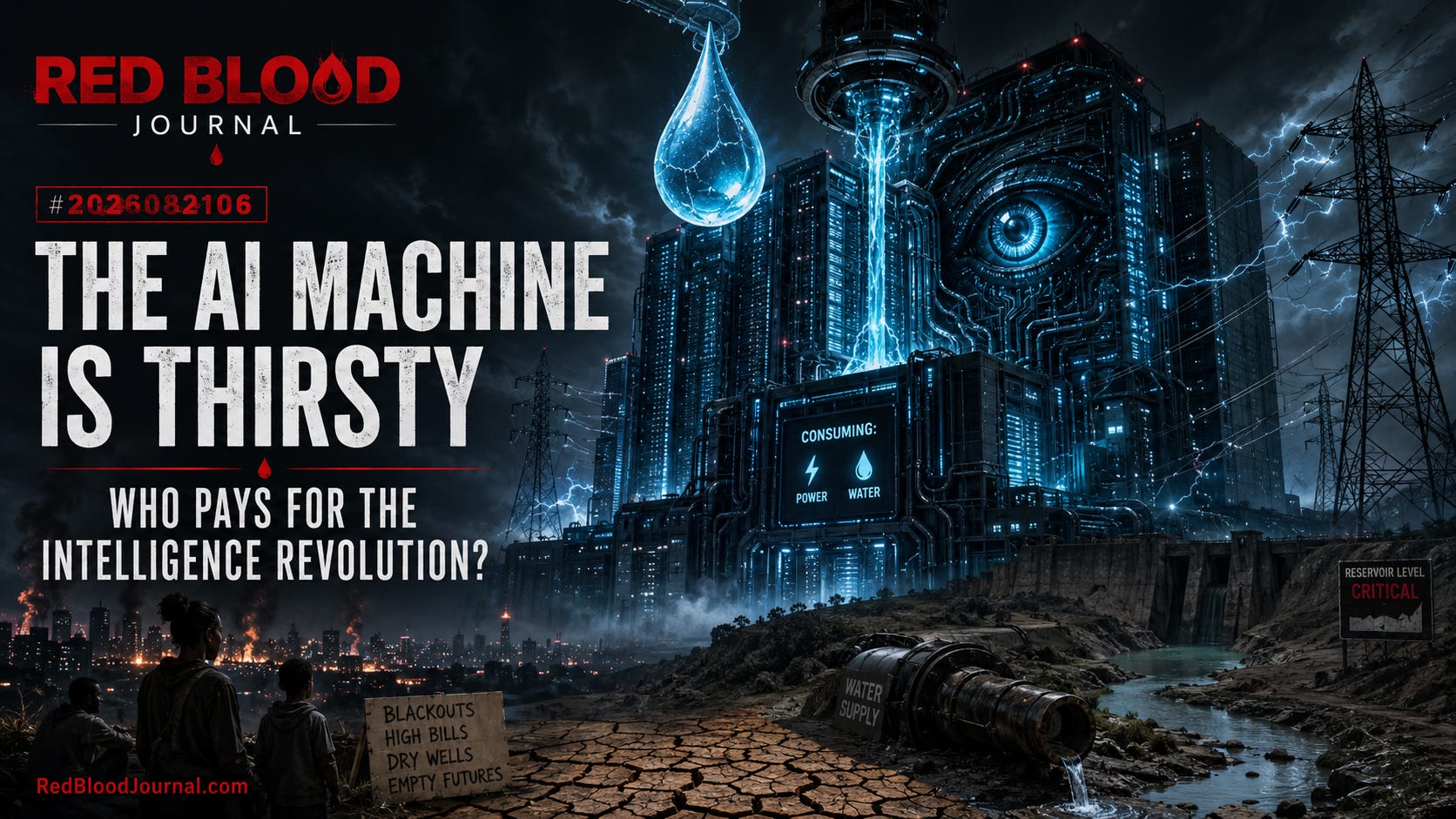
🩸 ⚡ 💧 🤖 #2026082106 — The AI Machine Is Thirsty: Who Pays for the Intelligence Revolution?
Red Blood Journal — August 21, 2026
Artificial intelligence is usually presented as something weightless.
A prompt enters a screen.
An answer appears.
A photograph is generated.
A meeting is summarized.
A robot receives instructions.
And somewhere inside that magic word — “cloud” — the work supposedly happens.
But there is no cloud.
There are buildings.
There are transformers.
There are power plants.
There are diesel generators.
There are cooling systems.
There are transmission lines.
There are enormous quantities of water.
And behind the friendly little box asking what it can help with today stands one of the largest physical infrastructure expansions America has attempted in generations.
That was the deeper warning running through Tucker Carlson’s August 21, 2026 conversation with Clayton Morris.
The question was no longer simply:
Will artificial intelligence someday control humanity?
The more immediate question became:
What are we willing to surrender just to power it?
🔻 THE MACHINE HAS A BODY
Artificial intelligence sounds digital.
Its appetite is physical.
Every large AI system ultimately depends upon processors running inside enormous data centers.
Those processors consume electricity.
They create heat.
That heat must be removed.
Cooling requires additional energy — and in many existing facilities, tremendous quantities of water.
Morris argued that America has barely begun the coming data-center construction wave and that thousands more facilities may eventually be required as AI becomes embedded throughout business, robotics, communications and government systems.
This changes the conversation completely.
The AI revolution isn’t occurring only inside Silicon Valley laboratories.
It is arriving in:
aquifers, power grids, farms, neighborhoods and utility bills.
💧 THE WATER QUESTION
Perhaps the most alarming portion of the conversation involved water.
Morris said many current data centers use evaporative cooling systems and described individual facilities consuming hundreds of millions of gallons of water. Newer closed-loop cooling technology may reduce water consumption considerably, but Morris argued that most existing infrastructure has not yet made that transition.
And this is where the story becomes bigger than technology.
In parts of the American West, ranchers are already struggling to obtain enough water.
Aquifers are stressed.
Municipal permits are limited.
Agriculture competes against growing cities.
Then another competitor enters the room:
The AI industry.
Morris described ranchers asking why additional water rights appear unavailable to them while major data-center projects seemingly receive access or special arrangements.
That accusation deserves verification community by community.
But the question itself is legitimate:
When water becomes scarce, who stands first in line?
The family?
The farmer?
The rancher?
Or the corporation operating billions of dollars of computers?
⚡ THEN COMES ELECTRICITY
Water is only half the story.
The machines also need enormous amounts of electricity.
And unlike a factory that may reduce production when demand falls, AI computing infrastructure is being designed for near-continuous operation.
The interview describes electricity systems already preparing for future data-center demand.
Morris argues this projected demand can influence electricity markets and utility investment before facilities even become fully operational.
The public may therefore experience increased electricity costs while infrastructure is expanded partly to accommodate companies whose products most citizens never directly requested.
The interview points to Western Pennsylvania as an example where Morris says residents are already seeing higher power prices and local officials fear eventual grid strain and blackouts.
Whether every prediction proves correct remains uncertain.
But the underlying engineering problem is unavoidable:
Electricity demand cannot grow indefinitely without additional generation and transmission.
If AI consumes enormous new amounts of power, somebody must build that capacity.
And somebody must pay.
🏭 PRIVATE POWER — PUBLIC CONSEQUENCES
Technology companies increasingly propose a solution:
We’ll generate our own electricity.
Natural-gas plants.
Revived generating stations.
Small modular nuclear reactors.
Private power infrastructure.
At first glance, that sounds fair.
If a company creates its own electricity, why should the public care?
Because infrastructure rarely exists in isolation.
Transmission capacity changes.
Fuel markets change.
Land use changes.
Water use changes.
Regional electricity planning changes.
Demand forecasts change.
Morris’ argument is that even an ostensibly self-contained data center can create spillover costs for surrounding communities.
That possibility deserves serious examination.
Because the important question is not whether the data center owns its power plant.
The question is:
Does the surrounding population still pay indirectly for the system required to support it?
🚿 YOUR WATER METER KNOWS WHAT YOU DID TODAY
One of the strangest contrasts in the interview concerns household water monitoring.
Morris discusses Aurora, Colorado, where smart water meters can measure residential usage at frequent intervals and residents may receive notices concerning excessive consumption.
Meanwhile enormous industrial computing facilities may be consuming vastly larger quantities of water.
That creates an uncomfortable image.
A homeowner receives a warning because the lawn was watered too long.
Across town sits a building containing billions of dollars in processors requiring industrial-scale cooling.
The issue isn’t that homeowners should waste water.
They shouldn’t.
The issue is proportionality.
If conservation becomes necessary, then transparency should apply upward as aggressively as it applies downward.
The citizen should be able to ask:
How much water did I use?
And also:
How much did the data center use?
👁️ THE INFRASTRUCTURE DOES MORE THAN THINK
Then the discussion becomes darker.
AI infrastructure is not only capable of generating answers.
It can store and analyze information.
Conversations.
Locations.
Faces.
Transactions.
Vehicle movements.
Internet activity.
Business communications.
Voice recordings.
Video.
Everything converted into data can potentially become searchable.
Morris and Carlson discuss software applications increasingly incorporating AI transcription and automated note-taking.
What appears to be convenience also creates another reality:
More human behavior becomes permanently machine-readable.
That doesn’t automatically mean a centralized surveillance system exists.
But the architecture capable of enabling one grows more powerful every year.
The distinction matters.
A hammer does not prove someone intends to break a window.
But when governments, corporations, cameras, communications systems and enormous AI computing capacity become increasingly interconnected, citizens are reasonable to ask who ultimately controls the hammer.
🏛️ AND WHAT HAPPENS WHEN A TOWN SAYS NO?
This may be the most important section of the entire discussion.
According to Morris, federal AI policy includes a Justice Department litigation effort capable of challenging state or local barriers to AI infrastructure development.
He describes communities objecting to data centers because of pollution, zoning, diesel generators, water consumption and other local concerns.
Carlson’s reaction is essentially constitutional:
Whose town is it?
If residents don’t want a facility, should Washington override them?
If federal policy considers artificial intelligence strategically necessary, does national interest outweigh local consent?
That isn’t an easy question.
National infrastructure projects have always created conflicts between federal power and local interests.
Railroads did.
Highways did.
Pipelines did.
Power lines did.
Military installations did.
But AI introduces something new.
The infrastructure may simultaneously serve:
private profit, national security, commercial automation and surveillance capability.
That combination deserves extraordinary transparency.
🚧 PEOPLE ARE ALREADY RESISTING
Morris says hundreds of communities have already pushed back against proposed data-center projects, citing noise, pollution, resource consumption and quality-of-life concerns.
That does not prove those communities are correct.
Neither does opposition automatically mean development should stop.
But it reveals something important:
The AI revolution is beginning to leave the computer screen.
Once it reaches neighborhoods, politics changes.
People rarely protest algorithms.
They protest:
higher bills.
dry wells.
diesel fumes.
transmission lines.
construction noise.
tax abatements.
and losing control over their community.
That is when artificial intelligence becomes real.
💰 FOLLOW THE TAX REVENUE
The conversation does acknowledge an important counterargument.
Data centers can bring enormous tax revenue into small communities.
Morris discusses Quincy, Washington, where data-center development reportedly helped finance schools, infrastructure and public improvements.
That is significant.
A town receiving tens or hundreds of millions of dollars can rebuild itself.
New schools.
Roads.
Sewer systems.
Public facilities.
Reduced taxes elsewhere.
So the argument should never become:
Data centers provide no benefit.
That would be false.
The better question is:
What is the complete balance sheet?
Tax revenue coming in.
Water going out.
Electricity consumed.
Land occupied.
Infrastructure expanded.
Environmental consequences.
Employment created.
Subsidies granted.
And long-term obligations inherited by the community.
👷 THE JOBS QUESTION
This creates another paradox.
Traditional industrial development consumes resources but typically employs substantial numbers of workers.
Data centers can consume enormous resources while requiring relatively few permanent employees after construction.
Morris claims some large facilities may ultimately employ around fifty workers or fewer.
Imagine the equation:
A gigantic building.
Massive power demand.
Enormous capital investment.
Significant water requirements.
Billions of dollars of hardware.
And perhaps only dozens of permanent workers.
That doesn’t automatically make the development bad.
But it changes how governments should calculate economic benefits.
📈 IS EVERYONE RUNNING TOWARD THE SAME CLIFF?
Then Carlson asks perhaps the simplest question of all:
How does this ultimately make money?
Companies are spending extraordinary amounts on AI infrastructure.
Investors are valuing companies around expected AI growth.
Utilities are forecasting unprecedented power demand.
Governments are reorganizing policy around artificial intelligence.
But eventually economic value must emerge somewhere.
Morris argues that demand for computing power remains enormous and believes the buildout is only beginning.
Yet he also acknowledges that relatively few corporate earnings reports currently demonstrate large percentages of revenue directly resulting from AI deployments.
That does not prove AI is a bubble.
But history provides a useful warning.
Railroads were revolutionary.
And railroad companies still went bankrupt.
The internet changed civilization.
And the dot-com bubble still collapsed.
A technology can transform humanity while investors simultaneously overpay for it.
Both things can be true.
🧠 THE REAL QUESTION ISN’T WHETHER AI IS GOOD OR BAD
Artificial intelligence can produce extraordinary benefits.
Medical research.
Engineering.
Education.
Accessibility.
Scientific discovery.
Productivity.
Transportation.
Emergency response.
Communication.
There is no wisdom in blindly rejecting technology.
But there is equally little wisdom in worshiping it.
The mature question is:
What are the tradeoffs?
Carlson’s interview repeatedly returns to a concern about citizens feeling powerless while the AI infrastructure system rapidly expands around them.
That concern reaches beyond AI.
It touches the structure of modern power itself.
Government says something is necessary.
Corporations say it represents progress.
Investors say enormous profits are coming.
Experts say resistance will leave America behind China.
And the citizen asks:
What exactly am I receiving?
🩸 THE RED BLOOD PERSPECTIVE
The danger isn’t artificial intelligence.
The danger is unaccountable intelligence combined with concentrated power.
AI should not belong exclusively to technology companies.
Water should not quietly be reprioritized without public accounting.
Electricity expansion should not become an invisible subsidy.
Citizens should not discover infrastructure decisions after agreements have already been signed.
And government should never become the enforcement arm of private industrial expansion without citizens understanding exactly why.
The answer is not to destroy AI.
The answer is to expose the ledger.
For every major data center:
How much electricity?
How much water?
How much public subsidy?
How many permanent jobs?
Who receives the tax revenue?
Who receives the electricity?
Who receives the water?
Who owns the data?
What government agencies can access it?
And what happens when the community votes no?
Those answers should be public before construction begins.
Not twenty years later.
🌊 THE OCEAN OF LOVE AND POSITIVITY PERSPECTIVE
Technology is supposed to serve humanity.
Humanity was never created to serve technology.
There is something almost beautiful buried inside the warning.
Morris suggests that as artificial intelligence produces more synthetic voices, synthetic photographs, synthetic writing and synthetic relationships, people may begin craving something machines cannot manufacture:
each other.
He describes younger people gathering around tables with cards and board games, sometimes putting the phones aside entirely.
He predicts an increasing hunger for genuine human interaction as artificial content becomes unavoidable.
Perhaps that becomes AI’s unexpected gift.
Machines become extraordinarily intelligent.
And humanity rediscovers what intelligence cannot replace.
A conversation.
A laugh.
A hand on another person’s shoulder.
A meal.
A friendship.
A family sitting together without screens.
Artificial intelligence may eventually generate almost everything.
But it cannot manufacture the experience of genuinely being alive together.
So build the machines.
Study them.
Improve them.
Use them.
But never forget who they were supposed to serve.
Human beings first.
Machines second.
Transparency before power.
Community before empire.
Love before control.
In an Ocean of Love and Positivity.
🩸🌊✨ Fantastic!
🏗️
The Physical Cost of the Artificial Intelligence Revolution
Aug 21, 2026
The provided text examines the physical and social consequences of the rapid expansion of artificial intelligence infrastructure. While AI is often perceived as a digital concept, it relies on massive data centers that consume vast amounts of electricity and water, leading to potential conflicts with local communities over resource scarcity. The source highlights a growing tension between corporate interests and the rights of citizens, particularly regarding utility costs, environmental impact, and government transparency. Ultimately, it serves as a warning that the intelligence revolution requires a physical foundation that could fundamentally reshape local economies and personal privacy. Beyond the technical concerns, the text suggests that an increasingly automated world may drive a renewed societal appreciation for genuine human connection.
#RedBloodJournal #TheAIMachineIsThirsty #ArtificialIntelligence #AI #DataCenters #AIInfrastructure #Electricity #PowerGrid #Blackouts #WaterShortage #WaterCrisis #EnergyCrisis #ResourceScarcity #SmartMeters #Surveillance #DigitalPrivacy #CorporatePower #GovernmentPower #LocalSovereignty #CommunityRights #TechIndustry #BigTech #AIRevolution #Infrastructure #EnergyDemand #WaterDemand #TechnologyAndSociety #HumanityFirst #OceanOfLoveAndPositivity #RedBlood #2026082106


