


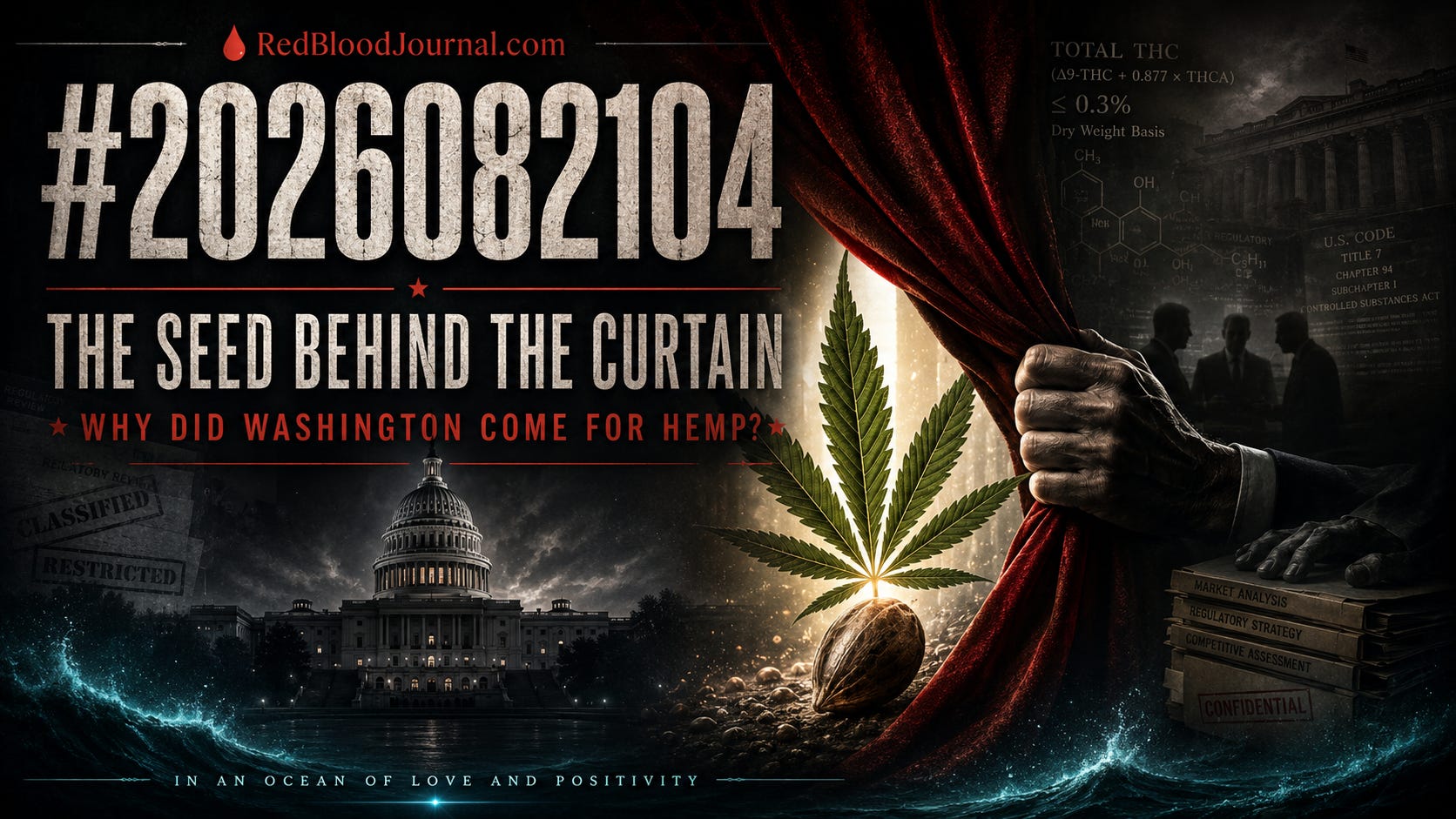
🩸 🌱 👁️ 🌊 #2026082104 — The Seed Behind the Curtain: Why Did Washington Come for Hemp?
RedBloodJournal.com
When Washington rewrites the law around one plant, the question is not merely what was prohibited. The deeper question is: who wanted the prohibition—and why?
Red Blood Journal
August 21, 2026
THE SEED
Sometimes the largest political questions arrive disguised as very small things.
Not a missile.
Not a war.
Not a billion-dollar weapons system.
A seed.
Hemp.
For years, millions of Americans were told that Washington was moving away from the old prohibition era.
The 2018 Farm Bill appeared to open a door.
Farmers planted.
Businesses formed.
CBD stores appeared.
Researchers experimented.
Consumers discovered an enormous new marketplace of hemp-derived products.
Then Washington changed the rules.
And buried inside the language of federal law was a number so small that almost nobody outside the industry would immediately understand its significance:
0.4 milligrams per container.
Not 0.4 percent.
Not 0.4 milligrams per serving.
Per container.
That number deserves attention.
Because sometimes the most consequential government decisions are hidden inside the smallest measurements.
THE FIRST REVEAL: THE STORY WAS EVEN STRANGER THAN WE THOUGHT
There is an important correction to the earlier Red Blood Journal transmission.
The new hemp restrictions were not part of the One Big Beautiful Bill Act.
They came through a different piece of legislation.
On November 12, 2025, federal law changed the definition of hemp.
The previous framework centered on delta-9 THC concentration.
The new framework moves toward total THC, explicitly including THCA, while excluding certain synthesized or manufactured cannabinoids and establishing an extremely low threshold for some final hemp-derived cannabinoid products.
The Congressional Research Service says the new definition takes effect November 12, 2026.
So the restriction is real.
The legal text is real.
The 0.4-milligram threshold is real.
What is not established is the much larger allegation:
That Donald Trump was installed or controlled by the CIA in order to capture American political dissidents.
There is no publicly established evidence proving that.
But Red Blood Journal is interested in another question.
What if we stop trying to prove the biggest conspiracy first—and examine the smaller, documented decisions that make people suspicious in the first place?
That is where this story becomes far more interesting.
THE PLANT THAT REFUSES TO STAY IN ONE INDUSTRY
Hemp is unusual because it does not belong neatly inside one economic box.
It touches agriculture.
Textiles.
Construction.
Food.
Cosmetics.
Cannabinoids.
Wellness products.
Paper.
Biomaterials.
And potentially other industrial applications.
That means hemp does something economically uncomfortable:
It crosses boundaries.
Most industries prefer boundaries.
Oil companies sell petroleum products.
Pharmaceutical companies sell medicines.
Timber companies sell wood.
Textile companies sell fibers.
Agricultural companies sell crops and seeds.
But hemp has historically been promoted as something capable of entering several of those markets simultaneously.
That does not automatically mean those industries secretly conspired against it.
That leap requires evidence.
But it does mean that whenever government restricts hemp, there is a perfectly legitimate question to ask:
Who benefits economically from the restriction?
That is not conspiracy theory.
That is economics.
WHY 0.4 MILLIGRAMS MATTERS
Congress did not simply say:
“Keep marijuana illegal and industrial hemp legal.”
The new structure goes much deeper.
Federal law now distinguishes industrial hemp from hemp-derived cannabinoid products and excludes certain products once specified THC-related thresholds are crossed.
For final hemp-derived cannabinoid products, the threshold is extraordinarily specific:
greater than 0.4 milligrams combined total per container.
Congressional researchers have acknowledged that the change could alter the legal status of many hemp products currently being sold.
Industry groups have pushed back and argued for regulation rather than prohibition.
That creates the actual political battlefield.
On one side:
Protect consumers from intoxicating products being sold through a federal loophole.
On the other:
Regulate an emerging industry without effectively destroying large portions of it.
Those are two legitimate positions.
But there is a third question that Red Blood Journal believes should always accompany both:
Who was at the table when the number was chosen?
Who proposed 0.4?
Who supplied the research?
Who lobbied for it?
Who opposed it?
Who profits if competitors disappear?
Who gains market share?
Who gains regulatory authority?
And most importantly:
Can the public trace the fingerprints?
THE TRUMP PARADOX
This is where the story becomes politically explosive.
Donald Trump built one of the most powerful political identities in modern American history around several promises:
Fight the establishment.
Drain the swamp.
Challenge intelligence agencies.
Attack entrenched bureaucracy.
Protect ordinary Americans from elites.
Reduce unnecessary regulation.
That created something larger than a traditional presidency.
It created trust.
Millions of people who distrusted Washington decided they trusted him.
That distinction matters enormously.
Because whenever political trust becomes concentrated in one individual, supporters can gradually stop auditing the government itself.
The reasoning becomes:
He knows what he’s doing.
He must have a reason.
His advisers will fix it.
Wait until the next election.
Trust the plan.
And this is where Red Blood Journal separates itself from both Trump worship and Trump hatred.
Never outsource your skepticism to the politician who earned your skepticism.
If Trump fights the intelligence establishment, audit him.
If Trump fights pharmaceutical power, audit him.
If Trump promises deregulation, audit his regulations.
If Trump says America First, examine who receives the economic advantage.
The Ocean of Love does not require loyalty to Trump.
It does not require hatred of Trump either.
It requires loyalty to truth.
WAS TRUMP A CONTROLLED ASSET?
This is the sensational question.
And the answer today is:
There is no publicly established evidence proving it.
That matters.
Red Blood Journal should never transform suspicion into evidence merely because the suspicion creates a better headline.
Could intelligence agencies manipulate political movements?
History says intelligence agencies have conducted influence operations.
Could governments attempt to redirect political opposition?
Of course.
Could political movements become personality cults that neutralize their own independence?
Absolutely.
But those facts do not prove that Trump himself was manufactured by the CIA.
There is another possibility that is far more ordinary—and perhaps equally disturbing.
A politician does not need to be controlled by a secret agency to become captured by the machinery around him.
Washington already contains:
Lobbyists.
Campaign donors.
Congressional interests.
Regulators.
Career bureaucracies.
Industry groups.
Political consultants.
Defense interests.
Financial interests.
Pharmaceutical interests.
Agricultural interests.
Law-enforcement interests.
Party interests.
Sometimes there does not need to be one puppet master.
Sometimes the machine itself is the puppet master.
THE MORE DANGEROUS POSSIBILITY
Imagine a political system containing thousands of incentives.
Each participant pursues his own interest.
A corporation wants regulation that hurts competitors.
A senator wants campaign support.
A bureaucracy wants jurisdiction.
A regulator wants authority.
A politician wants votes.
An industry wants protection.
A police organization wants funding.
A pharmaceutical company wants market share.
Nobody needs to meet in a dark room.
Nobody needs to whisper:
“Let us control America.”
They simply pull in the direction that benefits them.
And eventually the citizen feels the rope tighten.
This may be one of the most misunderstood forms of modern power.
Centralized outcomes can emerge without centralized conspiracy.
That possibility should frighten us almost as much as conspiracy.
Because you cannot expose a mastermind who does not exist.
You have to expose the architecture.
HEMP IS THE TEST
Forget Trump for one moment.
Forget Republicans.
Forget Democrats.
Forget CIA theories.
Take the plant itself.
Ask a simple question.
If a product creates legitimate safety concerns, should government regulate it?
Yes.
Should children be protected from intoxicating products?
Yes.
Should labeling be truthful?
Absolutely.
Should potency be disclosed?
Yes.
Should contaminated products be removed?
Certainly.
But then comes the Ocean of Love question:
Does protection require destruction?
There is an enormous moral difference between:
“We will make this market safe.”
and
“We will make this market impossible.”
That distinction applies far beyond hemp.
It applies to food.
Medicine.
Technology.
Speech.
Finance.
Transportation.
Energy.
And eventually liberty itself.
THE OCEAN OF LOVE AND POSITIVITY
The Ocean of Love does not begin with hemp.
It begins with the human being.
Government exists because people exist.
Corporations exist because people exist.
Markets exist because people exist.
Institutions exist because people exist.
Yet somewhere along the journey, civilization repeatedly reverses the equation.
The institution becomes sacred.
The corporation becomes sacred.
The party becomes sacred.
The ideology becomes sacred.
The politician becomes sacred.
And the human being becomes expendable.
The Ocean reverses it again.
Citizen first.
Not because citizens are always right.
But because systems were created to serve life—not the other way around.
If hemp products are dangerous, prove the danger.
If they require regulation, regulate transparently.
If a threshold is scientifically necessary, show the science.
If lobbying shaped the legislation, disclose the lobbying.
If an industry benefits, identify the benefit.
If government got it wrong, correct it.
No secret enemies are necessary.
No red pills are necessary.
No blind allegiance is necessary.
Only sunlight.
THE RED BLOOD PERSPECTIVE
The most important discovery in this investigation may not be that Trump was secretly controlled.
Perhaps that theory is wrong.
Perhaps it is partly right.
Perhaps history will uncover things we cannot presently see.
But Red Blood Journal does not need to wait for a declassified document to recognize a much simpler danger:
When citizens surrender independent judgment to any political savior, they surrender the very sovereignty they believe the savior is protecting.
That is the trap.
Left.
Right.
Religious.
Secular.
Trump.
Anti-Trump.
It makes no difference.
The moment a citizen says,
“My leader will think for me,”
the gate has already closed.
Hemp therefore becomes more than a plant.
It becomes a test.
A test of whether Americans will examine legislation instead of slogans.
A test of whether they will investigate lobbying instead of merely choosing teams.
A test of whether they will question politicians they love as aggressively as politicians they hate.
And a test of whether freedom is still understood as something citizens practice—
rather than something politicians grant.
🌊 THE FINAL QUESTION
Maybe the mystery is not:
“Was Trump the operation?”
Maybe the better question is:
“Why does America keep building systems in which one person can capture the hope of millions?”
A truly free population should never require a political messiah.
A truly free population should be difficult to herd.
Difficult to frighten.
Difficult to purchase.
Difficult to divide.
And almost impossible to deceive for long.
That is where the Ocean of Love meets political freedom.
Not in hatred.
Not in revenge.
Not in burning the system down.
But in millions of citizens becoming conscious enough that manipulation no longer works.
Then no CIA operation could control them.
No corporation could purchase them.
No politician could own them.
No party could hypnotize them.
And no government could quietly bury something consequential in hundreds of pages of legislation and assume nobody would look.
The seed worth planting is larger than hemp.
It is independent thought.
Plant that seed everywhere.
In an Ocean of Love and Positivity.
🩸🌊✨ Fantastic!
🌱
The Seed Behind the Curtain: Hemp and Political Sovereignty
1 source·Aug 21, 2026
The provided text from the Red Blood Journal examines the shifting legal landscape for hemp following federal legislative changes in late 2025. It highlights a specific, highly restrictive THC threshold of 0.4 milligrams per container, questioning whether such a narrow limit is designed to benefit entrenched corporate interests rather than ensure public safety. Beyond the agricultural implications, the source uses the regulation of this plant as a case study for regulatory capture and the erosion of independent oversight within the American political system. It challenges readers to maintain skepticism toward political leaders, regardless of their affiliation, to prevent the surrender of personal sovereignty. Ultimately, the narrative advocates for independent thought and transparency as the primary defenses against systemic manipulation by government and industry machines.
#RedBloodJournal #TheSeedBehindTheCurtain #Hemp #HempLaw #HempIndustry #Washington #Congress #Trump #PoliticalPower #GovernmentPower #RegulatoryCapture #Lobbying #FollowTheMoney #CitizenSovereignty #CivilLiberties #EconomicFreedom #AgriculturalFreedom #NaturalMedicine #Cannabinoids #CBD #THC #THCA #WarOnHemp #CorporatePower #BigPharma #PoliticalInfluence #GovernmentTransparency #QuestionTheNarrative #IndependentThought #CriticalThinking #Freedom #Populism #PoliticalAccountability #CitizenFirst #OceanOfLoveAndPositivity #OceanOfLove #RedBlood #2026082104


