


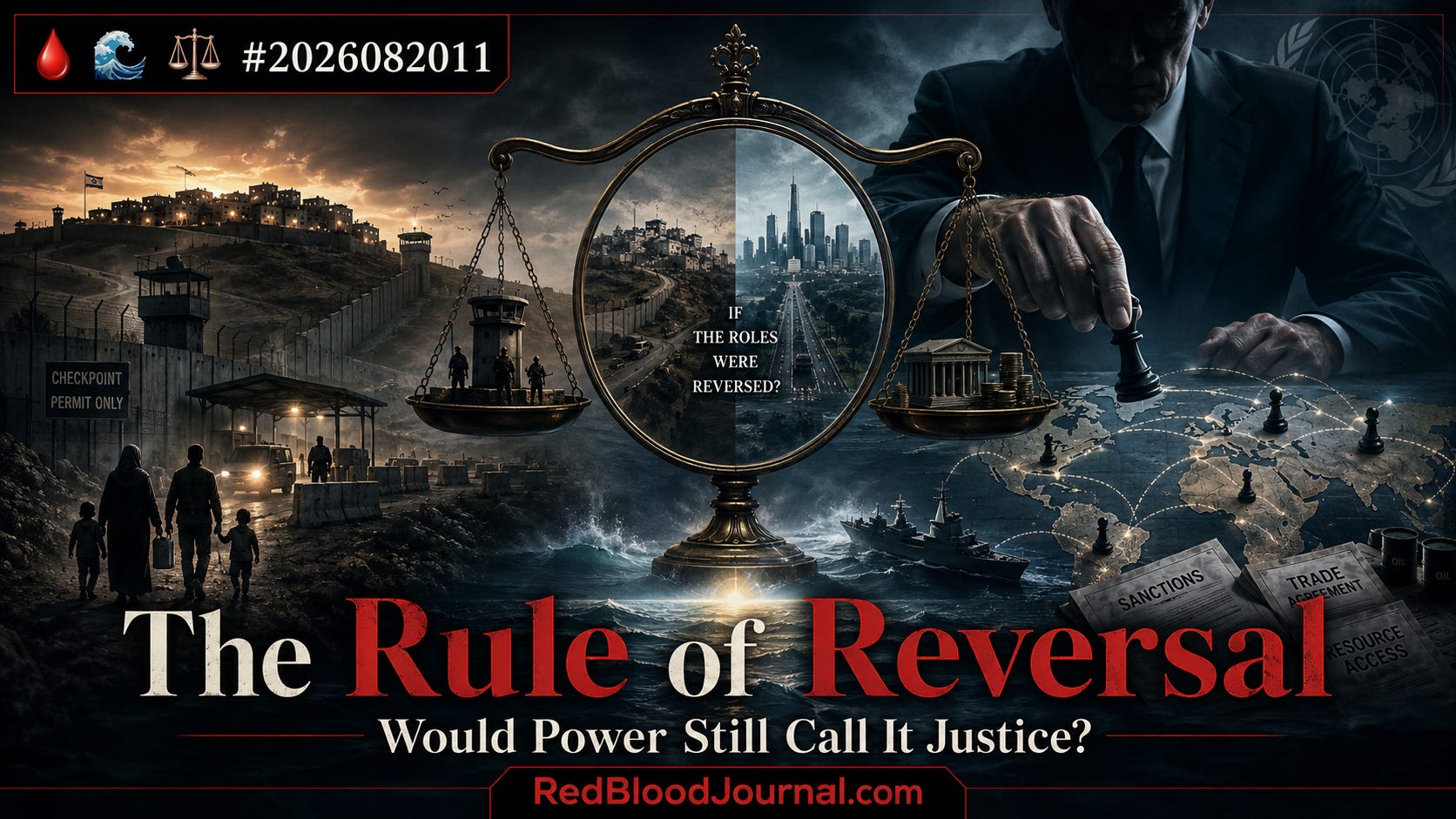
🩸 🌊 ⚖️ #2026082011 — The Rule of Reversal: Would Power Still Call It Justice?
Red Blood Journal
RedBloodJournal.com
There is a simple way to examine power without choosing a flag.
Remove the names.
Remove Israel.
Remove Palestine.
Remove America.
Remove Iran, Iraq, Venezuela, Guatemala, Vietnam, Chile, or any other country that has lived beneath the shadow of a stronger state.
Remove religion.
Remove ideology.
Remove history for one moment.
Now place two human beings in a room.
One is enormously powerful.
The other is much weaker.
Then watch what happens.
That may be one of the clearest windows through which the Ocean of Love and Positivity can examine politics.
Because the Ocean does not begin by asking:
Who is Israeli?
Who is Palestinian?
Who is American?
Who is Muslim, Jewish, Christian, capitalist, socialist, democratic, revolutionary, conservative, or liberal?
The Ocean asks something more primitive:
What is one human being doing to another?
Two Human Beings
Imagine the Israeli settlement system as one human being.
Call him Person A.
Now imagine the foreign-policy behavior of a great power toward weaker nations as another human being.
Call him Person B.
Person A looks at property, land, roads, water, security zones, hills, neighborhoods, or territory occupied by another person and says:
“I have a legitimate reason to exercise authority here.”
The reason may come from history.
It may come from religion.
It may come from security.
It may come from law.
It may come from ancestral claims.
It may come from fear.
It may even come from genuine trauma.
But to the weaker person standing across from him, the practical result may be much simpler:
Someone stronger than me is deciding what happens to my life.
Now consider Person B.
Person B is enormously wealthy and powerful.
He approaches a smaller neighbor and says:
“You are sovereign. You are free. You may govern yourself.”
But sometimes another sentence quietly follows:
“As long as what you do does not seriously conflict with my interests.”
The smaller person may elect the wrong leader.
Nationalize the wrong resource.
Trade with the wrong country.
Refuse the wrong military relationship.
Adopt the wrong political system.
Or simply become strategically inconvenient.
And suddenly his sovereignty begins acquiring conditions.
Sanctions.
Financial restrictions.
Political isolation.
Military pressure.
Covert action.
Support for domestic opposition.
Regime-change discussions.
Proxy warfare.
Or direct military intervention.
Different tools.
Different geography.
Different history.
But beneath them may exist the same human question:
Who gave the stronger person authority over the weaker one?
The Ocean Removes the Flags
The Ocean of Love and Positivity is uncomfortable for political systems because it refuses to recognize a moral exemption based on nationality.
If taking someone’s property by force is wrong when an individual does it, putting a flag over the action does not automatically make the moral question disappear.
If threatening another human being until he changes his behavior is coercion between individuals, calling it foreign policy does not automatically settle the moral question.
If surrounding someone’s home and deciding who may enter or leave would be domination between neighbors, describing similar behavior through bureaucratic language does not remove the underlying human relationship.
The Ocean strips away vocabulary.
And underneath the vocabulary it sees:
one being with power
and
one being living under that power.
The Most Dangerous Sentence in Power
Both imaginary people may eventually say almost exactly the same thing:
“I respect your freedom, but your freedom cannot be allowed to threaten my security.”
At first that sounds reasonable.
Every human being has a right to protect himself.
Every country has legitimate security concerns.
Every community deserves protection from attack.
But the sentence contains a hidden doorway.
Who determines when the weaker person’s freedom has become a threat?
Usually:
the stronger person.
And once the stronger person becomes both participant and judge, almost anything can eventually be described as security.
Land can become security.
Oil can become security.
Trade routes can become security.
Political movements can become security.
Elections can become security.
Speech can become security.
Foreign alliances can become security.
Religion can become security.
Technology can become security.
Entire populations can become security problems.
That is where self-defense can slowly transform into domination without the powerful person ever believing he became an oppressor.
The Strange Psychology of Resistance
There is another pattern shared by powerful human beings.
Imagine Person A enters Person C’s yard repeatedly.
Person C becomes angry.
Person C shouts.
Eventually perhaps Person C becomes violent.
Person A then says:
“Look at this dangerous man. This proves why I needed protection from him.”
Something important has happened.
The argument has moved.
The original question was:
Why were you entering his yard?
The new question becomes:
Why is he so violent?
The same psychological transformation can occur between nations.
Pressure produces resentment.
Resentment produces resistance.
Resistance sometimes produces violence.
Violence then becomes justification for even greater pressure.
The sequence can become:
control → resistance → retaliation → greater control.
And eventually neither side remembers where the circle began.
The stronger party sees only the latest act of resistance.
The weaker party sees only decades of what preceded it.
Both begin telling completely different histories of the same relationship.
None of This Makes Violence Innocent
The Ocean does not excuse murder because somebody has suffered.
It does not excuse terrorism.
It does not excuse killing civilians.
It does not excuse hostage-taking.
It does not excuse indiscriminate attacks.
It does not excuse revenge.
Likewise, it does not excuse dispossession, collective punishment, abuse, occupation, domination, torture, or political coercion because the person carrying them out believes he has historical or security reasons.
The Ocean does something more difficult.
It holds both hands simultaneously.
It can say:
Your suffering is real.
And then say:
You still may not deliberately create suffering for someone innocent.
That applies equally to the powerful and the powerless.
The Rule of Reversal
Perhaps the most useful moral test is therefore extraordinarily simple.
Take whatever policy a powerful person believes is legitimate.
Reverse the positions.
Then ask whether the powerful person still accepts the principle.
Imagine Palestinians establishing protected settlements throughout Israeli territory.
Imagine Palestinian security forces controlling roads between Israeli cities.
Imagine Palestinians determining where Israelis may build.
Imagine Palestinian authorities deciding which Israelis can travel through particular checkpoints or roads.
Imagine the Israeli population being told:
“These arrangements are necessary for Palestinian security.”
Would Israelis accept the principle?
Probably not.
Now reverse the international relationship.
Imagine China surrounding the United States with military bases.
Imagine China financing American political organizations.
Imagine China sanctioning American politicians.
Imagine China freezing American assets.
Imagine Beijing deciding which countries American companies may trade with.
Imagine Chinese intelligence agencies secretly helping preferred American political factions.
Imagine Chinese leaders publicly discussing what kind of American government would be acceptable to China.
Imagine China saying:
“American sovereignty is important, but Chinese national security comes first.”
Would Washington accept that relationship?
Almost certainly not.
And suddenly something becomes visible.
If a rule is just only while you are powerful, perhaps it was never a rule of justice.
Perhaps it was a rule of power.
The View From the Strong Side
Power creates a peculiar blindness.
The powerful person usually does not wake up thinking:
“Today I will oppress someone.”
He wakes up thinking:
“Today I will maintain stability.”
He says:
security.
deterrence.
strategic necessity.
historical rights.
national interest.
law and order.
regional stability.
Those words may even contain genuine truths.
But the weaker person may experience exactly the same actions through different words:
occupation.
interference.
humiliation.
domination.
dispossession.
colonialism.
economic warfare.
loss of sovereignty.
Two people can therefore experience the same relationship and honestly describe two completely different realities.
The Distance Problem
There is an important difference between our two imaginary human beings.
Person A frequently lives physically beside the people affected by his power.
The Palestinian home, farm, village, road, checkpoint, wall, neighborhood, or hillside may literally be visible.
Person B may operate from thousands of miles away.
For him, the affected human beings can become abstractions.
A government briefing may say:
Iran.
Iraq.
Libya.
Venezuela.
Vietnam.
Guatemala.
But those words contain millions of individual lives.
A sanction written inside an office may become an unavailable medicine somewhere else.
A military operation ordered from a conference room may become a destroyed home.
A political maneuver described as strategy may become a generation of instability.
Distance protects the decision-maker from seeing much of what the decision produces.
That may make foreign power even more psychologically dangerous.
Because human beings find it much easier to harm an abstraction than a neighbor whose eyes they must look into every morning.
The Ocean’s Question
The Ocean of Love and Positivity does not ask the powerful person to become weak.
It does not demand that countries abandon defense.
It does not pretend history never happened.
It does not ask Israel to ignore terrorism.
It does not ask America to ignore genuine threats.
It does not ask Palestinians to forget displacement.
It does not ask nations to pretend competing interests do not exist.
Instead, the Ocean asks one question before everything else:
Would you accept this treatment if the bodies were exchanged?
If the answer is yes, perhaps there is a principle involved.
If the answer is no, perhaps there is merely power.
That question can be applied almost everywhere.
Would a government tolerate another government doing the same thing to it?
Would a police officer accept the same treatment from another police force?
Would a corporation accept the contract it gives its weakest worker?
Would a landlord accept the conditions imposed on his tenant?
Would a nation accept foreign interference identical to the interference it practices abroad?
Would a population accept another population exercising identical authority over it?
The Ocean does not need a thousand-page legal argument to recognize hypocrisy.
It simply reverses the chairs.
The Red Blood Perspective
Red Blood is not required to decide that every Israeli settler is evil.
That would itself become another form of blindness.
Nor is every American policymaker secretly seeking domination.
History contains genuine security threats, real wars, complicated alliances, sincere humanitarian interventions, terrible miscalculations, competing interests, and sometimes decisions for which no clean option exists.
But systems can produce injustice even when the individuals inside them believe themselves to be good.
That may be one of history’s most important lessons.
Most human beings committing institutional injustice do not think of themselves as villains.
They think they are defending:
their country,
their people,
their religion,
their economy,
their civilization,
their families,
or their security.
And that makes the rule of reversal even more important.
Because conscience becomes unreliable when self-interest is involved.
The Ocean of Love and Positivity Perspective
Imagine humanity before the first border was drawn.
Before the first passport.
Before the first national anthem.
Before someone said:
“This land belongs to us, and that land belongs to you.”
Before one child was taught that another child’s blood belonged to a different category.
There were simply human beings.
The Ocean sees that human being first.
Israeli blood is red.
Palestinian blood is red.
American blood is red.
Iranian blood is red.
The mother mourning a child does not experience geopolitics.
She experiences an empty chair.
The father whose home disappears does not experience strategy.
He experiences loss.
The young soldier does not experience a policy paper when a bullet arrives.
He experiences mortality.
And perhaps civilization begins moving toward wisdom only when power finally asks itself:
Would I permit another human being to do this to me?
Not:
Can I legally do it?
Not:
Can I militarily do it?
Not:
Can I economically force it?
Not:
Can I explain it historically?
But:
Would I call it justice if I were standing on the other side?
That may be one of the cleanest windows into the Ocean.
Because love does not require everyone to agree.
Positivity does not require ignoring evil.
Peace does not require surrender.
But justice may require something extraordinarily difficult:
judging our own behavior by the same standard we use to judge our enemies.
And perhaps when humanity finally learns to do that consistently, many of the conflicts we currently treat as impossible will begin looking very different.
In an Ocean of Love and Positivity.
🩸🌊✨ Fantastic!
⚖️
The Rule of Reversal: Power Through the Mirror of Justice
Aug 20, 2026
This text introduces a moral framework called the Rule of Reversal, which evaluates the fairness of political and international actions by stripping away national identities and ideologies. By imagining global conflicts as simple interactions between two individual human beings, the author highlights how imbalances of power often mask domination as necessary security or justice. The narrative argues that true moral consistency requires a person or nation to ask if they would accept a specific treatment if their positions were swapped with their opponent. It critiques the psychological blindness of the powerful, who often view their own coercive actions as stability while perceiving the resulting resistance as unprovoked aggression. Ultimately, the source advocates for a universal standard of justice based on shared humanity rather than the justifications of flags, history, or strategic interests.
#RedBloodJournal #RuleOfReversal #OceanOfLoveAndPositivity #PowerAndJustice #IsraelPalestine #Palestine #Israel #USForeignPolicy #ForeignPolicy #Geopolitics #HumanRights #Justice #DoubleStandards #Power #Occupation #Settlements #Sovereignty #Intervention #MoralConsistency #Peace #CitizensFirst #RedBloodPerspective


