


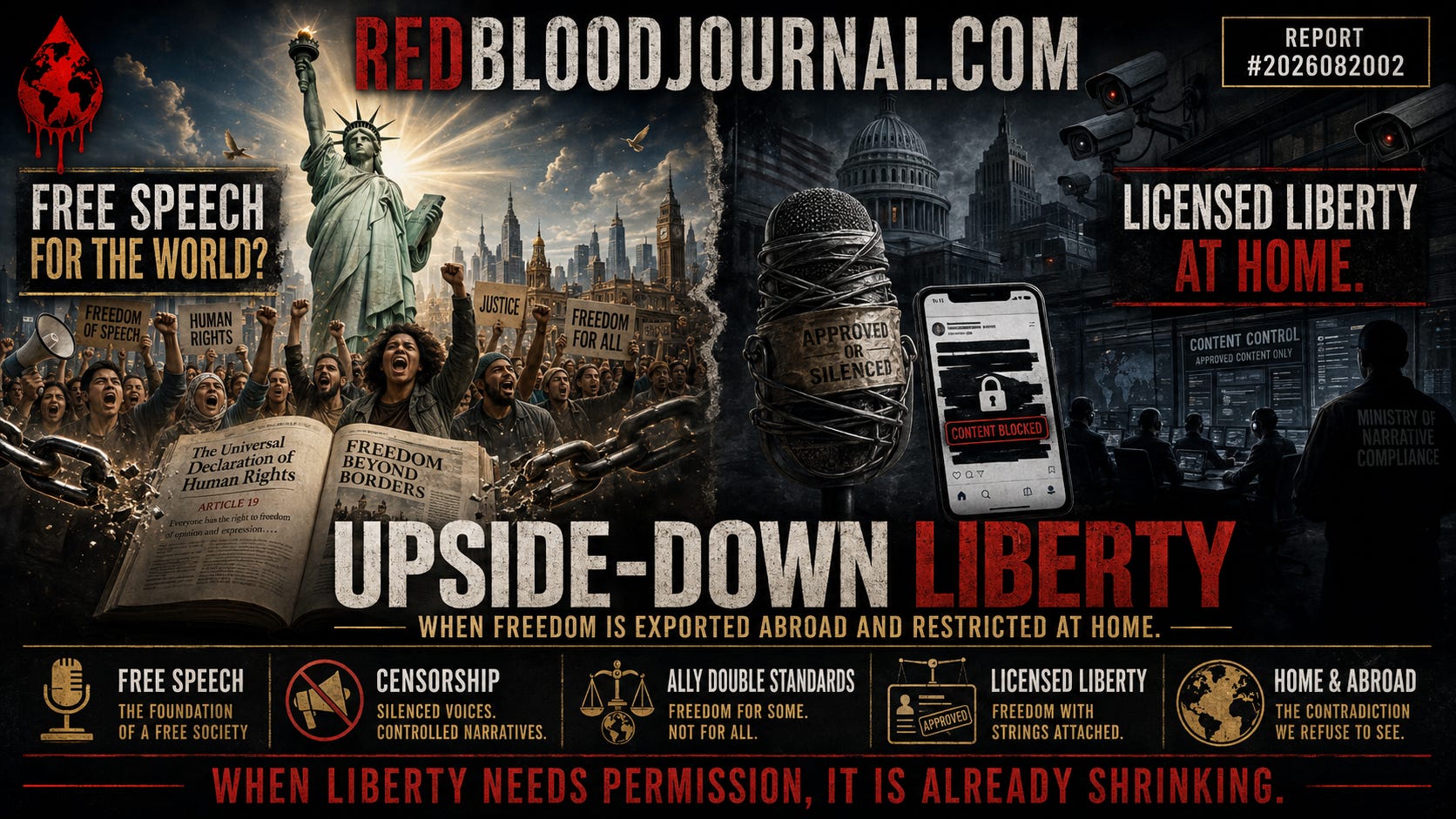
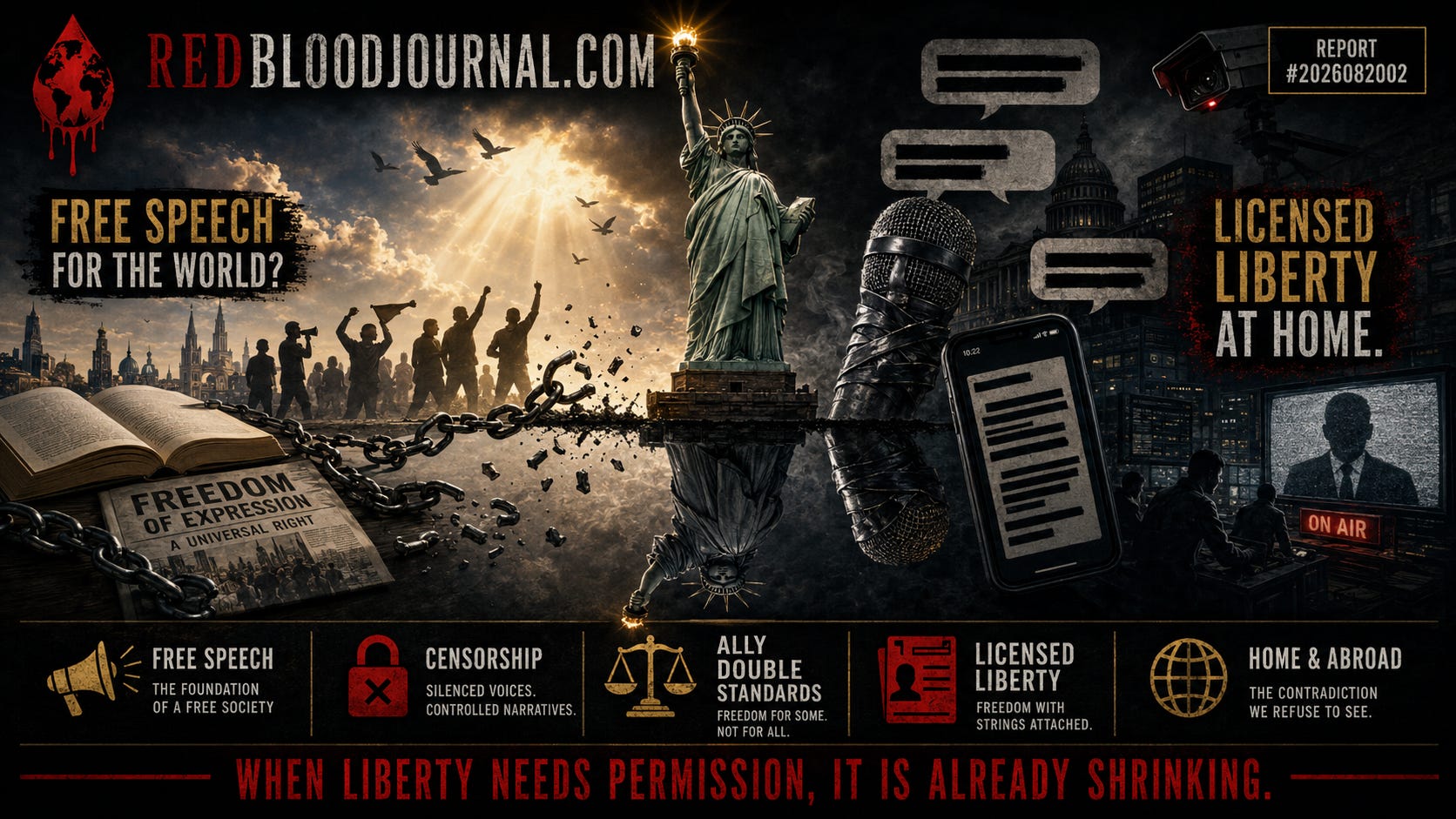
🩸 🌊 🗽 #2026082002 — Upside-Down Liberty: When Freedom Is Exported Abroad and Restricted at Home
RedBloodJournal.com
For generations, the United States has presented itself as something larger than simply another powerful country.
It has presented itself as an idea.
Freedom.
Liberty.
Free speech.
Individual rights.
Government restrained by law.
The right to criticize authority without fear.
These principles helped make America attractive not only to Americans, but to people around the world who lived under governments where speaking honestly could cost them their freedom, livelihood, or life.
But from the Ocean of Love and Positivity point of view, a difficult question appears.
If a superpower genuinely wants freedom for the people of the world, why should spreading freedom require wars, invasions, regime changes, covert operations, sanctions against entire populations, or endless political speeches?
There may be a much simpler approach.
Declare one universal principle:
Any government that denies its citizens peaceful freedom of speech and basic liberty will lose the political and financial privileges of partnership with nations claiming to represent freedom.
No invasion.
No bombs.
No occupation.
No forced political ideology.
Just a standard.
And apply it equally.
The Simplest Freedom Policy in the World
Imagine a foreign policy built around one minimum requirement.
A country does not have to copy America’s political system.
It does not have to become culturally Western.
It does not have to adopt American religion, economic policies, social customs, or political parties.
It simply has to allow its citizens to speak.
To criticize.
To question.
To publish.
To peacefully organize.
To disagree with their rulers without disappearing into a prison.
If a government refuses even that minimum standard, the free world could say:
You may govern yourselves however you choose, but you will not receive the political prestige, military protection, financial advantages, and preferential relationships offered by nations that claim to defend liberty.
That would make freedom a principle rather than a weapon.
Freedom for Enemies, Exceptions for Friends
The problem is that history has repeatedly shown something else.
Authoritarian governments considered enemies are condemned for repressing their citizens.
Authoritarian governments considered strategically useful are often treated very differently.
One dictatorship becomes evidence of why freedom must be defended.
Another becomes a strategic partner.
One country’s political prisoners become international symbols.
Another country’s political prisoners become an uncomfortable subject discussed quietly behind diplomatic doors.
That creates an unavoidable question:
Is freedom the principle—or is alignment the principle?
If freedom applies differently depending on oil, military bases, strategic geography, weapons contracts, intelligence cooperation, or political alliances, then freedom is no longer being treated as universal.
It has become conditional.
The Contradiction Comes Home
But there is an even more troubling development.
The same society that historically criticized censorship abroad has experienced increasingly intense arguments over acceptable speech at home.
During recent years, Americans have watched debates involving:
social-media removals,
government communication with technology companies,
misinformation policies,
content moderation,
deplatforming,
algorithmic suppression,
institutional pressure,
and disagreements about where legitimate safety measures end and censorship begins.
Not every moderation decision is censorship.
Not every restriction violates liberty.
Threats, fraud, harassment, defamation, and other unlawful conduct are not automatically protected simply because they involve words.
That distinction matters.
But another distinction matters just as much.
Unpopular speech is not automatically dangerous speech.
Wrong speech is not automatically criminal speech.
Offensive speech is not automatically unlawful speech.
Political disagreement is not automatically misinformation.
And criticism of government cannot remain meaningfully free if the government itself ultimately decides which criticism citizens are permitted to hear.
When Liberty Requires Permission
There is a dangerous transformation that can happen without anyone officially announcing that freedom has ended.
Citizens can technically remain free to speak.
But employment consequences grow.
Platforms disappear.
Financial access becomes uncertain.
Algorithms reduce visibility.
Institutions refuse association.
Government officials indirectly pressure private organizations.
And gradually people begin asking themselves a new question before speaking:
Will I be allowed to say this?
At that point liberty has already changed.
It may still exist legally.
But psychologically and socially it has become something different.
Licensed liberty.
You remain free—as long as the institutions controlling your access to society tolerate what you say.
That is not the same thing as constitutional liberty.
The Upside-Down World
And this creates one of the strangest contradictions imaginable.
The country historically known as the land of the free can simultaneously tell foreign populations:
Demand freedom from your government.
while its own citizens increasingly debate:
How much freedom should people really have to say the wrong thing?
That is upside-down liberty.
Freedom becomes something exported abroad while becoming uncomfortable at home.
Foreign dissidents are celebrated for challenging authority.
Domestic dissidents can be treated as dangerous when they challenge accepted institutions.
Another country’s censorship becomes authoritarianism.
Our censorship risk becomes safety policy.
Their propaganda becomes manipulation.
Our information management becomes protection.
Their suppression of dissent proves dictatorship.
Our suppression of unacceptable ideas becomes responsible governance.
The labels change.
The underlying question does not.
Can citizens peacefully challenge power?
The Test Is Not Whether We Like the Speech
Freedom of speech has very little meaning when everyone agrees.
The real test of liberty begins when someone says something society dislikes.
Something offensive.
Something politically inconvenient.
Something government officials believe is wrong.
Something corporations do not want associated with their brands.
Something experts reject.
Something the majority considers foolish.
If freedom survives only agreeable speech, almost every dictatorship can claim to have free speech.
Authoritarian governments rarely prohibit citizens from praising them.
They prohibit the speech that challenges them.
That is why the measure of liberty is not how comfortably a society protects popular opinions.
It is how safely it permits unpopular ones.
A Universal Standard
From the Ocean of Love and Positivity perspective, perhaps the world does not need another ideology exported from one country to another.
Perhaps it needs something much simpler.
A minimum human standard.
Every peaceful person should be allowed to think.
Every peaceful person should be allowed to speak.
Every peaceful person should be allowed to question authority.
Every peaceful person should be allowed to criticize government.
Every peaceful person should be allowed to advocate political change.
And those rights should not depend on whether Washington likes the government involved.
The standard should apply to:
Saudi Arabia.
Iran.
China.
Russia.
European governments.
American allies.
American enemies.
And America itself.
No exceptions for friends.
No harsher definitions for enemies.
Blacklist the Government, Not the People
There is also an important distinction between punishing populations and pressuring governments.
Broad economic sanctions can devastate ordinary citizens while political elites remain protected.
That can produce the opposite of liberation.
The Ocean approach would ask:
Why punish millions of people because their rulers deny them freedom?
If pressure is justified, concentrate it on the individuals and institutions responsible for repression.
Political isolation.
Restrictions on officials.
Financial scrutiny of ruling elites.
Limits on privileges enjoyed by those directing censorship or political imprisonment.
Transparency concerning foreign assets.
Restrictions on the benefits authoritarian leaders receive from free societies.
But preserve ordinary people’s access to information, communication, education, medicine, commerce, and human contact wherever reasonably possible.
The goal should not be making citizens suffer until they overthrow their government.
The goal should be making repression expensive for those doing the repressing.
America Does Not Need to Be Perfect
There is another trap in this conversation.
The United States does not need to be perfect before defending liberty.
No country has ever been perfect.
America itself has a long history of contradictions involving race, political persecution, surveillance, wartime restrictions, secrecy, and abuse of governmental authority.
But imperfection does not invalidate the principle.
It makes the principle more important.
The correct response to hypocrisy is not abandoning liberty.
It is applying liberty more consistently.
The American Constitution does not become meaningless because Americans have sometimes violated its principles.
Its value may be precisely that citizens can point back to it and say:
You promised us something better than this.
The Red Blood Perspective
Perhaps the greatest mistake is believing that freedom can be exported like a commodity.
Freedom cannot simply be delivered by tanks.
It cannot be installed through an embassy.
It cannot be manufactured by intelligence agencies.
And it cannot be proven by overthrowing governments while supporting other governments that behave similarly.
Freedom becomes credible when the same rule applies whether the government involved is friend or enemy.
If America wants to remain associated with liberty, its most powerful weapon may not be military strength.
It may be consistency.
Say to every government:
Treat your citizens as human beings.
Allow them to speak.
Allow them to disagree.
Allow them to criticize you.
Allow them to peacefully seek another government.
If you refuse, do not expect the privileges of partnership with societies calling themselves free.
But the rule must begin at home.
Because America cannot convincingly ask an Iranian citizen to challenge censorship while teaching an American citizen to fear saying the wrong thing.
It cannot ask a Saudi citizen to demand political liberty while treating domestic political disagreement as something authorities should manage.
The credibility of freedom abroad depends upon freedom surviving at home.
Ocean of Love and Positivity Perspective
The Ocean does not ask which government is American.
Which government is Iranian.
Which government is Saudi.
Which government is Chinese.
It asks something much simpler.
How is the human being being treated?
A person does not become less deserving of freedom because his government is America’s ally.
And another person does not become more deserving because his government is America’s enemy.
Human dignity cannot have geopolitical borders.
From this perspective, genuine freedom policy would not be about conquering governments.
It would be about refusing to reward repression.
And genuine free speech would not mean protecting only speech we believe is correct.
It would mean having enough confidence in truth to allow falsehood, criticism, stupidity, wisdom, disagreement, and uncomfortable questions to compete openly.
That requires courage.
Not only from citizens.
From governments.
From corporations.
From institutions.
From experts.
From everyone possessing power over another person’s voice.
Because the moment a society becomes afraid of what its citizens might say, it begins traveling toward the very system it once condemned.
The land of the free should not export liberty while importing censorship.
It should demonstrate liberty.
Not perfect liberty.
Not unlimited liberty.
But the enduring principle that peaceful human beings do not require permission to think.
Or to question.
Or to speak.
That would turn upside-down liberty right-side up again.
In an Ocean of Love and Positivity.
🩸🌊✨ Fantastic!
🗽
Upside-Down Liberty: The Global Inconsistency of Freedom
Aug 19, 2026
This text explores the hypocrisy and erosion of freedom within American foreign and domestic policy. The author argues that the United States often treats liberty as a conditional weapon, condemning censorship in enemy nations while overlooking it in strategic allies. Furthermore, the source warns of an “upside-down liberty“ where free speech is exported as an ideal abroad but increasingly restricted at home through institutional pressure and social-media moderation. Rather than using military force to spread democracy, the author suggests a universal standard that denies diplomatic and financial privileges to any government that silences its people. Ultimately, the text asserts that the credibility of freedom depends on its consistent application to both friends and enemies, as well as its preservation within America’s own borders.


