


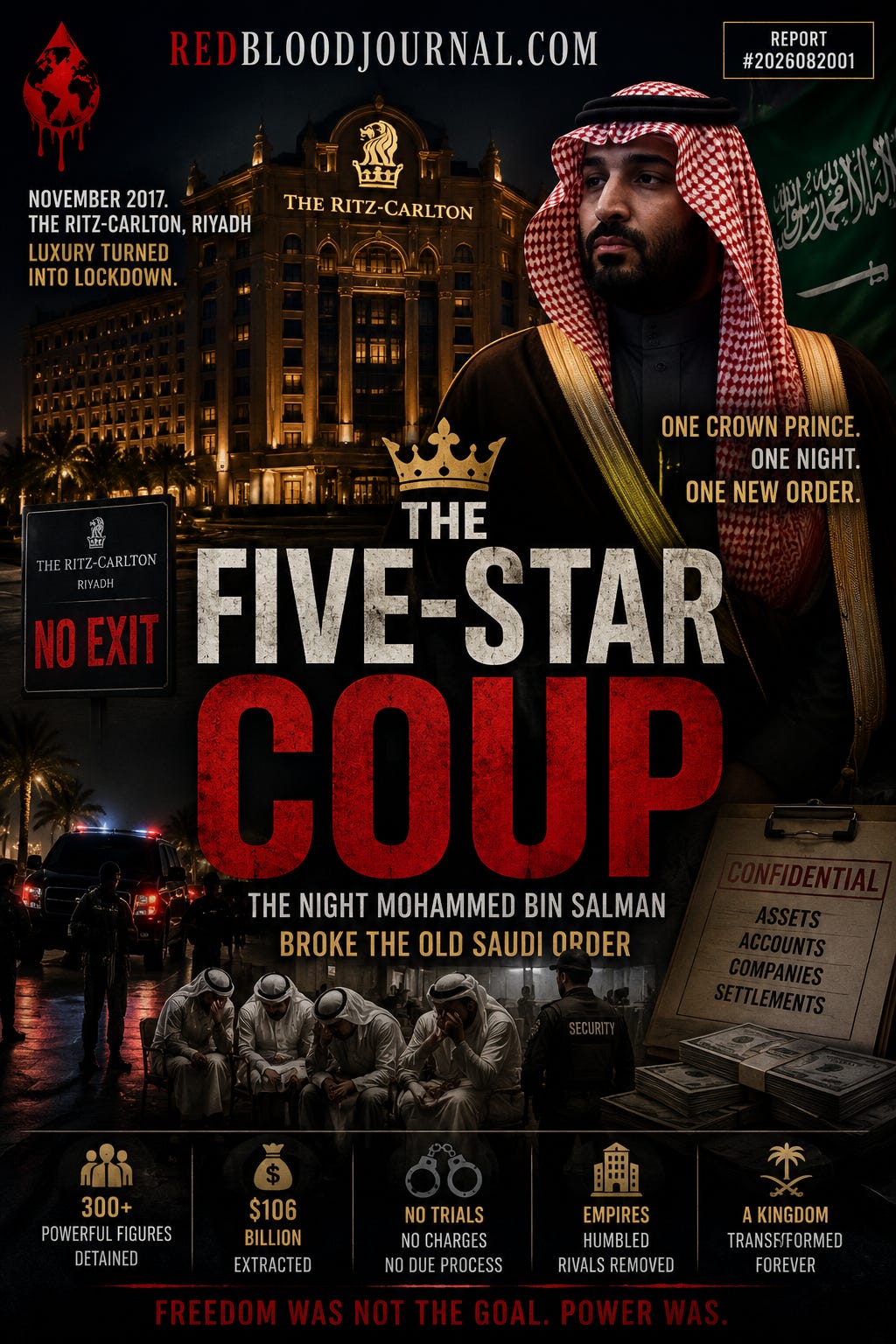
🩸 🏨 👑 #2026082001 — The Five-Star Coup: The Night Mohammed bin Salman Broke the Old Saudi Order
RedBloodJournal.com
On an ordinary night in November 2017, one of the most luxurious hotels in Riyadh stopped being a hotel.
Guests and foreign diplomats were abruptly told to leave. Telephone service was cut. Internet access disappeared. Steel doors were closed. Then, under cover of darkness, black limousines and security vehicles began arriving at the Ritz-Carlton.
Inside them were some of the most powerful men in Saudi Arabia.
Princes.
Ministers.
Military commanders.
Billionaires.
Media owners.
Business tycoons.
They had been summoned under the impression that they were attending an urgent official gathering.
Instead, they were entering what would become one of the most extraordinary detention operations in modern Middle Eastern history.
The Ritz-Carlton had become a five-star prison.
And behind the operation stood the young crown prince:
Mohammed bin Salman.
The Night the Rules Changed
For decades, Saudi Arabia had functioned through an internal balance of power within the royal family.
Different branches of the House of Saud controlled different centers of influence.
One branch dominated the National Guard.
Others controlled major business empires.
Others had influence over media.
Others commanded large networks of political patronage.
The king was powerful, but the structure depended heavily on consensus among senior princes.
Mohammed bin Salman appeared determined to end that system.
The Ritz-Carlton operation became the moment when the unwritten rules of royal immunity were shattered.
The message was simple:
No prince was untouchable anymore.
No fortune was beyond reach.
No independent power center was safe.
More Than 300 Powerful Figures Detained
By the following morning, according to the account, more than 300 influential political and economic figures had been detained at the Ritz-Carlton and nearby hotels.
One of the most famous was Prince Alwaleed bin Talal.
Alwaleed was among the wealthiest businessmen in the Arab world, with investments connected to major global companies including Apple, Citigroup, Disney, and Twitter.
A man accustomed to international boardrooms and private jets suddenly found himself confined inside a hotel room without normal access to the outside world.
But Alwaleed may not have been the most politically important detainee.
That distinction may have belonged to Prince Mutaib bin Abdullah.
The Man Who Controlled the National Guard
Mutaib bin Abdullah, son of the former King Abdullah, commanded the Saudi Arabian National Guard.
This was not simply another military organization.
The National Guard represented one of the last powerful armed institutions not fully controlled by Mohammed bin Salman.
Its tens of thousands of trained personnel gave Mutaib something far more dangerous than wealth.
He had an independent military power base.
His sudden detention effectively removed one of the crown prince’s strongest possible internal rivals.
After Mutaib was removed, the balance changed dramatically.
Military and security authority became increasingly centralized under Mohammed bin Salman.
The Economic and Media Empires Were Next
The crackdown did not stop with royal rivals.
Major business and media figures were also swept into the operation.
Among those named in the account were powerful construction executives and owners of major Saudi media networks.
Current and former ministers were detained as well.
The pattern suggests something larger than a normal criminal investigation.
Political power.
Military power.
Media power.
Economic power.
All were being brought into a single operation at the same time.
The Official Explanation: Fighting Corruption
The Saudi government publicly described the Ritz-Carlton operation as a major anti-corruption campaign.
And corruption within the Saudi elite was hardly an imaginary problem.
For decades, vast government contracts, oil revenues, land deals, and privileged business arrangements had helped produce enormous private fortunes.
From this perspective, Mohammed bin Salman could be seen as confronting a deeply entrenched oligarchy.
Many ordinary Saudis reportedly welcomed the spectacle of previously untouchable billionaires and princes suddenly facing consequences.
But there was another interpretation.
The arrests were highly selective.
There were no normal public trials.
There was little judicial transparency.
And the same operation that claimed to fight corruption also eliminated nearly every major independent center of power capable of challenging Mohammed bin Salman.
The Five-Star Interrogation Rooms
The contrast inside the Ritz-Carlton was extraordinary.
Luxury continued.
Expensive meals were reportedly served.
Suites remained luxurious.
But outside the doors stood armed security personnel.
The detainees could not freely leave.
They could not normally contact families or lawyers.
Hotel conference rooms were transformed into interrogation centers.
And the interrogators were not only security officers.
Teams of accountants, banking experts, and government auditors reportedly arrived with financial records, offshore account information, company ownership documents, and asset records.
The objective was not simply confession.
It was wealth.
Allegations of Torture
According to the transcript, international reporting later alleged that some detainees were subjected to physical abuse, beatings, sleep deprivation, and threats involving their families.
The purpose was allegedly to force them to surrender assets and sign settlement agreements.
The account also links the interrogation process to Saud al-Qahtani, a powerful security adviser close to Mohammed bin Salman.
Al-Qahtani would later become widely associated with another event that damaged Saudi Arabia’s international reputation:
the killing of journalist Jamal Khashoggi.
A Death Inside the System
One particularly disturbing episode involved Major General Ali al-Qahtani, an officer associated with the National Guard.
According to the account, he died during the detention period.
Reports later alleged that his body showed signs of severe physical abuse.
The Saudi government did not provide a transparent public explanation.
For the remaining detainees, the implication would have been impossible to ignore.
Prince.
General.
Billionaire.
None of those titles necessarily guaranteed safety.
The Price of Freedom
The settlements offered to detainees were extraordinary.
There were no conventional public trials.
No lengthy courtroom proceedings.
No open presentation of evidence.
Instead, detainees were allegedly required to surrender substantial portions of their wealth in exchange for release.
In some cases, the transcript claims that authorities demanded as much as 70 to 80 percent of an individual’s assets.
Prince Mutaib bin Abdullah reportedly paid more than $1 billion before being released.
Saudi authorities described these arrangements as financial settlements.
Critics saw something very different.
State-controlled extortion.
Alwaleed’s Strange Television Appearance
One of the most memorable moments came when Reuters was eventually allowed to interview Alwaleed bin Talal inside the Ritz-Carlton.
The purpose appeared to be reassurance.
International rumors about the detainees’ health and treatment had become increasingly damaging.
Alwaleed appeared inside his luxury suite, showing the kitchen, food, and surroundings.
He insisted that he was comfortable.
He described the situation as little more than a misunderstanding between himself and Mohammed bin Salman.
But the transcript characterizes the scene as deeply unnatural.
A billionaire explaining to the world how comfortable he was while still unable to leave the building.
Days later, he reached a confidential financial settlement and was released.
$106 Billion
By early 2018, the Ritz-Carlton detention operation began winding down.
Saudi Arabia’s attorney general later announced that settlements had transferred assets worth approximately $106 billion to the state.
The assets reportedly included:
cash,
property,
companies,
and shares.
The hotel reopened.
Tourists returned.
The carpets were cleaned.
The luxury returned.
But Saudi Arabia itself had fundamentally changed.
The End of the Old Saudi System
Before November 2017, Saudi Arabia was effectively governed through a complicated network of royal family alliances.
Senior princes possessed their own institutions.
Their own money.
Their own military relationships.
Their own patronage systems.
Their own political influence.
After the Ritz-Carlton purge, those independent islands of power were dramatically weakened.
The National Guard was brought under tighter centralized authority.
Major financial empires were humbled.
Political rivals were neutralized.
Media figures were reminded where ultimate power now rested.
The transcript concludes that Mohammed bin Salman had effectively become the undisputed ruler of Saudi Arabia even before formally becoming king.
But Was It Really an Anti-Corruption Revolution?
This is where the story becomes difficult.
There are two arguments, and both deserve examination.
The first argument:
Saudi Arabia had a genuine corruption problem.
Royal elites had accumulated enormous fortunes through privileged access to the state.
Reform required breaking entrenched interests.
Vision 2030 required enormous restructuring.
The old consensus system could make radical reform almost impossible.
Under this interpretation, Mohammed bin Salman did something that weaker leaders were unwilling to do.
He confronted the oligarchy.
The second argument:
A genuine anti-corruption system depends on law.
Evidence.
Courts.
Independent judges.
Defense lawyers.
Transparency.
Equal treatment.
The Ritz-Carlton process offered almost none of these safeguards.
Instead, the same operation that confiscated wealth also destroyed Mohammed bin Salman’s political rivals.
That creates an obvious question:
Was corruption the target?
Or was corruption the justification?
The Red Blood Perspective
The most important lesson of the Ritz-Carlton operation may not be about Saudi Arabia at all.
It is about the difference between justice and power.
A corrupt billionaire can still be denied justice.
A corrupt prince can still be abused by a government.
A guilty person can still be the victim of an unlawful process.
These ideas are not contradictions.
If government can confiscate a corrupt man’s fortune without transparent evidence and due process, the same mechanism can eventually be used against someone who is not corrupt.
That is why the question is bigger than whether Mohammed bin Salman arrested bad people.
The real question is:
Who decides who is bad when the person making the accusation also controls the police, the prison, the courts, the military, and the money?
The Ritz-Carlton operation appears to have accomplished several objectives simultaneously.
It raised enormous sums of money.
It eliminated military rivals.
It weakened independent business empires.
It disciplined the royal family.
And it concentrated authority in one man’s hands.
That does not automatically prove that the corruption allegations were false.
It means the political incentives cannot be separated from the anti-corruption narrative.
Ocean of Love and Positivity Perspective
Corruption damages societies because wealth and power become disconnected from responsibility.
But removing corruption through fear creates another form of corruption.
The corruption of unlimited power.
A healthy society cannot depend only on whether the person holding power happens to be good today.
It must depend on systems capable of restraining whoever holds power tomorrow.
Justice must remain justice even when applied to enemies.
Rights must remain rights even when protecting unpopular people.
Otherwise law becomes only another weapon.
Saudi Arabia may have entered the Ritz-Carlton as a fragmented royal oligarchy and emerged as a more centralized state.
Whether history eventually calls that transformation modernization, authoritarian consolidation, or both remains an open question.
But one thing appears difficult to dispute.
In November 2017, behind the locked doors of one of the world’s most luxurious hotels, the internal architecture of Saudi power changed.
Not with tanks.
Not with soldiers occupying the streets.
Not with a televised revolution.
With hotel rooms.
Bank records.
Security guards.
Signatures.
And fear.
In an Ocean of Love and Positivity.
🩸🌊✨ Fantastic!
🏨
The Five-Star Coup: Shattering the Saudi Royal Order
Aug 19, 2026
In November 2017, Saudi Arabia underwent a monumental shift in power when Crown Prince Mohammed bin Salman transformed the Ritz-Carlton in Riyadh into a high-end detention center. The operation targeted over 300 influential figures, including wealthy princes and military leaders, under the official guise of a crackdown on corruption. While many viewed this as a necessary step to reform an entrenched oligarchy, critics argued it was a calculated move to centralize authority by eliminating political and economic rivals. Detainees were reportedly forced to surrender billions of dollars in assets and sign settlement agreements in exchange for their freedom. This event effectively shattered the traditional consensus-based rule of the Saudi royal family, replacing it with a singular, concentrated power structure. Ultimately, the purge serves as a complex case study on the intersection of legal justice and absolute political control.


