


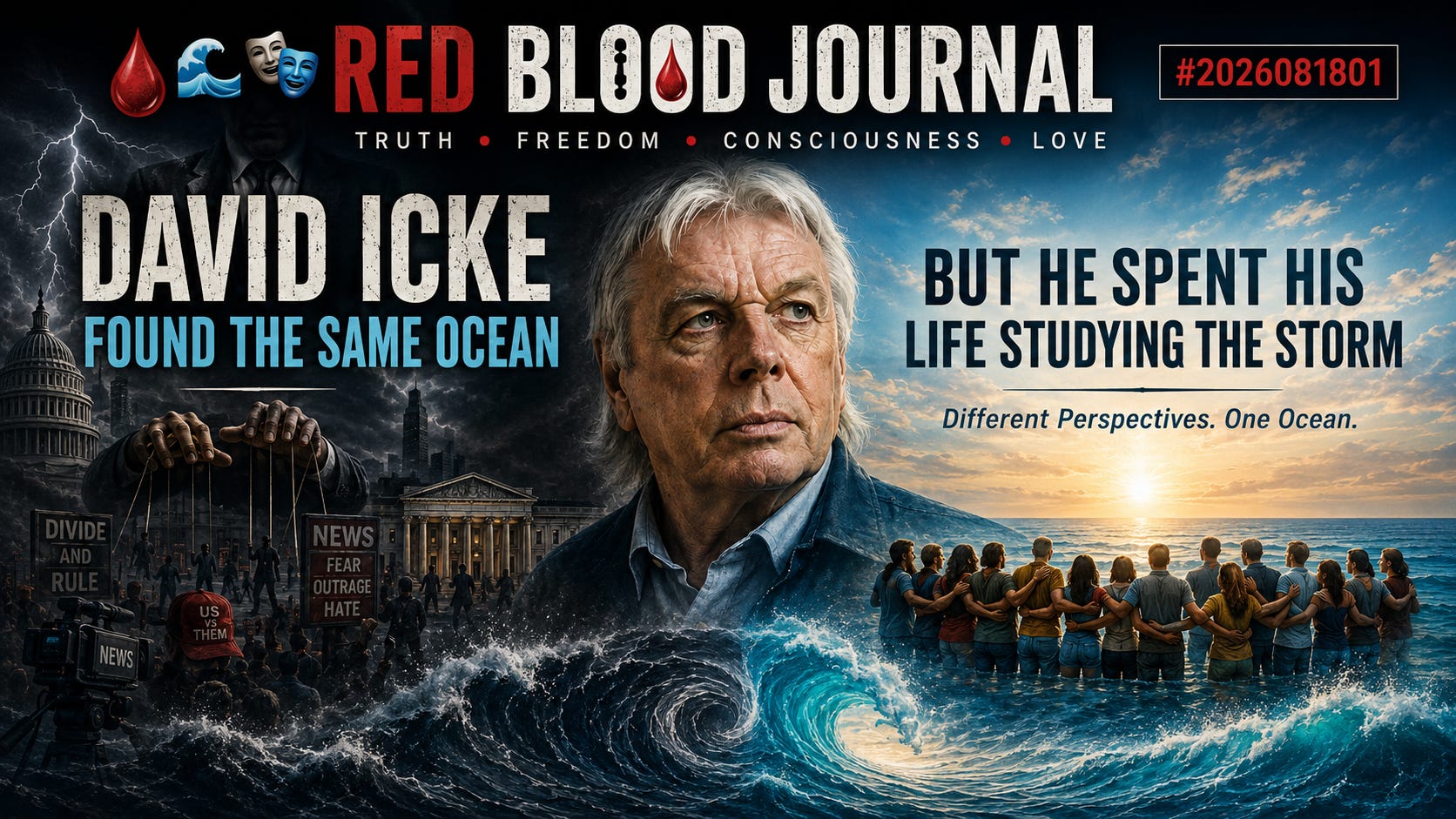
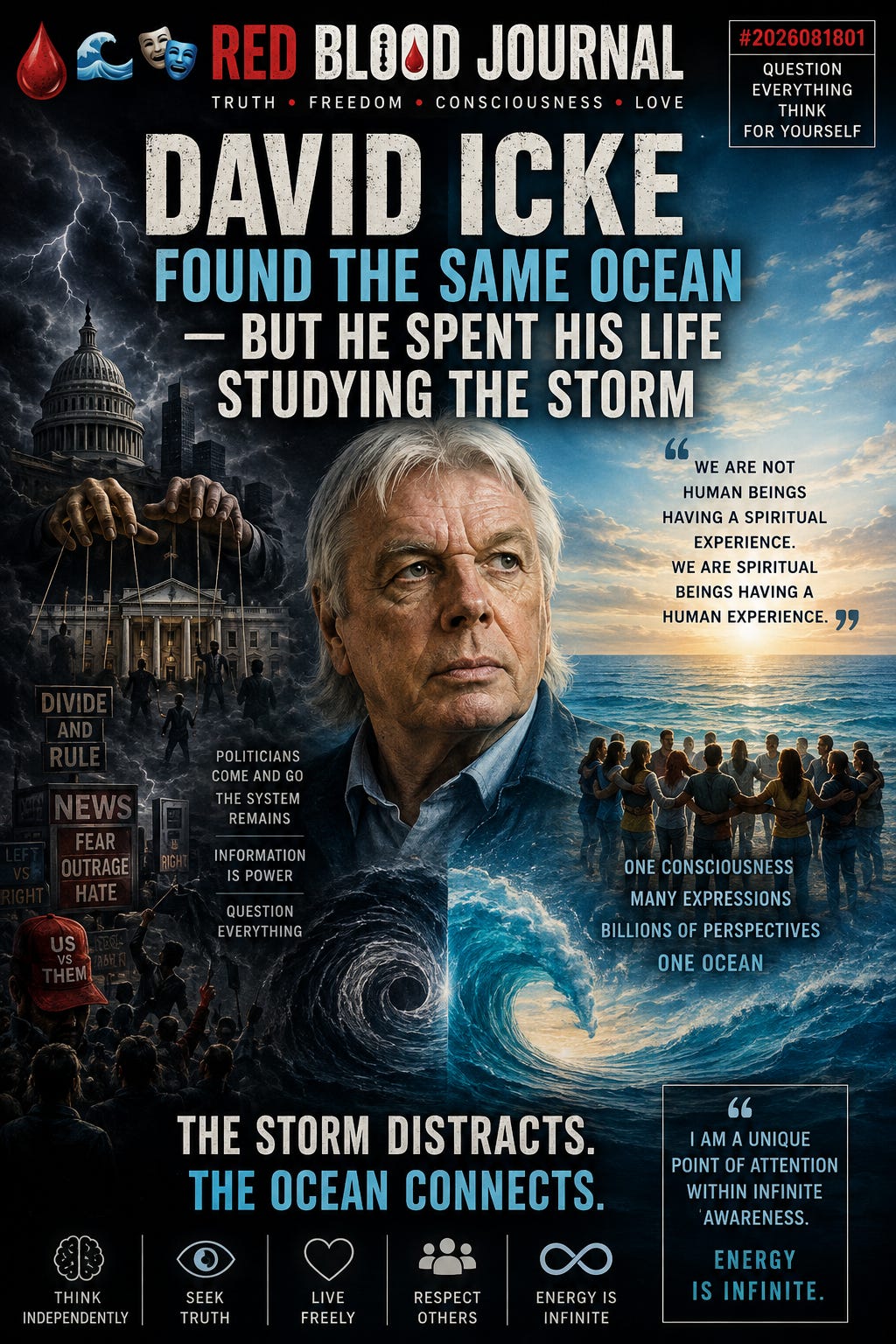
🩸 🌊 🎭 #2026081801 — David Icke Found the Same Ocean — But He Spent His Life Studying the Storm
“WE ARE NOT HUMAN BEINGS HAVING A SPIRITUAL EXPERIENCE.
WE ARE SPIRITUAL BEINGS HAVING A HUMAN EXPERIENCE.”
When the Search for the Hidden Hand Leads Back to the Human Mind
There is an unusual moment near the end of a David Icke interview that changes the meaning of almost everything that came before it.
For most of the conversation, Icke is talking about politics.
Trump.
Anti-Trump.
Republicans.
Democrats.
War.
Regime change.
Silicon Valley.
Censorship.
Political correctness.
The military-industrial structure.
The hidden hand behind governments.
It sounds like a conversation about power.
But underneath it is something else entirely.
It is a conversation about separation.
And once that is recognized, David Icke’s worldview begins to look less like a collection of disconnected political theories and more like one long attempt to answer a single question:
Why does humanity keep forgetting that it is connected?
The Political Movie
Icke opens his discussion of Donald Trump with a provocative analogy.
Trump, he says, is like an actor appearing on a movie screen.
The people opposing Trump are actors too.
The audience becomes absorbed in deciding who is the hero and who is the villain.
Trump good.
Trump bad.
Republican good.
Democrat bad.
Left.
Right.
One side against the other.
Meanwhile, according to Icke, the machinery underneath the political theater continues operating regardless of which actor currently occupies the screen.
His argument is not simply that politicians do nothing.
His argument is that people may be looking at the wrong level of the system.
Politicians arrive.
Politicians leave.
Presidents change.
Parties alternate.
But large institutions, intelligence organizations, military structures, financial networks, corporations and bureaucracies may remain for decades.
Icke therefore argues that the more important question is not always:
Who won the election?
It may be:
What did not change when the election changed everything else?
The Continuity Problem
Icke uses American foreign policy as an example.
He points to the Project for the New American Century and its discussions of American military power and geopolitical transformation.
He then traces wars and interventions across different administrations.
Bush.
Obama.
Trump.
Different personalities.
Different parties.
Yet, in his interpretation, significant parts of the geopolitical direction continued.
This is where the distinction between documented history and Icke’s interpretation becomes important.
Government policies do sometimes continue across administrations.
Permanent institutions do outlast elected politicians.
Foreign-policy establishments do develop institutional momentum.
Those are legitimate subjects of investigation.
Icke goes further.
He interprets this continuity as evidence of a coordinated hidden power structure operating behind visible government.
That larger conclusion is his theory.
The transcript itself does not establish it as fact.
But the underlying question survives regardless:
How much power actually changes hands when political leadership changes?
That is a question worth asking without requiring acceptance of every answer Icke proposes.
Trump: Actor, Instrument, or Disruption?
Icke’s treatment of Trump is more complicated than either Trump’s supporters or opponents might expect.
He does not simply describe Trump as an enemy.
Nor does he describe him as a savior.
He argues that Trump served the system in some ways because Trump became one of the strongest political polarizing forces in modern America.
Trump could generate extraordinary loyalty.
He could generate extraordinary hatred.
That polarity, Icke argues, is politically useful because populations preoccupied with fighting one another may pay less attention to institutions operating above or around the conflict.
Yet Icke simultaneously says he believes Trump’s desire to improve relations with Russia was genuine.
In Icke’s interpretation, the Russia controversy that followed Trump’s election helped make any rapprochement politically dangerous.
Whether that interpretation is accepted or rejected, something interesting appears.
Icke refuses the simplest political categories.
Trump is not completely independent.
Trump is not completely controlled.
Trump is neither pure hero nor pure villain.
He is an individual operating inside a larger system containing competing interests.
That may be a more useful way to understand political leaders generally.
Then the Interview Suddenly Becomes About Consciousness
Approximately halfway through the conversation, something happens.
The discussion moves from presidents and governments to consciousness.
And suddenly the earlier political argument becomes easier to understand.
Icke says humanity experiences reality through the perception that everything is separate from everything else.
Individual from individual.
Race from race.
Country from country.
Political party from political party.
Gender from gender.
Religion from religion.
Yet Icke says this separation is ultimately an illusion because human beings are expressions of the same consciousness.
And there it is.
The Ocean.
Not his word.
But remarkably close to the same concept.
The Ocean and the Storm
Imagine humanity as an ocean.
Every human being is a wave.
One wave is Iranian.
One is American.
One is Jewish.
One is Muslim.
One is Christian.
One is Republican.
One is Democrat.
One is conservative.
One is progressive.
Each wave looks different.
Each has a different shape.
Different history.
Different experience.
Different movement.
But none of them exist separately from the ocean.
The mistake begins when the waves forget the water.
Then one wave believes another wave is fundamentally foreign.
The labels become more important than the substance.
The argument becomes more important than the consciousness experiencing the argument.
Politics then becomes an endless competition between waves that have forgotten they are made from the same thing.
Icke spends much of his work examining the forces that he believes encourage humanity to forget.
Divide and Rule
This becomes one of the central themes of the interview.
Icke repeatedly returns to division.
Political division.
Social division.
Cultural division.
Gender division.
Racial division.
Ideological division.
His argument is that people who are fighting each other become easier to manage.
While citizens debate which political actor deserves hatred, institutions continue functioning.
While groups fear each other, they may fail to investigate the structures affecting all of them.
Whether one agrees with Icke’s explanation of who is responsible, the psychological principle itself is familiar.
Fear narrows attention.
Tribal identity simplifies complicated issues.
Anger rewards certainty.
Social groups strengthen themselves by defining enemies.
And political systems throughout history have exploited those tendencies.
The more interesting question therefore may not be:
Who is dividing us?
It may be:
Why are we so easy to divide?
The Hidden Hand May Not Need to Be Hidden
This leads to a possibility that goes slightly beyond Icke’s own framing.
Suppose there is no single control room.
Suppose there is no table around which twelve people secretly decide humanity’s future.
Perhaps systems can produce similar outcomes without requiring one centralized mastermind.
Governments want authority.
Corporations want market dominance.
Political parties want votes.
Media companies want attention.
Algorithms want engagement.
Military organizations want strategic advantage.
Intelligence agencies want information.
Activist movements want ideological influence.
Individuals want status.
Each player may pursue its own incentives.
Yet together those incentives can produce something that looks coordinated from the outside.
A system does not always need a conductor to produce music.
Sometimes every musician simply learns which notes are rewarded.
That possibility does not eliminate the possibility of conspiracy.
History contains real conspiracies.
It simply means that systemic incentives deserve investigation alongside secret coordination.
Control the Information, Control the Perception
Icke becomes particularly concerned when discussing information.
His fear is that censorship rarely begins by announcing:
We are going to censor ordinary disagreement.
It usually begins with something society overwhelmingly condemns.
Violence.
Abuse.
Threats.
Hatred.
Then, he argues, the definition gradually expands.
Eventually people begin censoring themselves because they fear social or professional punishment.
The most powerful censorship may therefore not require police.
It requires hesitation.
Before speaking:
Can I say this?
Will someone misunderstand me?
Will I lose my job?
Will I be attacked online?
Will the algorithm punish it?
When enough people perform that calculation, the boundary of acceptable thought can shrink without a formal government order.
That is the danger Icke believes he sees.
His Philosophy Becomes Surprisingly Simple
After all the discussion of conspiracies, wars, institutions and political manipulation, Icke eventually states a remarkably uncomplicated philosophy:
Do what you want as long as you do not impose it upon somebody else.
That principle changes the character of the interview.
Because underneath the elaborate theories is something much simpler:
Freedom of thought.
Freedom of expression.
Freedom of personal existence.
And reciprocity.
Icke wants the right to believe what he believes.
But he also says other people must have the right not to believe him.
The Most Important Thing Icke Says
The strongest part of the interview may not involve Trump, 9/11, secret governments or political correctness.
It comes when he explains what he expects people to do with his information.
He does not say:
Believe David Icke.
He says essentially:
Look at the evidence.
Look at different information.
Then decide for yourself.
He describes independent thinking as something humanity is losing.
Instead of receiving a finished worldview from government, media, religion, political parties—or even David Icke—he argues that every individual should construct a personal understanding after examining competing perspectives.
Then he makes an observation that almost deserves to stand alone:
If there were only one correct way to perceive everything, perhaps humanity would only need one person.
Instead there are billions.
Therefore there should be billions of perspectives.
That may be the healthiest safeguard against every ideology—including Icke’s own.
Where Icke and the Ocean Separate
There is an interesting difference.
Icke spends enormous energy examining the storm.
Who created it?
Who benefits from it?
Who controls the information?
Who manipulates governments?
Who pushes humanity apart?
The Ocean of Love and Positivity begins somewhere slightly different.
It asks:
Once we recognize that we are waves belonging to the same ocean, what do we do next?
Finding the manipulator does not automatically create peace.
Exposing propaganda does not automatically create compassion.
Destroying one power structure does not guarantee that another will not replace it.
History repeatedly demonstrates that revolutionaries can become rulers and victims can become oppressors.
The deeper transformation therefore cannot only be political.
It must also occur inside the individual.
Otherwise humanity merely changes costumes while continuing the same movie.
And Then Comes the Final Line
Near the end of the conversation, the interviewer asks Icke how he maintains the energy required for extremely long speaking events.
Icke responds from his concept of consciousness.
He says he sees himself as:
a unique point of attention within infinite awareness.
And he asks:
Would infinite awareness struggle to find energy?
His answer:
No.
Then comes the final statement:
Energy is infinite.
Perhaps that sentence contains the entire interview.
If consciousness is larger than the identity attached to the body, nationality, party, race or religion, then many of the divisions dominating human life suddenly become much smaller.
The actor is temporary.
The movie is temporary.
The political argument is temporary.
The wave is temporary.
But perhaps the ocean is not.
The Red Blood Perspective
David Icke should neither be accepted automatically nor dismissed automatically.
Some of his claims are controversial.
Some move far beyond what can be demonstrated from the evidence he presents.
Others raise legitimate questions about institutional continuity, concentration of power, censorship, political polarization and the incentives driving modern societies.
The useful approach is exactly the approach Icke himself recommends:
Do not surrender judgment.
Investigate.
Compare.
Question.
Separate evidence from interpretation.
Separate documented events from theories attempting to explain them.
And never allow disagreement about the explanation to prevent examination of the evidence.
Perhaps the greatest mistake would be replacing one authority with another.
Government says believe this.
Media says believe this.
Political party says believe this.
Alternative media says believe this.
David Icke says believe this.
Red Blood should say something different:
Here is the information.
Now think.
The Ocean of Love and Positivity Perspective
David Icke has spent decades staring into the storm.
He sees manipulation.
Division.
Fear.
Censorship.
Institutions.
Hidden structures.
Political theater.
But beneath all of it he eventually arrives at something remarkably peaceful:
We are expressions of the same consciousness.
That is where the storm meets the Ocean.
Perhaps humanity does not need everyone to believe the same thing.
Perhaps humanity needs something much more difficult:
To disagree while remembering that the person standing on the opposite side is another wave in the same water.
Billions of people.
Billions of perspectives.
One Ocean.
And perhaps that is where freedom actually begins.
Not when everyone finally agrees.
But when disagreement no longer requires hatred.
In an Ocean of Love and Positivity.
🩸🌊✨ Fantastic!
🌊
The Storm, the Ocean, and the Architecture of Separation
Aug 18, 2026
The provided text explores the philosophical and political worldview of David Icke, focusing on his belief that global conflict is a calculated distraction managed by permanent, hidden institutions. Icke suggests that while the public is fixated on the polarizing theater of elective politics, deeper power structures maintain a steady, unchanging course behind the scenes. Central to this perspective is the idea that humanity has been manipulated into a state of artificial separation, forgetting that all individuals are part of a single, unified consciousness. By viewing people as distinct waves in one vast ocean, the text argues that overcoming systemic control requires moving past tribal hatred toward independent thinking. Ultimately, the source advocates for a transformation of perception where personal freedom is found through recognizing our shared essence despite differing viewpoints.


