


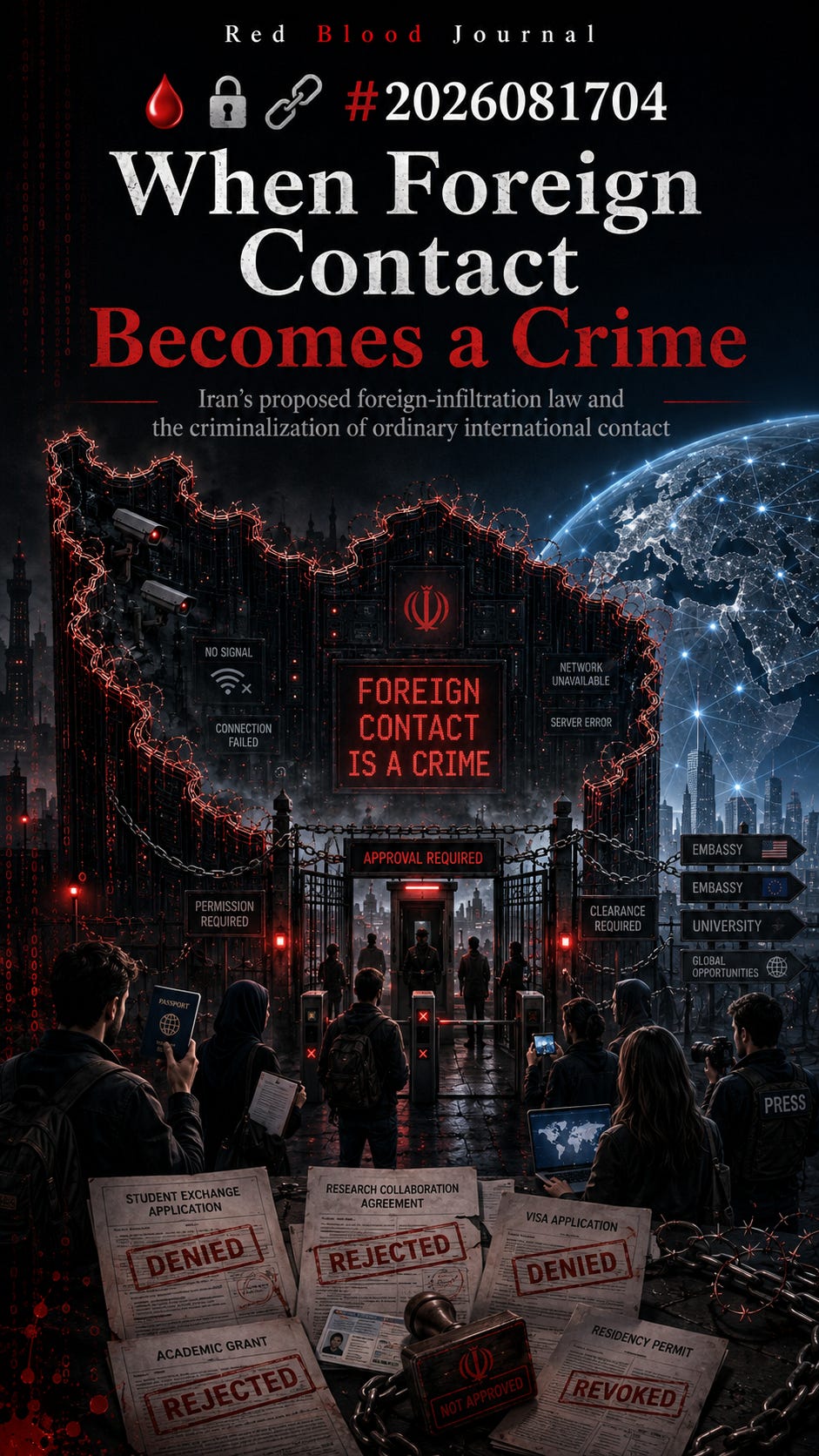
🩸 🔐 #2026081704 — When Foreign Contact Becomes a Crime
Iran’s proposed “Countering Foreign Infiltration” law and the criminalization of ordinary international contact
There is a point at which national security stops being a shield and begins becoming a wall.
The material reviewed for this report describes a proposed Iranian law presented as a measure to counter foreign infiltration. On its face, the stated concern is familiar to nearly every government: espionage, foreign intelligence activity, covert influence, unauthorized transfer of information, and interference by hostile states.
But the provisions described in the source go much further than traditional espionage law.
They reach into journalism.
Universities.
Scholarships.
Scientific cooperation.
Embassies.
Charities.
Academic conferences.
Research.
And ordinary communication with institutions outside Iran.
The central question is therefore not whether Iran has legitimate security concerns.
It does.
The question is much larger:
When almost any meaningful connection with the outside world can require government permission, is the law still protecting the country from infiltration—or protecting the government from connection?
What the Proposed Law Would Do
According to the source, the proposed legislation includes several sweeping restrictions.
Interviews with media affiliated with the United States or Israel would be prohibited.
Interviews with other foreign media could require authorization.
Scholarships could be limited to universities approved by Iranian intelligence authorities.
Scientific collaboration with foreign universities or institutions could require approval.
Contact with foreign embassies could require government authorization.
Political, scientific, and organizational actors could be required to disclose or conduct foreign relationships under intelligence supervision.
Taken separately, each provision might be defended under a national-security argument.
Taken together, they create something much broader:
a permission system for international life.
The Academic World Becomes a Security Zone
Some of the most consequential provisions described in the source concern universities and scientific work.
The material says that the Ministry of Intelligence would publish approved lists of foreign governments, universities, institutions, and organizations for matters including scholarships, grants, contracts, memoranda of understanding, conferences, and scientific events.
Cooperation with institutions outside those approved lists could potentially become prohibited.
The source also describes restrictions involving the transfer of medical, research, and archaeological samples to foreign institutions, with criminal penalties attached to violations.
This changes the nature of academic life.
Science normally advances through contact.
A researcher emails another researcher.
A student applies to a university.
A professor writes a recommendation.
A physician sends a sample for specialized analysis.
A scholar submits a paper.
A laboratory enters a collaboration.
A researcher attends a conference.
Under a heavily securitized system, each of those ordinary actions can acquire a second identity.
Not only academic.
Potentially political.
Potentially suspicious.
Potentially criminal.
When Applying to School Becomes Politically Dangerous
The source captures the fear among young Iranians in unusually simple terms.
People interpreted the proposed law as potentially touching activities such as contacting foreign professors, applying to universities, seeking recommendations, attending embassy appointments, studying abroad, publishing internationally, and participating in conferences.
Some of those interpretations may be broader than the exact legal text.
That distinction matters.
But the reaction itself tells us something important.
When citizens read legislation and immediately begin asking whether routine academic behavior could expose them to criminal liability, the law has already produced a chilling effect before enforcement even begins.
People do not need to be arrested to change their behavior.
They merely need to believe arrest is possible.
The Invisible Permission Slip
A system like this does not need to prohibit international contact completely.
It only needs to make contact conditional.
Conditional on approval.
Conditional on reporting.
Conditional on intelligence review.
Conditional on whether the institution is on a government list.
Conditional on whether the interaction is interpreted as acceptable later.
That creates an invisible permission slip between the citizen and the outside world.
Before speaking, ask permission.
Before studying, check the list.
Before collaborating, obtain approval.
Before entering an embassy, report it.
Before accepting support, verify the source.
Before publishing abroad, consider whether someone may interpret it differently.
The result is not necessarily silence.
It is self-surveillance.
The Embassy Provision
The source describes a particularly broad provision concerning contact with foreign embassies, offices, organizations, and non-Iranian institutions inside or outside the country.
Such contact, according to the material, could require notification and written authorization from Iranian authorities, with penalties including fines and deprivation of certain social rights.
Again, governments routinely regulate official dealings involving national security.
But embassies are not used only by spies.
People go to embassies for visas.
Education.
Family matters.
Legal documentation.
Cultural events.
Business.
Travel.
Immigration.
Academic exchange.
If those ordinary interactions fall under a security framework, the category of suspicious behavior expands enormously.
Iranians Abroad May Not Escape the Reach
One of the most significant aspects of the proposed framework is its possible effect on Iranians living outside the country.
The source warns that Iranians who study, teach, research, or work with foreign institutions could face uncertainty when returning to Iran.
Activities considered normal abroad could potentially be examined under a legal framework concerned with foreign influence or unauthorized cooperation.
That creates a peculiar situation.
A person may do something perfectly ordinary in Paris, Toronto, London, Sydney, Berlin, or Los Angeles—
and then wonder whether that same act becomes suspicious the moment they land in Tehran.
The border would therefore not simply separate Iran from the world.
It could follow Iranians into the world and wait for them when they return.
Journalism Is Another Front
The proposed restrictions described in the source also extend to communication with foreign media.
Interviews with certain foreign outlets would be prohibited, while other foreign-media interactions could require authorization.
This matters because information control works in two directions.
Governments often focus on what foreign information enters a country.
But equally important is what information leaves.
A citizen speaking to an outside journalist can describe economic conditions.
A scientist can describe institutional problems.
A family can describe an arrest.
A worker can describe a strike.
A witness can describe violence.
A photograph can contradict an official account.
Controlling international media contact therefore does more than regulate speech.
It regulates the export of reality.
The Broadening Definition of “Foreign”
The most revealing feature may be the way the word foreign functions inside the proposed system.
Foreign university.
Foreign journalist.
Foreign embassy.
Foreign institution.
Foreign charity.
Foreign funding.
Foreign conference.
Foreign research collaboration.
Foreign organization.
The term gradually stops describing geography.
It begins describing risk.
And once “foreign” itself becomes a security category, the citizen is placed in an impossible position.
Modern life is international.
Science is international.
Business is international.
Medicine is international.
Technology is international.
Culture is international.
Higher education is international.
Even families are international.
Iran has one of the world’s largest diasporas.
Trying to separate domestic life from foreign contact is therefore not simply regulating espionage.
It potentially means regulating normal twenty-first-century existence.
The Government’s Case
A fair examination has to acknowledge the argument Iranian authorities could make.
Iran has been the target of foreign intelligence operations.
It has experienced cyberattacks.
It has faced sanctions, covert operations, assassinations, political pressure, and attempts by foreign states to influence its internal affairs.
Universities, NGOs, media organizations, businesses, and cultural institutions can sometimes be used as covers or channels for intelligence activity.
No serious national-security system ignores those risks.
A government is entitled to investigate espionage.
It is entitled to protect classified information.
It is entitled to prosecute covert agents.
It is entitled to defend sensitive research.
But that leads to the dividing line that matters most:
Does the law target espionage—or does it make ordinary contact resemble espionage?
The Difference Is Everything
A narrow security law says:
Do not secretly work for a foreign intelligence service.
A broad control law can gradually become:
Do not communicate with the wrong foreign institution.
Do not attend the wrong conference.
Do not accept the wrong scholarship.
Do not speak to the wrong journalist.
Do not contact the wrong embassy.
Do not collaborate with the wrong researcher.
Do not send information outside approved channels.
The first targets conduct.
The second begins regulating relationships.
That difference is enormous.
Knowledge Cannot Be Domesticated
Scientific knowledge does not respect national borders.
A cancer treatment discovered in Japan may be useful in Iran.
An Iranian mathematician may collaborate with someone in France.
A Persian historian may need an archive in Britain.
A medical researcher may need specialized laboratory analysis in Germany.
A student may find the world’s best professor for a particular field in Canada.
A government can place a checkpoint between those people.
But the checkpoint does not make the knowledge more Iranian.
It merely makes the knowledge harder to reach.
The Brain Drain Problem
There is another possible consequence.
If talented young people believe that international collaboration itself may become legally risky, they face a choice.
Stay and limit their professional world.
Or leave and build their careers elsewhere.
Iran has already experienced decades of outward migration by highly educated citizens.
The proposed restrictions described in the source could create an additional incentive for students, academics, physicians, researchers, entrepreneurs, and professionals to establish lives permanently outside the country.
A law designed to prevent foreign influence could therefore produce an unintended result:
more Iranians becoming foreign residents.
A Law Can Build a Border Without Concrete
There is a connection between this report and the previous Red Blood Journal report on Iran’s digital isolation.
A restricted internet controls the pathway.
A restrictive foreign-contact law controls the traveler.
One limits access to the world electronically.
The other can limit access legally.
Together, they create two layers of separation.
The first says:
You may not be able to reach them.
The second says:
Even if you can reach them, you may need permission.
That combination deserves attention.
Because countries do not become isolated only when their borders close.
They can become isolated while airplanes still fly and smartphones still work.
The Red Blood Perspective
The most important question is not whether every clause described in the proposed law will ultimately be enacted exactly as interpreted by critics.
That remains a matter for examination.
The larger warning is structural.
Whenever contact between citizens and the outside world moves from being presumptively legal to presumptively suspicious, society changes.
People begin calculating risk before conversation.
Researchers calculate risk before collaboration.
Students calculate risk before applying.
Businesses calculate risk before partnering.
Journalists calculate risk before speaking.
Eventually the state does not need to stop every interaction.
Citizens stop many interactions themselves.
That is the quiet power of uncertainty.
Ocean of Love and Positivity Perspective
Security and openness do not have to be enemies.
A country can protect itself from espionage without treating scholarship as espionage.
It can protect classified information without making conversation suspicious.
It can defend its sovereignty without fearing every university, journalist, scientist, artist, and ordinary citizen outside its borders.
Real strength is not achieved by shrinking the world available to citizens.
It is achieved by preparing citizens to enter that world intelligently.
Knowledge crossing a border does not weaken a nation.
Human beings exchanging ideas do not automatically threaten sovereignty.
The safest society is not necessarily the society with the highest walls.
It may be the society whose people have enough knowledge, confidence, judgment, and freedom that the walls are no longer necessary.
In an Ocean of Love and Positivity.
🩸🌊✨ Fantastic!
⛓️
Iran’s Criminalization of International Contact
Aug 17, 2026
The provided text examines a proposed Iranian law titled Countering Foreign Infiltration, which threatens to transform routine international interactions into criminal offenses. This legislation shifts the burden of proof onto citizens by requiring explicit government permission for activities like applying to foreign universities, speaking with international media, or visiting embassies. By labeling global cooperation in science, journalism, and academia as potential security risks, the state creates a system of pervasive self-surveillance and fear. The source highlights how these restrictions may exacerbate brain drain, as talented professionals seek careers in environments where global connectivity is not viewed with inherent suspicion. Ultimately, the report argues that while nations have legitimate security concerns, this law creates an invisible wall that isolates Iranian society from the modern, interconnected world. This legal framework moves beyond traditional espionage prevention to regulate the very nature of human relationships and intellectual exchange.


