


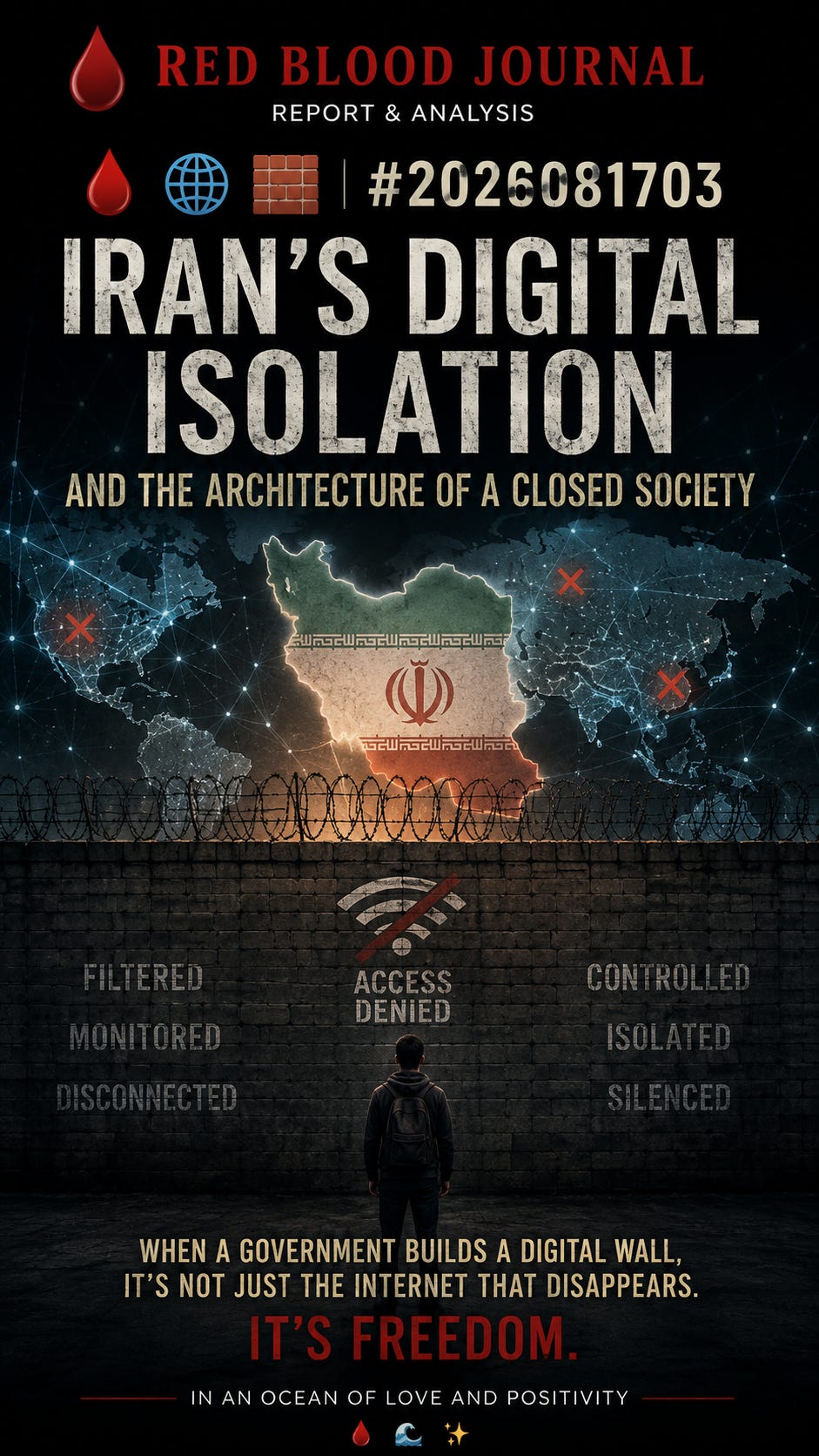
🩸 🌐 🧱 #2026081703 — Iran’s Digital Isolation and the Architecture of a Closed Society
When a government begins separating its citizens from the world, the internet is no longer only a communications system.
It becomes a border.
The material examined for this report describes a pattern developing inside Iran: severe internet disruption, worsening mobile and fixed connectivity, public complaints about basic communications services, official criticism of citizens for consuming too much internet, and discussion by former Iranian cyberspace officials of effectively separating Iran’s internet from the wider global network.
Taken individually, each development can have an ordinary explanation.
Networks become overloaded. Infrastructure deteriorates. Governments regulate telecommunications. Companies complain about costs.
But when all of these developments occur beside laws restricting foreign universities, foreign media, foreign institutions and contact with the outside world, another question becomes difficult to avoid:
Is Iran merely experiencing a bad internet system, or is the country gradually constructing an information border around its population?
The Internet Begins to Disappear
The source describes major internet disruptions across Iran affecting fixed internet, mobile services and data centers.
It cites internet-monitoring observations suggesting that Iranian connectivity fell sharply during the disruption and compares conditions with previous periods of major internet shutdowns. Ordinary users describe difficulty making telephone calls, accessing mobile data and maintaining normal fixed connections.
For someone outside Iran, slow internet can sound like an inconvenience.
Inside a tightly controlled political environment, it can mean considerably more.
The internet is how families communicate.
It is how businesses operate.
It is how students apply to universities.
It is how researchers exchange information.
It is how citizens publish photographs and videos.
It is how people discover what is occurring beyond their immediate neighborhood.
And perhaps most importantly, it is how information leaves Iran.
A communications disruption therefore affects two directions simultaneously:
what Iranians can see from the world, and what the world can see from Iran.
Then Came an Interesting Explanation
According to the source, an executive associated with AsiaTech argued that internet service in Iran had become so inexpensive that users were no longer managing their consumption properly.
The criticism was immediately compared with familiar arguments blaming citizens for excessive consumption of electricity, water and gas.
The pattern is politically interesting.
When infrastructure fails, responsibility can be assigned in several directions.
The government can blame poor investment.
The operator can blame government restrictions.
Management can blame technical limitations.
Or everyone can blame the customer.
Under that final model, scarcity itself becomes evidence of citizen irresponsibility.
The lights disappear because people use too much electricity.
Water disappears because people consume too much water.
Gas disappears because people use too much gas.
And now, potentially:
the internet deteriorates because people use too much internet.
That explanation may contain legitimate questions about network capacity and pricing.
But it also raises another question.
If citizens are repeatedly blamed for consuming basic services that modern society requires, when does infrastructure management become behavioral management?
The Word That Matters: Balkanization
One of the most important passages in the source concerns a former secretary of Iran’s Supreme Council of Cyberspace discussing what he characterizes as the desire among some policymakers to “Balkanize” the internet.
The analogy refers to separating a larger unified system into smaller isolated components.
In this case, the concept described is essentially:
an Iranian internet existing increasingly apart from the global internet.
Iran already possesses extensive domestic digital infrastructure.
A national network is not inherently sinister.
Countries maintain domestic servers, banking networks, government systems, data centers and internal services for many legitimate reasons.
The critical distinction is whether a domestic network supplements access to the global internet—
or replaces it.
Those two designs produce completely different societies.
One increases resilience.
The other can increase control.
The Digital Island
Imagine two versions of the internet.
In the first:
An Iranian student can read an American university website.
A doctor can communicate with researchers in Germany.
A musician can upload work to a global audience.
A journalist can send a photograph abroad.
A businessman can contact an international supplier.
A family can speak freely with relatives outside Iran.
Now imagine a second system.
Domestic banking works.
Government websites work.
Approved messaging applications work.
State news works.
Local shopping works.
Perhaps domestic entertainment works beautifully.
But large portions of the outside world become slow, unreliable, filtered or unreachable.
Technically, the population still has “internet.”
Practically, it has something very different.
It has an intranet with carefully managed windows.
The source itself says plainly that many Iranians want continued connection with the world while describing authorities as progressively tightening the surrounding walls.
That metaphor may be more important than internet speed tests.
This Is Not Only About the Internet
The communications story becomes more significant when placed beside another development discussed in the same material.
The proposed legislation described as a measure for “countering foreign infiltration” would impose restrictions on interactions with foreign media, universities, institutions and embassies.
According to the source, international academic cooperation could require security approval, contact with foreign embassies could require authorization, and organizations or individuals maintaining foreign connections could face extensive intelligence oversight.
The proposed restrictions described later extend into academic conferences, scholarships, research cooperation and certain exchanges of scientific or research materials.
Now the larger structure begins to appear.
One system controls the digital road connecting citizens to foreigners.
Another potentially controls the legal road connecting citizens to foreigners.
Viewed separately, they are telecommunications policy and national-security legislation.
Viewed together, they raise a larger possibility:
Iran may be moving from controlling specific foreign influences toward controlling the very act of foreign connection.
The North Korea Comparison
The source itself repeatedly invokes the possibility of Iran moving toward something resembling a North Korean model of isolation.
That comparison should be handled carefully.
Iran is not North Korea.
Iran has a large educated population, extensive international family networks, substantial technological expertise, an enormous diaspora and decades of exposure to global culture.
Its economy and society are structured differently.
Its political institutions are different.
Its technological environment is different.
But this may actually make the question more consequential.
North Korea built its isolation around a population that had been separated from much of the outside world for generations.
Iran would be attempting something different:
closing a population that already knows what the outside world looks like.
That is a far more difficult engineering problem.
Not a technical engineering problem.
A human one.
The Government’s Security Argument
There is another side that should not be ignored.
Iranian authorities can reasonably argue that hostile foreign governments conduct intelligence operations, cyberattacks, propaganda campaigns and covert political activity against Iran.
Those threats are not imaginary merely because a government uses them politically.
Iran exists inside an extremely hostile regional and international environment.
Foreign intelligence agencies undoubtedly seek information from Iran.
Foreign governments attempt to influence Iranian politics.
Cyberwarfare involving Iranian systems is well documented as a feature of modern geopolitical conflict.
From the government’s perspective, restricting foreign communication may therefore be presented as national defense.
The difficult question is not whether foreign threats exist.
They do.
The question is:
How much of a nation’s ordinary intellectual and social life can be placed behind a security checkpoint before national security becomes national isolation?
Security Has an Expanding Definition
Every restrictive system begins with something dangerous.
Espionage.
Terrorism.
Foreign intelligence.
Sabotage.
Few citizens object to preventing those things.
But the boundaries matter.
If “foreign influence” eventually includes:
a scientist speaking with another scientist,
a student applying to a foreign university,
a researcher attending a conference,
a citizen speaking to foreign media,
or an ordinary person communicating with people abroad,
then foreign infiltration no longer describes an activity.
It begins describing a relationship.
And when relationships themselves become suspicious, the walls can expand indefinitely.
Why Internet Architecture Matters Politically
A government does not necessarily need to disconnect the entire country.
Complete shutdowns are expensive.
They damage commerce.
They anger citizens.
They interfere with government operations themselves.
A more sophisticated system would allow most ordinary domestic digital life to continue while making global access increasingly unpredictable.
The result could be extremely powerful.
Citizens continue banking.
They continue shopping.
They continue watching entertainment.
They continue messaging one another.
Life appears digitally functional.
But the world’s information slowly becomes farther away.
This is fundamentally different from censorship of a newspaper.
A newspaper ban removes one publication.
An isolated network can shape the entire information environment.
The Quietest Form of a Border
Physical borders are obvious.
There are fences.
Guards.
Passports.
Checkpoints.
Digital borders are different.
They can appear as:
a page that will not load,
a VPN that suddenly stops working,
a video that buffers forever,
a message that never arrives,
a foreign website that mysteriously times out,
or an international service that simply becomes too frustrating to use.
There may never be a dramatic announcement:
“Iran is now disconnected from the world.”
The separation could happen gradually.
Ten percent here.
Twenty percent there.
Another service filtered.
Another protocol disrupted.
Another foreign platform blocked.
Another domestic substitute introduced.
Eventually, the population may still possess smartphones, fiber connections and mobile applications while inhabiting a fundamentally different information universe.
The Red Blood Perspective
The most important question may not be whether Iran’s internet becomes completely disconnected.
That is an extreme benchmark.
The more useful question is whether connection with the outside world becomes sufficiently difficult, sufficiently monitored and sufficiently legally dangerous that ordinary people begin avoiding it themselves.
A perfectly functioning censorship system does not require blocking everyone.
It only requires teaching enough people that crossing the invisible boundary carries consequences.
Then citizens begin building the wall for the government.
They stop clicking.
They stop speaking.
They stop applying.
They stop contacting.
They stop sharing.
Eventually the border moves from the router into the mind.
Ocean of Love and Positivity Perspective
A society does not become stronger by preventing its people from seeing the rest of humanity.
Knowledge is not a foreign invasion.
A conversation is not automatically espionage.
A university is not automatically an intelligence service.
A scientist speaking with another scientist is not automatically betrayal.
Human civilization advanced because ideas crossed borders long before governments learned how to build them.
If information becomes dangerous simply because it originates somewhere else, then every country eventually becomes poorer—not only economically, but intellectually and spiritually.
The healthier direction is not an Iran disconnected from the world.
Nor a world attempting to dominate Iran.
It is an Iran secure enough in itself that its people can communicate freely, learn freely, question freely and contribute freely.
A confident civilization does not need to hide its citizens from the ocean.
It teaches them how to swim in it.
In an Ocean of Love and Positivity.
🩸🌊✨ Fantastic!
🧱
Iran’s Digital Border: The Architecture of Isolation
Aug 17, 2026
The provided text examines the systematic digital and physical isolation of Iran as the government implements policies to separate its citizens from the global community. This transition involves deteriorating internet connectivity and new legislation that restricts interactions with foreign institutions, media, and universities. By blaming users for network scarcity and promoting a “Balkanized” internet, authorities are accused of shifting toward a model of behavioral management and state control. The source suggests that these measures aim to transform the internet from a communication tool into a controlled border, potentially moving the nation toward a state of permanent information seclusion. Ultimately, the report highlights the tension between national security justifications and the fundamental human need for global connection and intellectual freedom.


