


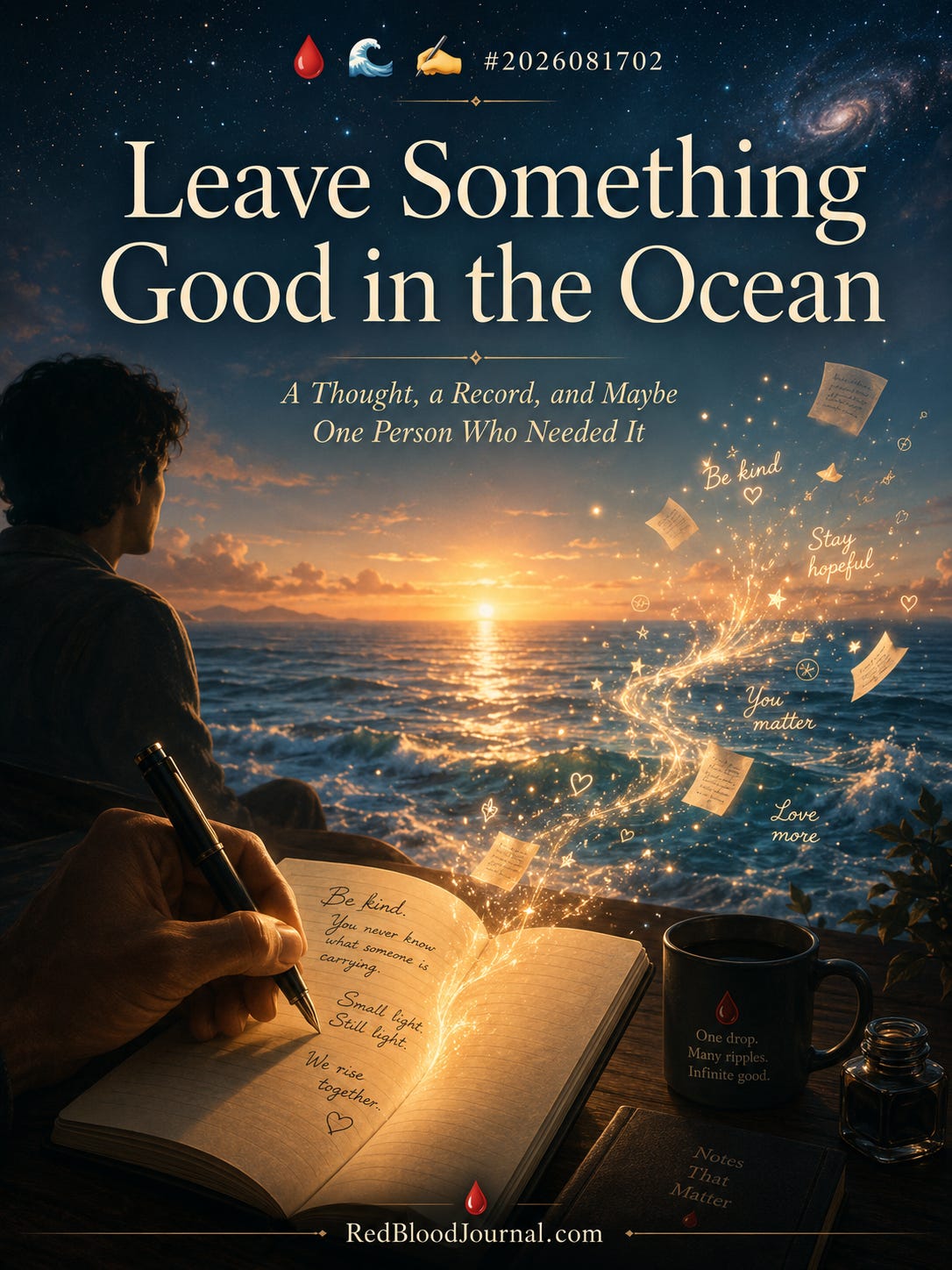
🩸 🌊 ✍️ 💧 #2026081702 — Leave Something Good in the Ocean
A Thought, a Record, and Maybe One Person Who Needed It
RedBloodJournal.com
There is a strange kind of thought that visits almost everyone.
It arrives suddenly.
While driving.
While showering.
While staring out a window.
While talking to someone.
While doing absolutely nothing important.
For a few seconds, something connects.
An idea.
A question.
A realization.
A different way of looking at something.
Maybe something useful.
Maybe something ridiculous.
Maybe something that could help another human being.
And then life interrupts.
The phone rings.
The light turns green.
Someone asks a question.
The television changes the subject.
And ten minutes later:
Gone.
Not just forgotten.
Sometimes even the memory of what was forgotten disappears.
I Started Writing Them Down
At some point, I developed a very simple habit.
When one of those thoughts appears, I write it down.
It does not have to be beautiful.
It does not have to be organized.
It does not even have to make complete sense yet.
Just capture it.
A sentence.
A few words.
A question.
Anything.
Because once the thought is written somewhere, something interesting happens.
The mind can let it go.
There is no longer the little background voice saying:
Don’t forget this.
The thought is safe.
It can be returned to tomorrow.
Or next month.
Or never.
And strangely, this simple practice reduced stress.
The brain no longer had to become a warehouse for unfinished thoughts.
Then Something Else Happened
Eventually I realized that some of those little notes were worth investigating.
So I investigated them.
Then some became reports.
And then another realization arrived.
One day I will be gone.
Everyone will.
But the thoughts do not necessarily have to disappear with the person who had them.
If they are written down, they remain.
If they are published, someone else may encounter them.
Maybe tomorrow.
Maybe twenty years from now.
Maybe never.
But the possibility exists.
And suddenly writing became about something much larger than remembering.
It became about leaving something behind.
Not a Monument
I am not talking about leaving behind a statue.
Or a fortune.
Or a famous name.
Or convincing the world that I was right.
Quite the opposite.
A report can simply say:
This is what I saw.
This is what I wondered.
This is what I learned.
This is where I may have been wrong.
This is what I thought might be worth examining.
Take what helps.
Question what does not.
Improve the rest.
That may be enough.
My Search for Meaning
For much of a lifetime, I searched for an explanation of what all of this means.
Religion offered answers.
Philosophy offered answers.
Politics offered answers.
Science offered pieces of answers.
Culture offered answers.
People offered answers.
Some were beautiful.
Some were useful.
Some contradicted one another.
Some demanded belief before understanding.
None completely settled the question for me.
Then came what I describe as the Ocean of Love and Positivity.
I cannot prove that metaphor to another person.
Nor should anyone accept it simply because I say it makes sense to me.
But internally, something changed.
The idea that we are individual expressions within something larger—and that what we place into that larger whole matters—gave me a framework that felt remarkably simple.
Instead of constantly asking:
What am I supposed to get from life?
The question slowly became:
What am I putting into it?
That change mattered.
One Clean Drop
Here is the idea in its simplest form.
Imagine humanity as an ocean.
Every interaction contributes something to it.
Fear.
Anger.
Kindness.
Knowledge.
Humor.
Manipulation.
Compassion.
Deception.
Curiosity.
Help.
Everybody adds something.
None of us controls the entire ocean.
That would be an impossible responsibility.
But perhaps each person can take responsibility for one thing:
What am I personally pouring into it?
I cannot clean the whole ocean.
But I can try not to intentionally dirty my little portion of it.
And perhaps I can contribute something useful.
One thought.
One report.
One conversation.
One act.
One clean drop.
My Strange Insurance Policy
There is also a slightly humorous way I sometimes think about it.
If there really is some greater Ocean waiting at the end of all this, I would like to arrive carrying my records.
Not because the reports prove that I was right.
They certainly will not.
Some predictions will probably look ridiculous.
Some conclusions will age badly.
Some questions may turn out to have obvious answers.
But maybe the archive can at least say:
I was trying.
I questioned.
I examined.
I changed my mind.
I tried to understand.
I tried to avoid unnecessary hatred.
And when I thought something might help another person, I did not intentionally keep it locked inside my head.
Consider it my extremely unofficial receipt for participation.
But This Report Is Not Really About Me
This is the part I hope someone else considers.
You have these thoughts too.
Everyone does.
You may not want to write reports.
Fine.
You may never publish anything.
Fine.
You may not believe in an Ocean.
Also fine.
But consider capturing the thoughts.
Your observations.
Your mistakes.
The lessons you learned the expensive way.
The thing you wish someone had told you thirty years ago.
The trick you discovered at work.
The sentence your grandmother once said that suddenly makes sense.
The strange idea that came while walking the dog.
Write it down.
Because one of those thoughts may contain something another human being needs.
Do Not Wait for Genius
This is probably the biggest trap.
People think something must be important before it deserves to be recorded.
How would you know?
Importance is often visible only later.
The stupid little note from Tuesday may connect with the strange observation from February and suddenly become something worth investigating.
Do not appoint yourself judge too early.
Capture first.
Judge later.
A very simple system works:
Thought.
Capture.
Release.
Revisit.
Investigate.
Share, if useful.
That is it.
Publishing Changes the Equation
A private note helps the writer.
A published thought has the possibility of helping someone else.
That does not mean everything should be published.
Privacy matters.
Accuracy matters.
Other people’s dignity matters.
And some thoughts belong exactly where they began: inside a notebook.
But when something survives investigation and appears genuinely useful, sharing it creates an extraordinary possibility.
The author no longer controls where the idea goes.
Someone may disagree with it.
Someone may improve it.
Someone may completely dismantle it.
Someone may build something better from it.
Excellent.
That means the thought lived.
What If Only One Person Reads It?
Then one person read it.
What if one sentence helps that person?
Then it worked.
This may be one of the healthiest discoveries I have made about publishing.
The value of an idea does not necessarily equal the size of its audience.
A million views can produce nothing.
One reader can sometimes produce a lifetime consequence.
We have become accustomed to measuring ideas by clicks, followers, subscribers and algorithms.
But humanity existed long before analytics dashboards.
Maybe another measurement deserves consideration:
Did anything useful enter the world because I was here?
That is a much quieter metric.
But perhaps a more meaningful one.
A Small Experiment
So here is the invitation.
Not a philosophy that must be believed.
Not another doctrine.
Just an experiment.
For thirty days, whenever one of those little flash thoughts appears, write it down immediately.
Do not polish it.
Do not judge it.
Do not worry whether it is profound.
At the end of each week, read the notes.
Choose one that still interests you.
Investigate it.
Talk about it.
Research it.
Write about it.
Or simply keep it.
Then notice what happens.
Notice whether your mind feels lighter.
Notice whether you begin seeing connections between ideas.
Notice whether forgotten pieces of yourself begin accumulating into something larger.
And perhaps notice whether contribution starts producing a kind of meaning that searching alone never did.
The Red Blood Perspective
A human life produces enormous amounts of unrecorded thought.
Most of it disappears.
Perhaps that is perfectly natural.
But modern technology has given ordinary people something almost no previous generation possessed at this scale:
The ability to preserve an idea and make it available to another human being almost anywhere on Earth.
That ability does not have to be used for fame.
It can simply be used for contribution.
An archive does not have to declare:
Look how important I was.
It can quietly say:
I was here.
I paid attention.
I tried to understand.
Here is anything useful I managed to collect.
Ocean of Love and Positivity Perspective
The Ocean does not require everyone to become a philosopher.
It does not require everyone to become a writer.
It does not require everyone to agree.
Maybe it asks something much simpler.
Become conscious of what you contribute.
When something helpful enters the mind, do not automatically let it disappear.
Capture it.
Examine it.
Clean it up.
And if it still seems worth placing into the world, release it.
Perhaps someone else will find it.
Perhaps they will add something to it.
Perhaps what began as one person’s passing thought becomes another person’s useful idea.
And perhaps that is how positivity actually moves.
Not through enormous declarations.
Drop by drop.
Person by person.
Thought by thought.
If someday there really is an Ocean to return to, perhaps the best record any of us can carry is simply this:
I tried to leave it a little cleaner than I found it.
In an Ocean of Love and Positivity.
🩸🌊✨ Fantastic!
💧
One Clean Drop: The Art of Capturing Thought
Aug 17, 2026
This text encourages individuals to preserve their fleeting thoughts by writing them down rather than letting them disappear. By capturing these observations, people can reduce mental stress and create a meaningful record of their personal growth and realizations. The author suggests that sharing these insights serves as a “clean drop” contributed to the collective human experience, potentially helping others in the future. Rather than seeking fame or perfection, the goal is to take responsibility for one’s contributions to the world. Ultimately, the practice turns simple writing into a way of leaving behind something useful for the next generation.


