


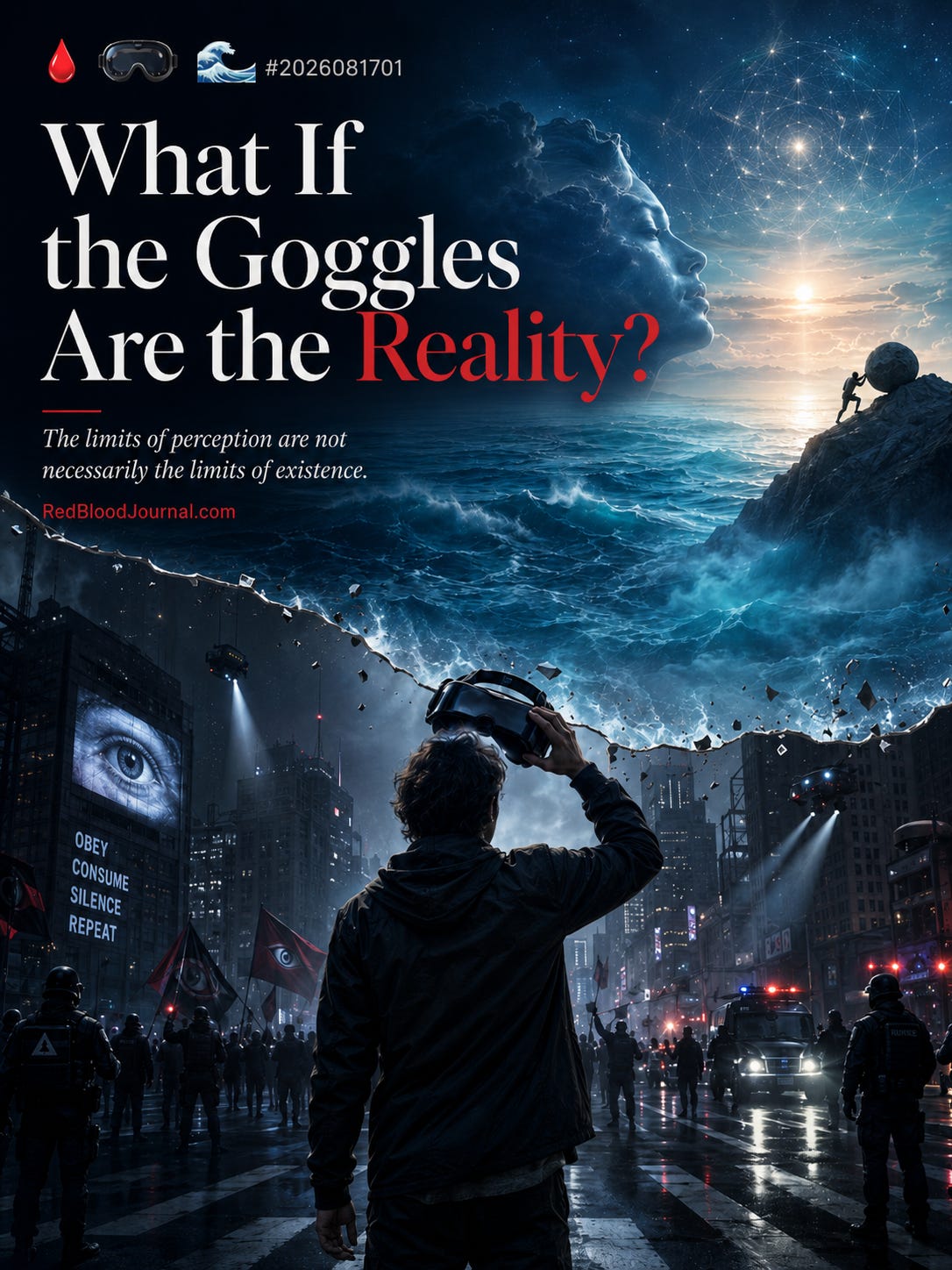
🩸 🥽 🌊 #2026081701 — What If the Goggles Are the Reality?
The Ocean of Love and Positivity Is Not an Answer — It Is a Refusal to Mistake the Limits of Perception for the Limits of Existence
RedBloodJournal.com
The conversation began with Iran.
A person living there described what he sees at night.
At intersections, groups gather with the regime’s flags.
They chant.
They are organized.
And behind all of it is the fact that gives their visibility weight:
they have the guns.
He was not saying they are the numerical majority.
He meant something much more practical.
The people with the guns become the majority that matters because they can determine what happens in the visible world.
They can control the street.
They can influence public behavior.
They can impose consequences.
From inside that reality, the argument is difficult to dismiss.
Then came the reply:
Reality is not only what you see. Much of reality is what you do not see.
At first that sounds political.
Perhaps the people inside the apartments think differently.
Perhaps the visible crowd does not represent the population.
Perhaps fear hides a silent majority.
All of that may or may not be true.
But that was not really the point.
The point was much larger.
What if the reality we see is itself the goggles?
Forget Iran for a Moment
Suppose every single person at those intersections genuinely believes what he is chanting.
Suppose there is no hidden opposition.
Suppose the armed side really does control the country.
Suppose the political order remains exactly as it is for another hundred years.
None of that changes the question.
Because the question is not:
Who really controls Iran?
The question is:
What exactly are we calling reality?
That is where the VR goggles matter.
Put On the Headset
A person puts on virtual-reality goggles.
Suddenly he is standing at the edge of a cliff.
His heart begins to race.
His muscles tighten.
His body refuses to move forward.
Everything he sees tells him:
One more step and you fall.
The fear is real.
The physical reaction is real.
The experience is real.
But the person standing next to him without the goggles sees a carpet.
No cliff.
No abyss.
No danger.
Who is seeing reality correctly?
That question is already more complicated than it sounds.
The person wearing the goggles is not hallucinating.
He really is experiencing the cliff.
The person outside the headset is not imagining the carpet.
He really is seeing the room.
Both are observing something real.
But they are observing different levels of the same situation.
The mistake would be assuming that the reality available inside the headset must therefore be the entirety of reality.
Now Look at Human Life
Human beings also experience reality through an interface.
Eyes.
Ears.
Touch.
Memory.
Language.
Culture.
Time.
The nervous system.
The brain.
We do not encounter existence directly in some unlimited form.
We encounter whatever our biological equipment allows us to encounter.
And because we have never taken the equipment off, the rendered world feels complete.
Of course it does.
A person born permanently inside VR would probably say the same thing.
“What do you mean there is something outside this? Show it to me.”
And if nobody could show him, he might conclude:
“Then there is nothing outside.”
But that conclusion would go beyond the evidence.
The correct statement would be:
“I cannot currently perceive anything outside.”
Those are not the same sentence.
The Ocean Begins There
The Ocean of Love and Positivity is not a declaration that we know what exists beyond human perception.
It does not say:
There definitely is another world.
It does not say:
Consciousness definitely survives death.
It does not say:
The body is definitely an avatar.
It says something much more modest:
Why are we so certain that the limits of our perception are the limits of existence?
That is the doorway.
Not certainty.
Not religion.
Not denial.
A question.
And perhaps humility.
The Gun Inside the Goggles
Now return to the person holding the gun.
The gun is real within this experience.
It can injure a body.
It can end a body’s life.
It can create fear.
It can control behavior.
It can imprison.
Nothing about the Ocean requires pretending otherwise.
The Ocean does not say:
Ignore the man with the gun because reality might be larger.
That would be foolish.
It asks:
What exactly does the gun possess?
The body?
Possibly.
Movement?
Possibly.
Speech?
Possibly.
Fear?
Often.
But does it possess the entire being?
That question cannot be answered simply by pointing at the weapon.
The gun demonstrates power inside the experience.
It does not prove that the experience is the entirety of existence.
The Character and the Player
This becomes easier to understand through a game.
A character in a game can lose everything.
Money.
Health.
Status.
Freedom.
Possessions.
Eventually the character can die.
Inside the game, those events are enormous.
But the player and the character are not necessarily identical.
When the character dies, the player remains.
That distinction seems almost embarrassingly obvious when discussing a video game.
Then apply it to ourselves and suddenly the idea becomes uncomfortable.
We say:
I am old.
I am afraid.
I am Iranian.
I am American.
I am poor.
I am powerful.
I am imprisoned.
But who exactly is the I?
The body changes.
Opinions change.
Memories change.
Personalities change.
Political identities change.
Almost everything we attach to the word I changes.
Yet throughout those changes there remains the experience of being the one to whom the changes are happening.
That may be nothing more than brain activity.
Perhaps it is.
But perhaps it is not.
Again, the Ocean does not pretend to know.
It refuses to close the question prematurely.
Then Came Sisyphus
The person in Iran sent Albert Camus’s The Myth of Sisyphus.
That turned out to be almost the perfect book for this conversation.
Camus confronts one of the most fundamental problems possible.
Human beings want meaning.
The universe does not clearly provide it.
That collision produces what Camus calls the absurd.
He describes the absurd as arising from the confrontation between human longing for clarity and the unreasonable silence of the world.
Sisyphus becomes the symbol.
He pushes the rock uphill.
It falls.
He returns.
He pushes it again.
The punishment does not end.
Camus does not rescue him.
No god arrives.
No hidden doorway opens.
No cosmic explanation is provided.
Instead, consciousness changes Sisyphus’s relationship with his fate.
At the end, Camus portrays the struggle itself as capable of filling the human heart and leaves us with the famous challenge to imagine Sisyphus happy.
That is profound.
But the goggles introduce another question.
What If Sisyphus Never Asked About the Headset?
Camus asks:
How should Sisyphus live knowing that the rock will always return?
The Ocean asks:
How does Sisyphus know the mountain is the largest reality?
Perhaps it is.
Perhaps there is nothing outside it.
Perhaps the rock, the mountain, consciousness and death are exactly what they appear to be.
But perhaps not.
And the distinction matters because Camus’s refusal to invent an answer beyond the world does not logically establish that nothing exists beyond the world.
He refuses certainty.
The Ocean agrees.
But refusing certainty works both ways.
It means we should also hesitate before declaring:
This is all there is.
Grok’s revised version put this particularly well:
Camus refuses to fill the silence with certainty. But refusing certainty does not require refusing the question.
That may be where Camus and the Ocean finally separate.
Camus stops at the silence.
The Ocean remains curious about what the silence means.
The Greatest Prison May Not Have Walls
Now something else becomes visible.
Suppose an armed government controls a population.
That government can occupy the streets.
It can occupy television.
It can occupy institutions.
But there may be a more complete form of occupation.
The government can become the central object inside the consciousness of the person resisting it.
Every morning:
the government.
Every conversation:
the government.
Every emotion:
the government.
Every fear:
the government.
Every hope:
the government.
Every future:
the government.
A person can hate the ruler completely and still allow the ruler to occupy almost every room inside the mind.
That is a strange form of victory.
The jailer no longer needs to stand in the room.
The prisoner carries the jailer everywhere.
Grok’s revision captured this sharply when it asked what happens when the prison is reconstructed inside the prisoner.
That is where love and positivity stop sounding decorative.
They become resistance.
Why Love?
Why not anger?
Why not hatred?
Why not revenge?
Sometimes anger is appropriate.
Sometimes outrage is necessary.
Sometimes resisting injustice requires enormous force of will.
The Ocean does not demand emotional anesthesia.
It asks something different.
If another person’s cruelty can turn us permanently cruel, then that person has changed more than our circumstances.
He has helped construct us.
If hatred becomes the organizing principle of consciousness, the hated object continues ruling long after leaving the room.
So perhaps love is not simply kindness toward an enemy.
Perhaps love is a refusal to surrender ownership of consciousness.
And perhaps positivity is not pretending something terrible is wonderful.
Perhaps positivity is refusing to allow the terrible thing to become the only thing.
That is a much stronger idea.
The Ocean Is Not Escapism
This distinction matters.
The Ocean does not say:
The cliff is fake, so walk forward.
It says:
Understand the cliff while remembering the headset.
The Ocean does not say:
The gun is imaginary.
It says:
Respect what the gun can do without assuming it explains the entirety of existence.
The Ocean does not say:
Suffering is not real.
It says:
Suffering may be part of the experience without being the definition of the experiencer.
Those are very different ideas.
What We Cannot See
Perhaps what lies outside human perception is nothing.
Perhaps consciousness ends completely with the body.
Perhaps this universe is exactly as Camus feared: silent, indifferent and without an answer.
That remains possible.
But the opposite possibility also remains open.
Perhaps our sensory system renders only a tiny portion of reality.
Perhaps consciousness is something we understand poorly.
Perhaps death changes the observer rather than annihilating it.
Perhaps the human being is more like a player than a character.
Perhaps not.
We do not know.
That is precisely the point.
The Ocean is not built on knowing.
It is built on refusing to turn ignorance into certainty.
The Real Meaning of the Goggles
The VR metaphor is therefore not:
“Politics is an illusion.”
It is not:
“Iran is an illusion.”
It is not:
“Pain is an illusion.”
It is not even:
“Life is an illusion.”
It is much simpler.
Every reality we experience is being experienced through something.
And until we fully understand the thing doing the experiencing, perhaps humility is wiser than certainty about the limits of reality.
The Red Blood Perspective
Human beings have an unusual habit.
We discover something we cannot perceive and then expand our definition of reality.
Microbes existed before microscopes.
Radio waves existed before radios.
Galaxies existed before telescopes.
The unseen repeatedly becomes seen.
That does not prove another metaphysical layer exists.
But it should make certainty about the boundaries of existence uncomfortable.
The most dangerous intellectual mistake may not be believing in something unseen.
It may be believing that unseen means nonexistent.
The Ocean of Love and Positivity Perspective
The Ocean does not claim to know what lies beyond the goggles.
It simply refuses to mistake the goggles for the entire universe.
The rock may be real.
The mountain may be real.
The gun may be real.
The prison may be real.
The fear may be real.
The character may suffer terribly.
But perhaps the deepest question is not:
How do I defeat everything inside the experience?
Perhaps it is:
What am I that is experiencing it?
And until that question is answered, perhaps no government, no gun, no ideology, no suffering and no temporary circumstance deserves to be granted ownership of the entirety of the self.
Camus taught Sisyphus to become conscious of the rock.
The Ocean asks him to become conscious of the goggles.
Not so he can deny the mountain.
Not so he can pretend the stone is light.
But so that somewhere inside the struggle he can still remember:
The experience may be real without being all of reality.
And perhaps that is where love and positivity come from.
Not from blindness.
From perspective.
Not from denial.
From consciousness.
Not from escaping reality.
From refusing to assume that the part we can see is the whole.
The Ocean of Love and Positivity is not an answer to what lies beyond the goggles.
It is the refusal to confuse the limits of the goggles with the limits of existence.
In an Ocean of Love and Positivity.
🩸🌊✨ Fantastic!
🥽
Beyond the Goggles: The Limits of Perception
Aug 17, 2026
The provided text explores the philosophical concept that human perception acts as a virtual-reality interface, filtering a vast existence into a limited, manageable experience. Using the metaphor of VR goggles, the author argues that while our physical struggles—such as political oppression or suffering—are undeniably real within our current perspective, they do not necessarily define the entirety of reality. By examining the “Ocean of Love and Positivity,” the text suggests that true consciousness involves recognizing the boundaries of our biological and sensory equipment without mistaking those limits for the edge of the universe. This perspective encourages a form of spiritual resistance, where one refuses to let external hardships or “the gun” fully occupy their internal self. Ultimately, the work advocates for humility and curiosity over certainty, proposing that maintaining a sense of what lies beyond our immediate view is the key to psychological and existential freedom.


