


https://t.me/RedBloodTransmission
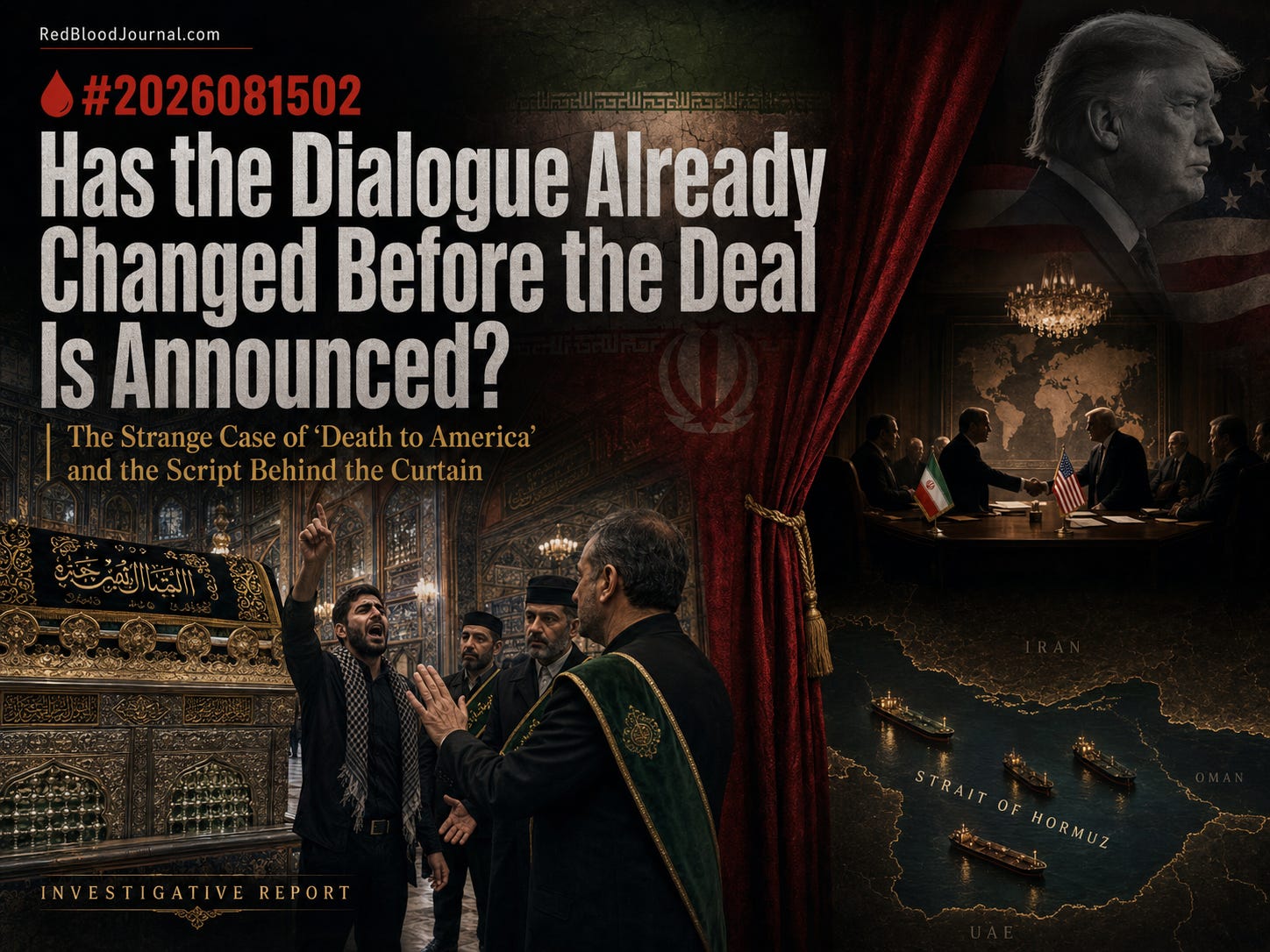
🩸 🎭 #2026081502 — Has the Dialogue Already Changed Before the Deal Is Announced?
The Strange Case of “Death to America,” the Imam Reza Shrine, and the Possibility That the Next Scene Has Already Been Written
RedBloodJournal.com
Something very small happened in Mashhad.
And sometimes the smallest political events are worth examining precisely because nobody is supposed to notice them.
A man described online as an arzeshī—a supporter of the Islamic Republic—stood near the burial place of Ali Khamenei inside the Imam Reza shrine and began chanting:
“Death to America.”
“Death to Trump.”
Then shrine personnel stopped him.
😊
Ordinarily, that would hardly deserve an international investigation.
Except there is a problem.
For nearly half a century, “Death to America” has not been an embarrassing slogan the Islamic Republic tries to suppress.
It has been part of the furniture.
It has been shouted at Friday prayers.
It has appeared at government-organized rallies.
It has decorated walls.
It has survived presidents, wars, negotiations, sanctions, nuclear agreements and multiple generations of American administrations.
Ali Khamenei himself said in 2019 that “Death to America” referred to Trump and other American leaders rather than ordinary Americans.
So imagine the political comedy.
For decades:
“Death to America!”
Approved.
“Death to Trump!”
Approved.
Then suddenly, at Ali Khamenei’s own burial site:
“Death to America!”
“Sir... could you not?”
That deserves a second look.
First: What Actually Happened?
The viral interpretation is that the slogan itself has somehow become prohibited.
The Imam Reza shrine has given another explanation.
According to the shrine, there has been no prohibition on “Death to America.” Personnel supposedly intervened because Qur’an recitation was taking place in the hall and chanting was inappropriate during that ceremony.
That explanation is entirely possible.
And if this were the only strange occurrence, the investigation could probably end there.
But it isn’t.
We Have Seen This Rumor Before
This is where the story becomes considerably more interesting.
Following the U.S.–Iran agreement in June 2026, reports circulated inside Iran claiming that the agreement had resulted in restrictions on slogans against the United States and perhaps even the burning of American flags.
The Iranian judiciary’s Mizan news service publicly denied those reports and called them false.
That means today’s controversy is not appearing in isolation.
We now have essentially the same question emerging twice, both times surrounding periods of U.S.–Iran negotiations:
Has anti-American political messaging become inconvenient?
The official answer remains:
No.
Red Blood therefore cannot report that “Death to America” has been banned.
There is currently insufficient evidence for that conclusion.
But something else can be investigated.
What If We Are Watching the Dialogue Change Before the Plot Changes?
Consider politics as theater for a moment.
The audience watches actors arguing furiously onstage.
One threatens the other.
The other threatens back.
There are explosions.
Sanctions.
Ships.
Missiles.
Speeches.
Flags.
Television commentators.
Everyone appears furious.
Meanwhile, backstage, lawyers are arguing over paragraph seven.
Diplomats are discussing frozen assets.
Bankers are calculating sanctions waivers.
Oman is discussing shipping lanes.
Pakistan is carrying messages.
European foreign ministers are making telephone calls.
And somebody somewhere is asking:
“Who announces what first?”
That scenario no longer requires imagination.
Much of it is already happening publicly.
Because There Already Is a Script
The most important piece of evidence is not the shrine video.
It is the Islamabad Memorandum of Understanding signed between Iran and the United States in June.
The 14-point document was subsequently transmitted by the White House to Congress.
Look at what was actually contemplated.
Iran and the United States agreed to terminate military operations.
They agreed not to threaten or use force against one another.
They agreed to respect each other’s sovereignty.
And then comes an extraordinarily interesting sentence:
Both governments agreed to refrain from interfering in each other’s internal affairs.
That is Paragraph 2.
The agreement went much further.
Washington agreed to begin removing its naval blockade.
Iran would facilitate commercial shipping through Hormuz.
A minimum $300 billion reconstruction and economic development framework was contemplated.
The United States committed, under the contemplated final agreement, to a schedule for terminating sanctions.
Iranian oil could receive waivers.
Frozen or restricted Iranian assets could become available.
Iran reaffirmed that it would not procure or develop nuclear weapons.
The highly enriched material would eventually be dealt with under an agreed mechanism and IAEA supervision.
That is not a rumor.
That document exists.
And suddenly the strange political situation becomes easier to understand.
The War May Not Be About Finding a Deal Anymore
There is another possibility.
Perhaps the framework for the deal has already been discovered.
What the two governments cannot agree upon is how to implement it.
That distinction is enormous.
The question may no longer be:
“What would an American-Iranian agreement look like?”
We already know approximately what it could look like.
The question may instead be:
“Who moves first?”
This is exactly what officials were saying when the June agreement was negotiated.
A senior U.S. official described the critical problem as sequencing—determining who performs which obligation, and when.
And here we are again in August.
Same problem.
Different act.
Iran Says There Are No Talks
Correct.
At least officially.
Foreign Minister Abbas Araqchi has said Iran and the United States are not presently engaged in direct negotiations.
But in the same description, Iran acknowledges that messages are being exchanged through intermediaries.
Welcome to diplomacy.
“We are not talking.”
“How did they receive your proposal?”
“We told somebody who told somebody.”
Fantastic.
The characters are not talking.
They are merely communicating.
Oman Is Already Building the Door
Iran has said its agreement with Oman concerning future Strait of Hormuz arrangements was in its “final stages.”
According to Iranian officials, the framework would define shipping lanes to be used if broader conditions for reopening Hormuz are satisfied.
That matters.
You do not normally design the parking lot for a restaurant you have absolutely no intention of opening.
It does not prove that an American-Iranian settlement is imminent.
But it shows that at least some of the infrastructure required after an agreement is already being discussed.
Then Look at Washington
Trump told Axios that Washington was “low-keying it” with Iran and characterized the situation as a form of partial negotiation. Iran simultaneously denied direct negotiations while acknowledging intermediary messages.
Those statements sound contradictory.
They may not be.
One side may define “negotiation” as representatives sitting together.
The other may define communication through mediators as negotiation.
Both descriptions could therefore be technically true.
And both governments retain the ability to tell their domestic audiences:
“We did not surrender.”
Now Austria and Greece Suddenly Enter the Movie
This week another curious development appeared.
Secretary of State Marco Rubio met the Austrian foreign minister and spoke with the Greek foreign minister.
Soon afterward, both European foreign ministers communicated with Iranian Foreign Minister Abbas Araqchi.
The State Department denied requesting that they deliver messages.
A European diplomat briefed on the contacts reportedly said the timing was not accidental.
Austria matters because Vienna houses the IAEA and has historically served as a venue for nuclear diplomacy.
Greece matters because of its enormous shipping interests.
Neither is random in a dispute involving:
nuclear inspections + Hormuz + international shipping.
Austria has even offered itself as a location for possible negotiations.
The theater apparently has several backstage entrances.
But Wait — Everyone Is Still Screaming
And this is the strongest argument against the theory that an imminent agreement has already been quietly settled.
The Strait of Hormuz remains severely disrupted.
Ships have been attacked.
Washington is threatening additional economic pressure.
Iran continues issuing strong conditions.
Trump continues issuing threats of his own.
Iran wants sanctions relief, access to frozen assets, an end to American pressure and compensation.
Washington wants Hormuz reopened and continues pressing the nuclear issue.
That does not look like two governments preparing to exchange friendship bracelets.
It looks like a confrontation.
Unless—
Unless the Confrontation Is Part of the Negotiation
This is where predictive analysis becomes difficult.
Escalation does not necessarily mean diplomacy has failed.
Sometimes escalation is diplomacy conducted with explosives.
Iran’s strongest bargaining instrument is Hormuz.
America’s strongest bargaining instruments include sanctions, financial isolation and military power.
Each side therefore possesses something the other wants removed.
Iran:
“Remove the sanctions and pressure.”
Washington:
“Open the Strait.”
Iran:
“You first.”
Washington:
“No, you first.”
Ladies and gentlemen, after months of war, we may have successfully reinvented marriage.
The June Agreement Tells Us What Each Side Wants
And this is why the June document is so predictive.
It already contains a possible exchange:
Iran gives:
Reduced military confrontation.
Commercial passage through Hormuz.
A nuclear-weapons commitment.
A mechanism addressing enriched uranium.
Future negotiation over enrichment.
Washington gives:
Reduced military confrontation.
Removal of the blockade.
Oil sanctions waivers.
Eventual sanctions termination under a final deal.
Access to frozen Iranian assets.
Withdrawal of forces from Iran’s proximity after a final agreement.
A proposed reconstruction and development framework.
Those pieces have already been placed on the table.
The current fight appears increasingly concerned with conditions, compliance, sequencing and who receives what first, rather than inventing a completely new diplomatic architecture.
Which Brings Us Back to the Man at the Grave
Now the tiny Mashhad incident looks different.
Not necessarily sinister.
Not necessarily coordinated.
Not necessarily important.
But potentially useful as an indicator.
Political systems prepare populations for policy changes.
The United States does it.
Iran does it.
Every government does it.
Yesterday’s monster can become tomorrow’s negotiating partner.
Yesterday’s impossible concession becomes tomorrow’s historic breakthrough.
And governments rarely announce:
“Attention citizens. Please immediately reverse everything we have trained you to believe for the past forty-seven years.”
The language normally changes gradually.
One word disappears.
Another appears.
A television host stops mentioning something.
A cleric chooses different terminology.
A slogan becomes less enthusiastic.
A photograph disappears.
An old enemy becomes an “adversary.”
Then a “counterparty.”
Then a “regional actor.”
Then someone shakes someone’s hand.
Red Blood’s Predictive Hypothesis
So let us formulate the hypothesis carefully.
Hypothesis:
The United States and Islamic Republic have already identified most of the architecture necessary for another settlement, largely based upon the June memorandum, and the present confrontation concerns leverage, sequencing, guarantees and presentation.
Under this hypothesis, both governments would continue publicly behaving as opponents while privately or indirectly negotiating how to transform the earlier framework into an enforceable arrangement.
Iran would need to demonstrate that American pressure failed.
Trump would need to demonstrate that Iranian pressure failed.
Iran would call the outcome resistance.
Trump would call the outcome victory.
Both could sign approximately the same piece of paper.
That is politics.
What Would We Expect to See Next?
Here is where Red Blood can make the investigation predictive rather than retrospective.
If this hypothesis is correct, several changes should eventually begin appearing.
Not necessarily simultaneously.
Not necessarily dramatically.
But directionally.
First: Iranian language toward Trump should soften.
“Death to Trump” would become increasingly awkward if the Iranian government expects Trump personally to sign or guarantee an agreement.
That does not require formally banning the slogan.
It only requires no longer encouraging it.
Second: “Death to America” May Remain — But Become Ceremonial
The Islamic Republic cannot easily delete one of its foundational revolutionary slogans overnight.
It may instead separate the slogan from current diplomacy.
The government could continue permitting it at anniversary ceremonies while reducing its prominence elsewhere.
That would preserve revolutionary mythology while allowing practical negotiation.
The slogan becomes heritage rather than instruction.
Political museum furniture.
Do not throw it away.
Just stop sitting on it.
Third: Trump May Become Less Interested in Regime Change
Watch Washington carefully.
If American rhetoric increasingly emphasizes:
Hormuz.
Nuclear guarantees.
Shipping.
Sanctions.
Verification.
rather than overthrowing the Islamic Republic, that would support the possibility that Washington is moving toward transactional coexistence.
AP reported this week that the administration’s immediate stated priority has increasingly become reopening Hormuz, while preventing an Iranian nuclear weapon remains another central objective.
That shift deserves attention.
Fourth: Watch the Money, Not the Speeches
This may be the single strongest indicator.
Forget slogans.
Watch:
Iranian oil waivers.
Frozen assets.
Banking permissions.
Insurance.
Shipping rules.
Sanctions enforcement.
Blockade changes.
If technical financial restrictions begin quietly loosening before a grand political announcement, the movie may already be moving toward its final scene.
The June memorandum specifically provides mechanisms for each of those areas.
Fifth: Watch Hormuz
Hormuz may be the scoreboard.
Not the speeches.
Not Trump Truth Social posts.
Not Tehran television.
Ships.
If commercial traffic begins increasing consistently, insurance costs begin normalizing, attacks diminish and Oman-administered arrangements start operating, something substantial has changed.
The Strait is too economically important for movement there to be dismissed as rhetoric.
Iran currently says the Oman framework is nearing completion even while broader American-Iranian disagreements remain unresolved.
That makes Hormuz perhaps the cleanest observable indicator available.
Sixth: Watch the Iranian Hardliners
This may be even more revealing than watching reformists.
Pezeshkian supporting negotiations tells us relatively little.
That is expected.
Watch the people who normally oppose accommodation.
If senior IRGC figures, Friday-prayer leaders and hardline media suddenly begin explaining why negotiation is consistent with revolutionary principles, something important may be approaching.
The most valuable propaganda does not announce a policy change.
It prepares the audience to accept one.
Seventh: Watch What Happens to “Death to Trump”
This particular slogan could become the canary.
“Death to America” is institutional.
“Death to Trump” is personal.
And Trump happens to be the man Iran would have to negotiate with.
Ali Khamenei himself once connected “Death to America” specifically with Trump and American officials rather than ordinary Americans.
That creates an unusual problem.
How does one spend years shouting:
“Death to Trump!”
and then announce:
“President Trump has generously agreed to release Iranian assets and terminate sanctions.”
Political choreography becomes difficult.
One solution is simple.
Stop emphasizing the first sentence before announcing the second.
But There Is Another Possibility
Everything above could be wrong.
The shrine employee may simply have wanted silence during Qur’an recitation.
The June slogan rumor may have been ordinary social-media speculation.
Indirect diplomatic contacts may amount to nothing.
The Oman agreement may remain limited to technical shipping arrangements.
The United States may increase military action.
Iran may escalate further.
The existing memorandum may remain dead.
And the current hostility may be exactly what it appears to be.
That possibility must remain completely open.
How the Theory Can Be Proven Wrong
This is important.
A useful hypothesis must be capable of failing.
If anti-American and anti-Trump slogans continue at full intensity across government-organized events;
if Tehran expands official calls for confrontation;
if Washington increases military deployments significantly;
if sanctions become substantially harsher;
if Hormuz remains closed;
if intermediary communications disappear;
if Oman negotiations collapse;
and if neither side begins implementing components resembling the June memorandum—
then the “script already written” interpretation becomes considerably weaker.
The shrine incident would then probably belong in the category labeled:
Man shouted during Qur’an recitation. Staff told man to stop shouting. Internet discovered international conspiracy.
Case closed.
😊
But If the Opposite Happens...
Suppose instead that over the next several weeks we observe:
less “Death to Trump,”
more Iranian discussion of negotiation,
greater intermediary activity,
technical Hormuz agreements,
quiet sanctions exceptions,
movement involving frozen assets,
reduced American military activity,
more discussion of IAEA mechanisms,
and eventually negotiations in Vienna, Muscat, Geneva or another intermediary location.
Then today’s tiny video should be pulled from the archive and watched again.
Because it may have captured something much larger than a shrine employee correcting an enthusiastic visitor.
It may have captured one frame in the transition between two political narratives.
The Most Interesting Prediction
Red Blood’s present predictive assessment is therefore not:
“America and Iran have secretly signed another deal.”
There is no evidence sufficient to make that statement.
The more defensible prediction is subtler:
The basic architecture of a possible U.S.–Iran settlement already exists, and both sides currently appear to be bargaining over how—and in what order—to return to something resembling it.
The June memorandum provides the blueprint.
Iran and Oman are constructing a possible Hormuz mechanism.
Messages continue through intermediaries despite the absence of acknowledged direct talks.
Additional European diplomatic channels are appearing around the dispute.
And both governments have substantial economic and political reasons to find an exit.
None of that proves that an agreement is coming.
But it makes the possibility considerably more concrete than simply imagining diplomats meeting secretly in a dark room.
Perhaps the Movie Is Already Further Along Than the Audience
This is ultimately the question raised by the shrine video.
Not whether one slogan was prohibited.
Something larger.
The public sees:
America versus Iran.
Trump versus Tehran.
Sanctions.
Ships.
Missiles.
Threats.
“Death to America.”
“Death to Trump.”
But governments sometimes negotiate precisely while their populations are being shown maximum confrontation.
The contradiction is not necessarily accidental.
The public narrative and the diplomatic negotiation serve different purposes.
One prepares leverage.
The other prepares settlement.
And eventually they have to meet.
Perhaps we are nowhere near that moment.
Or perhaps the governments have already written most of the ending and are still arguing about who gets the final line.
Which would make that poor man standing at Ali Khamenei’s grave unexpectedly useful.
He thought he was repeating yesterday’s approved script.
And a shrine employee appeared to tell him:
Not during this scene.
😊
🩸 The Red Blood Perspective
The evidence available on August 15, 2026 does not establish that anti-American slogans have been banned in Iran, nor does it establish the existence of a completed secret agreement.
But the surrounding diplomatic landscape makes the incident worth preserving rather than dismissing.
There is an existing U.S.–Iran framework.
There are intermediaries.
There is a developing Oman-Hormuz arrangement.
There are European diplomatic contacts.
There are enormous financial incentives.
There is pressure on both governments.
And there is now, once again, public discussion inside Iran about whether the oldest anti-American slogans remain appropriate.
Those facts do not produce a conclusion.
They produce a question.
Are Washington and Tehran still trying to write the next act—
or has the act already been written, while the audience is still watching the previous scene?
Time will answer it better than any intelligence service.
So instead of predicting the announcement—
watch the behavior before the announcement.
That may tell the story first.
🌊 Ocean of Love and Positivity Perspective
Behind governments, flags, sanctions, armies and slogans are ordinary human beings who rarely write the agreements and almost never decide when wars begin.
Americans are not their government.
Iranians are not their government.
A slogan does not define millions of people.
And perhaps the most positive possible ending to this particular political movie would be surprisingly boring:
Ships move.
Missiles stop.
Families live.
Businesses reopen.
People travel.
Politicians declare victory.
Everyone argues over who won.
And ordinary people finally get to go home.
That would be one political performance worth applauding.
In an Ocean of Love and Positivity.
🩸🌊✨ Fantastic!
🎭
Choreographing the Silence: The Shifting Script of U.S.-Iran Diplomacy
Aug 15, 2026
This source analyzes a recent incident at an Iranian shrine where a supporter was stopped from chanting anti-American slogans, sparking speculation about a shift in U.S.-Iran diplomacy. While officials cited religious decorum as the reason for the intervention, the text suggests this could reflect a broader transition in political messaging following a secret June 2026 memorandum. The author explores the hypothesis that the basic architecture for a deal—involving sanctions relief, nuclear guarantees, and the reopening of the Strait of Hormuz—may already be established. According to this perspective, current public hostilities may serve as political theater while both governments negotiate the delicate logistics and sequencing of a formal agreement. Ultimately, the text advises observers to monitor behavioral indicators, such as shifts in rhetoric and financial activity, rather than official speeches to determine if a diplomatic breakthrough is imminent.


