


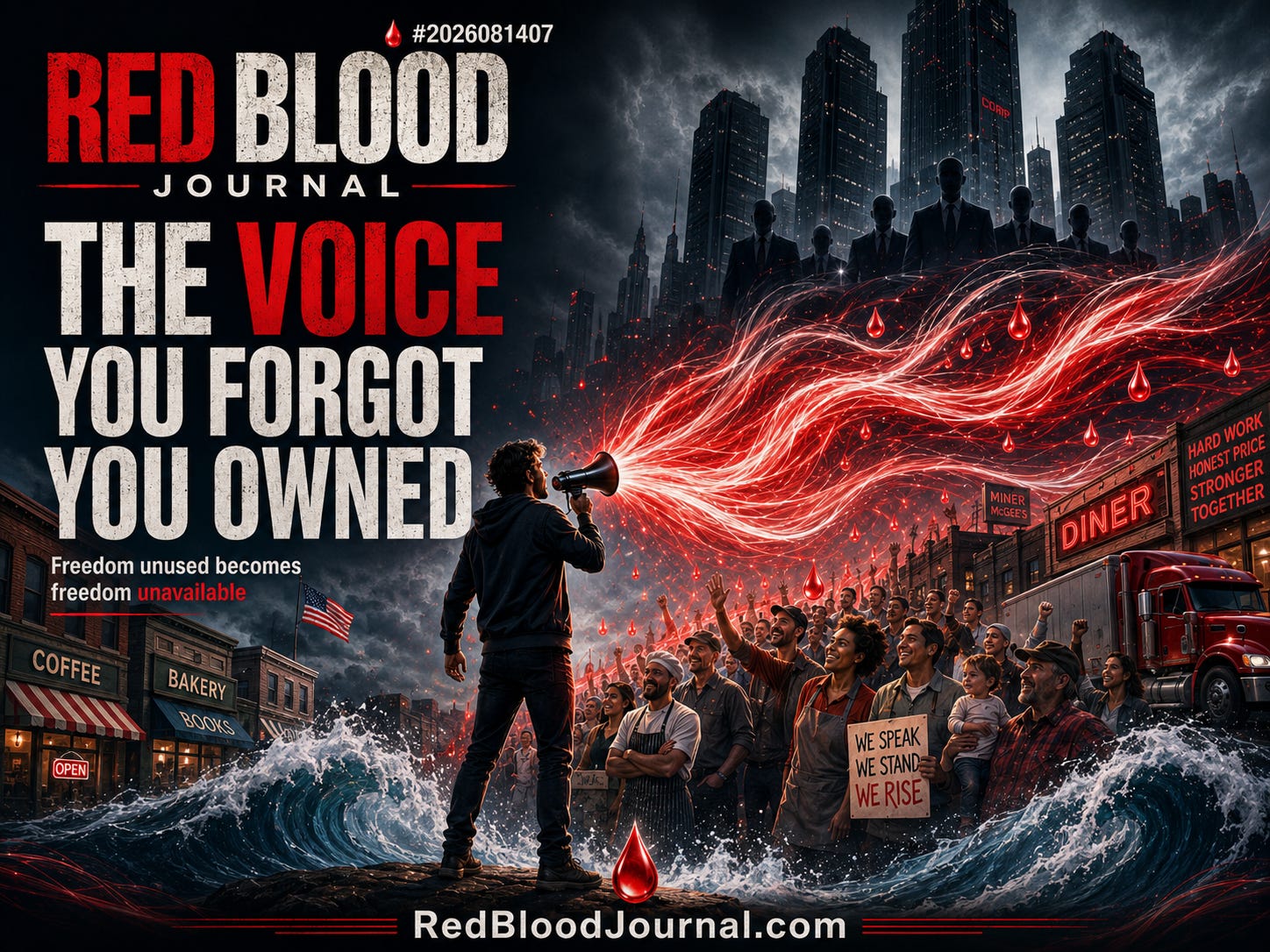
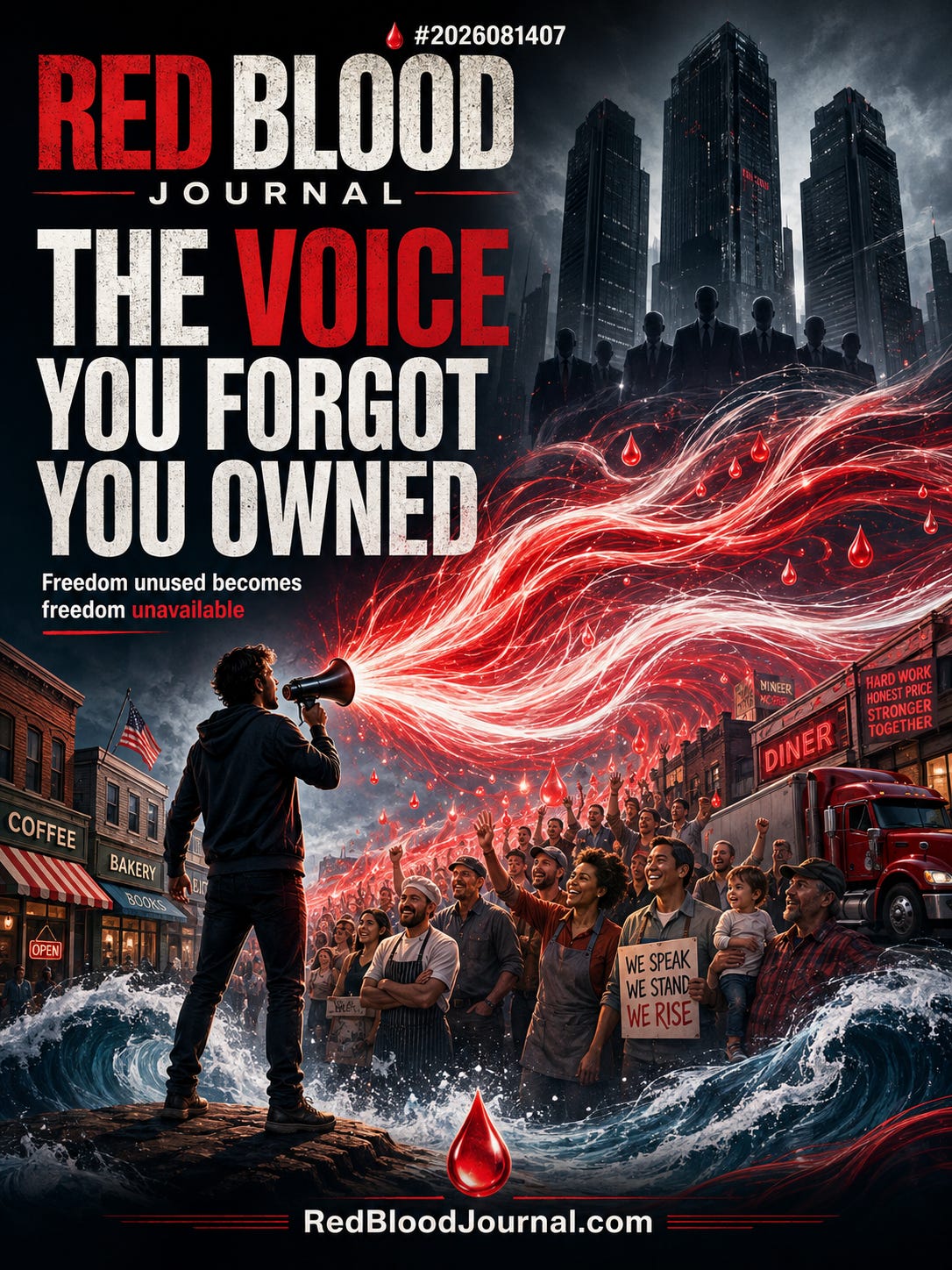
🩸 #2026081407 — The Voice You Forgot You Owned
Too Big to Fail, Too Small to Matter — and the Great Joke We Somehow Believed
RedBloodJournal.com
There is a rather magnificent joke being played on humanity.
Every American is repeatedly told:
You have freedom of speech.
Wonderful.
Fantastic.
Congratulations.
Here is your freedom of speech.
Please place it carefully in the closet, preferably behind the winter jackets, and whatever you do...
don’t actually use it.
Because someone might disagree.
Someone might call you a name.
Someone at work might look at you strangely.
Your neighbor might stop waving.
A stranger on the Internet—with a cartoon frog for a profile picture—might type something unpleasant.
And suddenly one of the most powerful political rights ever placed into the hands of an ordinary human being becomes something like the expensive china grandmother left behind:
Everybody owns it. Nobody wants to take it out of the cabinet.
That may be the problem.
The Most Powerful Person Nobody Notices
One person looks insignificant.
One restaurant looks insignificant.
One barber shop looks insignificant.
One mechanic.
One farmer.
One mother.
One father.
One cashier.
One truck driver.
One teacher.
One retired sailor sitting at the kitchen table saying:
“Something about this doesn’t make sense.”
Tiny.
Irrelevant.
Who cares?
Until there are ten.
Then a hundred.
Then ten thousand.
Then ten million.
And suddenly the supposedly insignificant individuals turn out to have been the entire country.
This is remarkably similar to the phrase “too big to fail.”
When giant financial institutions were in danger, their enormous interconnectedness became the argument for rescuing them.
They were too important.
Too connected.
Too consequential.
Their failure might damage everyone else.
But what about millions of independently owned restaurants, stores, workshops, salons, cafés, contractors and family businesses?
Individually they were small.
Collectively they represented an enormous part of American economic life.
Perhaps the trick was simply looking at them one at a time.
One closing restaurant does not look like a national emergency.
Neither does one silent citizen.
But millions?
That is another story entirely.
Welcome to the Human Vehicle
Now we arrive at the truly funny part.
Inside the human biological machine is one of the finest alarm systems ever produced.
Fear.
It is magnificent.
Fear kept ancestors from walking up to a saber-toothed tiger and saying:
“Excuse me, sir, may I pet you?”
Fear kept the body alive.
Excellent equipment.
Five stars.
Would recommend.
There is only one small engineering problem.
The alarm system doesn’t always know the difference between:
“A tiger is about to eat me”
and
“Bob from accounting might disagree with my opinion.”
The heart accelerates.
The stomach tightens.
The hands sweat.
The mind starts producing emergency scenarios.
WARNING!
You may be criticized!
WARNING!
Someone may unfollow you!
WARNING!
Thanksgiving dinner could become uncomfortable!
And somewhere deep inside the biological dashboard, every warning light begins flashing.
🚨 SOCIAL DANGER
🚨 EMPLOYMENT DANGER
🚨 REPUTATION DANGER
🚨 YOUR COUSIN MAY CALL YOU CRAZY
The body is doing exactly what it was designed to do.
Protect the vehicle.
But there is an important question:
Who is driving?
Fear Is a Warning Light, Not the Steering Wheel
Imagine driving down the highway when the dashboard suddenly says:
LOW FUEL.
Would anyone respond by handing the steering wheel to the gasoline gauge?
Of course not.
The gauge provides information.
The driver makes the decision.
Fear may operate the same way.
It says:
Something could happen.
Fine.
Thank you, Fear Department.
Report received.
Please return to your office.
The problem begins when the warning system climbs out of the dashboard, sits in the driver’s seat and announces:
“I WILL BE MAKING ALL DECISIONS FROM NOW ON.”
And the consciousness inside the vehicle says:
“Well... you do seem very confident.”
That is when survival instinct can become self-imposed imprisonment.
The Freedom Nobody Can Exercise for You
There is something strange about freedom.
Nobody can exercise yours on your behalf.
Someone else can defend the legal right.
Someone else can protest.
Someone else can write.
Someone else can argue.
Someone else can investigate.
But nobody can speak your words.
That little job belongs exclusively to you.
Which means freedom has a peculiar characteristic:
Freedom unused begins to resemble freedom unavailable.
A society could theoretically possess an extraordinary collection of rights while developing a population increasingly afraid to exercise them.
The Constitution may remain sitting beautifully underneath glass.
The law may still say the words.
The plaques may still hang on courthouse walls.
Meanwhile citizens begin whispering:
“Better not.”
That may be how freedom begins weakening long before anyone officially announces its disappearance.
The Great Somebody-Else Department
Human civilization apparently employs an enormous invisible organization called:
SOMEBODY ELSE
Somebody else will speak.
Somebody else will investigate.
Somebody else will object.
Somebody else will defend the little guy.
Somebody else will run for office.
Somebody else will attend the meeting.
Somebody else will question the policy.
Somebody else will protect freedom for the children.
Excellent organization.
One minor issue:
Nobody has ever located its headquarters.
Because Somebody Else is mostly staffed by people waiting for somebody else.
And that brings us directly to the most dangerous sentence in a free society:
“What difference can one person make?”
Every crowd in human history consisted entirely of one persons.
Every movement.
Every revolution.
Every invention.
Every business.
Every newspaper.
Every resistance.
Every change in public opinion.
Every great idea began inside a ridiculously tiny piece of territory:
one human mind.
Your Voice Does Not Need to Be Loud
Here is another misunderstanding.
Using one’s voice does not require screaming.
It does not require hatred.
It does not require insulting anyone.
It does not require becoming permanently angry at the universe.
In fact, a calm question can sometimes be far more disruptive to nonsense than a thousand shouted slogans.
Why?
Who benefits?
Where is the evidence?
Why are the rules different for them?
What happens if we are wrong?
Why can’t we discuss this?
That last one is particularly interesting.
Because whenever someone says:
“You are not allowed to question this.”
A functioning human mind has just received one of the greatest invitations imaginable:
Question it.
Politely.
Carefully.
Relentlessly.
And preferably with a sense of humor.
Power has always had difficulty dealing with the person who is simultaneously informed, peaceful and laughing.
The Children Are Watching the Adults
Every generation teaches the next one what freedom means.
Not merely through textbooks.
Through behavior.
A child watches adults.
The child notices what subjects suddenly make everyone quiet.
The child notices when Dad lowers his voice.
The child notices when Mom says:
“Don’t say that outside.”
The child notices which questions create panic.
Eventually nobody needs to formally teach censorship.
The culture teaches it automatically.
One generation learns:
Don’t say it.
The next generation learns:
Don’t think about saying it.
Eventually someone asks:
“Why would anybody ever want to say that?”
And the original freedom becomes almost archaeological.
Something ancestors apparently used.
Like rotary telephones.
Perhaps Courage Has Been Misunderstood
Courage is often portrayed as the absence of fear.
That would make courage fairly useless, because a person who feels absolutely no fear isn’t necessarily courageous.
They may simply have no idea what is happening.
Courage becomes meaningful precisely because fear exists.
Fear says:
Stay quiet.
Something deeper says:
But this matters.
Fear says:
Protect yourself.
Conscience says:
What about everyone else?
Fear says:
You are only one person.
And reality quietly answers:
Everybody is.
The Real Too Big to Fail
Perhaps America’s greatest misunderstanding was accepting a definition of “too big” measured primarily by balance sheets, financial networks and institutional concentration.
There is another kind of size.
Human size.
Millions of independent businesses.
Millions of families.
Millions of workers.
Millions of opinions.
Millions of people capable of saying:
No.
Or:
Why?
Or:
Prove it.
Or perhaps the most powerful four words available to an independent mind:
I don’t believe you.
Not because disbelief is automatically correct.
Not because government is automatically wrong.
Not because corporations are automatically evil.
Not because institutions must automatically be distrusted.
But because authority does not eliminate the responsibility to think.
The citizen must still examine.
Compare.
Question.
Listen.
Challenge.
Reconsider.
And occasionally admit:
“I was wrong.”
That last freedom may be the most difficult one of all.
The Red Blood Perspective
The individual may have been sold two remarkably similar ideas.
The small business owner was told:
You are too small to matter.
The individual citizen was told:
Your voice is too small to matter.
Both statements contain the same mathematical problem.
Millions of small things become an enormous thing.
Millions of small businesses become an economy.
Millions of individual citizens become a nation.
Millions of individual voices become public power.
Perhaps the population was never powerless.
Perhaps it was simply persuaded to calculate itself incorrectly.
Instead of:
1 + 1 + 1 + 1 + 1...
people were taught to see:
just me.
And “just me” sounds terribly small.
Until everyone discovers at exactly the same moment that there are millions of other people saying:
“Funny. I thought it was just me too.”
Ocean of Love and Positivity Perspective
The purpose of finding one’s voice does not have to be conflict.
It can be connection.
It can be curiosity.
It can be refusing hatred while refusing silence.
It can mean speaking firmly while still recognizing the humanity of the person standing on the opposite side.
Perhaps fear was placed inside the biological vehicle for good reason.
It keeps the body alive.
Thank it.
Listen to it.
But do not automatically give it the car keys.
The body can shake.
The heart can race.
The palms can sweat.
And the person inside can still calmly say:
“I have a question.”
That may be what courage actually looks like most of the time.
Not a superhero.
Not a warrior charging onto a battlefield.
Not someone shouting from a stage.
Just an ordinary human being whose biological alarm system is screaming:
BE QUIET!
while something deeper reaches for the microphone and says:
“No. I think I’ll speak.”
Because freedom of speech is not something inherited once and placed safely on a shelf.
It is something each generation demonstrates to the next generation by using it peacefully, responsibly and fearlessly enough that the children understand:
This belongs to you too.
The voice of one human being may appear tiny.
So does one drop of water.
Until someone finally looks up and notices the ocean.
In an Ocean of Love and Positivity.
🩸🌊✨ Fantastic!
📣
The Human Scale of Freedom
Aug 14, 2026
The provided text explores the paradox of free speech in a society where individuals possess the legal right to speak but are often paralyzed by social and biological fear. It argues that true liberty is lost when citizens allow instinctual anxieties about reputation or conflict to silence their unique perspectives, effectively handing the “steering wheel” of their lives over to fear. By highlighting the collective power of individuals, the author suggests that a nation is composed of millions of “small” voices that only become significant when they refuse to delegate their responsibilities to “somebody else.” The source emphasizes that courage is not the absence of fear but the decision to speak truthfully despite it, serving as a vital example for the next generation. Ultimately, the narrative asserts that personal inquiry and peaceful dissent are the only ways to prevent freedom from becoming a mere historical artifact. Underestimating the impact of a single voice is a mathematical error, as the cumulative strength of independent thinkers forms the true foundation of a resilient society.


