


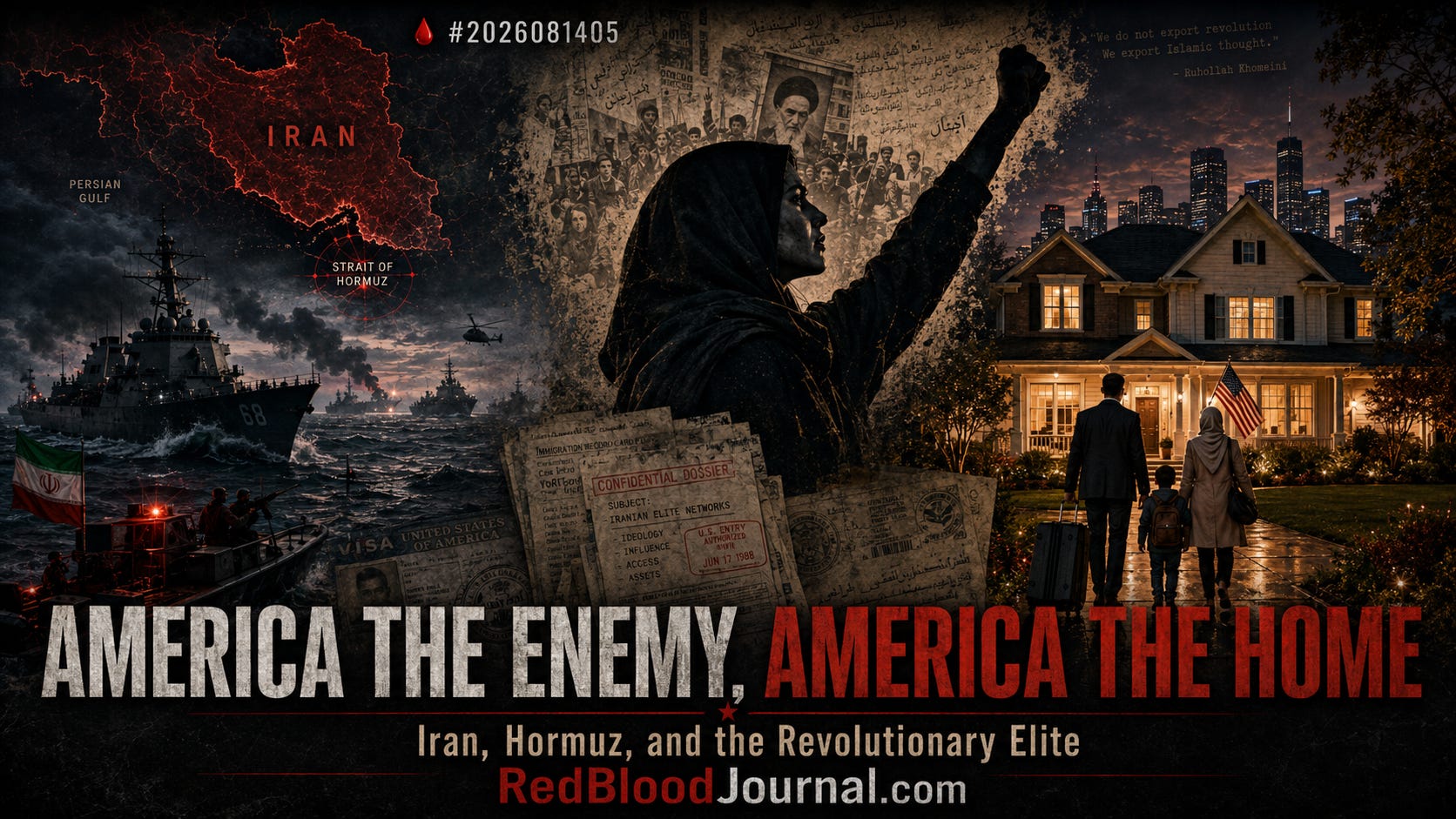
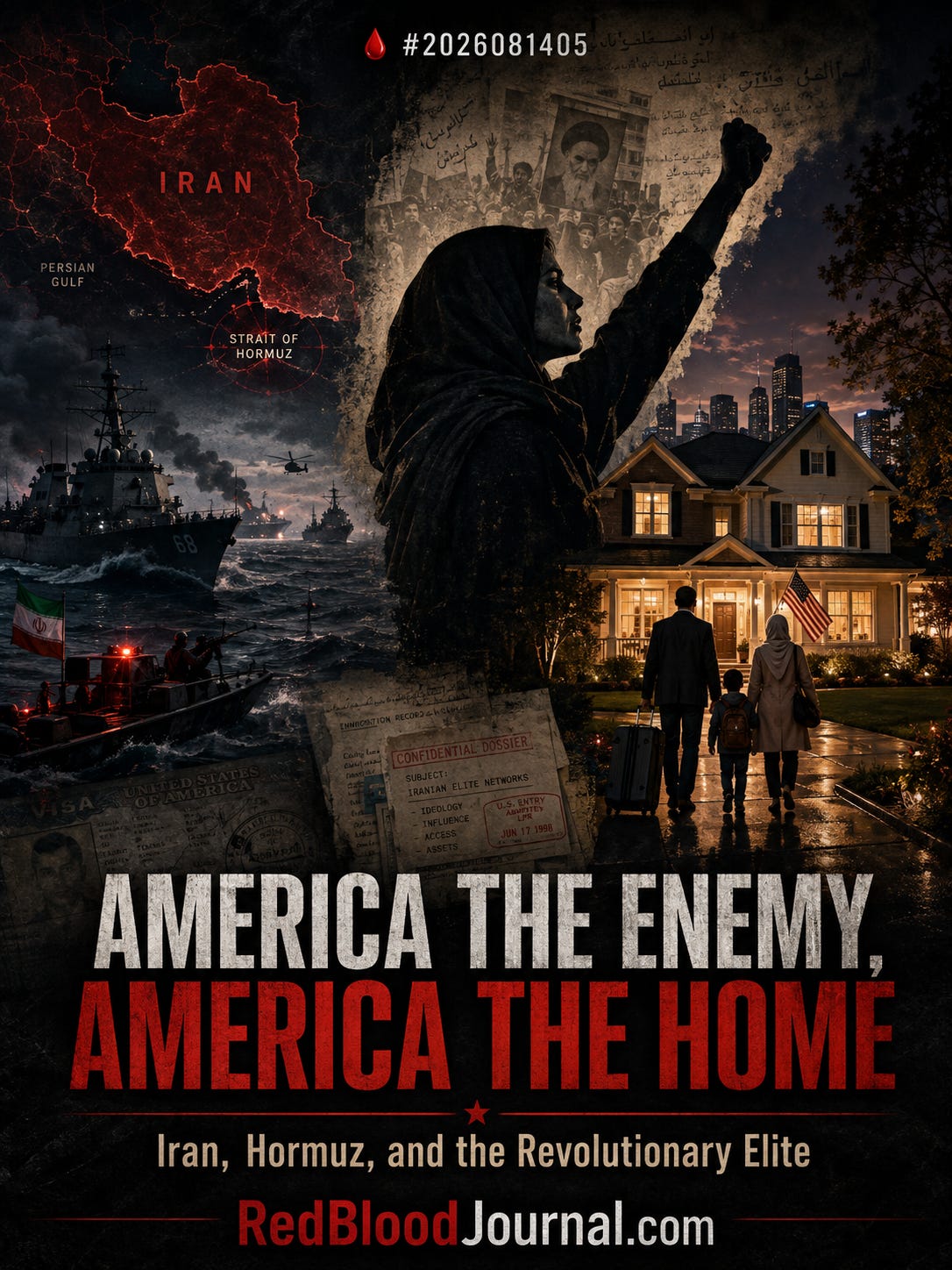
🩸 #2026081405 — America the Enemy, America the Home
Iran’s Confrontation With Washington, the Strait of Hormuz, and the Strange Journey of the Revolutionary Elite
RedBloodJournal.com
For nearly half a century, the Islamic Republic has built a large part of its political identity around confrontation with the United States.
America was presented as the enemy.
American influence was treated as contamination.
The seizure of the U.S. Embassy became one of the defining events of the new revolutionary order.
Now, according to the material examined for this report, that confrontation may be approaching one of its most dangerous stages.
But at almost the same moment, another story is unfolding thousands of miles away.
Members of the family of one of the most recognizable figures associated with the 1979 U.S. Embassy seizure are fighting to remain in the United States.
One story is about war.
The other is about where people choose to live.
Placed beside each other, they raise a question that deserves examination.
How did “Death to America” eventually produce families seeking an American life?
The Conflict Moves Toward Direct Confrontation
The source report opens with the assertion that the confrontation between the Islamic Republic and the United States has entered a sensitive stage.
Mohammad Mokhber, described in the source as an adviser to Iran’s leadership, is quoted as warning that if Washington refuses Tehran’s conditions, the war could become offensive — meaning Iran rather than the United States could initiate attacks.
The statement goes beyond ordinary military rhetoric.
Mokhber reportedly argues that such a strategy could alter the global balance of power and that the future security and economic structure surrounding the Strait of Hormuz should operate independently of American military guarantees.
That places Hormuz at the center of the confrontation.
It is not simply a shipping lane.
In this interpretation, it becomes a bargaining weapon.
Hormuz: Geography Turned Into Political Leverage
Later in the source, an American analysis is presented arguing that Tehran does not view the Strait of Hormuz as something it would voluntarily surrender through ordinary negotiation.
The argument is that Iranian decision-makers see the strait as a strategic asset and may calculate political power differently from Washington.
Economic losses, inflation, falling currency values and declining living standards may seem unbearable when viewed through a Western political lens.
But the source presents the counterargument that Iran’s leadership may be willing to tolerate extraordinary economic pain among the population if it believes doing so protects the regime’s strategic position.
That distinction is important.
A policy designed around the assumption that economic suffering eventually forces political surrender only works if the government experiencing the pressure fears the suffering enough to change course.
What happens when the people experiencing the suffering and the people making the decision are not the same people?
Waiting for American Politics?
The source also presents an analysis suggesting Tehran may increasingly watch the American political calendar.
As the United States approaches its 2026 midterm elections, the theory is that Iranian demands could become more aggressive and instability could increase if Tehran believes domestic American political pressure may weaken Washington’s willingness to continue the confrontation.
That is an analysis, not an established fact.
But Iran has survived multiple American administrations.
Presidents leave.
Congresses change.
Public tolerance for distant conflicts changes.
The Islamic Republic has remained.
From Tehran’s perspective, therefore, time itself may be part of the strategy.
And Then There Is Masoumeh Ebtekar
While governments threaten each other across the Strait of Hormuz, the source turns to a smaller story that may reveal something equally important about the revolution.
Masoumeh Ebtekar became internationally known through the 1979 seizure of the U.S. Embassy in Tehran.
Her precise role remains politically disputed.
She has often been described as an English-speaking spokesperson or translator associated with the hostage-takers.
But historical material presented in the source portrays a more active role.
The report includes statements attributed to Ebtekar in which she reportedly said that hostages could be killed if the embassy were attacked and that she personally would be capable of using a weapon against a hostage under such circumstances.
Former hostage Barry Rosen is also cited in the source as describing Ebtekar not merely as a translator but as a harsh interrogator.
Those are historical claims and recollections presented by the source and should be examined as such.
But they make the next chapter particularly striking.
Her Son Went to America
The source reports that Ebtekar’s son, Eisa Hashemi, his wife Maryam Tahmasbi and family members became involved in an immigration detention case in the United States.
From detention in Texas, Tahmasbi reportedly wrote a lengthy appeal to Americans.
Her message contained a remarkable sentence in the context of her family’s revolutionary history:
She loves America.
She reportedly described America as her home and said her 12-year-old child cannot speak Persian.
She argued that she, her husband and their child should be judged according to their own choices rather than an action committed by another family member nearly fifty years earlier.
On one level, that argument is straightforward.
Children are not automatically responsible for the political actions of their parents.
A daughter-in-law is not responsible for what her mother-in-law did decades before she entered the family.
Individual responsibility matters.
But another question exists alongside it.
Why America?
Millions of destinations exist.
Why did members of families connected to a revolution built partly around opposition to the United States repeatedly choose the United States as the place where they wanted to study, work, raise children or establish their future?
The source makes that contradiction central to its criticism.
Those who helped build a political culture condemning American influence later saw members of their own families establish lives inside the very society they had denounced.
This does not by itself establish hypocrisy.
People change.
Families disagree.
Children reject parents’ ideologies.
Political circumstances evolve.
But it creates a legitimate historical question.
If the United States was sufficiently dangerous that a generation of revolutionaries justified extraordinary actions against it, what changed when their children needed somewhere to build their lives?
From Revolutionary Simplicity to Comfortable Living
The source then moves from ideology into class.
Tahmasbi reportedly described herself and her husband as working-class people who came to America to build a normal life.
But videos discussed in the source are described as showing a large home, tall ceilings, spacious entertainment areas and a comfortable American lifestyle.
Whether that lifestyle should properly be called luxurious is subjective.
Whether it could have been financed through legitimate American employment is another question the source itself does not establish.
What matters is the contrast being presented.
Inside Iran, ordinary families are described as struggling to purchase medicine, food, housing and fuel.
Outside Iran, politically connected families are portrayed as having obtained the very normality that millions inside the country increasingly cannot afford.
The contradiction becomes even sharper because the revolution originally celebrated simplicity.
When Even Kebab Was Too Bourgeois
The report recounts an anecdote attributed to Abbas Abdi, another participant in the embassy seizure.
According to that account, before the wedding of Masoumeh Ebtekar and Mohammad Hashemi, revolutionary friends worried that serving chelo kebab might appear excessively extravagant.
The meal was reportedly simplified.
Years later, Abdi reportedly contrasted that revolutionary austerity with the much more elaborate wedding of the couple’s son, held at an upscale garden with numerous dishes — while beans were included almost as a reminder of the earlier revolutionary era.
It is almost comic.
Except the underlying question is not.
What happens when revolutionaries who once feared appearing wealthy eventually become members of an elite?
Allegations of Business Privilege
The source also compiles a series of allegations surrounding Ebtekar, her husband Mohammad Hashemi and associated business interests.
They include accusations involving gasoline imports, hunting operations, environmental permits, imported timber, land and commercial relationships.
The report also states that several of these accusations have been denied.
For example, allegations concerning gasoline-import interests are explicitly described as having been rejected by Ebtekar and her husband.
The source similarly discusses allegations involving hunting access and protected environmental areas, again including denials.
Other claims concern business relationships, wildlife permits, timber imports and environmental organizations.
These allegations should not be converted into proven facts simply because they appear in a political report.
But taken together, they illustrate the larger accusation being made against sections of Iran’s post-revolutionary elite:
A political class that preached sacrifice allegedly developed access to opportunities unavailable to ordinary citizens.
That question deserves evidence, not slogans.
Two Americas
Perhaps there were always two Americas in the revolutionary imagination.
There was America the political symbol:
Imperialism.
CIA.
The Shah.
Sanctions.
Military power.
“The Great Satan.”
And then there was America the actual place:
Universities.
Jobs.
Property.
Safety.
Opportunity.
A future for children.
It is possible to oppose American foreign policy while wanting to live in America.
Millions of Americans themselves criticize their government’s policies.
There is no inherent contradiction there.
The more difficult contradiction appears when a ruling class restricts choices for its own population while members of that class possess choices unavailable to everyone else.
That is where ideology becomes privilege.
The Revolution Comes Full Circle
There is something historically unusual about the scene now unfolding.
In 1979, young revolutionaries entered the American Embassy in Tehran.
Nearly half a century later, the Islamic Republic and the United States once again threaten each other across the Persian Gulf.
The Strait of Hormuz has become a weapon.
Economic pressure is increasing.
Military vessels move through the region.
Officials speak about offensive warfare.
And meanwhile, descendants of that revolutionary generation argue from inside America that America is their home.
The political conflict traveled in a circle.
The people traveled in the opposite direction.
The Red Blood Perspective
The question is not whether Maryam Tahmasbi should be punished for something Masoumeh Ebtekar did in 1979.
Collective guilt would answer one injustice with another.
The more revealing question is what her family’s story tells us about the revolution itself.
Did revolutionary leaders eventually discover that the societies they condemned offered opportunities they wanted for their own children?
Did ideological hostility coexist with private admiration?
Did the revolutionary elite simply evolve?
Or is the apparent contradiction being exaggerated because the political choices of parents and children should never be treated as one ideology?
Then there is the larger strategic question.
If Iranian leaders believe they can withstand American pressure indefinitely while ordinary Iranians absorb the economic consequences, Washington may be fighting a government according to assumptions that do not apply to it.
And if Tehran believes American elections will eventually weaken Washington’s resolve, it may see survival itself as victory.
Hormuz, sanctions, military pressure, immigration, revolutionary privilege and the Ebtekar family may appear to be separate stories.
Perhaps they are.
Or perhaps they are different chapters of the same forty-eight-year story.
The evidence is on the table.
The reader decides what it means.
Ocean of Love and Positivity Perspective
Governments inherit enemies.
Children inherit stories.
Neither must inherit hatred.
The strange possibility within this entire history is that the child of one generation’s enemy may someday call the enemy’s country home.
That may expose hypocrisy.
It may demonstrate human adaptability.
Or perhaps it quietly reveals something governments rarely admit:
Ordinary human beings eventually want much the same things regardless of the slogans surrounding them.
A safe home.
Enough food.
A future for their children.
Freedom to choose where and how they live.
When ideology makes those simple desires impossible, people eventually begin looking beyond ideology.
Sometimes they even cross an ocean to find them.
In an Ocean of Love and Positivity.
🩸🌊✨ Fantastic!
⚖️
Revolution and Refuge: The Double Life of Iran’s Elite
Aug 14, 2026
The provided text explores the paradoxical relationship between the Islamic Republic of Iran and the United States, contrasting official geopolitical hostility with the personal choices of the revolutionary elite. While Tehran utilizes the Strait of Hormuz as a strategic weapon and prepares for potential military confrontation, the descendants of prominent revolutionaries are increasingly seeking refuge and residency within American borders. A primary focus is placed on Masoumeh Ebtekar, a key figure in the 1979 hostage crisis, whose family members now fight to remain in the U.S. while praising it as their true home. This transition highlights a sharp divide between the revolutionary austerity preached to the Iranian public and the privileged lifestyles enjoyed by those connected to power. Ultimately, the source examines how an ideology built on anti-American sentiment has resulted in a leadership class whose own children prefer the opportunities of the West. This narrative suggests that while political rhetoric remains fixed in conflict, individual desires for safety and prosperity often transcend national enmity.


