


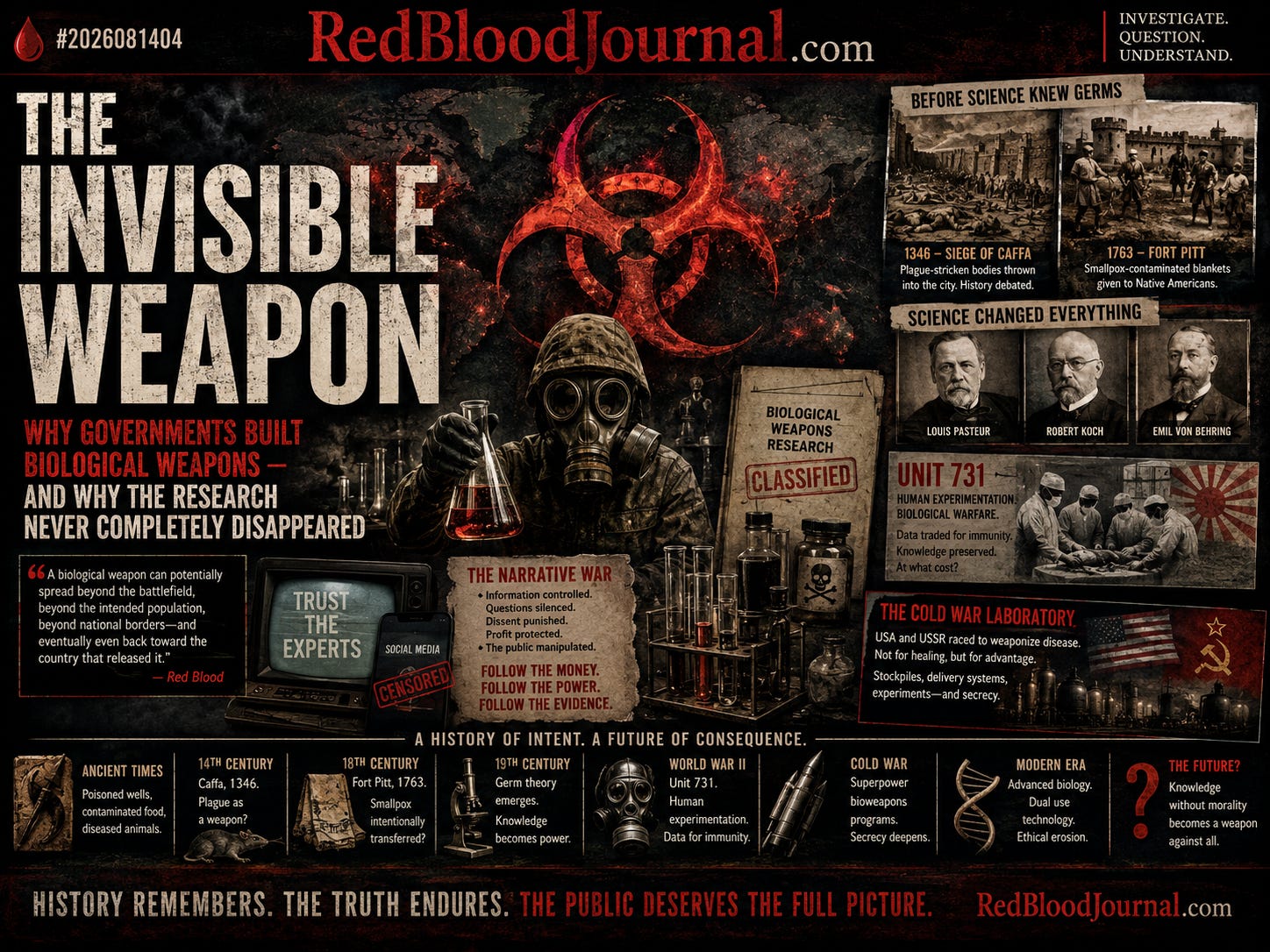
🩸 🧪 #2026081404 — The Invisible Weapon
Why Governments Built Biological Weapons — and Why the Research Never Completely Disappeared
RedBloodJournal.com
There is something fundamentally different about a biological weapon.
A bullet must reach its target.
A bomb must be delivered.
A missile has to cross the distance between the attacker and the enemy.
But a biological weapon introduces something alive—or something produced by living organisms—into the equation.
Once released, biology may begin doing the work itself.
That simple fact has attracted military planners for centuries and frightened them for exactly the same reason.
A biological weapon can potentially spread beyond the battlefield, beyond the intended population, beyond national borders and eventually even back toward the country that released it.
It may be one of the few weapons ever conceived in which the feature that makes it attractive is also the feature that makes it terrifying.
Before Anyone Knew What a Germ Was
Biological warfare is much older than microbiology.
Ancient armies did not understand bacteria, viruses, incubation periods or immune systems, but they understood something much simpler.
Some things made people sick.
Contaminate water.
Poison food.
Use diseased animals.
Place decomposing bodies near an enemy.
Coat weapons with poisonous or contaminated substances.
The science was primitive, but the idea was already recognizable.
Instead of defeating every enemy soldier individually, make the environment itself hostile to the enemy.
One frequently cited example comes from the siege of Caffa in 1346, when Mongol forces were reported to have thrown plague-stricken bodies into the besieged city.
Whether those bodies actually caused the plague outbreak inside Caffa remains debated. Fleas and infected rodents may have transmitted the disease naturally.
That distinction matters.
Red Blood does not need the most dramatic interpretation to be true in order to recognize the larger historical idea.
Humans had discovered that disease might become part of warfare long before they understood what disease actually was.
Fort Pitt and Smallpox
Another disturbing case appears in North America.
During the 1763 conflict around Fort Pitt, historical records document British personnel giving Native Americans blankets and a handkerchief taken from a smallpox hospital.
The intention appears clear from surviving correspondence.
The result is much harder to establish.
Smallpox was already circulating, and historians continue debating whether those particular contaminated materials produced additional infections.
Again, intention and demonstrated outcome are not always the same thing.
But by this point the concept was unmistakable.
Disease could potentially be deliberately transferred from one population to another.
Then Science Changed Everything
The nineteenth century transformed biological warfare.
Scientists began understanding that specific microorganisms caused specific diseases.
Louis Pasteur, Robert Koch and others helped establish modern germ theory.
Humanity was no longer merely observing disease.
Humanity was beginning to understand it.
That knowledge produced extraordinary benefits.
Sanitation improved.
Vaccines developed.
Diseases could increasingly be identified, prevented and treated.
But nearly every major technological breakthrough carries another possibility.
If humans could understand microorganisms well enough to stop disease, they could potentially understand them well enough to deliberately cause it.
The laboratory had entered warfare.
Unit 731
Among the darkest examples came from Imperial Japan.
During World War II, Unit 731 conducted biological warfare research involving human experimentation.
Prisoners were deliberately exposed to infectious diseases.
Japanese forces investigated and used pathogens including plague and other infectious agents.
Experiments examined how diseases affected living human beings.
The story became even more disturbing after the war.
American authorities wanted the information accumulated by Japanese researchers.
Historical evidence indicates that some participants received protection from prosecution in exchange for biological warfare data.
That creates one of the recurring questions running throughout this history.
When governments discover knowledge obtained through horrific methods, do they destroy it because of how it was obtained?
Or do they preserve it because another government might use it first?
The historical record shows which choice was often made.
The Cold War Laboratory
After World War II, biological warfare entered the age of superpower competition.
The United States developed an offensive biological weapons program.
The Soviet Union developed one as well.
Researchers studied diseases that might incapacitate or kill military personnel, livestock or agricultural crops.
From the perspective of a military planner, the appeal was obvious.
Biological weapons appeared potentially inexpensive compared with enormous conventional armies or nuclear arsenals.
A microscopic organism could theoretically affect thousands or millions of people.
Factories, bridges, oil fields and infrastructure could remain physically intact while the population operating them became sick.
And unlike an artillery shell, disease could reproduce.
That last characteristic changes the economics of warfare.
A conventional weapon uses energy supplied by the attacker.
A biological organism may use the enemy’s own biological environment to reproduce itself.
That possibility made biological warfare extraordinarily attractive on paper.
It also made it extraordinarily dangerous.
The Weapon That Cannot Read a Map
Imagine releasing a weapon capable of reproducing.
Now imagine ordering it to stop at the border.
Biology does not recognize flags.
It does not recognize treaties.
It does not understand military objectives.
It does not know the difference between the enemy’s children and the attacker’s children.
Wind changes.
Animals migrate.
People travel.
Viruses mutate.
Bacteria reproduce.
Human immunity varies.
A military commander can theoretically calculate where a conventional bomb will explode.
No commander can guarantee where an infectious disease will eventually go.
That was one of the central strategic problems surrounding biological weapons.
The perfect biological weapon would have to be contagious enough to spread through the enemy while somehow remaining obedient enough not to spread somewhere else.
Nature has never agreed to such a contract.
Why Build Them Anyway?
Because military history repeatedly shows that governments investigate possibilities before knowing whether those possibilities can be completely controlled.
Biological weapons offered several attractions.
They could potentially affect enormous populations while requiring relatively small quantities of material.
Symptoms might appear hours or days after exposure, delaying recognition of an attack.
An outbreak might initially appear natural.
Military forces could become incapacitated without destroying valuable territory or infrastructure.
Disease targeting livestock or agriculture could damage an enemy without directly attacking its soldiers.
And perhaps most importantly, biological weapons could generate fear far beyond the number of people actually infected.
An invisible enemy changes human behavior.
People may become frightened of strangers.
Hospitals can become overwhelmed.
Trade can slow.
Schools can close.
Transportation may be disrupted.
Governments may impose emergency measures.
A relatively small biological incident can potentially produce consequences far larger than the immediate casualties.
That makes biological warfare not simply a medical weapon.
It can become an economic weapon, a psychological weapon and a political weapon simultaneously.
Nixon Ends the American Offensive Program
In 1969, President Richard Nixon announced that the United States would renounce the use of biological weapons and terminate its offensive biological warfare program.
The United States would continue biological research for defensive purposes.
That distinction would become enormously important.
Offensive biological weapons research seeks to develop disease as a weapon.
Defensive biological research seeks to protect populations from biological threats.
At first the difference appears simple.
In practice, the boundary can become much less obvious.
To build a vaccine against a dangerous pathogen, researchers must understand the pathogen.
To develop detection systems, researchers must study how it behaves.
To understand how an enemy might modify a biological agent, scientists may need to study potential modifications themselves.
This is where the modern dual-use dilemma begins.
The same scientific knowledge can potentially protect humanity or threaten it.
The knowledge itself does not announce which purpose it serves.
The intention belongs to the people controlling it.
The Biological Weapons Convention
In 1972, nations opened the Biological Weapons Convention for signature.
It entered into force in 1975.
The treaty prohibited development, production and stockpiling of biological and toxin weapons.
It represented something historically significant.
Humanity had agreed that an entire category of weapons should not exist.
But treaties do not eliminate scientific knowledge.
They do not eliminate laboratories.
And they cannot physically prevent governments from secretly violating them.
The Soviet Union illustrates the problem.
Despite joining the convention, the Soviet state continued operating an enormous covert biological weapons program.
The program reportedly expanded biological research and production capabilities across multiple facilities.
Once again, the logic of the arms race appeared.
A government might publicly reject a weapon while privately fearing that another government still possessed it.
Fear becomes justification.
Justification becomes research.
Research creates capability.
Capability produces more fear.
The circle closes.
The Question of Defensive Research
This brings the biological weapons story into the modern world.
A country concerned about biological attack logically wants laboratories capable of identifying dangerous pathogens.
Those laboratories need scientists.
Those scientists need samples.
They need to understand transmission.
They need to understand immune responses.
They may need to understand how a pathogen could become more dangerous.
All of this can have completely legitimate medical and defensive purposes.
But some of the same knowledge might also theoretically assist an offensive program.
That is why biological research produces a question that conventional weapons rarely produce.
A missile factory looks like a missile factory.
A biological research laboratory may be developing a vaccine, studying emerging disease, designing medical countermeasures, conducting defensive research—or producing knowledge that could potentially have several applications at once.
The equipment does not necessarily reveal the intention.
Then Came the Anthrax Letters
Shortly after the September 11 attacks, another biological event terrified the United States.
Letters containing anthrax spores were mailed through the American postal system in 2001.
Twenty-two people became infected.
Five died.
The physical attack was limited compared with conventional warfare.
The psychological effect was enormous.
Government offices were disrupted.
Postal facilities became crime scenes.
People feared opening ordinary envelopes.
News organizations followed every development.
The incident demonstrated something military planners had understood for decades.
Biological warfare does not necessarily require millions of infections to change society.
Fear can become part of the weapon.
The Most Important Question May Not Be Who Has Them
The easiest question is:
Which countries possess biological weapons?
The more difficult question may be:
How would anyone know where defensive biological research ends and offensive capability begins?
A nation developing vaccines against a dangerous organism naturally learns how that organism functions.
A nation developing detection equipment naturally needs samples to test against.
Scientists studying future pandemics naturally want to understand how pathogens may evolve.
Military researchers naturally want to know what an adversary could potentially create.
Each step can be individually justified.
But collectively those steps may also produce knowledge that earlier generations would have considered part of biological warfare capability.
That does not mean every biological laboratory is secretly making weapons.
It also does not mean every declaration of peaceful research should automatically end investigation.
The proper question is not whether the laboratory has a frightening name.
The proper questions are what is being researched, why it is being researched, who funds it, who controls it, what safeguards exist, what information is withheld, what biological capabilities result, and whether independent evidence agrees with the public explanation.
The Red Blood Perspective
The history of biological weapons is not simply the history of evil scientists attempting to manufacture disease.
It is also the history of governments confronting the same strategic temptation repeatedly.
What if an enemy possesses something we do not?
What if we stop researching while they continue?
What if understanding the weapon is necessary to defend against the weapon?
What if defensive knowledge itself creates offensive capability?
Those questions helped drive biological weapons research through several generations.
They remain relevant because biotechnology has advanced enormously since the first armies contaminated wells.
Modern scientists can examine genetic sequences, manipulate biological systems, rapidly manufacture vaccines and study pathogens at a level that would have appeared impossible to the researchers of World War II.
That scientific progress has saved countless lives.
The same progress also means humanity understands biology more deeply than any previous civilization.
Whether that knowledge becomes medicine, defense, surveillance, deterrence or weaponry depends largely upon the institutions and people controlling it.
Perhaps that is the real lesson hidden inside the biological weapons story.
The weapon was never merely the microorganism.
The weapon was knowledge combined with intention.
And intentions are much more difficult to inspect under a microscope.
The reader is left with the question.
If a government must understand a biological weapon in order to defend against it, how much biological weapons knowledge can it accumulate before defense and capability become indistinguishable?
Ocean of Love and Positivity
Human knowledge does not arrive carrying instructions telling us whether it must be used for healing or destruction.
The same understanding of biology that can create fear can also create medicine.
The same laboratory capable of studying disease can develop the treatment that saves millions.
Perhaps humanity’s greatest challenge is not discovering what can be done.
We have become remarkably skilled at that.
The greater challenge is deciding what should be done once we discover that we can.
In an Ocean of Love and Positivity.
🩸🌊✨ Fantastic!
RedBloodJournal.com
🧪
The Invisible Weapon: The Ethics of Biological Warfare
Aug 14, 2026
The provided text chronicles the evolution of biological warfare, tracing its history from primitive ancient tactics to modern laboratory research. It highlights a strategic paradox where the ability of pathogens to reproduce makes them potent weapons yet impossible to fully control. While international treaties eventually banned offensive stockpiles, the source explains that the distinction between defensive and offensive research remains dangerously blurred. Scientific advancements have created a dual-use dilemma, as the same knowledge required to develop life-saving vaccines can also be utilized to engineer more lethal diseases. Ultimately, the text argues that the true nature of biological capability is defined less by technology and more by the intentions of those in power. This history serves as a warning that humanity’s increasing mastery over biology requires a corresponding increase in ethical responsibility and transparency.


