


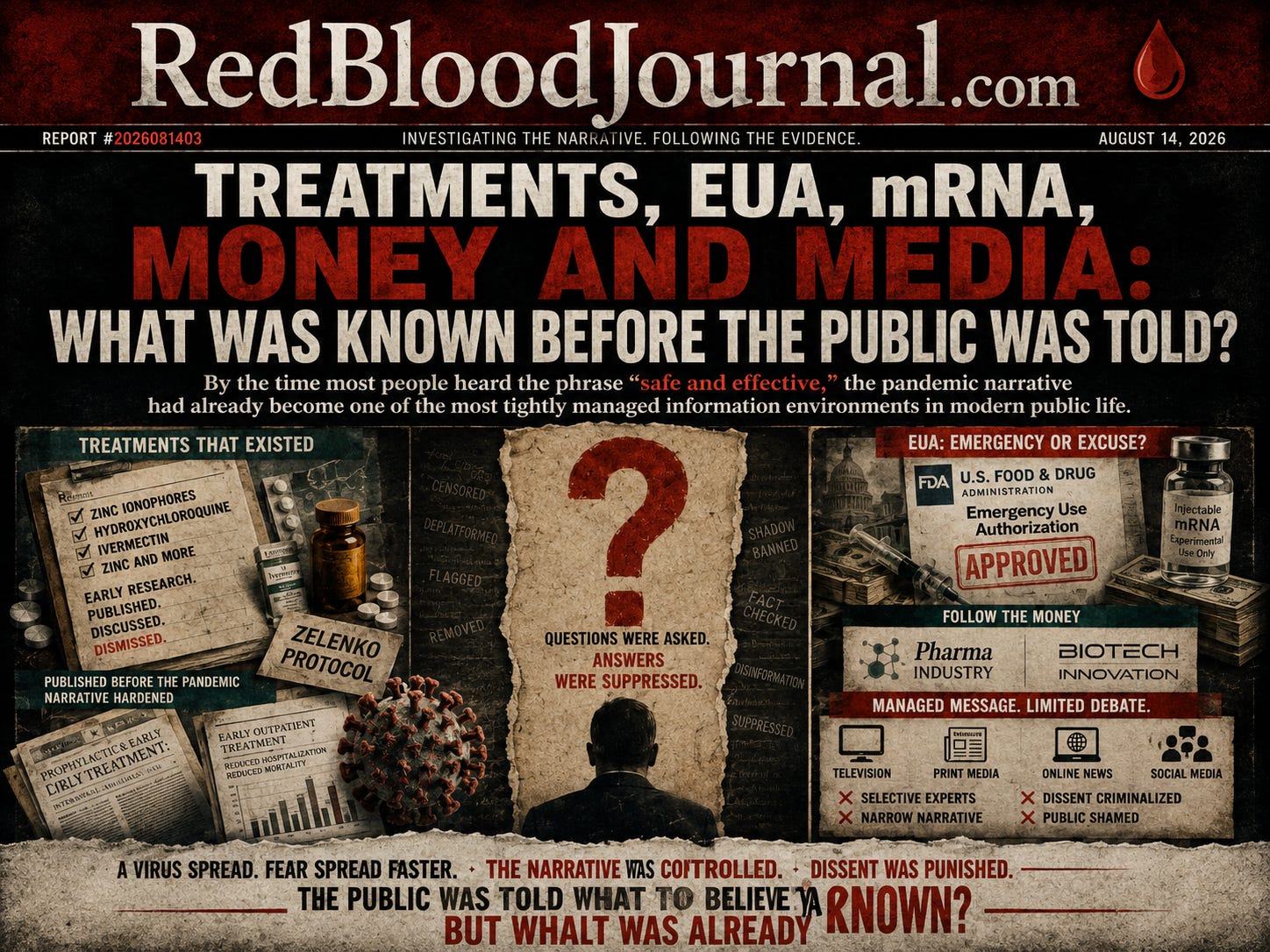
🩸 #2026081403 — Treatments, EUA, mRNA, Money and Media: What Was Known Before the Public Was Told?
RedBloodJournal.com
By the time most people heard the phrase “safe and effective,” the pandemic narrative had already become one of the most tightly managed information environments in modern public life.
A virus had appeared. Fear spread faster than clarity. Governments moved. Pharmaceutical companies accelerated. Public-health authorities gave instructions. News organizations repeated them. Social-media platforms enforced them. Dissenting doctors were marginalized, punished or ignored. The public was told there was an emergency, and because there was an emergency, many normal questions would have to wait.
But one of the deepest questions raised in the Jimmy Dore interview with Dr. David Martin is whether those questions should have been asked at the very beginning.
Not after the vaccine rollout.
Not after mandates.
Not after injuries, censorship battles and institutional embarrassment.
At the beginning.
The heart of this third report is not simply whether the authorities were right or wrong.
It is whether the public was given a complete picture of what was already known about treatments, emergency authorization, financial interests, product risks and media behavior before millions of people were told what they must believe.
The Treatment Question Came Before the Vaccine Question
One of Martin’s central claims is that the public was pushed toward a narrow conclusion: that vaccination under Emergency Use Authorization was necessary because there were no adequate alternative treatments.
He challenges that premise directly.
In the interview, Martin discusses earlier research involving zinc ionophores, hydroxychloroquine, ivermectin, zinc and related countermeasures, arguing that treatment concepts for coronavirus exposure existed in published material before the COVID emergency narrative hardened into policy. He specifically links these ideas to work he associates with Ralph Baric and what later became known publicly as the Zelenko Protocol.
That is a major claim because under the logic of emergency authorization, the existence or nonexistence of adequate alternatives matters enormously.
If serious treatment alternatives were already known, then the legal and moral justification for the EUA era becomes more complicated.
If those alternatives were weak, mischaracterized, overstated or unsuitable, then the authorities might argue their decisions still stand.
But the public cannot evaluate that question if the discussion is treated as forbidden from the start.
Instead of a structured debate over evidence, what often happened was more primitive. One side was granted institutional legitimacy. The other was branded reckless or anti-scientific before the public had any realistic opportunity to compare the underlying material.
That is not the same thing as proving the alternative side was correct.
It is simply recognizing that a filtered debate is not a full debate.
The Zelenko Protocol and the Meaning of “Known”
Martin makes a particularly provocative argument when he says the so-called Zelenko Protocol was not some spontaneous improvisation discovered during the pandemic, but rather a practical reading of published countermeasure logic that already existed in relation to coronavirus work.
Whether that argument holds up in full depends on document-level examination far beyond a single interview. The names, papers, timing and medical interpretation would all need careful review.
But the larger issue remains.
What counts as “known” in a public-health crisis?
Does something count as known only after major institutions endorse it?
Or can knowledge exist in published literature before institutions are willing to publicly bless it?
That distinction matters because the public was repeatedly told there was no alternative, no treatment, no meaningful debate, no legitimate challenge to the official route.
If that statement was too strong, then the public was not simply being guided. It was being narrowed.
EUA Was Not Just a Medical Issue. It Was a Narrative Issue.
The Emergency Use Authorization process was presented to the public as a necessary response to extraordinary circumstances.
But Martin’s argument is that the emergency itself was not merely a medical event. It was also an informational event.
He says the case for EUA depended on suppressing or sidelining discussion of already published alternatives. If that is true, then EUA was not simply granted because of a virus. It was made possible by controlling the menu of acceptable solutions.
That is a disturbing possibility.
Yet it fits a pattern many people observed during the pandemic. The issue was not only that some treatments were rejected. It was that questioning the rejection itself became suspect.
A normal scientific process would involve disagreement, criticism, replication, caution and uncertainty.
What emerged instead often felt more like message discipline.
A treatment was either inside the protected circle or outside it.
And once outside, it was not merely debated. It was stigmatized.
Remdesivir and the Risk-Benefit Question
Another major piece of the interview concerns remdesivir.
Martin argues that concerns about remdesivir were already present in prior published work, including discussion of its use in the Ebola context, and that these concerns should have made its enthusiastic promotion during COVID more controversial than it was. In the transcript, he refers to a 53% fatality rate in the ZMAP/Ebola context and argues that this information was available before remdesivir was promoted in COVID treatment settings.
This claim needs careful contextual scrutiny, because drug studies, disease settings and endpoints can be interpreted differently depending on the trial and the medical context.
But again, the broader question is not erased simply because one must verify the details.
Why was public discussion so one-directional?
Why was remdesivir elevated so quickly as a respectable institutional answer while other treatments were portrayed as fringe or dangerous?
Was this because the evidence genuinely supported that hierarchy?
Or because one option aligned with institutional, regulatory and commercial structures while the others disrupted them?
The transcript does not settle that.
It does, however, raise the question in a way that deserves more than dismissal.
Financial Interests Were Not a Side Note
During the pandemic, public messaging often relied on a simple moral frame. Scientists were serving public health. Companies were racing to help. Regulators were protecting people. Critics were slowing the response.
Martin does not accept that clean separation.
He argues that NIH and NIAID had financial interests connected to some of the proposed solutions and that those interests were not transparently handled. In the interview, he says that in October 2020, when Congress asked NIH and NIAID to show their financial interest in proposed remedies, the agencies allegedly failed to fully disclose those interests.
If that allegation is accurate, it strikes at public trust.
Public-health legitimacy depends not only on expertise, but on the perception that recommendations are made without hidden incentive structures.
The moment the recommending institution may also have a financial interest in the recommended product, the burden of transparency rises dramatically.
That does not automatically invalidate the recommendation.
But it does make secrecy or incomplete disclosure far more serious.
During COVID, the public was routinely instructed to trust institutions because they were institutions.
Martin’s argument suggests that the institutions themselves may have had more layered interests than the public was told.
Liability Shields and the Architecture of Protection
The interview also connects the pandemic response to a broader history of liability protection.
Martin discusses the PREP Act and frames liability shields as part of a larger system protecting manufacturers and connected interests. He ties this discussion to a broader historical pattern in which biological threats and emergency responses can create legal structures that insulate powerful actors from consequences.
Once again, the exact scope of his interpretation can be challenged.
But the structural question is sound.
What happens when product deployment, emergency authority, public fear, government recommendation and liability protection all converge at the same time?
The answer is that the ordinary consumer is placed in a very weak position.
The doctor is constrained.
The patient is pressured.
The manufacturer is protected.
The regulator is defended by emergency logic.
And if the media repeat the same script, the public sphere no longer functions as a corrective mechanism.
That is not merely a medical arrangement. It is a system.
mRNA Was Presented as the Solution. Was It Also the Destination?
Another underlying theme in the interview is that mRNA technology may not have been merely one available option, but a destination toward which institutions were already moving.
Dore and Martin discuss a preexisting push toward mRNA and connect it to commercial logic, platform technology and the possibility that COVID accelerated a transition some powerful interests already wanted.
This is where caution is especially important. It is easy to turn such claims into a grand unified conspiracy without sufficient proof.
But it is equally unwise to ignore the obvious fact that crises often accelerate technologies and policy frameworks that already have institutional backers.
COVID did not occur in a vacuum. It arrived in a world of patents, platforms, investors, government partnerships and biotech ambitions.
The question is not whether mRNA had supporters before COVID. Of course it did.
The question is whether the crisis became the perfect justification for rapidly overcoming barriers that would otherwise have taken much longer to overcome.
That is a legitimate investigative question, not a fringe one.
Safety Claims and the Question of What Was Already Known
The most explosive medical claims in the interview concern pseudouridine, cancer promotion, “turbo cancer,” cardiac problems and pregnancy risk.
Martin argues that pseudouridine-related concerns had already appeared in published literature and that toxicological or pathological warning signs were available before the public was told the shots were broadly safe. He also argues that toxic agents used in the mRNA context were already known to be problematic.
These are serious and controversial claims. They require careful, independent verification through primary scientific literature and pharmacovigilance evidence. They should not be accepted or rejected casually.
But even without endorsing every conclusion, one question becomes unavoidable:
How much preexisting risk information did authorities have, and how completely was that uncertainty communicated to the public?
The official style of communication often projected confidence far beyond what many citizens later felt was warranted.
A medicine can be promising and still uncertain.
A public-health intervention can be useful and still carry unresolved risks.
But during COVID, uncertainty itself was often treated as dangerous to acknowledge.
That may have protected compliance.
It did not necessarily protect trust.
Pregnancy and Miscarriage Risk
Among the more specific allegations, Martin says officials including Fauci and CDC leadership possessed information indicating elevated miscarriage risk in the first trimester while publicly maintaining that vaccination was safe for pregnant women.
That is an extremely grave accusation.
If false, it should be disproven clearly and publicly.
If true, it would represent one of the most morally serious failures of the pandemic era.
The significance here is not only the claim itself, but the structure around it. Pregnant women were often asked to trust layered institutions all at once: doctors, agencies, hospital systems, pharmaceutical companies, media messaging and social pressure.
If those institutions presented a confidence level that exceeded what the evidence justified, then the harm was not only physical. It was relational.
Trust was spent in advance.
And people were told that to hesitate was selfish, ignorant or dangerous.
That is a very different moral landscape from one in which informed consent is treated as a real process rather than a slogan.
The Media Were Not Just Reporting. They Were Enforcing
One of the strongest themes in the latter part of the interview is Martin’s hostility toward the media environment around COVID.
He argues that media figures and institutions were not neutral messengers. They helped promulgate claims that, in his view, were fact-checkable at the time and still went largely unchallenged. He specifically criticizes major media and says they were complicit in repeating statements about safety and efficacy while disregarding prior published warnings and contrary information.
This deserves careful attention.
A reporter can be wrong.
A commentator can be partisan.
A network can favor one narrative over another.
Those are old problems.
But during COVID, the media problem often went beyond preference. In many cases, media, platforms, public-health messaging and policy enforcement moved in unusually synchronized ways.
The public did not merely hear one message more often than another.
It was often made difficult to hear competing messages at all.
That is why so many people later stopped trusting not only specific outlets, but the very idea of “the approved version.”
Once the public suspects that journalism is functioning as a relay system for institutional messaging, every correction arrives too late.
What Was Known Before the Public Was Told?
This is the central question of Report 3.
Not what is provable beyond dispute today.
Not what one guest argued in one interview.
Not what one side wants to win.
But what was already in the literature, already in the files, already in the incentives, already in the research history, and already in the institutions before the public was told that only one path was legitimate?
If serious treatment alternatives had a stronger basis than the public was led to believe, that matters.
If EUA depended on narrowing the definition of “available alternatives,” that matters.
If agencies had financial interests that were not transparently disclosed, that matters.
If risk signals were stronger than the public messaging suggested, that matters.
If media functioned more as enforcers than investigators, that matters.
The pandemic response was not one decision.
It was a chain of decisions, and every link in that chain affected the next.
The Red Blood Perspective
The strongest institutional systems do not survive by hiding every fact.
They survive by selecting which facts can be discussed, which can be delayed, which can be framed as settled and which can be painted as irresponsible to question.
That is what makes Martin’s interview worth examining, whether one ultimately agrees with him or not.
He is not simply arguing that authorities made mistakes.
He is arguing that the public was placed inside a managed corridor where treatment debate, EUA legitimacy, product risk, financial conflict and media conduct were all pre-filtered before open judgment was possible.
Some of his claims may not survive scrutiny.
Some may survive in part.
Some may prove stronger than critics expect.
But the only honest route is the same route that should have existed from the beginning:
Open the documents.
Examine the papers.
Compare the timelines.
Trace the incentives.
Separate known fact from interpretation.
And let the public see more than the official summary.
Ocean of Love and Positivity
In every system of control, there comes a moment when the people inside it realize that the issue was never only the event itself.
It was also the management of awareness around the event.
A crisis can be real.
A response can be sincere.
And yet the narrative built around both can still be selective, self-protective and incomplete.
If the public was fully informed, the record should show it.
If the public was guided away from inconvenient questions, the record should show that too.
The reader can decide what was known, what was hidden, and what was simply never allowed to become a proper public question.
In an Ocean of Love and Positivity.
🩸🌊✨ Fantastic!
🔍
The Managed Narrative: COVID Treatments, EUA, and Institutional Control
Aug 14, 2026
This text explores claims made by Dr. David Martin regarding the strategic management of information during the COVID-19 pandemic. It suggests that health authorities and media outlets intentionally marginalized alternative treatments to maintain the legal necessity for Emergency Use Authorizations. The source highlights potential conflicts of interest within government agencies and questions whether known risks associated with mRNA technology were suppressed to ensure public compliance. By examining the timing of published research versus official narratives, the text argues that the public was denied a complete picture of available medical data. Ultimately, it calls for a transparent investigation into how institutional incentives and liability shields shaped the global response. The overview serves to challenge the “safe and effective” mantra by questioning what was scientifically documented before policies were finalized.


