


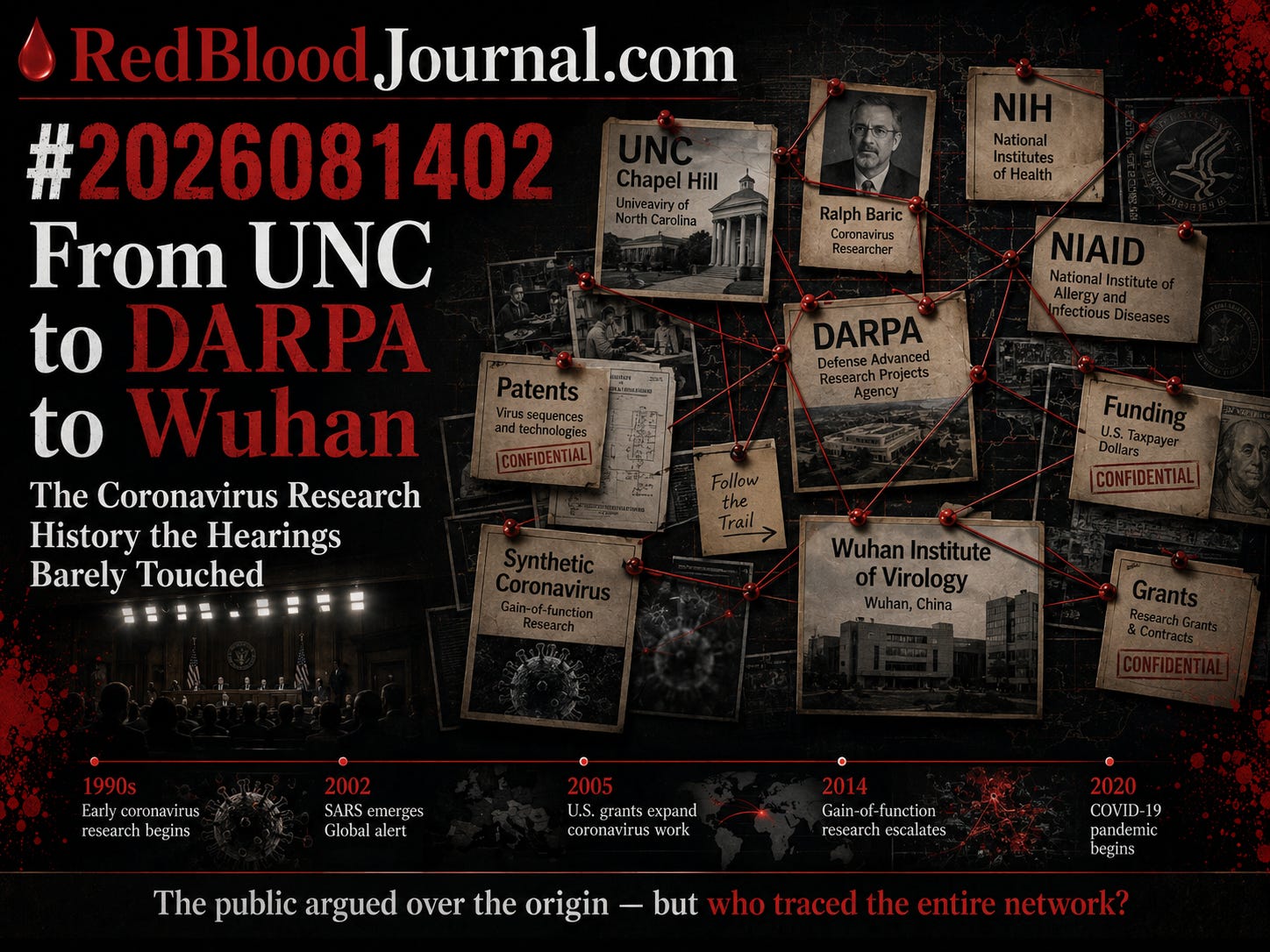
🩸 #2026081402 — From UNC to DARPA to Wuhan: The Coronavirus Research History the Hearings Barely Touched
RedBloodJournal.com
The public argument over COVID’s origin was gradually squeezed into a narrow box.
Either the virus emerged naturally.
Or it leaked from a laboratory in Wuhan.
That framing dominated headlines, television segments, congressional exchanges and social-media combat for years. It gave the public a debate, but it may also have done something else. It may have hidden a longer, more complicated research history behind a simpler geopolitical argument.
In the interview “Fauci Hearings Were a Complete Coverup! Here’s What They’re Hiding w/ Dr. David Martin”, Martin argues that the real story does not begin in Wuhan and does not begin in 2020. He says the relevant trail runs through Ralph Baric, the University of North Carolina at Chapel Hill, NIH, NIAID, DARPA, patents, earlier coronavirus work and years of American research that received far less public attention than the Wuhan debate.
That is a serious claim.
It does not prove itself merely because it is dramatic. It must be tested carefully.
But it also should not be dismissed simply because it is inconvenient.
The important question is not whether the public was given a theory.
The important question is whether the public was given the whole timeline.
The Wuhan Frame May Have Been Too Small
By the time the mainstream press became comfortable discussing a laboratory origin, the public conversation had already been conditioned to think in one direction.
Attention flowed toward China, the Wuhan Institute of Virology, international blame and the possibility of a leak from a Chinese facility.
Martin’s argument is that this frame may have been incomplete from the start.
In the interview, Jimmy Dore notes that Jeffrey Sachs had concluded he was “99% sure” the virus came out of UNC Chapel Hill and was engineered by Ralph Baric. Martin agrees that UNC deserves scrutiny, but he then goes even further and argues that the story extends deeper into earlier U.S. programs, patents and research structures.
This matters because a research network is not the same thing as a physical location.
A virus can emerge from one place while the techniques behind it were refined somewhere else.
Funding can originate in one institution, experiments can be carried out in another, and international collaboration can move methods, materials and expertise across borders long before the public hears a single name.
Once that possibility is admitted, the argument stops being just China vs. America.
It becomes a question of who built the scientific pathway, who financed it, who approved it, who benefited from it, and who later controlled the narrative about it.
The Name That Keeps Reappearing: Ralph Baric
One of the strongest recurring themes in the interview is the name Ralph Baric.
Martin places Baric near the center of the coronavirus research history he wants investigated. He connects Baric to recombinant coronavirus work, synthetic coronavirus work, patents, gain-of-function disputes, and later treatment-related arguments.
According to the transcript, Martin says Fauci funded recombinant coronavirus work with Baric at UNC Chapel Hill and that the related work was patented through UNC and NIAID-linked interests. He argues that this places important events in 2002, not merely in the period immediately before COVID.
If that timeline is relevant, then a great deal of public debate began too late.
Most people were taught to start with Wuhan.
Some were later encouraged to start with 2014 and the gain-of-function moratorium.
Martin is telling viewers to start earlier than both.
That does not automatically make him right. But it does present a straightforward investigative demand:
What was Baric’s coronavirus research history, what was federally funded, what was patented, and how much of it predates the pandemic by years or decades?
That is a question Congress could ask without endorsing any sweeping conclusion.
“Biological Warfare Enabling Technologies”
The most explosive part of the interview may not be a verbal allegation at all. It may be a phrase shown in a document.
Dore displays a document connected to Baric and UNC Chapel Hill that, according to the transcript, includes the words “synthetic coronaviruses, biohacking, biological warfare enabling technologies.” Martin treats this phrase as enormously significant and argues it should have received much more attention.
This is exactly the kind of material that demands careful handling.
A phrase by itself is not a verdict.
Scientific, military and biodefense language often overlaps. Research may be defensive, dual-use or exploratory while still using alarming terminology. On the other hand, public officials and institutions sometimes hide behind technical ambiguity precisely because most citizens will never see the underlying documents.
So the phrase does not settle the matter.
But it does raise questions that deserve open examination.
What was the exact context?
Who authored the document?
Was it a proposal, a summary, a presentation, or a description of operational work?
How was “biological warfare enabling technologies” defined by the people using the phrase?
How did federal agencies interpret it?
And why did that language not become a central line of questioning in highly publicized hearings?
The phrase is not proof of Martin’s entire case.
It is, however, a legitimate investigative doorway.
NIH, NIAID and DARPA
Another major point in Martin’s argument is that the research history cannot be understood by talking only about Fauci and Wuhan while ignoring the institutions that fund and shape scientific programs.
He repeatedly points toward NIAID, NIH and DARPA.
According to the transcript, Martin says DARPA and NIAID funded what he describes as a “Biowarfare Enabling Technology Program” using synthetic coronavirus work beginning around 2005. He treats that period as a critical chapter that the public largely missed.
This is where the investigation becomes structurally important.
NIH and NIAID belong to the public-health universe in the public mind.
DARPA belongs to the defense universe.
When a research trail moves through both, the public deserves a clear distinction between biodefense, dual-use pathogen research, medical countermeasure development, and anything that could plausibly shade into weapons-related capability.
The average citizen never receives that map.
They are given fragments.
A scary virus.
A few famous names.
A hearing clip.
A lab-leak headline.
A bureaucratic denial.
Then they are told to choose which team they believe.
A serious investigation would not ask the public to choose teams.
It would reconstruct the institutional network.
2002, 2005 and the Problem With Starting the Story Too Late
Martin repeatedly returns to the timeline.
He says that if people begin with 2014, or 2019, or 2020, they are already entering the story after some of the most important chapters.
He points to 2002 as a year of recombinant coronavirus work and says 2005 brought labeling connected to “biological warfare enabling technology.”
Again, those interpretations require verification.
But the timeline question itself is very strong.
If the relevant patents, grants, experiments, institutional interests and scientific capabilities were already present years before COVID, then any investigation beginning only with the pandemic years may be performing more than investigating. It may be controlling the frame.
To begin the story too late is to shape the story before the facts are examined.
The public becomes trapped inside a preselected window.
Inside that window, everything looks sudden.
Outside it, much less does.
The 2014 Moratorium Question
The gain-of-function moratorium became one of the most publicized reference points in later political debate.
Martin argues that even this focus may be misleading if it is treated as the main starting point.
In the interview, he says a 2014 NIAID communication to Baric indicated that work involving the Wuhan Institute of Virology was considered gain-of-function research and that it was still allowed to continue despite the moratorium. He also alleges that this information had been given to senators but was not fully used in hearings.
If accurate, that would be significant.
But even here the deeper issue remains the same.
Why does the public hear mostly about whether there was gain-of-function research, while hearing much less about the longer chain of who financed what, who approved exceptions, how the work was categorized, how collaboration moved between institutions and what exactly the researchers believed they were building or defending against?
The public was often asked to debate labels.
Martin is asking viewers to examine the structure beneath the labels.
The Patent Trail
One of Martin’s recurring methods is to use patents as a historical trail.
He argues that patents can reveal who was working on coronavirus technologies, what was being claimed, and when those claims existed.
In the transcript, he refers not only to 2002 recombinant coronavirus patent-related issues, but also to a 1990 Pfizer coronavirus vaccine patent for veterinary use, which he uses to argue that coronavirus vaccine work and spike-related thinking long predated the public’s awareness of COVID.
A patent, of course, is not the same thing as a finished deployed product. It does not prove intention beyond its legal and technical scope. It may represent speculative, defensive or commercial pathways.
But patents are powerful because they create timestamps.
They can show what institutions were already imagining, protecting, commercializing or investing in.
If Martin is overstating their meaning, that can be shown by fuller document review.
If he is not, then the patent trail may be one of the clearest ways to reconstruct a research history that the public never received in orderly form.
SARS-1 and the Missing Historical Memory
Another revealing point in the interview is Martin’s insistence that the public forgot, or was never properly taught, the relevance of SARS-1.
He argues that SARS in 2002–03 should not be treated as merely an earlier unrelated outbreak floating in the background of COVID. He connects it to earlier patented and engineered coronavirus work and treats it as part of a larger historical continuum rather than an isolated event.
Whether one accepts Martin’s strongest claims or not, the core issue is difficult to ignore.
Why was SARS-1 rarely treated as a major part of the same investigative history?
Why was the public encouraged to think of COVID as a shocking rupture rather than the apparent continuation of an already mature coronavirus research landscape?
If a technology or research pathway existed long before 2020, then 2020 did not create the system. It exposed it.
The Politics of the Research Network
The research history is not only scientific. It is political.
Federal money runs through universities. Universities produce prestige, employment, patents, contractors and regional economic influence. Members of Congress oversee agencies that finance programs benefiting institutions in their own states. Defense and public-health programs often overlap through grants, labs and technical collaboration.
Martin suggests that these relationships help explain why deeper questions are avoided. He specifically argues that powerful institutions are financially and politically intertwined with the same system supposedly being investigated.
This is an allegation, but it is a plausible line of inquiry.
If Congress is investigating a research ecosystem that supports universities, labs and contractors across congressional districts, then Congress is not investigating a distant object. It is investigating something tied to local interests, budgets and influence.
That does not mean every lawmaker is compromised.
It does mean the incentives for narrow investigation are real.
And if the incentives are real, the public should not be surprised when the inquiry stops at the most television-friendly witness.
The Heart of Report 2
The real force of Martin’s argument is not that he has a perfectly finished theory.
It is that he believes the official and semi-official theories were built inside an artificially limited frame.
His core message is this:
Do not begin with Wuhan only.
Do not begin with Fauci only.
Do not begin with 2020 only.
Do not begin with the hearing-room performance only.
Begin with the longer chain.
Begin with the research history.
Begin with Baric, UNC, patents, NIH, NIAID, DARPA, the moratorium questions, the collaborations, the classifications, and the institutions that existed before the public ever heard the word COVID.
That is not a final conclusion.
It is an investigative direction.
And perhaps that is exactly what was missing.
The Red Blood Perspective
The deeper research history around coronaviruses may prove less sinister than Martin argues.
It may prove more sinister.
It may reveal a pattern of reckless dual-use research rather than deliberate malicious design.
It may reveal bureaucratic fragmentation rather than one coherent master plan.
It may reveal institutional negligence, commercial opportunism, narrative management, or some combination of all of them.
But one thing is hard to ignore.
A public that spends years fighting over Wuhan while barely discussing Baric, UNC, DARPA, patent histories and the older U.S. research trail is a public being asked to argue inside a narrow corridor.
Narrow corridors are useful.
They direct movement.
They keep the crowd from entering the rest of the building.
If the coronavirus story truly runs through a wider network, then the fight over origin has never just been about science. It has also been about frame control.
And whoever controls the frame controls how far the public is allowed to look.
Ocean of Love and Positivity
There is no need to panic at every document and no wisdom in ignoring every disturbing clue.
The stronger path is to keep widening the timeline, widening the map, and widening the list of institutions under examination until the story stands on evidence rather than branding, fear or team loyalty.
If the deeper research history changes nothing, it should be able to withstand scrutiny.
If it changes everything, scrutiny is exactly what it has needed all along.
The reader can decide how much of the trail has been hidden in plain sight.
In an Ocean of Love and Positivity.
🩸🌊✨ Fantastic!
🧬
Beyond Wuhan: The Hidden Coronavirus Research Timeline
Aug 14, 2026
This text explores the theory that the origins of COVID-19 are rooted in a long-standing American research history rather than a sudden event in China. It argues that the public debate has been artificially restricted to the Wuhan lab-leak theory, ignoring decades of coronavirus experiments and patents involving Ralph Baric and the University of North Carolina. According to the sources, organizations like the NIH, NIAID, and DARPA funded sophisticated synthetic biology and dual-use technologies long before the 2020 pandemic. By focusing on a broader timeline starting in 2002, the author suggests that the virus may be the result of an established international research network. Ultimately, the text calls for a deeper investigation into how federal funding and institutional interests shaped the scientific path that led to the global crisis.


