


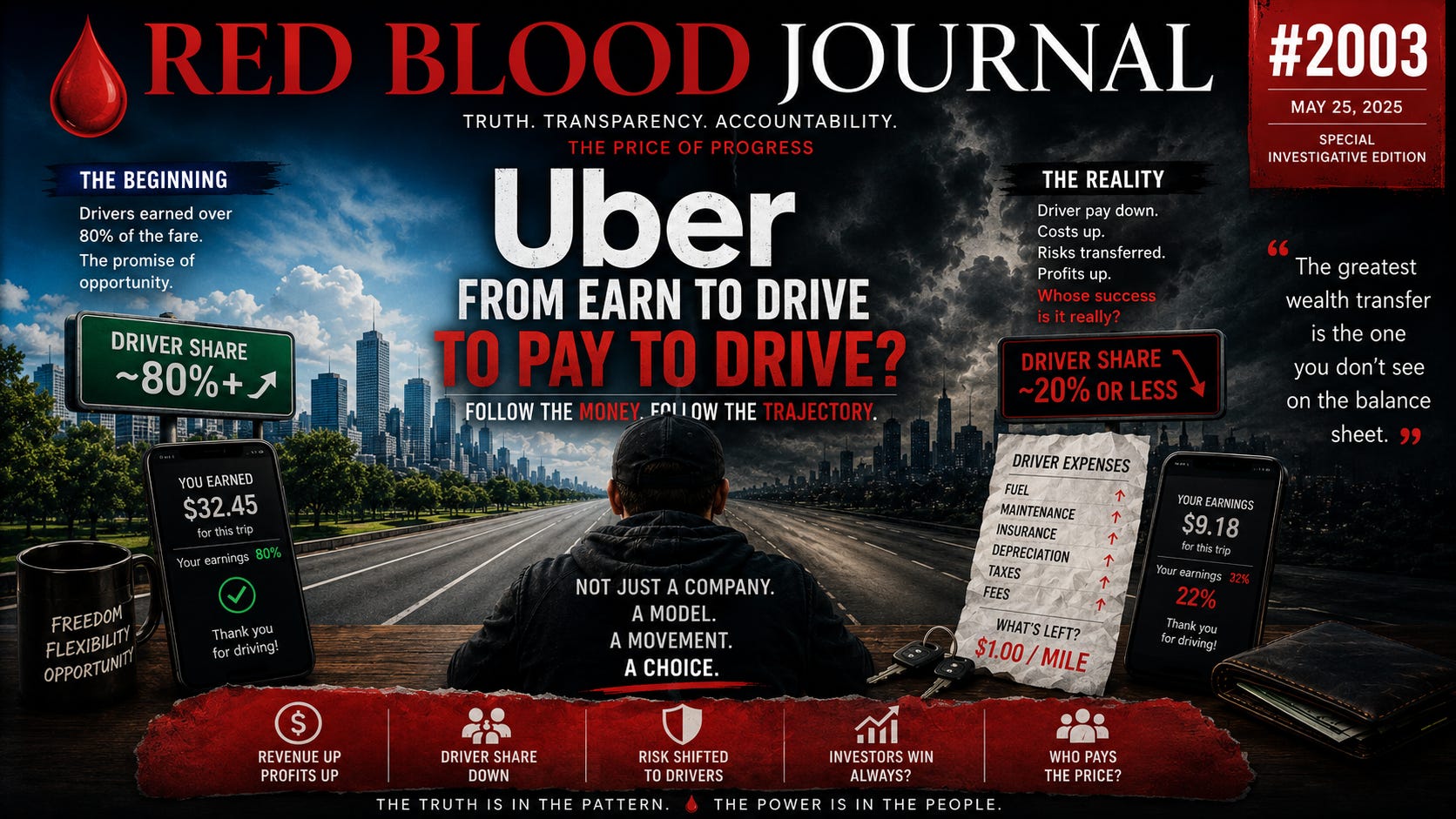
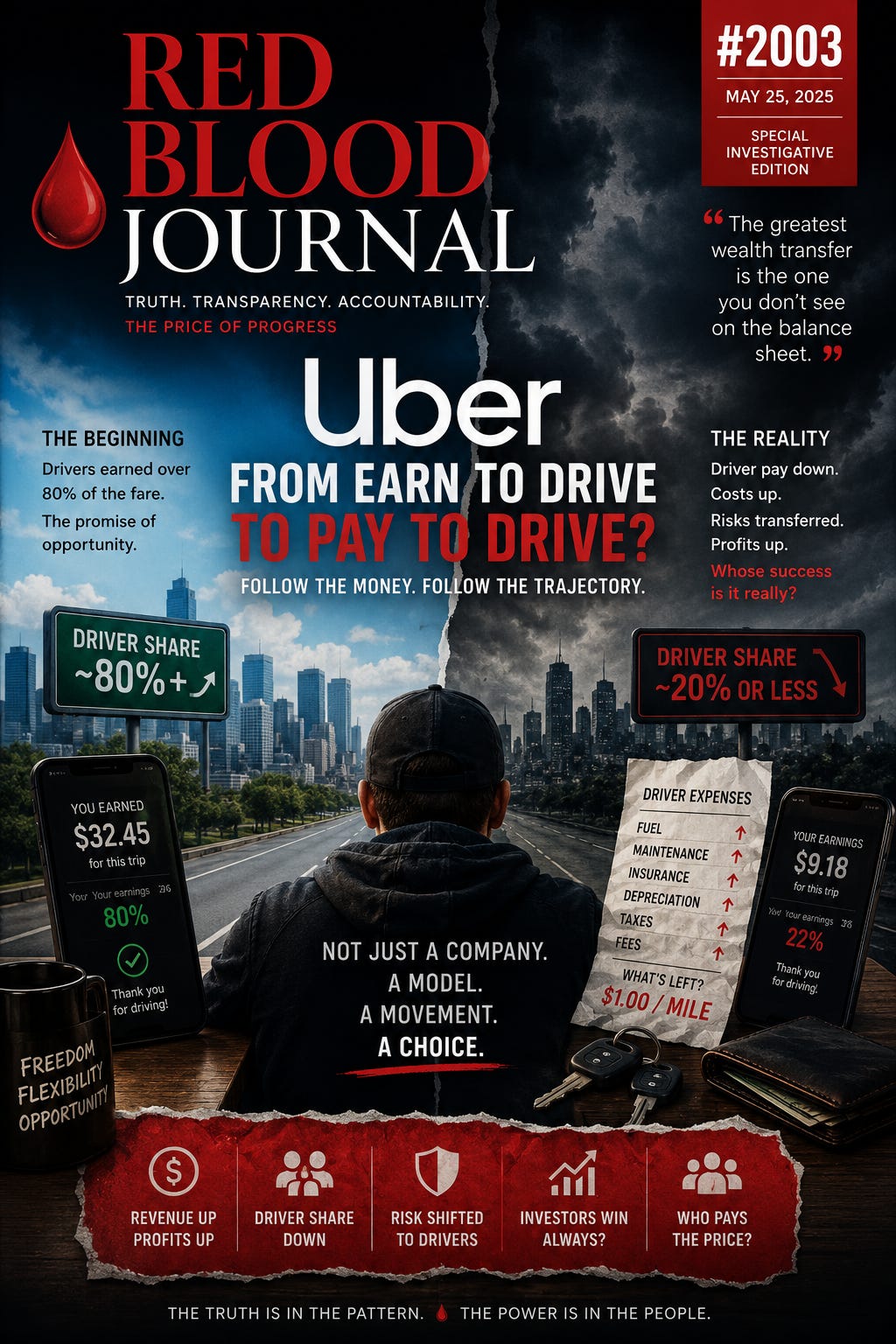
🩸 Red Blood Journal
#2003 – When Growth Begins to Consume Itself
Reading Between the Lines of Uber
Every investor is taught to read financial statements.
Revenue.
Profit.
Cash flow.
Earnings per share.
But financial statements only tell us what happened.
They rarely tell us how it happened.
Sometimes the most revealing information is found not in the balance sheet, but in the company’s behavior.
The Beginning
Uber began by solving a real problem.
It connected riders with drivers through technology.
To build that network, it needed drivers.
Drivers were attracted by relatively generous compensation, incentives, and a straightforward revenue-sharing model.
Investors supplied billions of dollars.
The company expanded rapidly.
The objective was growth.
Profit could wait.
Everyone appeared to benefit.
The Shift
As the network matured, the objective changed.
Growth alone was no longer enough.
Public markets demanded profits.
The company reduced incentives.
Pricing became more algorithmic.
Driver compensation became less directly tied to the passenger’s fare.
Recent insurance changes supported by Uber have also drawn attention to how costs and risks are allocated between the platform, drivers, passengers, and insurers.
Viewed individually, each decision can be explained as normal business management.
Viewed together, they raise a more interesting question.
Reading Between the Lines
Businesses communicate in two languages.
One is spoken through press releases.
The other is spoken through actions.
When a mature company repeatedly searches for ways to reduce costs, adjust compensation, or transfer risk, investors naturally ask:
What pressure is management responding to?
If the business were becoming stronger every year, would these changes still be necessary?
Or do they suggest that maintaining growth has become progressively more difficult?
No outsider can know the answer with certainty.
But actions often reveal what numbers alone cannot.
The Growth Trap
Every business eventually reaches a limit.
There is only so much technology that can be developed.
Only so many new customers to acquire.
Only so many efficiencies to discover.
Once those opportunities become smaller, the easiest path to improving quarterly results may be to reduce expenses.
If that process continues long enough, the business may begin shifting more costs onto the very people who create its value.
Drivers purchase the vehicle.
Drivers purchase the fuel.
Drivers pay for maintenance.
Drivers absorb depreciation.
Drivers pay self-employment taxes.
Drivers often carry additional insurance.
If compensation does not keep pace with those costs, a troubling possibility emerges.
The platform may continue showing improving financial results while the people performing the work experience declining economic returns.
When Earning Becomes Paying
Taken to its logical conclusion, one arrives at a difficult question.
At what point does a worker stop earning from a platform and begin subsidizing it?
A driver may still receive deposits into a bank account.
But if operating expenses steadily consume a larger share of those deposits, the remaining income can become so small that the driver is effectively financing part of the platform’s success through personal assets, unpaid time, and vehicle depreciation.
Whether that point has already been reached depends on each driver’s circumstances.
But the direction of travel deserves attention.
The Measure of Capitalism
Perhaps the greatest misunderstanding in modern investing is believing that profit alone measures success.
A criminal enterprise can generate profits.
A monopoly can generate profits.
Fraud can generate profits.
Profit answers only one question:
Did money accumulate?
It does not answer the more important one:
Who created that wealth, and who ultimately paid for it?
Healthy capitalism creates value for everyone involved.
Customers receive better service.
Workers build better lives.
Investors earn fair returns.
Communities become stronger.
When one group prospers only because another steadily absorbs more cost and risk, the appearance of success may become disconnected from the underlying health of the system.
The Final Question
Perhaps investors have been asking the wrong question.
Instead of asking,
“How much profit did the company make?”
Perhaps they should ask,
“As the company became wealthier, did the people who made that success possible become more prosperous as well?”
If the answer is no, then perhaps the balance sheet is measuring financial growth while overlooking something far more important.
The long-term sustainability of the system itself.
Subjects
Uber
Gig economy
Driver compensation
Platform economics
Corporate incentives
Insurance changes
Shareholder capitalism
Stakeholder capitalism
Business ethics
Long-term corporate sustainability
Value creation versus value extraction
Modern investing
🩸 Red Blood Journal
The strongest businesses are not those that merely generate profits.
They are those that continue creating prosperity for everyone who makes those profits possible.
🌊✨ Fantastic!
📈 The Growth Trap:
Value Extraction in the Gig Economy
Jul 21, 2026
The provided text from the Red Blood Journal examines the evolving business model of Uber and its broader implications for the gig economy. It argues that while the company initially prioritized rapid growth and driver incentives, its transition toward profitability has led to increased financial pressure on the workers who sustain the platform. By shifting operational costs and risks onto drivers, the business may be generating financial gains that mask a decline in the underlying health of its ecosystem. The author suggests that true corporate success should be measured by whether a company creates mutual prosperity for all stakeholders rather than just extracting value for shareholders. Ultimately, the source challenges investors to look past balance sheets to question the long-term sustainability of systems where worker wealth does not grow alongside corporate riches.


