


🩸 Red Blood Journal
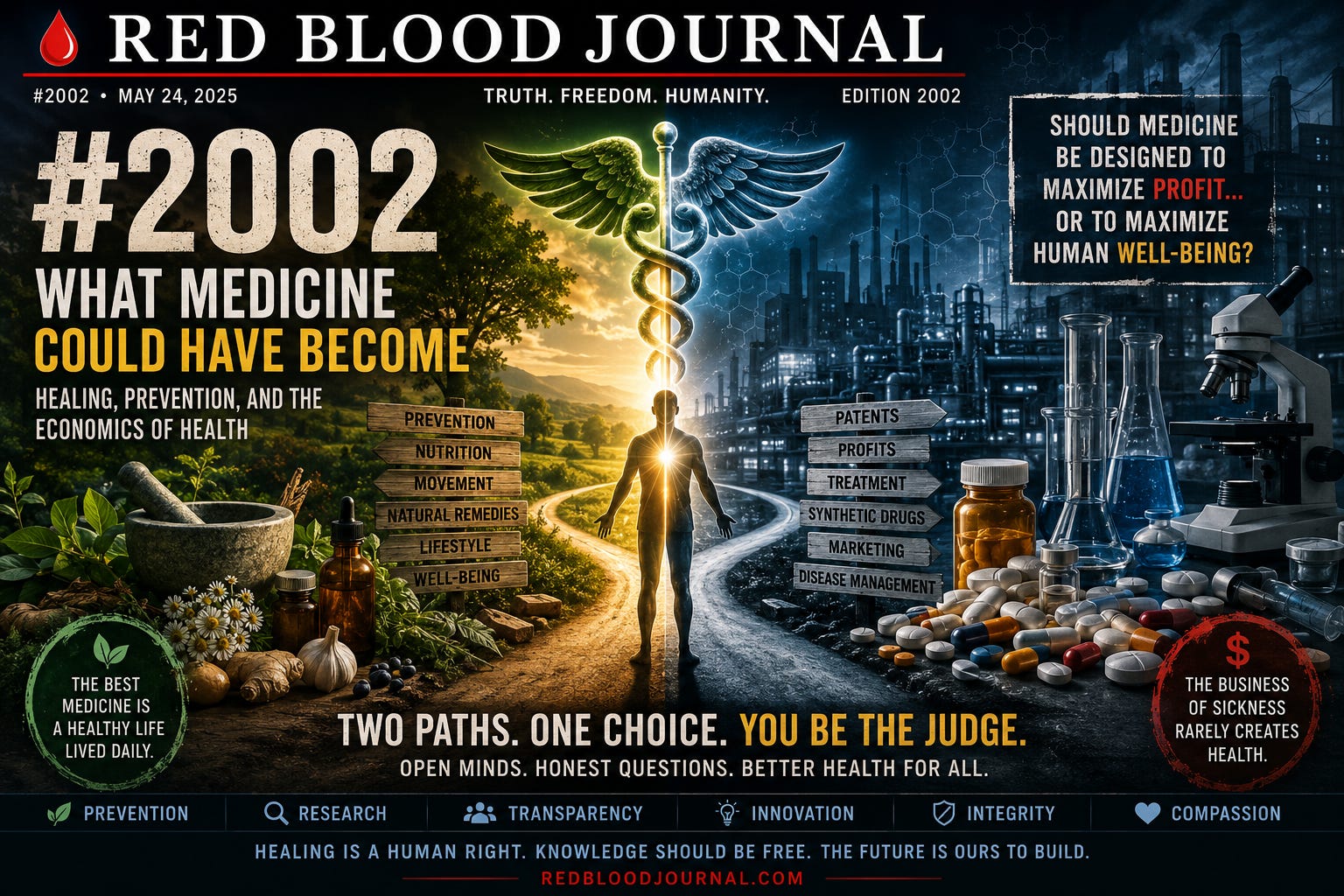
#2002 – What Medicine Could Have Become
Healing, Prevention, and the Economics of Health
Imagine a world where the primary purpose of medicine was not to maximize financial return, but to maximize human health.
A world where success was measured by the number of diseases prevented rather than the number of prescriptions filled.
A world where doctors celebrated having fewer patients because more people remained healthy.
In such a world, prevention might become the first line of medicine.
Nutrition would receive as much attention as pharmaceuticals.
Sleep before sedatives.
Exercise before surgery whenever appropriate.
Stress reduction before lifelong medication whenever possible.
Sunlight.
Fresh air.
Clean water.
Healthy food.
Movement.
Community.
Purpose.
These would not be considered “alternative.”
They would simply be medicine.
Natural remedies that demonstrated safety and effectiveness through rigorous scientific research would be investigated with the same enthusiasm as laboratory-developed medicines.
Plants would not compete with pharmaceuticals.
They would complement them.
Many of today’s most important medicines originated from compounds first discovered in nature.
Nature has long been one of humanity’s greatest laboratories.
Yet another question naturally follows.
Does the way medicine is financed influence the kind of medicine that is developed?
Some critics believe the answer is yes.
They argue that modern healthcare systems can place greater financial emphasis on treating disease than preventing it.
They note that many naturally occurring substances cannot be patented in their natural form, while newly developed medicines often can be.
From this perspective, commercial incentives may influence which treatments receive the greatest research funding, publicity, and investment.
Supporters of this view argue that humanity should reward the transformation of knowledge into useful products and services—not the long-term ownership of knowledge itself.
If a safe and effective treatment exists, they believe it should be investigated and, when supported by evidence, made widely available regardless of whether it originated in a laboratory or in nature.
Others strongly disagree.
They point out that modern medicine has dramatically increased life expectancy and reduced suffering across the world.
Antibiotics transformed once-deadly bacterial infections.
Insulin allows millions of people with diabetes to live productive lives.
Anesthesia made modern surgery possible.
Many cancer therapies have extended survival for patients who previously had few options.
Emergency medicine, organ transplantation, and antiviral therapies have changed the course of countless lives.
Supporters of the current system argue that these breakthroughs required decades of research, enormous investment, and significant financial risk.
Many experimental medicines fail before a successful one reaches patients.
Without intellectual property protections and the possibility of financial return, they argue that much of this research might never occur.
Perhaps the debate is not really about natural versus synthetic.
Perhaps it is about incentives.
Should medicine primarily reward the treatment of disease?
Or should it increasingly reward keeping people healthy in the first place?
Should greater public investment be directed toward prevention, nutrition, lifestyle medicine, and the rigorous scientific study of promising natural therapies alongside conventional pharmaceuticals?
Could healthcare systems reward physicians and researchers based on healthier populations rather than simply on the volume of treatments provided?
These are not simple questions.
Nor are they questions with only one correct answer.
They deserve thoughtful discussion rather than ideological certainty.
Perhaps the future of medicine is not found in choosing one side over the other.
Perhaps it lies in combining the best of both.
A healthcare system that embraces scientific rigor.
That investigates every promising therapy with the same standards of evidence.
That values prevention as highly as treatment.
That welcomes innovation whether it begins in a rainforest, a university laboratory, or a research hospital.
If humanity’s goal is health rather than simply healthcare, then every promising path deserves honest investigation.
In the end, this report is not intended to declare a winner.
It is intended to ask a question.
If medicine were redesigned today from the beginning, with only one objective—maximizing human well-being—what would it look like?
The answer belongs not to governments.
Not to corporations.
Not to researchers.
Not to journalists.
It belongs to every reader willing to examine the evidence, consider the incentives, and decide for themselves.
Subjects
The Future of Medicine
Preventive Medicine
Healthcare Economics
Natural Products Research
Pharmaceutical Innovation
Medical Ethics
Public Health
Scientific Evidence
Incentives in Healthcare
Human Well-Being
🩸🌊✨ Fantastic!
⚖️ The Architecture of Human Well-Being
Jul 20, 2026
The provided text from Red Blood Journal explores a theoretical shift in healthcare that prioritizes preventative lifestyle measures over the traditional focus on pharmaceutical intervention. It highlights a tension between modern medical breakthroughs, which have saved countless lives through synthetic innovation, and a profit-driven system that may disincentivize the study of non-patentable natural remedies. The author questions whether current financial incentives reward the treatment of chronic illness more than the maintenance of long-term wellness. By advocating for a system that values nutrition, environment, and community alongside rigorous laboratory science, the source suggests that the future of medicine should be built on scientific evidence rather than commercial interests. Ultimately, the text invites readers to envision a healthcare model where maximizing human well-being is the sole objective, harmonizing nature with technology.


