


🩸 Red Blood Journal
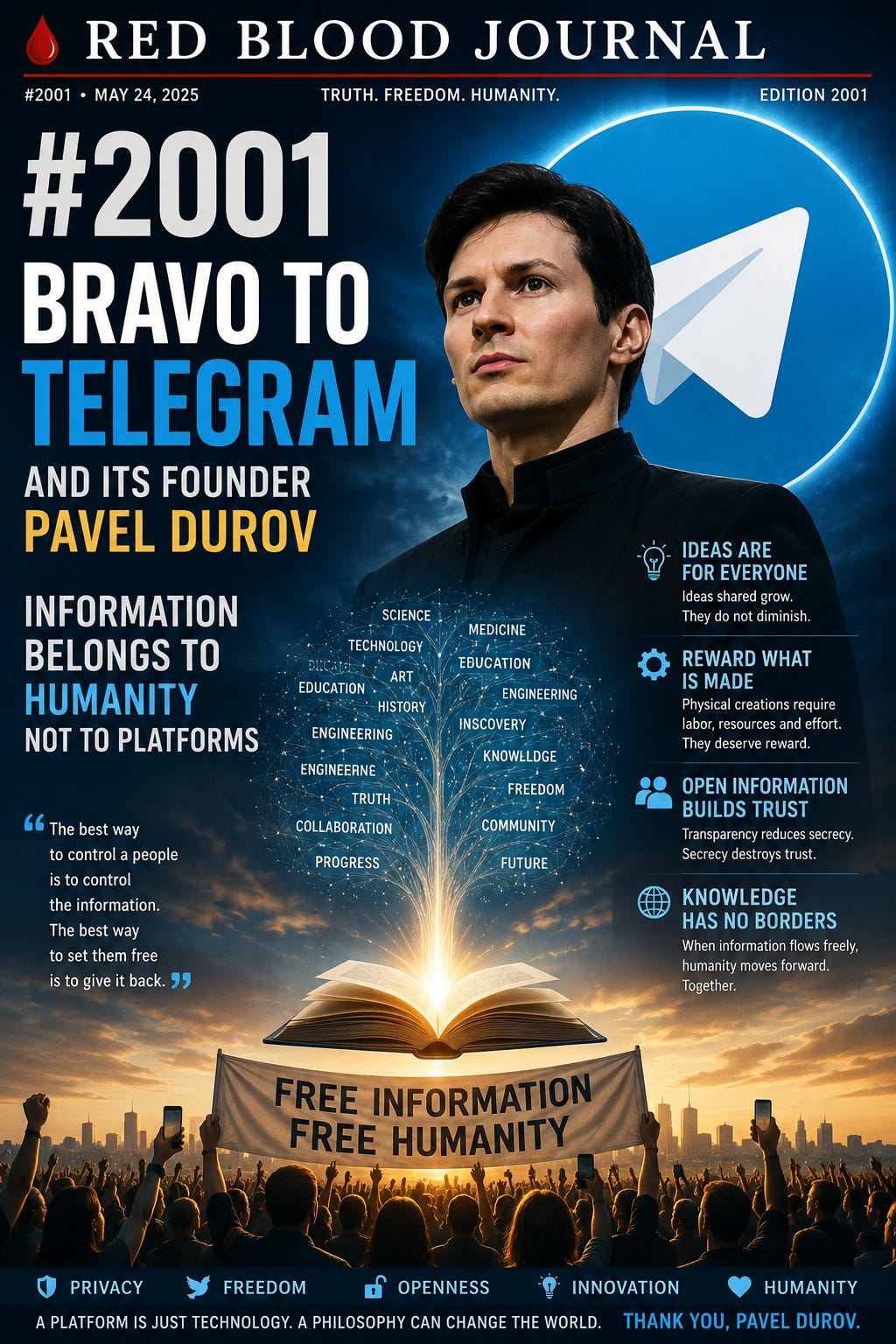
#2001 – Bravo to Telegram
When Information Belongs to Humanity
Among today’s social media platforms, one stands apart in the eyes of many of its supporters.
That platform is Telegram.
The reason is not simply its technology.
It is its philosophy.
Telegram has often been praised for enabling information to flow directly between people with comparatively fewer algorithmic barriers than many other mainstream platforms. To many users, that represents more than a technical feature—it represents an idea.
The idea that information should belong to humanity rather than to any single corporation, government, or institution.
This raises one of the most important questions of the digital age.
Who owns information?
There is a strong argument that only physical goods should become permanent property.
A craftsman builds a chair.
A machinist manufactures an engine.
A farmer grows food.
An engineer constructs a bridge.
These require labor, materials, machinery, transportation, maintenance, and skill.
They deserve to be rewarded.
Ideas are different.
When one person shares an idea with another, nothing is lost.
When an idea is shared with one million people, it still belongs to the original thinker while simultaneously becoming the starting point for countless new ideas.
Knowledge multiplies.
It does not diminish.
Unlike gold, land, or machines, information becomes more valuable the more widely it is shared.
Civilization itself was built this way.
Mathematics was shared.
Language was shared.
Agriculture was shared.
Engineering was shared.
Medicine was shared.
Each generation inherited knowledge from the one before.
Humanity advanced because people built upon previous discoveries instead of recreating them from the beginning.
From this perspective, the greatest reward should not come from owning ideas indefinitely.
The reward should come from transforming those ideas into useful products, services, inventions, works of art, and solutions that improve people’s lives.
Competition would remain.
Innovation would remain.
But competition would focus on who can build the best future, rather than who can own knowledge the longest.
Another benefit of freely available information is transparency.
Open information reduces unnecessary secrecy.
Transparency builds confidence.
Excessive secrecy can erode it.
When people feel that important information is hidden from them, some begin to question institutions, official narratives, and even long-established conclusions.
Whether those doubts ultimately prove correct or incorrect is not the central issue.
The deeper issue is trust.
Many advocates of openness argue that trust grows strongest when evidence, methods, and information can be examined independently rather than accepted solely on authority.
Knowledge becomes stronger when it is continuously questioned, tested, challenged, and improved.
That process is possible only when information can circulate freely.
Perhaps this is why Telegram has earned such loyalty among many of its users.
To them, it represents more than another messaging application.
It represents resistance to the idea that information should be treated primarily as a commodity.
It represents the belief that knowledge should travel as freely as possible so that every human being has an equal opportunity to learn, question, create, and contribute.
For that philosophy, many supporters would simply say:
Bravo to Telegram.
Bravo to its founder, Pavel Durov, for championing a vision of digital communication that many see as prioritizing openness, privacy, and individual freedom.
Whether history ultimately agrees with that vision remains to be seen.
But history has often shown that civilizations advance most rapidly when ideas are allowed to travel farther than the walls built around them.
Subjects
Telegram
Pavel Durov
Freedom of Information
Knowledge Sharing
Transparency
Digital Privacy
Open Communication
Intellectual Property
Innovation
The Future of Information
🩸🌊✨ Fantastic!
📖 The Architecture of Open Knowledge
Jul 20, 2026
The featured text explores the philosophical foundations of the social media platform Telegram, highlighting its role in promoting the unrestricted flow of information. It posits that while physical goods require private ownership, knowledge and ideas should belong to all of humanity to foster collective advancement and innovation. By championing transparency and reducing algorithmic barriers, the platform is presented as a tool for building institutional trust through independent verification. The author argues that intellectual progress accelerates when information is treated as a shared resource rather than a guarded commodity. Ultimately, the source credits founder Pavel Durov with prioritizing digital freedom and individual privacy over corporate control. This vision suggests that the future of civilization depends on the ability of ideas to travel without borders.


