


🩸 Red Blood Journal
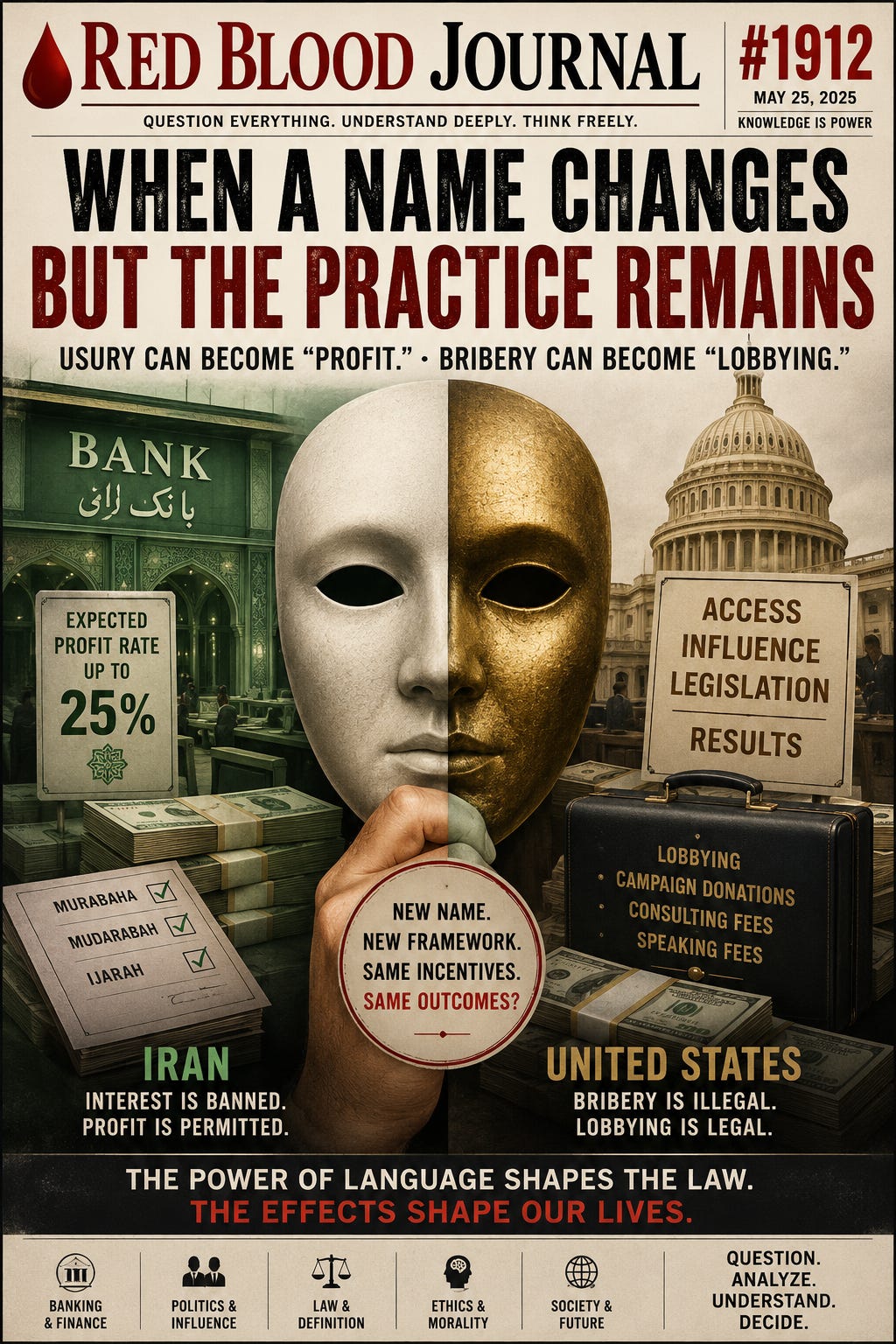
#1912 – When a Name Changes but the Practice Remains
The Power of Language in Law, Economics, and Politics
Executive Summary
Throughout history, societies have often prohibited practices considered unethical, harmful, or incompatible with their values.
Yet history also shows another recurring pattern.
Sometimes the practice itself does not disappear.
Instead, it is redefined.
A new legal framework is created.
A new vocabulary is introduced.
The original concept survives under a different name.
Whether this represents genuine reform or simply legal evolution is a question each reader must decide.
The Iranian Banking Example
Following the 1979 Islamic Revolution, Iran officially prohibited riba, commonly translated as usury or interest.
Modern economies, however, require savings, lending, and investment.
Banks still needed a mechanism to attract deposits and finance businesses.
Rather than describing payments to depositors as “interest,” Islamic banking developed alternative contractual structures such as:
Profit-sharing
Partnership financing
Leasing
Installment sales
Expected profit returns
To many supporters, these contracts represent legitimate Islamic financial principles.
To many critics, the economic outcome can resemble conventional interest despite the different legal structure.
During periods of high inflation, Iranian banks reportedly offered deposit returns approaching 20–25 percent in order to encourage citizens to keep their savings inside the banking system instead of purchasing foreign currency or gold.
Eventually those returns became increasingly difficult to sustain as inflation, banking stress, and fiscal pressures intensified.
The debate continues today:
Has the practice fundamentally changed, or has its legal description changed while producing a similar economic result?
The American Example
A similar philosophical discussion appears in American politics.
Bribery is illegal.
Lobbying is legal.
The distinction is important under the law.
Bribery generally requires an explicit exchange of something valuable for a specific official act.
Lobbying, campaign contributions, policy advocacy, and political donations operate under regulated legal frameworks with disclosure requirements and constitutional protections.
Yet many citizens ask a broader ethical question.
If money consistently purchases greater access to lawmakers, greater influence over legislation, or greater visibility for particular interests, how different is the practical outcome from corruption?
Legal scholars continue to debate where influence ends and corruption begins.
The Power of Definitions
Every legal system depends upon definitions.
Words determine:
what is legal,
what is prohibited,
what is taxable,
what is protected,
and what society considers acceptable.
A change in terminology can sometimes transform the legal status of an activity without eliminating the activity itself.
This observation extends beyond banking and politics.
History contains many examples where changing language has changed public perception.
A Broader Pattern
Many modern terms describe activities that existed long before the words themselves.
Examples often discussed include:
Interest becoming “expected profit.”
Lobbying replacing what some might once have broadly described as influence buying.
Public relations replacing older forms of political messaging.
Data collection replacing practices once described more simply as surveillance.
These comparisons are not exact legal equivalents.
Rather, they illustrate a broader philosophical idea:
Language has the power to reshape how institutions understand and regulate human behavior.
The Central Question
Perhaps the deeper issue is not whether a word changes.
The deeper issue is whether the underlying incentives, relationships, and outcomes change with it.
If two systems produce nearly identical practical effects but rely on different terminology and legal structures, should they be judged primarily by their names—or by their consequences?
That question reaches beyond any one country, religion, or political system.
It invites every society to examine not only the laws it creates, but also the language through which those laws are understood.
Subjects
Islamic Banking
Riba (Usury)
Interest and Profit
Iranian Economy
Banking Reform
Inflation
Political Lobbying
Bribery
Campaign Finance
Influence and Power
Legal Definitions
Language and Law
Ethics
Public Policy
Institutional Philosophy
🩸 Red Blood Journal
Sometimes history does not erase an idea.
Sometimes it simply gives it a new name.
As always, continue questioning, continue learning, and continue searching for understanding.
Fantastic!
⚖️ The Lexicon of Law and the Illusion of Reform
Jul 17, 2026
The provided text from the Red Blood Journal explores how language and legal definitions are used to rebrand controversial practices rather than eliminating them. By examining Iranian Islamic banking, the author illustrates how the prohibited concept of usury is restructured as profit-sharing to maintain economic functionality. Similarly, the source compares the legal distinction between lobbying and bribery in the United States to show how terminology can legitimize systemic influence. The core thesis suggests that while rebranding changes the legal status of an activity, the underlying economic or social outcomes often remain the same. Ultimately, the article challenges readers to judge institutions by their practical consequences rather than the specific labels used to describe them.


