


🩸 Red Blood Journal
Report #1828
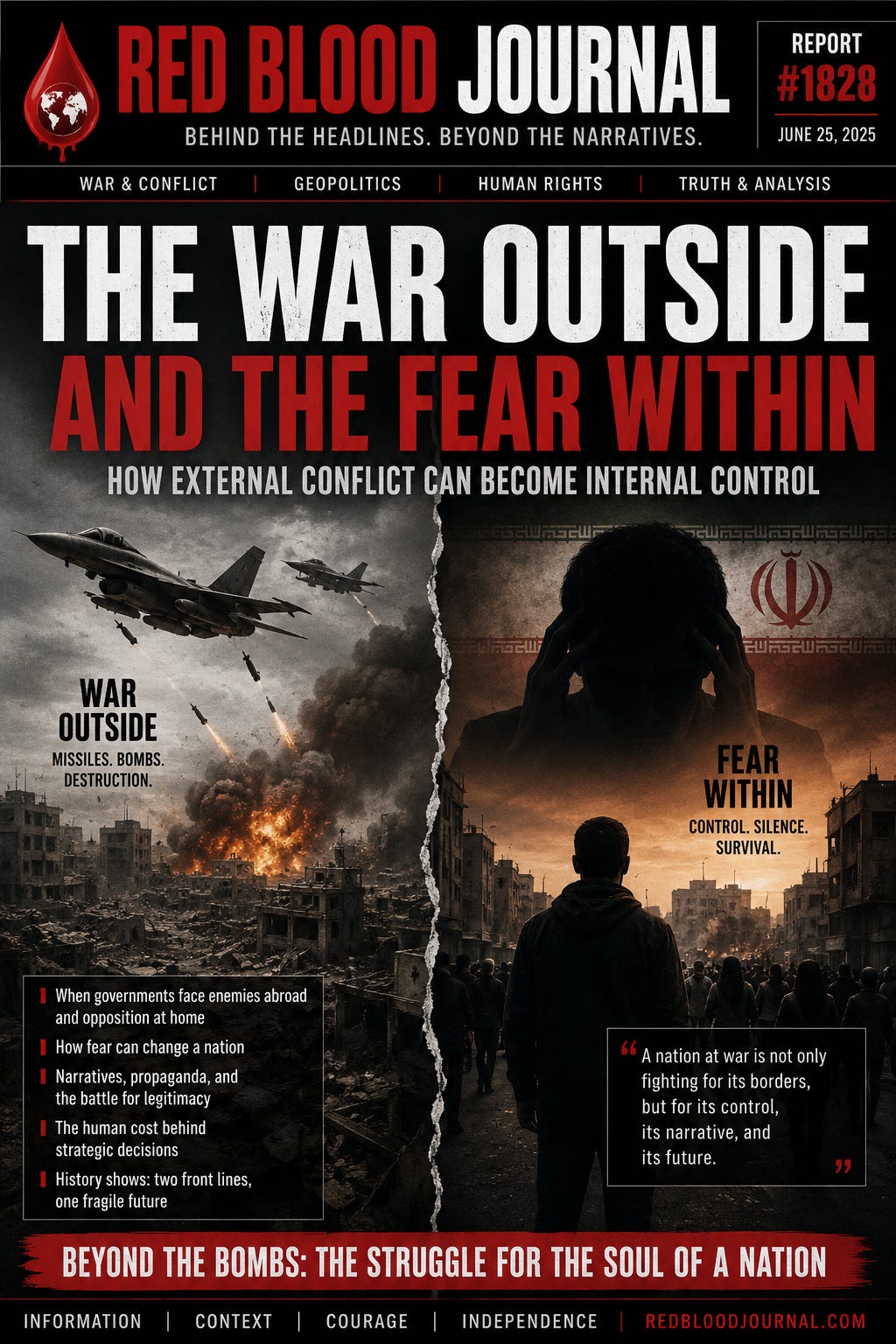
The War Outside and the Fear Within
How External Conflict Can Become Internal Control
Executive Summary
Throughout history, governments engaged in external wars have often faced another battle at home: maintaining political stability. Whether democratic or authoritarian, leaders confronting military conflict must also contend with public morale, economic strain, political opposition, and the possibility of domestic unrest.
This report examines a recurring political theory: that external conflict and internal stability are often inseparable. It explores how governments may respond when military pressure from abroad coincides with growing dissatisfaction at home.
Rather than attempting to determine motives, this report analyzes the strategic incentives that may exist during periods of war.
The Two Fronts of Every War
Military history demonstrates that nations rarely fight on only one battlefield.
There is the visible battlefield against an external opponent.
Then there is the invisible battlefield inside the country itself.
As wars become longer and more costly, governments must preserve:
Public confidence
Political legitimacy
Military morale
Economic stability
Social order
History shows that internal cohesion often becomes as important as success on the battlefield.
Fear as a Political Variable
Periods of national emergency naturally shift public attention.
Citizens focus on immediate survival.
Political disagreements often become secondary.
Economic hardship may be accepted as unavoidable.
Extraordinary government powers become easier to justify.
This does not necessarily imply manipulation; it reflects a recurring pattern observed throughout history. Crises frequently reshape the relationship between governments and the public.
External Conflict and Domestic Unrest
When dissatisfaction already exists before a war begins, the interaction between external conflict and internal politics becomes even more complex.
Governments facing protests, economic challenges, or declining public trust may simultaneously confront:
Foreign military pressure
Internal political opposition
Economic disruption
Information campaigns
Declining public morale
Managing both pressures becomes part of the overall strategic challenge.
Competing Narratives
Every conflict produces multiple narratives.
Military leaders emphasize security.
Political leaders emphasize national unity.
Opposition groups emphasize accountability.
Citizens often focus on daily survival.
International observers analyze strategic consequences.
Each perspective may describe the same events differently depending upon priorities and available information.
The Psychology of Wartime
Fear changes decision-making.
People become more willing to accept restrictions.
Attention narrows toward immediate threats.
Long-term political questions are often postponed.
History demonstrates that populations under sustained stress frequently prioritize stability over reform, regardless of political system.
The Human Cost
Beyond military objectives lie ordinary people.
Families lose loved ones.
Cities suffer destruction.
Businesses close.
Children grow up surrounded by uncertainty.
Economic hardship spreads far beyond the battlefield.
Every strategic decision eventually reaches the lives of ordinary citizens.
Can War Delay Internal Change?
Political analysts have long debated whether external conflict can delay domestic political movements.
Some argue that national emergencies temporarily suppress internal divisions.
Others argue that prolonged wars eventually magnify existing frustrations.
History offers examples supporting both conclusions.
The outcome often depends upon economic resilience, public confidence, military success, and the duration of the conflict.
Reading Between Events
Observers frequently attempt to interpret official statements not only for what is said, but also for what may be implied.
Announcements about negotiations, military escalation, economic preparation, or public messaging are often examined as indicators of broader strategic intentions.
Whether such interpretations prove accurate can only be judged with time and additional evidence.
The Strategic Question
One of the enduring questions of political history remains:
When a nation is engaged in war abroad while simultaneously confronting pressure at home, which battlefield ultimately determines its future?
Military victory may secure borders.
Political legitimacy secures governments.
Public trust secures nations.
Without all three, even the strongest military achievements may prove temporary.
Conclusion
Wars are fought with aircraft, missiles, ships, intelligence services, and diplomacy.
But they are also fought through confidence, resilience, public perception, and national unity.
The visible conflict may dominate headlines.
The invisible struggle for legitimacy, stability, and public confidence often determines how history ultimately judges the outcome.
Understanding both dimensions provides a more complete picture of how modern conflicts unfold.
🩸 Red Blood Journal
Report #1828
The War Outside and the Fear Within
“History reminds us that every war has two battlefields: one beyond the border, and one within the nation itself. Understanding both is essential to understanding the course of history.”
⚖️ The Invisible Battlefield: War and Internal Control
Jul 16, 2026
The provided text examines the dual nature of warfare, asserting that governments must manage an invisible domestic battlefield alongside their external military efforts. According to the report, national leaders utilize the psychology of fear and the urgency of crisis to maintain political legitimacy and social order during times of upheaval. While external conflicts often justify the expansion of governmental authority, they also serve to suppress internal dissent by shifting the public’s focus toward immediate survival. Ultimately, the source argues that a nation’s long-term stability depends less on military conquest and more on the delicate balance of public trust and internal cohesion. This strategic interplay suggests that the struggle for domestic control is as critical to a country’s future as any victory achieved on a foreign front.


