


🩸 RedBloodJournal.com
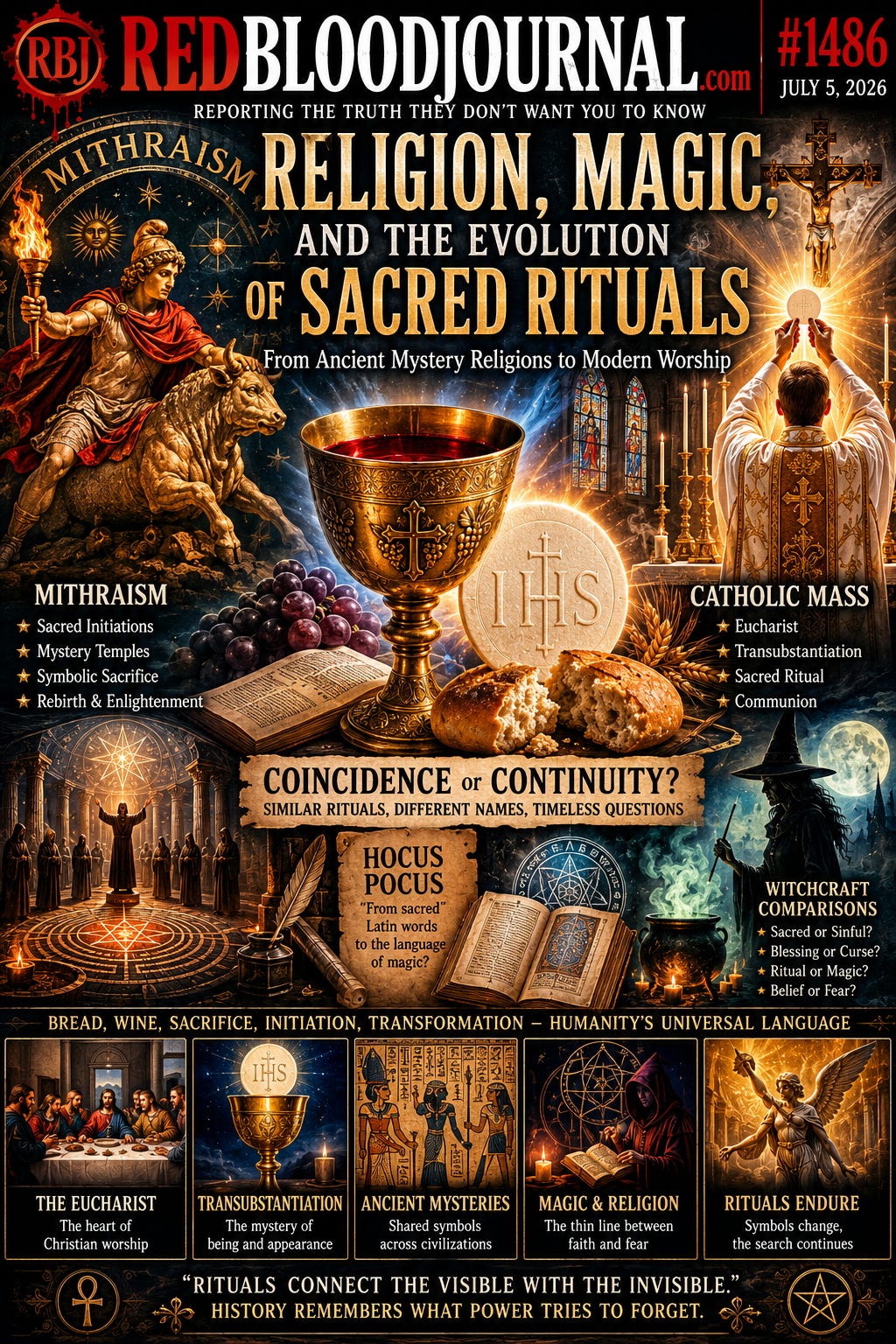
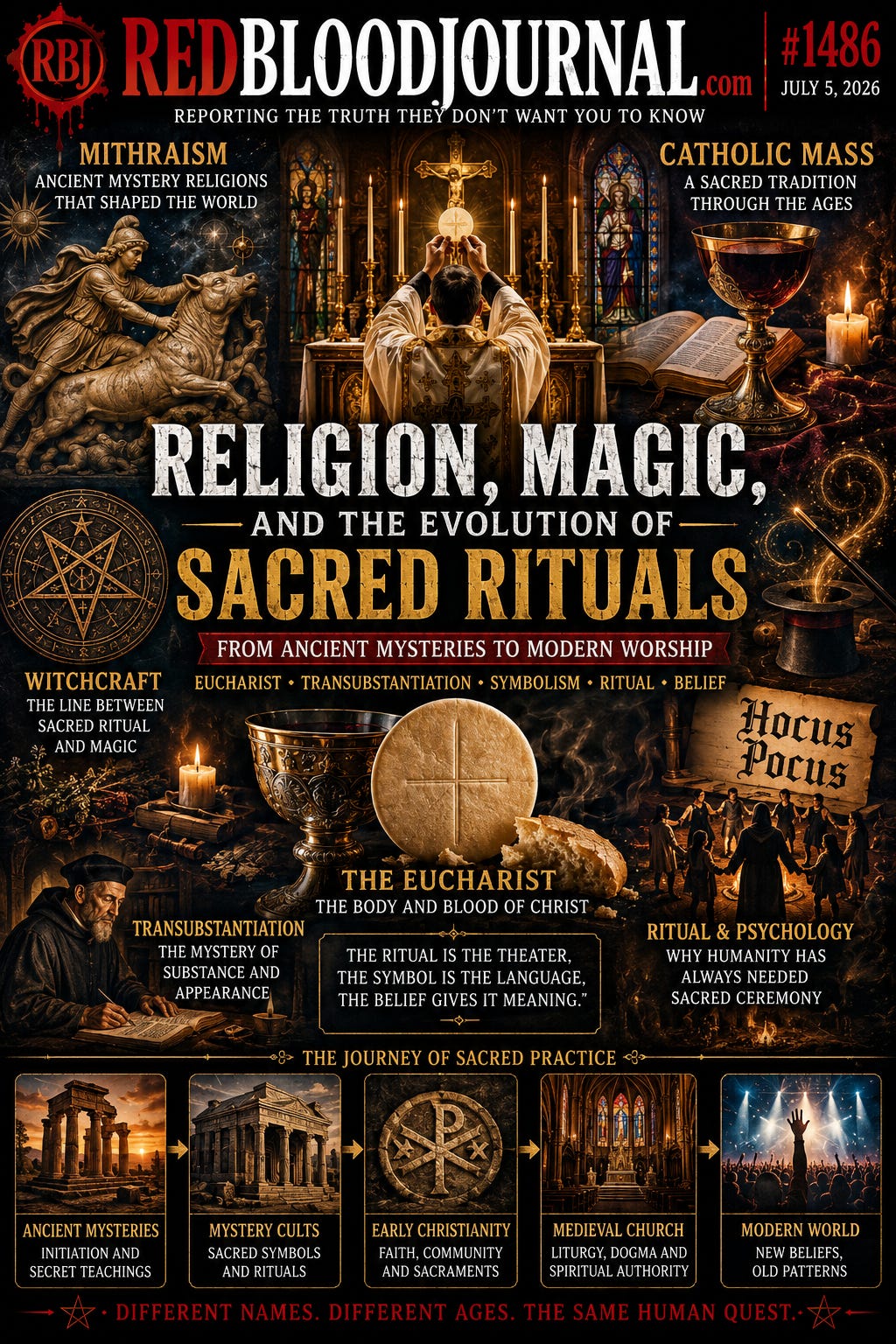
#1486 – Religion, Magic, and the Evolution of Sacred Rituals
Exploring Ancient Mystery Religions, Christian Worship, and the Historical Development of Sacred Ceremony
By Red Blood
July 5, 2026
Introduction
Throughout human history, every civilization has developed sacred rituals intended to connect humanity with the divine.
Some traditions centered on prayer.
Others emphasized sacrifice.
Many incorporated symbolic meals, ceremonial language, sacred garments, incense, or dramatic reenactments of spiritual events.
As civilizations interacted through trade, conquest, and migration, religious ideas often influenced one another. This has led historians to examine whether similarities between ancient religions and later traditions represent direct borrowing, parallel development, or universal patterns in human spirituality.
This report explores several historical comparisons frequently discussed by historians and researchers while recognizing that many conclusions remain debated.
Ritual Before Religion
Long before organized religions emerged, early societies practiced ritual.
Archaeological discoveries reveal ceremonies involving:
sacred fires
offerings
seasonal festivals
initiation rites
burial customs
symbolic meals
These practices appear across civilizations separated by thousands of miles and centuries of history.
Their existence suggests that ritual may be one of humanity’s oldest forms of spiritual expression.
The Ancient Mystery Religions
Among the most influential religious movements of the ancient Mediterranean were the mystery religions.
Unlike public worship, these traditions admitted members only after initiation.
Examples include:
the Eleusinian Mysteries
the cult of Isis
the cult of Mithras
Dionysian mysteries
Orphic traditions
Participants often experienced symbolic ceremonies representing death, rebirth, enlightenment, or spiritual transformation.
Many details remain unknown because initiates were sworn to secrecy.
Mithraism
One of the most studied mystery religions is Mithraism, which flourished throughout the Roman Empire between the first and fourth centuries.
Its followers worshipped Mithras, a figure commonly depicted slaying a sacred bull.
Mithraic temples contained rich symbolic imagery involving:
light
darkness
stars
cosmic order
sacrifice
spiritual ascent
Membership was restricted to initiates who progressed through multiple ceremonial grades.
Because much of Mithraism disappeared after the rise of Christianity, historians continue debating the precise nature of its beliefs.
The Catholic Mass
The Catholic Mass stands among Christianity’s oldest and most sacred forms of worship.
At its center lies the Eucharist, commemorating the Last Supper described in the New Testament.
The ceremony includes:
Scripture readings
prayer
bread
wine
blessing
communion
For Catholics, the Mass represents participation in Christ’s sacrifice and resurrection.
Its structure has developed over nearly two thousand years while preserving traditions rooted in the earliest Christian communities.
The Eucharist
The Eucharist occupies a central place within Catholic theology.
According to Catholic teaching, the consecrated bread and wine become the Body and Blood of Christ through the mystery of Transubstantiation.
Other Christian traditions interpret communion differently.
Some view it symbolically.
Others regard Christ as spiritually present rather than physically present.
These theological differences have shaped Christian history for centuries.
Transubstantiation
The doctrine of Transubstantiation was formally articulated during the Middle Ages to explain the Eucharist’s spiritual transformation.
According to Catholic theology:
the appearance of bread and wine remains unchanged
their underlying substance becomes the Body and Blood of Christ
This teaching reflects centuries of theological reflection rather than a sudden innovation.
It remains one of the defining doctrines distinguishing Catholicism from many Protestant traditions.
Ancient Parallels
Because ancient religions also practiced sacred meals, historians have long debated possible similarities between Christianity and earlier traditions.
Comparisons frequently involve:
ceremonial bread
sacred wine
ritual sacrifice
communal meals
symbolic rebirth
initiation
Some scholars argue these similarities reflect cultural continuity within the ancient Mediterranean.
Others emphasize the distinct theological foundations of Christianity despite superficial resemblances.
The discussion remains an active field of historical research.
The Phrase “Hocus Pocus”
One of the most famous expressions associated with magic is “Hocus Pocus.”
A popular historical explanation suggests the phrase may derive from a misunderstanding or parody of the Latin words spoken during the Catholic Mass.
Other linguists argue the phrase developed independently through stage magic traditions.
Its precise origin remains uncertain.
Regardless of its beginnings, the expression eventually became synonymous with illusion, magic, and sleight of hand.
Religion and Magic
Throughout history, religion and magic have often been viewed from opposite perspectives depending on cultural context.
Practices accepted as sacred within one society have sometimes been labeled magic by another.
Examples include:
blessings
relics
incense
sacred water
chanting
ritual gestures
The distinction often depends less upon the ceremony itself than upon the beliefs of those observing it.
This helps explain why accusations of witchcraft have appeared repeatedly throughout history.
Witchcraft Comparisons
Some historians note that critics of established religions have occasionally compared sacred rituals to magical practices.
Likewise, defenders of religious traditions emphasize the theological purpose behind ceremonies rather than their outward appearance.
The debate illustrates how identical actions may receive entirely different interpretations depending upon one’s worldview.
Understanding historical context is therefore essential before drawing conclusions about ritual similarities.
Why Ritual Endures
Despite enormous differences among religions, certain themes repeatedly appear:
sacred meals
symbolic sacrifice
purification
initiation
light overcoming darkness
spiritual transformation
remembrance
Whether practiced in ancient temples or modern churches, rituals help communities preserve identity, transmit beliefs, and connect generations through shared experience.
Their persistence suggests that ritual fulfills deep psychological and cultural needs beyond theology alone.
Final Thoughts
The evolution of sacred rituals reveals a fascinating journey through human history.
Ancient mystery religions, Judaism, Christianity, and countless other traditions each developed ceremonies that expressed humanity’s search for meaning, purpose, and connection with the divine.
Some similarities between traditions may reflect shared cultural environments.
Others may arise from universal human experiences that naturally produce comparable forms of worship.
Distinguishing documented historical influence from speculation remains an important task for scholars.
Rather than diminishing the significance of any tradition, studying these developments deepens our understanding of how civilizations preserve, adapt, and reinterpret sacred practices across generations.
Research Themes
Ancient mystery religions
Mithraism and Roman religious history
Early Christian worship
The Catholic Mass
The Eucharist and Transubstantiation
Comparative religion
The historical origins of “Hocus Pocus”
Ritual symbolism throughout history
Religion, magic, and cultural interpretation
🩸 RedBloodJournal.com
“Sacred rituals often outlive the civilizations that created them. Their forms may change, their meanings may evolve, but humanity’s search for the divine continues through symbols, ceremony, and remembrance.”
⛪ The Evolution of Sacred Rituals and Ancient Mystery Religions
Jul 16, 2026
This text investigates the historical evolution of sacred rituals, tracing the development of spiritual ceremonies from prehistoric traditions to the ancient mystery religions of the Mediterranean. The author examines the specific practices of groups like the Mithraic cults and compares them to the Catholic Mass, focusing particularly on the theological significance of the Eucharist and Transubstantiation. By exploring the shared use of symbolic meals and initiations, the source highlights how historians debate whether these similarities result from direct cultural influence or universal human patterns. The narrative also touches upon the linguistic origins of magic and the thin line between religious devotion and magical practice. Ultimately, the report suggests that these enduring rituals fulfill a deep psychological need for community and divine connection across different eras.


