


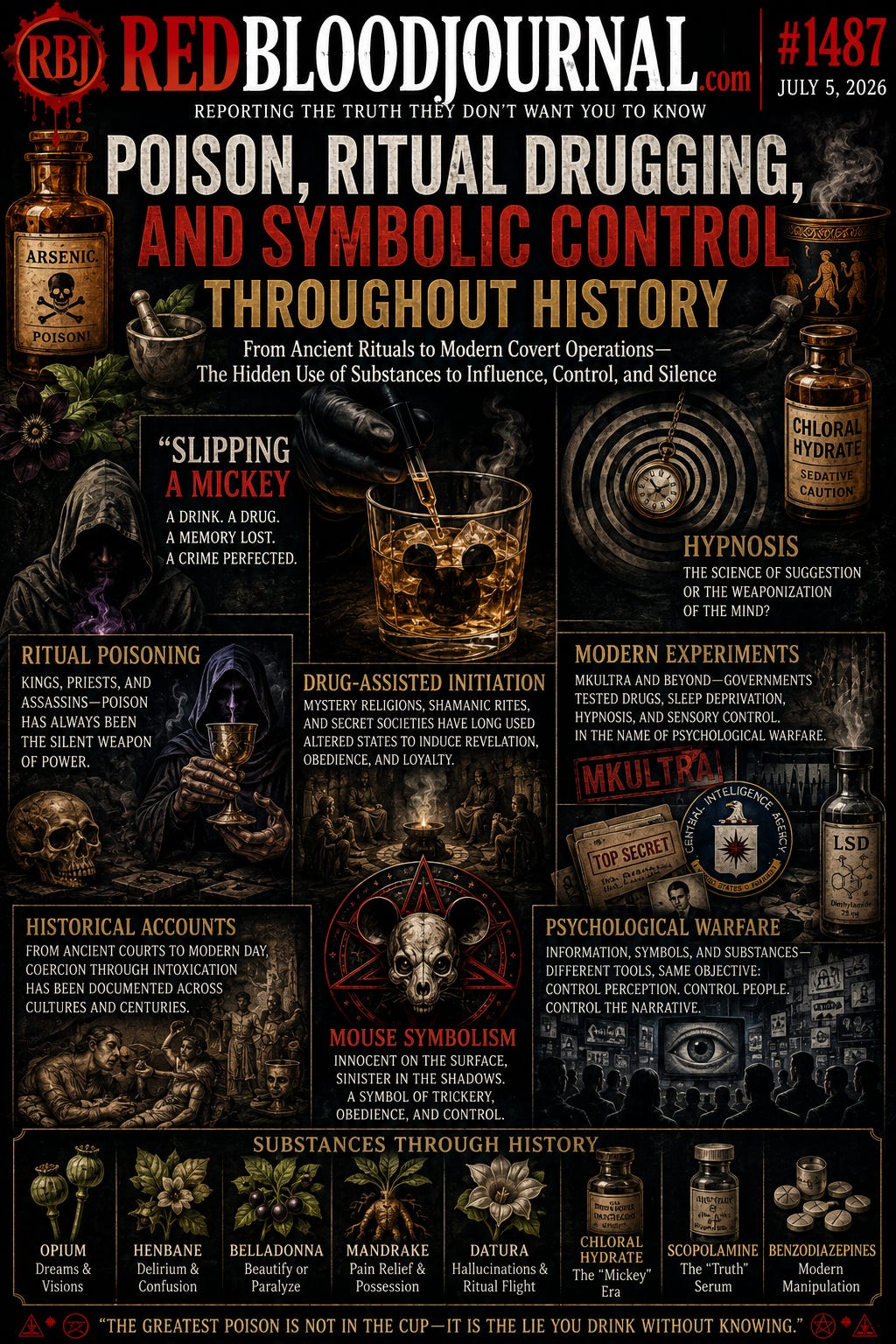
🩸 RedBloodJournal.com
#1487 – Poison, Ritual Drugging, and Symbolic Control Throughout History
From Ancient Rituals to Modern Psychological Influence: Examining the History Behind Drugging, Intoxication, and Symbolic Control
By Red Blood
July 5, 2026
Introduction
Throughout history, the use of intoxicating substances has occupied a complex place within religion, warfare, medicine, criminal activity, and ritual.
Some cultures employed psychoactive plants during sacred ceremonies intended to produce spiritual experiences. Others used poisons for assassination, warfare, or criminal deception. Over time, stories of ritual drugging became intertwined with legends of secret societies, occult traditions, espionage, and psychological control.
Modern discussions often extend these historical examples to theories involving covert behavioral manipulation and symbolic programming. While many documented cases exist of drug-assisted crime and government experimentation, other claims remain controversial or unverified.
This report examines the historical record while distinguishing documented evidence from speculation.
Humanity’s Oldest Intoxicants
Long before modern pharmaceuticals existed, civilizations discovered naturally occurring substances capable of altering perception.
Ancient cultures used:
alcohol
opium
cannabis
henbane
mandrake
belladonna
mushrooms
peyote
ergot
Some served medicinal purposes.
Others became associated with prophecy, initiation ceremonies, or religious visions.
The line between medicine and ritual was often blurred.
Sacred Intoxication
Many ancient mystery religions incorporated altered states of consciousness into ceremonial practice.
Historians have debated whether initiates consumed substances during:
the Eleusinian Mysteries
Dionysian celebrations
shamanic rituals
various indigenous ceremonies
Although definitive evidence remains limited in many cases, archaeological and textual research suggests psychoactive substances were sometimes employed within controlled ritual settings.
These practices sought spiritual insight rather than recreational intoxication.
Poison as a Political Weapon
Poison has been one of history’s most feared weapons.
Unlike the sword or spear, poison operates invisibly.
Historical records describe its use in:
royal courts
succession struggles
espionage
political assassinations
organized crime
Ancient Rome, Renaissance Italy, imperial China, and numerous other civilizations developed extensive knowledge regarding toxic substances.
The secrecy surrounding poison contributed to its enduring association with hidden power.
Ritual Drugging and Criminal Control
History also records numerous examples in which intoxicants were allegedly used to facilitate crime.
Victims have reportedly been drugged for purposes including:
robbery
kidnapping
assault
coercion
extortion
The phrase “slipping a Mickey” entered popular language during the late nineteenth and early twentieth centuries, referring to secretly placing drugs into another person’s drink to render them unconscious or compliant.
Although the precise origin of the expression remains debated, its meaning became widely understood throughout popular culture.
“Slipping a Mickey”
The expression generally refers to administering a sedative without the victim’s knowledge.
Historically, substances allegedly associated with such crimes have included:
chloral hydrate
barbiturates
alcohol mixtures
later, various prescription sedatives
Today the phrase survives largely as a cultural expression rather than a reference to any specific drug.
Its continued use illustrates how language preserves historical practices long after the original substances have changed.
Hypnosis
Hypnosis has fascinated scientists, physicians, psychologists, and the general public for centuries.
Modern clinical hypnosis is recognized as a legitimate therapeutic technique for selected medical and psychological applications.
Researchers continue studying its role in:
pain management
trauma therapy
habit modification
anxiety treatment
Popular culture, however, frequently portrays hypnosis as a nearly unlimited method of controlling another person’s behavior.
Most psychologists caution that these fictional portrayals greatly exaggerate hypnosis’s demonstrated capabilities.
Drug-Assisted Interrogation
Governments have historically investigated chemicals capable of influencing memory or reducing resistance during interrogation.
Among the most widely documented examples is the CIA’s Project MKUltra, which explored numerous psychoactive substances, including LSD and other compounds.
Declassified records confirm such experimentation occurred.
The effectiveness of these methods, however, often proved inconsistent and scientifically unreliable.
Nevertheless, the research contributed significantly to public concern regarding behavioral manipulation.
Mouse Symbolism
Some independent researchers have proposed symbolic connections between:
mice
intoxication
hidden influence
ritual initiation
cultural expressions such as “slipping a Mickey”
These interpretations frequently combine linguistic analysis, folklore, literature, and symbolic psychology.
Mainstream historians generally regard many of these proposed connections as speculative due to the absence of direct historical documentation.
Even so, they illustrate how symbols often accumulate additional meanings through storytelling and cultural memory.
Symbolic Control
Whether through advertising, politics, religion, education, or entertainment, symbols influence human attention.
Images...
Words...
Music...
Colors...
Rituals...
Repetition...
Each contributes to how individuals interpret the world around them.
Psychologists widely acknowledge that repeated symbolic exposure influences familiarity and emotional response.
Whether this constitutes “mind control” depends greatly upon how one defines the term.
Modern Information Warfare
Today’s methods of influence rarely require physical intoxication.
Digital technologies now shape public perception through:
targeted advertising
recommendation algorithms
behavioral analytics
artificial intelligence
social media
personalized messaging
Rather than chemically altering consciousness, modern systems increasingly compete for attention itself.
Some observers argue that information has become the most powerful intoxicant of the digital age.
Separating History from Interpretation
The historical record clearly documents:
ritual use of psychoactive substances
political poisonings
criminal drugging
government behavioral research
psychological operations
More controversial claims—including coordinated symbolic programming or ritualized drug-assisted control on a large scale—remain the subject of ongoing debate.
Responsible historical inquiry requires recognizing these distinctions.
Documented events and speculative interpretations should not be treated as identical.
Final Thoughts
The history of poison, ritual intoxication, and symbolic influence reveals one consistent truth:
Human beings have long sought methods of influencing both the body and the mind.
Sometimes those methods served healing.
Sometimes they served spiritual practice.
Sometimes they served deception, coercion, or violence.
As technology evolves, the instruments of influence continue to change.
Yet the underlying questions remain remarkably similar:
Who shapes perception?
How is belief influenced?
Where is the line between persuasion and manipulation?
Understanding history provides valuable perspective as society confronts these same questions in increasingly sophisticated forms.
Research Themes
Ancient ritual intoxicants
Poison throughout political history
The origin of “slipping a Mickey”
Ritual drugging in historical accounts
Clinical hypnosis versus popular mythology
Project MKUltra and behavioral research
Symbolic communication and perception
Information warfare in the digital age
Historical evolution of psychological influence
🩸 RedBloodJournal.com
“The tools of influence change with every generation. Whether through ritual, poison, propaganda, or technology, history repeatedly reminds us that the struggle for the human mind is as old as civilization itself.”
👁️ The Architecture of Influence:
Rituals, Poisons, and Symbolic Control
Jul 15, 2026
This article examines the evolution of human influence, tracing the use of intoxicants and poisons from ancient spiritual rituals to modern psychological tactics. The text documents how psychoactive substances were historically employed for religious initiation, political assassination, and criminal coercion. It explores the transition from physical methods, such as drug-assisted interrogation and “slipping a Mickey,” to the symbolic control found in modern digital media. By analyzing the intersection of mythology, government experimentation, and behavioral science, the author highlights a persistent societal desire to manipulate perception. Ultimately, the source distinguishes between verified historical records and speculative theories regarding mind control and symbolic programming. The overview concludes that while the tools of persuasion have changed with technology, the fundamental struggle for mental influence remains constant.


