


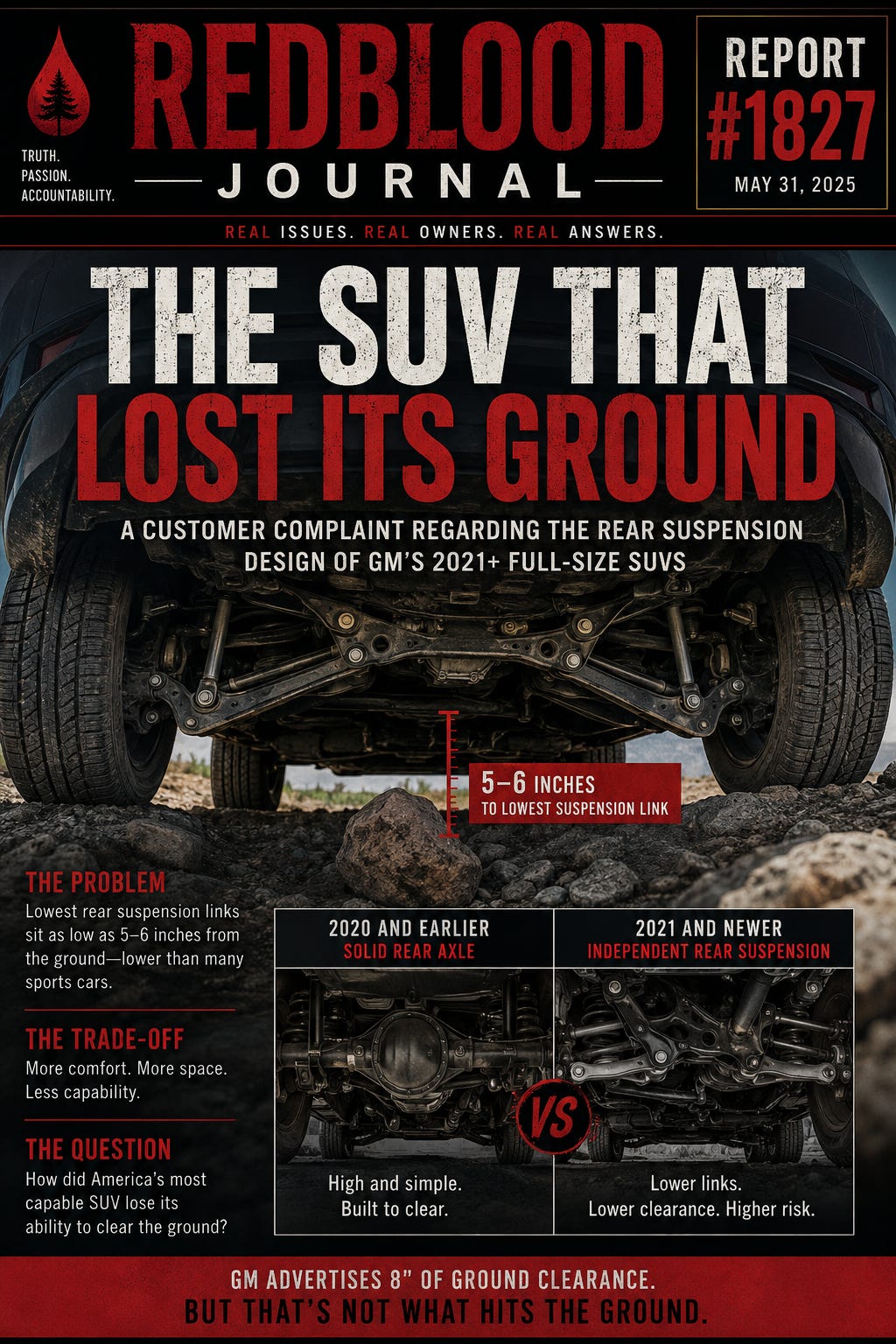
🩸 Report #1827
The SUV That Lost Its Ground
A Customer Complaint Regarding the Rear Suspension Design of GM’s 2021+ Full-Size SUVs
Executive Summary
For generations, the Chevrolet Suburban, Chevrolet Tahoe, GMC Yukon, and Cadillac Escalade earned their reputation as full-size body-on-frame SUVs capable of transporting families comfortably while maintaining the durability expected of a truck.
Beginning with the 2021 model year, General Motors introduced an independent rear suspension (IRS), replacing the traditional solid rear axle that had been a hallmark of these vehicles.
The redesign delivered measurable improvements in ride quality, passenger comfort, cargo space, and handling. However, it also introduced a concern that many customers believe deserves greater attention: the practical ground clearance of the rear suspension.
The Previous Design
The final Suburban equipped with a solid rear axle was the 2020 model year.
Its design offered:
A durable live rear axle.
Fewer suspension components below the frame.
Better protection against rocks and trail obstacles.
Proven performance on ranches, construction sites, forest roads, and uneven terrain.
Although the rear differential remained the lowest point, it was a robust housing specifically designed to withstand harsh operating conditions.
The New Design
The 2021 redesign introduced an independent rear suspension intended to improve:
Ride comfort.
Highway handling.
Third-row passenger space.
Cargo-floor height.
Overall refinement.
These improvements are real and appreciated by many owners.
However, they came with an unintended consequence.
The Practical Ground Clearance Issue
General Motors advertises approximately 8 inches of ground clearance on most models.
Yet this specification does not describe the clearance beneath the lowest rear suspension components.
Based on owner observations and underbody inspections, some rear suspension links and lower control arms may sit only approximately 5 to 6 inches above the ground under unloaded conditions.
For customers purchasing a large truck-based SUV, this is an unexpected discovery.
Why Customers Are Concerned
Many buyers choose a Suburban or Escalade because they expect the vehicle to:
Cross uneven terrain.
Clear deep ruts.
Navigate construction sites.
Drive on ranches or forest roads.
Traverse moderate off-road obstacles without damaging suspension components.
Instead, the lowest structural suspension members may contact obstacles before much of the vehicle’s underbody.
While these components are engineered for normal road use, they are not intended to function as sacrificial skid plates.
A Comparison That Raises Questions
One observation frequently made by owners is that the lowest rear suspension components appear to sit at a height similar to the overall ground clearance of certain sports cars.
This comparison does not suggest that the entire SUV has sports-car ground clearance.
Rather, it highlights how unexpectedly low some critical suspension components appear beneath a vehicle marketed for utility and capability.
Engineering Trade-Off
There is no question that the independent rear suspension represents a significant engineering achievement.
It delivers:
Better ride quality.
Improved passenger comfort.
Lower interior floor.
Superior on-road refinement.
Yet engineering is always a balance of compromises.
Many long-time Suburban owners believe that one of the vehicle’s defining strengths—its ability to confidently traverse rough terrain—was diminished in pursuit of improved on-road comfort.
Recommendations
General Motors could address these concerns by considering:
Increasing the clearance of the lowest rear suspension components.
Offering a dedicated heavy-duty or off-road rear suspension geometry.
Publishing the clearance to the lowest suspension component, not only the vehicle’s minimum ground-clearance specification.
Providing additional skid protection for customers who regularly operate off pavement.
Conclusion
The Suburban has long been recognized as more than a family vehicle. It has served as a work vehicle, expedition platform, tow vehicle, and dependable companion for those who travel beyond paved roads.
The transition to an independent rear suspension modernized the platform in many positive ways. However, many customers believe it also sacrificed a measure of the rugged capability that helped define the Suburban for generations.
This report is not an argument against innovation. It is a request that future designs strive to preserve the balance between comfort and the practical capability that owners have come to expect from one of America’s most iconic full-size SUVs.
🩸 Red Blood Journal
Report #1827 – The SUV That Lost Its Ground
RedBloodJournal.com
🚙 The Ground Clearance Paradox of GM’s Independent Rear Suspension
Jul 16, 2026
The provided report examines a significant design shift in General Motors’ full-size SUVs, specifically the transition from a solid rear axle to an independent rear suspension starting in 2021. While this change successfully enhanced passenger comfort and interior space, it introduced a controversial reduction in practical ground clearance. Critical suspension components now sit much lower than previous models, potentially making them vulnerable to damage on unpaved terrain or construction sites. Many long-time owners feel that the pursuit of on-road refinement has compromised the rugged utility and off-road capability traditionally expected from these iconic vehicles. Ultimately, the text argues for a better balance between modern handling and the durable clearance necessary for demanding work and travel conditions.


