


🩸 Red Blood Journal
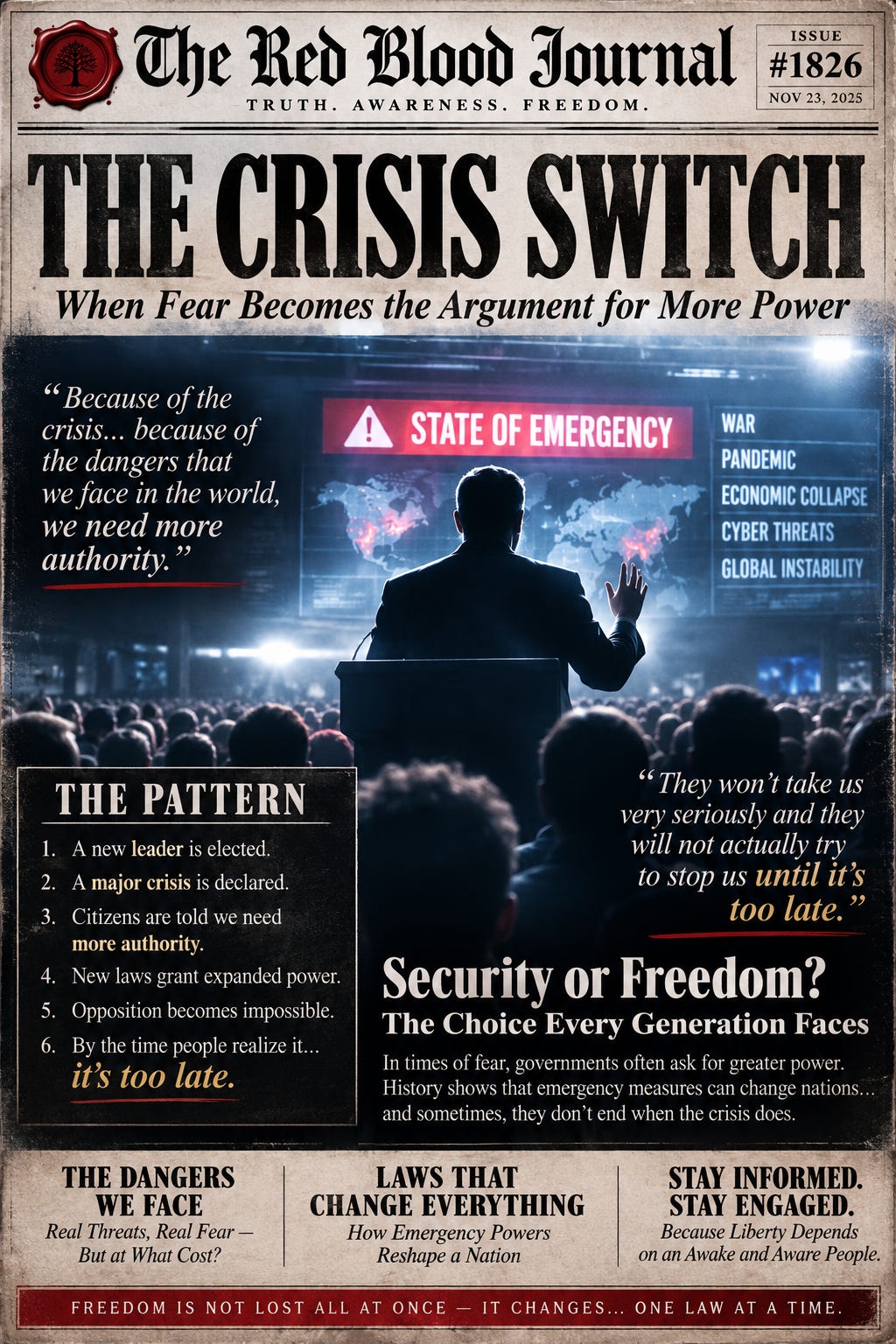
1826 – The Crisis Switch
When Fear Becomes the Argument for More Power
Executive Summary
This report examines a recurring political and historical idea:
During periods of uncertainty, governments often request greater authority by arguing that extraordinary dangers require extraordinary powers.
The transcript presents this concept in a concise sequence of statements, suggesting that a future leader could justify expanded governmental authority by pointing to crises and public fear. It also warns that opposition may become difficult once new powers are established.
The Sequence
According to the transcript, the pattern unfolds as follows:
A new leader emerges.
A major crisis or perceived danger is emphasized.
Citizens are told that existing powers are insufficient.
New laws or emergency authorities are introduced.
Opposition becomes increasingly difficult.
By the time the public recognizes the long-term implications, the institutional changes have already occurred.
Why Emergencies Matter
History demonstrates that wars, economic collapses, terrorist attacks, pandemics, and other emergencies often accelerate governmental decision-making.
In many countries, emergency legislation has been used to:
Expand executive authority.
Increase surveillance.
Restrict certain civil liberties.
Centralize decision-making.
Introduce temporary measures that sometimes become long-lasting.
Whether such measures are justified depends on the specific circumstances, the legal framework, and democratic oversight.
The Central Question
The transcript raises a philosophical question rather than presenting evidence for a particular future event:
How should societies balance security with liberty when confronted by genuine or perceived crises?
Every generation faces this challenge.
Too little authority can produce disorder.
Too much authority may reduce individual freedom.
Finding the appropriate balance is one of the enduring responsibilities of constitutional government.
The Warning
The closing statement suggests that significant institutional changes are often easier to implement before the broader public fully understands their long-term consequences.
Whether or not one agrees with this perspective, it highlights the importance of public engagement, informed debate, and careful examination of laws enacted during periods of fear or emergency.
Final Reflection
History repeatedly shows that crises test not only governments but also citizens.
Moments of uncertainty can inspire unity, resilience, and effective leadership. They can also prompt difficult debates about the proper limits of governmental power.
Understanding how societies respond to emergencies—and remaining engaged in those discussions—helps preserve both security and the institutions that protect individual liberty.
⚖️ The Architecture of Crisis and Control
Jul 15, 2026
This text examines the historical pattern of governments acquiring expanded authority during times of intense social or economic instability. It outlines a strategic sequence where crises are utilized to justify emergency legislation, often leading to a permanent increase in state control at the expense of individual liberties. The author highlights how public fear can be leveraged to centralize decision-making and silence opposition before the long-term consequences are fully realized. Ultimately, the source serves as a philosophical warning about the fragile balance between security and freedom. It encourages citizens to remain vigilant and engaged to ensure that temporary emergency measures do not become permanent fixtures of the law.


