


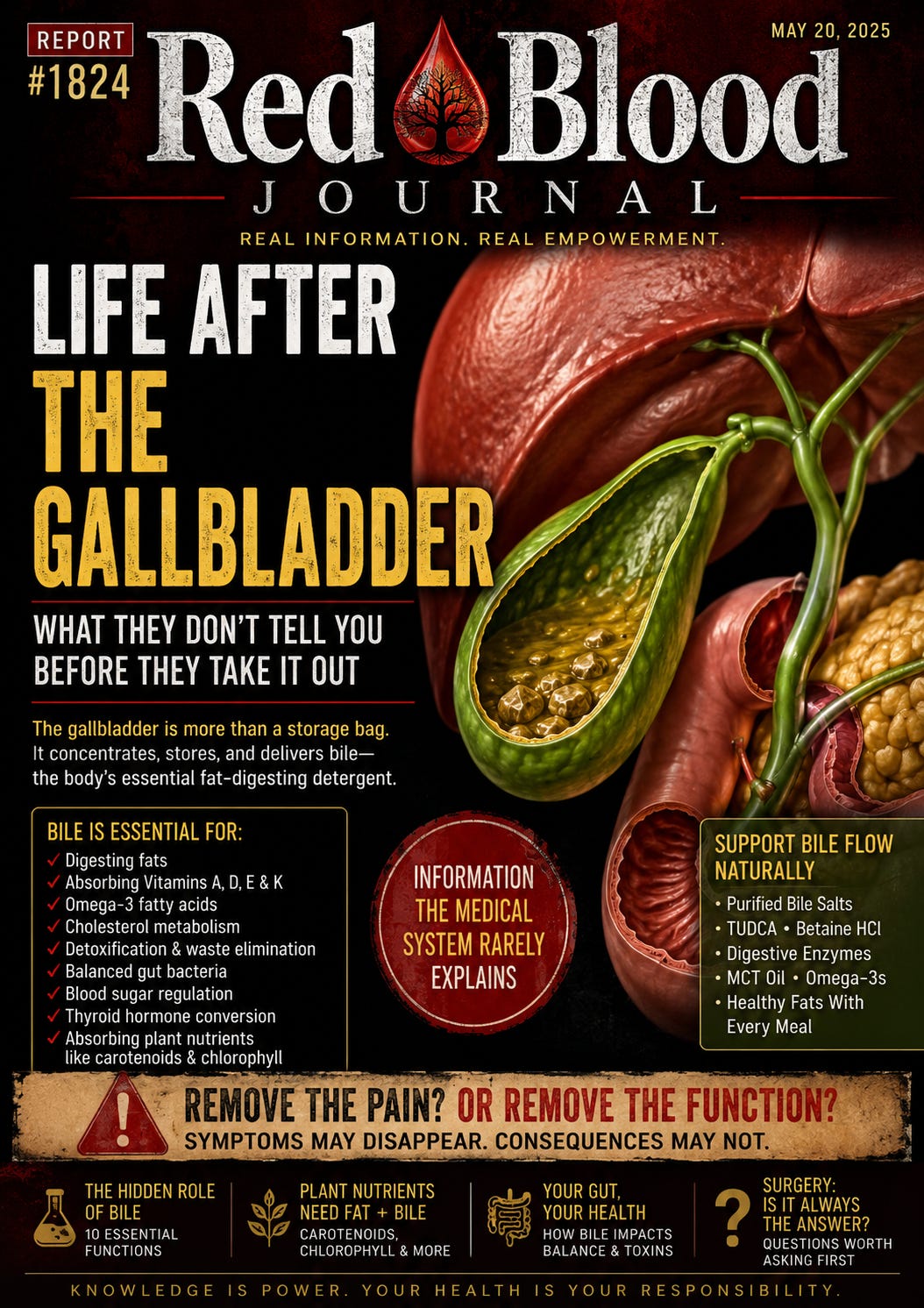
🩸 Red Blood Journal
#1824 – Life After the Gallbladder
The Organ Most People Never Think About Until It Is Gone
Throughout modern medicine, the gallbladder is often described as a non-essential organ.
When it becomes painful or develops stones, the common solution is simple:
Remove it.
For many people, the pain disappears.
But an important question often remains unanswered:
What exactly was removed, and what did it do every day for the rest of the body?
More Than a Storage Bag
The gallbladder is not merely a pouch holding bile.
It performs three critical jobs:
Stores bile produced by the liver.
Concentrates bile to several times its original strength.
Releases that concentrated bile precisely when fatty food enters the digestive system.
Without the gallbladder, bile still reaches the intestine—but only as a slow continuous trickle rather than a powerful, timed release.
That difference may seem small.
The report suggests it can influence far more than digestion alone.
Why Bile Matters
Most people associate bile only with digesting fats.
According to the information presented in the source material, bile participates in numerous essential functions throughout the body.
These include:
Breaking dietary fats into absorbable particles.
Helping absorb Vitamins A, D, E, and K.
Assisting the absorption of omega-3 fatty acids.
Supporting cholesterol metabolism.
Helping eliminate toxins.
Supporting balanced intestinal bacteria.
Neutralizing stomach acid entering the small intestine.
Assisting blood sugar regulation.
Supporting thyroid hormone conversion.
Helping absorb plant nutrients such as carotenoids and chlorophyll.
If these functions depend on adequate bile, then removing the organ responsible for concentrating and delivering bile naturally raises additional questions.
Looking Beyond Symptoms
Modern treatment frequently focuses on relieving symptoms.
Pain.
Inflammation.
Gallstones.
The report asks readers to consider another perspective:
What if removing the painful organ also removes an important biological function?
Eliminating pain and preserving function are not always the same objective.
Symptoms That May Point Toward Poor Bile Function
The source associates reduced bile flow with a wide variety of complaints, including:
Bloating
Burping
Nausea
Right shoulder pain
Pain beneath the right ribs
Constipation
Gallbladder sludge
Fat cravings
High cholesterol
Itching
Digestive discomfort after meals
Whether every symptom shares the same cause is a separate medical question.
The broader message is that digestion involves more than simply processing food.
Nutritional Support Discussed
The source describes several nutritional strategies intended to support bile function.
Among those mentioned are:
Purified Bile Salts
Suggested to replace some of the digestive function lost after gallbladder removal by assisting fat digestion and absorption.
TUDCA
Presented as a specialized bile acid that may help thin bile and improve bile flow.
Betaine Hydrochloride
Discussed as supporting stomach acidity, which the source says contributes to proper bile release.
Digestive Enzymes
Suggested to assist pancreatic digestion alongside bile.
MCT Oil
Described as a fat requiring less demand on bile compared with many other dietary fats.
Omega-3 Fatty Acids
Highlighted as beneficial fats whose absorption depends on adequate bile.
The source also emphasizes consuming vegetables together with healthy fats such as olive oil, butter, or coconut oil to improve absorption of fat-soluble nutrients.
The Larger Lesson
The gallbladder serves as a reminder that every organ evolved for a reason.
Removing an organ may solve one immediate problem while creating new physiological challenges that only become apparent years later.
For some individuals, surgery may be the most appropriate option.
For others, understanding the organ’s purpose before making irreversible decisions may be equally important.
Knowledge allows informed decisions.
Final Thought
This report is not an argument against surgery.
It is an argument for understanding the full role of the organ before deciding whether life without it is the only path forward.
The more people learn about how the body works, the better equipped they become to ask informed questions, participate in their own healthcare decisions, and appreciate the remarkable complexity of the human body.
🩸 RedBloodJournal.com
🟢 The Gallbladder: Essential Functions and Post-Surgical Care
Jul 15, 2026
The provided text examines the essential physiological functions of the gallbladder, challenging the common perception that it is an expendable organ. Beyond acting as a storage vessel, the gallbladder concentrates and regulates bile, which is crucial for nutrient absorption, toxin elimination, and metabolic balance. While surgical removal is a standard response to pain or stones, the source highlights how losing this organ can lead to long-term digestive and systemic challenges. To mitigate these effects, the report suggests various nutritional supports and supplements like bile salts or specific oils to aid fat processing. Ultimately, the material advocates for a comprehensive understanding of bodily complexity so individuals can make informed healthcare decisions. This overview emphasizes that preserving organ function is just as vital as alleviating immediate physical symptoms.


