


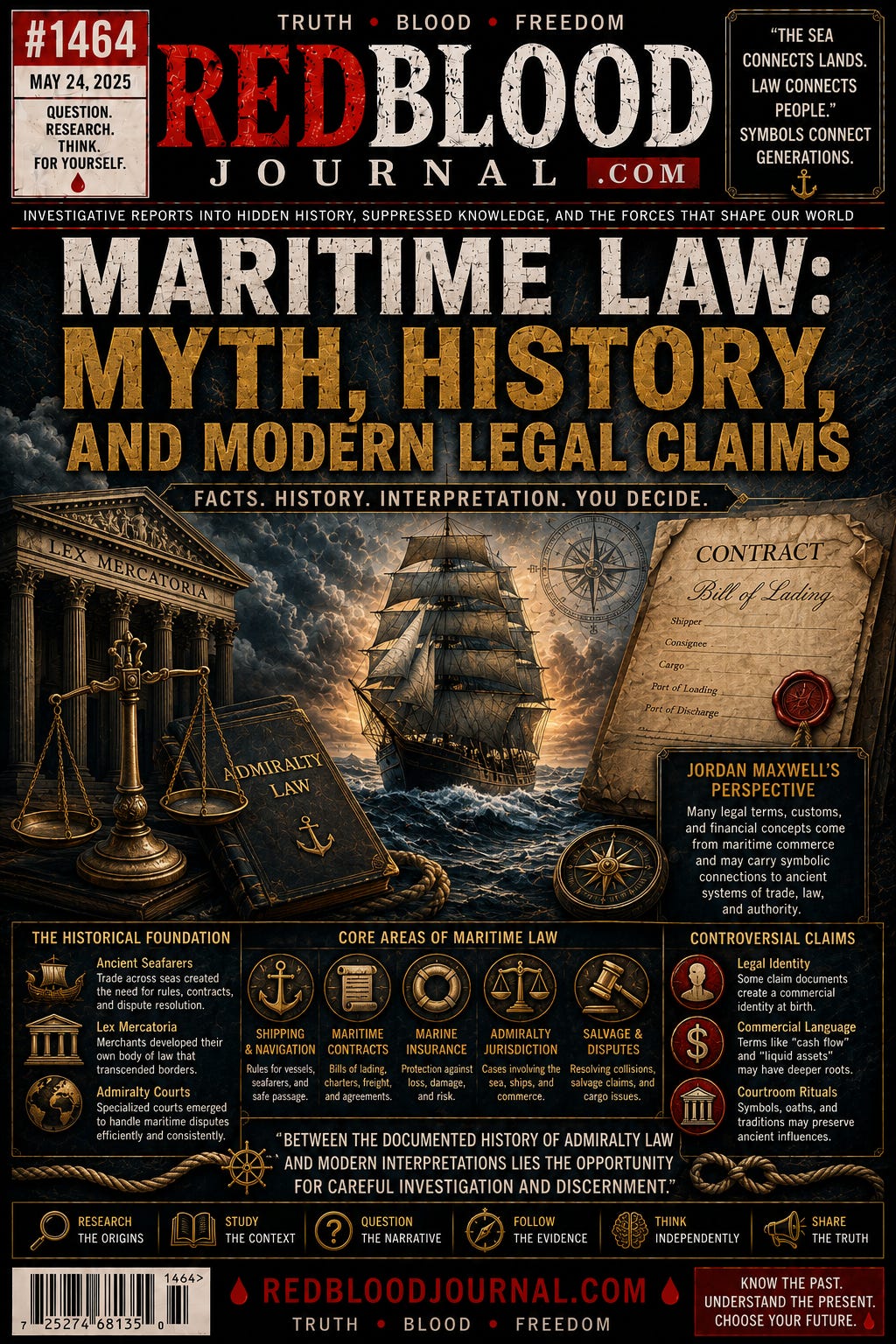
#1464 🩸 RedBloodJournal.com 🩸
Maritime Law: Myth, History, and Modern Legal Claims
By Red Blood
Introduction
Few subjects discussed by independent researchers have generated as much curiosity—and as much controversy—as maritime law.
For some, admiralty law is simply a specialized branch of legal practice governing ships, navigation, commerce, and international trade.
For others, it represents something far broader: a hidden legal framework that allegedly extends into everyday life through contracts, financial systems, and government institutions.
Among the researchers most closely associated with this perspective was Jordan Maxwell, who argued that many legal terms, courtroom traditions, and commercial practices preserve symbolic connections to ancient maritime commerce.
These ideas have attracted a dedicated following while also drawing substantial criticism from historians and legal scholars.
This report examines the documented history of maritime law alongside the broader interpretive claims surrounding it, encouraging readers to distinguish established historical evidence from theories that remain debated.
What Is Maritime Law?
Historically, maritime law—also called admiralty law—is a specialized body of law governing matters such as:
Shipping.
Navigation.
Ocean commerce.
Maritime contracts.
Marine insurance.
Cargo disputes.
Salvage operations.
Collisions at sea.
Because international trade depended upon ships for thousands of years, maritime law became one of the oldest specialized legal systems in human civilization.
Many of its principles developed through centuries of commercial practice before becoming formal legal codes.
The Sea Connected Civilizations
Long before airplanes and railroads, the sea connected continents.
Egypt traded across the Mediterranean.
Phoenician merchants established vast trading networks.
Greek and Roman commerce depended heavily upon maritime routes.
Later, European exploration expanded global trade even further.
As shipping increased, merchants required consistent legal rules to resolve disputes involving cargo, contracts, ownership, and navigation.
Maritime law emerged largely to meet those practical needs.
Why Admiralty Law Developed
Ocean commerce presented unique challenges.
Storms destroyed cargo.
Ships collided.
Crews abandoned vessels.
Pirates attacked merchants.
Insurance disputes arose.
National borders complicated trade.
Specialized legal systems gradually evolved to address these problems more efficiently than ordinary local courts.
Today, admiralty law continues to govern many international shipping matters.
Jordan Maxwell’s Interpretation
Jordan Maxwell argued that traces of maritime law extend far beyond shipping.
According to his interpretation, certain legal terminology, courtroom customs, financial language, and governmental procedures preserve symbolic connections to maritime commerce.
Among the examples frequently discussed are:
The historical use of terms such as vessel in different legal contexts.
The language of commerce, including phrases like cash flow and liquid assets.
Courtroom traditions and ceremonial symbolism.
Historical connections between trade, banking, and commercial law.
Maxwell viewed these patterns as evidence that ancient commercial systems continued to influence modern institutions.
These interpretations have been widely discussed in alternative research circles but are not generally accepted as established legal doctrine.
Language and Symbolism
One reason maritime law attracts attention is the language itself.
English contains many expressions originally associated with water or navigation.
Examples include:
“Cash flow.”
“Current account.”
“Liquid assets.”
“Making waves.”
“Weathering the storm.”
Linguists generally explain these as ordinary metaphors that developed naturally within the language.
Some independent researchers argue that their frequency reflects deeper historical influences.
Whether viewed as metaphor or symbolic continuity, these expressions demonstrate how commerce and navigation shaped the English language.
Birth Certificates and Legal Identity
Perhaps the most controversial claims involve birth certificates, legal identity, and commercial law.
Various researchers have argued that these documents create forms of legal or commercial identity beyond ordinary citizenship.
Legal scholars generally reject these interpretations, explaining birth registration as an administrative function used to establish identity, citizenship, and public records.
This difference illustrates the importance of distinguishing documented legal practice from broader interpretive theories.
Why the Debate Continues
Maritime law remains an enduring topic because it combines three powerful subjects:
History.
Language.
Law.
Many people become interested after noticing historical terminology, courtroom traditions, or symbolic similarities.
Others argue that similarities alone do not establish legal relationships.
Responsible investigation requires examining original legal sources, historical records, and scholarly research before drawing conclusions.
Questions Worth Asking
Whether one agrees with Jordan Maxwell’s conclusions or not, several worthwhile questions remain:
How did maritime law develop?
Why did commercial language influence modern English?
How do legal traditions preserve historical customs?
Why do institutions continue to use ceremonial practices inherited from earlier centuries?
Investigating these questions deepens understanding without requiring premature conclusions.
Final Thought
Maritime law is real.
Its historical importance to international commerce is well documented.
The broader claim that maritime law secretly governs everyday civilian life remains controversial and is not accepted by mainstream legal scholarship.
Between these two positions lies an opportunity for careful investigation.
History deserves to be studied.
Language deserves to be understood.
Legal traditions deserve to be examined.
Whether the connections are practical, symbolic, historical, or simply coincidental should ultimately be determined through evidence rather than assumption.
The search for understanding begins not with certainty...
but with asking better questions.
The investigation continues.
**🩸 RedBloodJournal.com 🩸
🚢 Admiralty Allegories:
The History and Symbolism of Maritime Law
Jul 15, 2026
This source examines the history and practical application of maritime law, which traditionally governs international shipping, navigation, and ocean commerce. The text highlights how these ancient legal principles evolved to resolve commercial disputes across borders long before modern transportation existed. Beyond its official use, the article explores the controversial theories of researchers like Jordan Maxwell, who suggest that maritime symbolism secretly permeates modern legal and financial systems. This perspective points to linguistic metaphors—such as “liquid assets” or “cash flow”—and courtroom traditions as evidence of a deeper connection to the sea. While mainstream scholars view these as simple historical artifacts, the source encourages readers to investigate how legal identity and institutional language have been shaped by maritime roots. Ultimately, the text seeks to distinguish documented legal history from broader interpretive claims regarding how the law functions today.


