


🩸 Red Blood Journal
#1818 – Palmistry (Chiromancy)
Can the Human Hand Reveal Character, Choice, or Destiny?
Executive Summary
For thousands of years, people have looked at the human hand and wondered whether it contains more than fingerprints and skin. Across cultures, palmistry—also known as chiromancy—has claimed that the lines, shapes, and features of the hand reveal aspects of personality, life experiences, and even future possibilities.
To believers, the hand is a living map.
To skeptics, it is simply the natural result of genetics, development, and physical use.
While modern science has not found reliable evidence that palm lines predict the future or reveal destiny, the enduring popularity of palmistry raises a deeper philosophical question:
Could the hand serve not as a predictor of fate, but as a symbol of the relationship between human potential and human choice?
A Practice Older Than Many Civilizations
Palmistry has been practiced for thousands of years.
Historical references appear in ancient India, China, Persia, Egypt, Greece, and later throughout Europe. Different traditions developed their own methods, yet many shared the belief that the hand reflected aspects of the individual beyond mere anatomy.
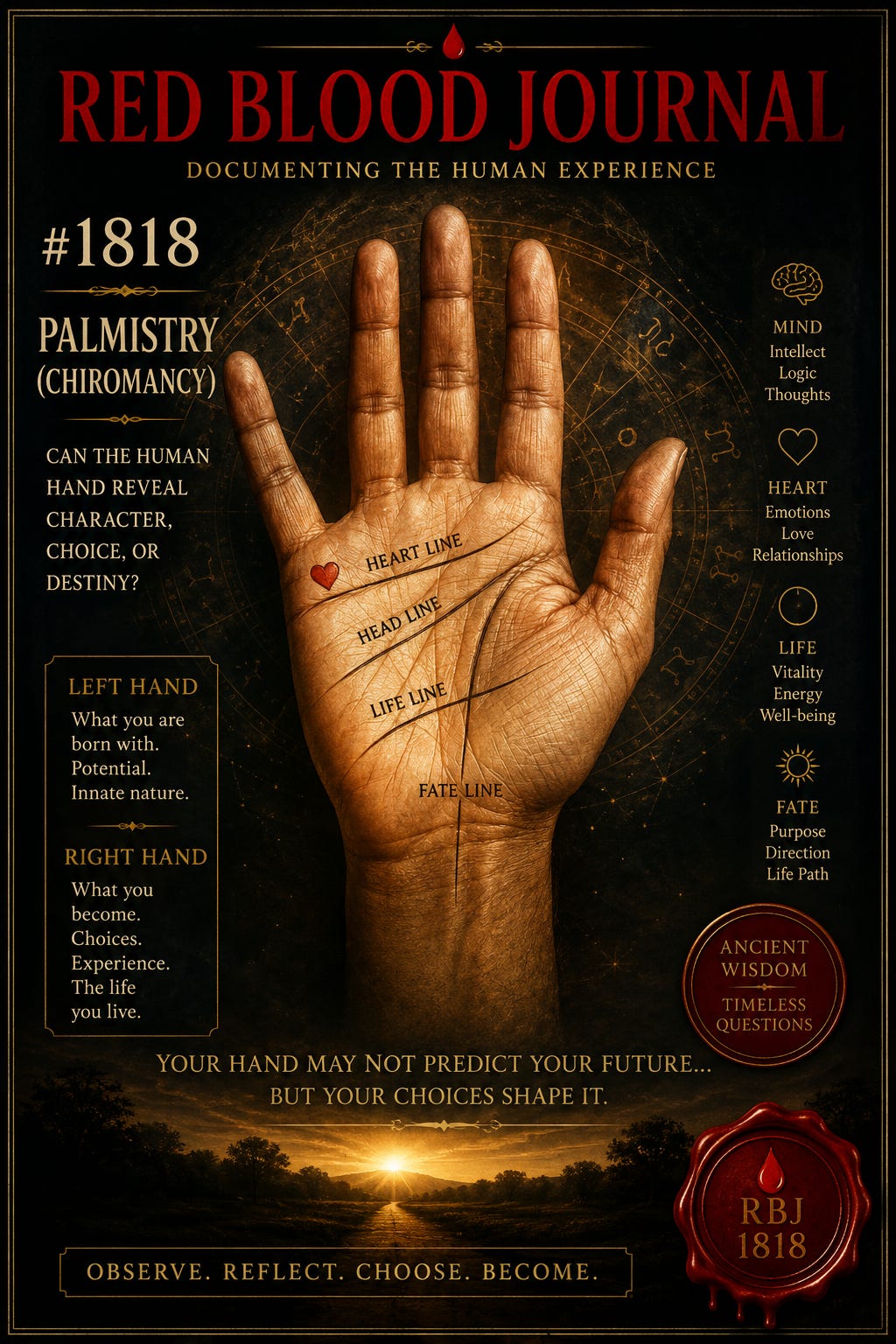
Although the details vary, many systems examine:
The Life Line
The Head Line
The Heart Line
The Fate Line
Finger proportions
Mounts of the palm
Overall hand shape
Interpretations differ widely between schools.
The Traditional View
One of the most common beliefs within palmistry is that the two hands represent different aspects of a person’s life.
Traditionally, for a right-handed person:
The Left Hand
Represents the qualities, tendencies, and potential with which a person is born.
It symbolizes possibility.
The Right Hand
Represents the life actually lived.
It reflects experience, decisions, habits, and personal development.
Many palmists believe the dominant hand changes over time because life itself changes.
Whether literally or symbolically, this distinction has fascinated people for centuries.
What Does Science Say?
Modern scientific research has not established palmistry as a reliable method for predicting personality, health, or future events.
Palm lines are known to form before birth and can change gradually over a lifetime due to:
Aging
Skin elasticity
Repeated physical use
Injury
Environmental factors
However, there is no broadly accepted scientific evidence that these changes correspond to destiny or specific life events.
For this reason, palmistry remains outside mainstream scientific practice.
A Different Way to Read the Hand
Perhaps the most interesting value of palmistry is not prediction but symbolism.
Imagine two hands.
One represents the person you were capable of becoming.
The other represents the person your decisions gradually created.
Suddenly, the hand becomes less about fate and more about responsibility.
Not because the lines determine the future...
But because every important decision leaves an invisible mark upon character.
The Hand as a Mirror
Whether one believes in palmistry or not, every human life tells a similar story.
We begin life with certain talents.
Certain limitations.
Certain opportunities.
What ultimately shapes us is not merely what we inherit.
It is what we repeatedly choose.
Every decision influenced by fear, greed, pride, jealousy, compassion, forgiveness, or integrity contributes to the person we become.
The hand may not literally record these choices.
But our character certainly does.
Beyond Prediction
Perhaps the greatest question palmistry inspires is not:
“Can my hand predict my future?”
But rather:
“If my future is influenced by my choices, what kind of person am I becoming?”
This shifts attention away from fate and toward personal responsibility.
Conclusion
Whether regarded as an ancient art, a cultural tradition, or simply an intriguing symbol, palmistry continues to captivate because it reflects a timeless human desire: to understand ourselves.
Science asks whether the hand can predict.
Philosophy asks whether the hand can remind.
If the left hand symbolizes potential and the right hand symbolizes the life we create, then every day becomes another opportunity to shape the person we are becoming.
Perhaps the most meaningful line is not one already etched into the palm, but the one we draw through our decisions.
🩸 Red Blood Journal
Report #1818
Title: Palmistry (Chiromancy): Can the Human Hand Reveal Character, Choice, or Destiny?
“Whether or not the hand records our destiny, our choices continually shape the person behind the hand.”
✋ Chiromancy: The Hand as a Map of Human Potential
Jul 14, 2026
This report examines the ancient practice of palmistry, exploring its historical roots across various civilizations and its traditional methods of interpreting the lines and shapes of the hand. While the text acknowledges that scientific evidence does not support the use of chiromancy for predicting the future, it highlights a compelling philosophical framework regarding human development. Traditionally, the two hands are viewed as symbols of innate potential versus the actual choices an individual makes throughout their life. This perspective shifts the focus away from predetermined fate and toward the weight of personal responsibility and character growth. Ultimately, the hand serves as a powerful metaphor for how our daily decisions continuously shape our identity.


