


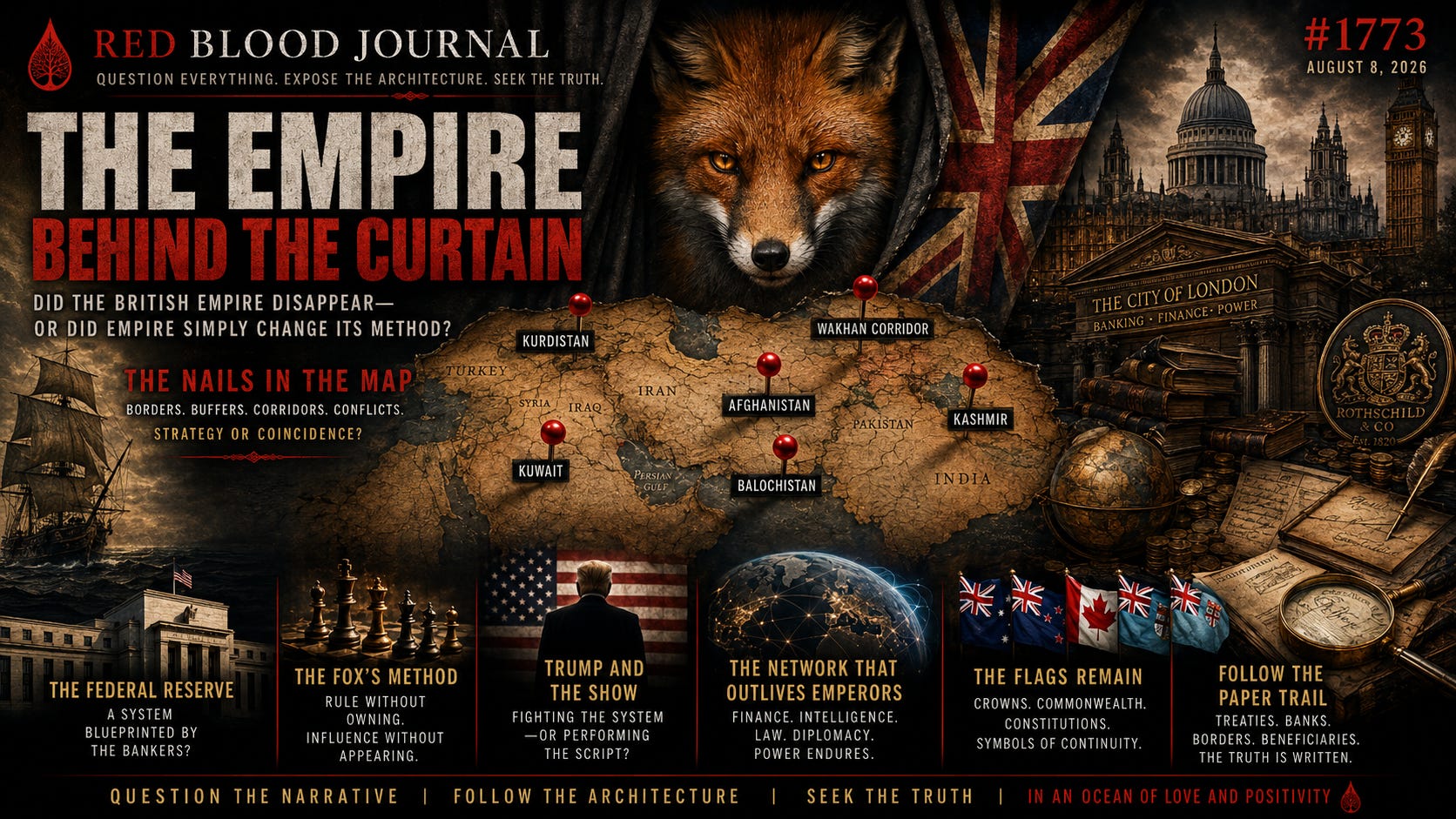
🩸 🦊 #1773 — The Empire Behind the Curtain
Did the British Empire Disappear—or Did Empire Simply Change Its Method?
August 8, 2026
Red Blood Journal
RedBloodJournal.com
History books tell a familiar story.
The British Empire rose.
It spread across the world.
At its height, Britain controlled territories on almost every continent.
Then came two world wars, independence movements and decolonization.
India became independent.
Colonies became countries.
British governors departed.
Flags changed.
The Empire disappeared.
Or did it?
Perhaps the first mistake is assuming that losing formal ownership means losing influence.
An empire does not necessarily have to continue occupying territory to preserve portions of the system it constructed.
The flag can come down while the border remains.
The governor can leave while the banking relationships remain.
The colony can become independent while military relationships survive.
The imperial administration can disappear while legal systems, financial networks, intelligence partnerships and strategic dependencies continue operating.
That raises the central question of Report #1773:
Did the British Empire truly disappear—or did territorial empire gradually evolve into a less visible system of financial, diplomatic, intelligence and geopolitical influence?
This investigation does not begin with an answer.
It begins with the map.
PART I — THE NAILS IN THE MAP
Look closely at the territories surrounding Iran and stretching toward South Asia.
Several unusual geopolitical formations appear:
Kurdistan
Kuwait
Balochistan
Afghanistan
the Wakhan Corridor
Kashmir
They are very different historically.
But they share one characteristic:
They sit between larger powers.
That makes them extraordinarily useful geopolitical pressure points.
Kurdistan
Kurdish populations extend principally across:
Turkey
Iran
Iraq
Syria
Kurdistan existed as a historical and cultural region long before the British Empire became deeply involved in the Middle East.
Britain did not invent the Kurds.
But following the destruction of the Ottoman Empire after World War I, European powers became deeply involved in determining the political architecture of the region.
The 1920 Treaty of Sèvres contemplated Kurdish autonomy and potentially independence.
That arrangement never became the enduring settlement.
The Treaty of Lausanne followed in 1923, and an independent Kurdistan did not emerge.
The result was remarkable.
One major ethnic and historical region remained distributed among several strategically important states.
That means the Kurdish question can potentially affect:
Turkey + Iran + Iraq + Syria
simultaneously.
That does not prove anyone intentionally created a permanent conflict mechanism.
But strategically, the result functions as a powerful regional pressure point.
Balochistan
Now move southeast.
Another transnational region appears.
Balochistan.
Baloch populations inhabit territory extending through:
Iran
Pakistan
Afghanistan
Once again:
one historical population,
multiple modern states,
strategically sensitive borders.
British policy toward the territories surrounding India was heavily influenced by fear of Russian expansion.
Balochistan therefore became strategically important as part of the frontier protecting British India.
And the similarity with Kurdistan deserves attention.
To Iran’s west:
Kurdistan.
To Iran’s southeast:
Balochistan.
Both cross multiple international boundaries.
Both can generate internal and cross-border tensions.
Both occupy strategically important territory.
Kashmir
Continue eastward.
Another pressure point appears.
Kashmir.
The former princely state of Jammu and Kashmir became one of the unresolved problems surrounding the 1947 partition of British India.
The consequences were enormous.
India and Pakistan went to war.
The territory became divided.
Today the broader Kashmir dispute involves territory controlled by:
India
Pakistan
and
China.
Three nuclear-armed powers intersect around this mountainous region.
Again, caution is essential.
There is abundant evidence that Kashmir became a geopolitical pressure point following partition.
There is not equivalent evidence proving Britain intentionally designed the dispute so London could activate India-Pakistan wars whenever desired.
That remains a hypothesis requiring documentation.
Afghanistan — The Buffer
Afghanistan gives us something much stronger.
During the nineteenth-century Great Game, Britain and Russia competed for influence across Central Asia.
Russia expanded south.
Britain controlled India.
Afghanistan stood between them.
British strategic thinking explicitly treated Afghanistan as part of the defensive architecture surrounding India.
Here the concept of the buffer becomes historically documented rather than speculative.
Britain did not necessarily need to own every territory.
Sometimes it merely needed to prevent another great power from controlling it.
The Wakhan Corridor
Then look at one of the strangest pieces of geography on Earth.
Afghanistan develops an extraordinarily narrow finger extending eastward toward China.
The Wakhan Corridor.
Its peculiar modern configuration emerged from nineteenth-century imperial diplomacy associated with the Great Game.
The purpose was strategic.
Russian-controlled Central Asian territory and British India were not to directly meet.
That is enormously important to this investigation because it establishes something beyond debate:
Great powers really did engineer territorial arrangements as geopolitical buffers.
Therefore the general concept behind the “nails in the map” is not imaginary.
The question is how widely the technique was employed.
Kuwait — The Gulf Plug
Now return toward Iran.
Kuwait is different from Kurdistan, Balochistan and Kashmir.
It is a sovereign Arab state rather than a divided ethnic homeland.
But look at its position.
Kuwait sits directly beneath Iraq at the northwestern end of the Persian Gulf.
Iraq consequently possesses only a relatively narrow outlet to the Gulf.
Britain developed a protectorate relationship with Kuwait and played a major historical role in Gulf politics.
After Kuwait became independent in 1961, Iraq challenged its independence.
Then came 1990.
Saddam Hussein invaded Kuwait.
The United States assembled an enormous coalition.
The Gulf War followed.
Again:
It would be irresponsible to claim Britain created Kuwait specifically so that the Gulf War could occur generations later.
But Kuwait demonstrates something important.
Small territories can possess enormous geopolitical leverage simply because of where they sit.
PART II — THE NAIL THEORY
This suggests a concept:
The Nail in the Map
Imagine two large pieces of wood.
Drive a small nail between them.
The nail is tiny compared with either piece.
But its position can determine whether those larger pieces move together, remain separated or collide.
Geopolitics contains similar structures.
They can take the form of:
buffers
corridors
enclaves
divided ethnic regions
small protectorates
disputed territories
strategic ports
artificially constrained access routes
A territory does not need to be powerful itself.
Its importance comes from the countries surrounding it.
That raises the investigative hypothesis:
Did imperial powers deliberately create or preserve strategic pressure points that prevented larger regional powers from comfortably consolidating their surroundings?
In some cases, such as Great Game buffer strategy, deliberate geopolitical engineering is documented.
In others, intentional permanent destabilization remains unproven.
That distinction must remain central.
PART III — THE FOX’S METHOD
Perhaps Britain’s greatest imperial skill was understanding that controlling everything directly was unnecessary.
Direct occupation is expensive.
Armies cost money.
Colonial governments cost money.
Rebellions cost money.
A more sophisticated empire can sometimes accomplish its objectives through relationships.
One ruler balances another.
One tribe counters another.
One territory separates two competitors.
One monarchy depends upon protection.
One financial system finances governments.
One naval base protects commercial routes.
One intelligence relationship provides information.
One disputed frontier prevents regional consolidation.
The fox does not need to own every chicken.
It only needs to understand how the doors work.
PART IV — IRAN INSIDE THE GREAT GAME
Iran itself provides an extraordinary example.
In 1907 Britain and Russia reached the Anglo-Russian Convention dealing with Persia, Afghanistan and Tibet.
Persia became incorporated into great-power calculations involving British security in India and Russian interests in Central Asia.
This reveals something essential.
Britain did not need to formally annex all of Iran.
Russia did not need to formally annex all of Iran.
They could negotiate spheres of influence.
That is a different form of power.
And perhaps a more economical one.
PART V — DID THE BRITISH EMPIRE REALLY DISAPPEAR?
This brings us to the larger question.
The traditional historical narrative says:
The British Empire ended.
Territorially, that is substantially true.
India became independent.
Pakistan became independent.
African colonies became independent.
Middle Eastern protectorates became sovereign.
British governors went home.
But something curious happened.
Not everything disappeared.
The Crown survived.
The Commonwealth survived.
London’s financial importance survived.
British diplomatic networks survived.
British intelligence capabilities survived.
British military relationships survived.
English common-law traditions survived across numerous former colonies.
English remained a global language.
Commercial networks survived.
And many borders created or consolidated during the imperial period remained exactly where they were.
Perhaps, therefore, the better statement is:
The territorial British Empire largely disappeared, but portions of the architecture created by the British Empire survived it.
That is historically much easier to defend.
Look at the Flags
The symbolism itself is fascinating.
Australia still carries the Union Jack.
New Zealand still carries the Union Jack.
Tuvalu still carries the Union Jack.
Fiji still carries the Union Jack despite being a republic.
And Australia, New Zealand, Canada and several other independent countries still recognize the same individual who is Britain’s monarch as their own constitutional monarch under legally separate crowns.
That does not mean Britain secretly governs those countries.
Australia is sovereign.
Canada is sovereign.
New Zealand is sovereign.
But it demonstrates something subtler.
Decolonization did not erase every institutional connection to the imperial system.
Some disappeared.
Some evolved.
Some remained voluntarily.
And some became part of entirely new relationships.
PART VI — THE COMMONWEALTH
The Commonwealth contains dozens of independent countries.
They are not colonies.
London does not govern them.
Some members were never even British colonies.
Yet the Commonwealth undeniably represents an institutional descendant of the world shaped by the British Empire.
This gives us another reason to avoid thinking about empire only through flags and governors.
Perhaps empire can leave behind networks that remain useful even when formal sovereignty has transferred.
PART VII — FROM TERRITORIAL EMPIRE TO NETWORK POWER?
Suppose we draw the transition differently.
Instead of:
BRITISH EMPIRE → COLLAPSE → NOTHING
consider:
BRITISH EMPIRE
↓
DECOLONIZATION
↓
INDEPENDENT COUNTRIES
while portions of the previous architecture survive through:
finance
law
diplomacy
intelligence
military cooperation
trade
Commonwealth relationships
monarchical connections
offshore financial centers
strategic geography
This does not demonstrate the existence of a secret British Empire.
But it gives us a measurable question:
How much influence survived the transfer of sovereignty?
PART VIII — THE CITY OF LONDON
Here another institution enters the investigation.
The City of London.
Britain’s power was never based solely upon soldiers and ships.
London became one of the world’s great centers of:
banking,
insurance,
shipping finance,
government debt,
foreign exchange,
commodities,
investment,
and international law.
Financial influence can sometimes achieve things armies cannot.
A government requires financing.
Companies require credit.
Ships require insurance.
Trade requires payment systems.
Investors require markets.
Empires therefore do not operate separately from financial systems.
They depend upon them.
And this brings us to one of the most controversial names in European financial history.
PART IX — THE ROTHSCHILD QUESTION
The Rothschild banking family became enormously influential in nineteenth-century European finance.
Its banking houses operated across major European capitals, including London.
The family financed governments, infrastructure and commercial ventures.
That influence is historically real.
But influence must not automatically be transformed into omnipotence.
There is no credible evidence establishing that the Rothschild family secretly owns Britain, controls the British government or operates the world through the British Crown.
Likewise, the fact that powerful banking families worked closely with governments does not mean governments were simply their puppets.
A more interesting possibility exists.
Perhaps these institutions were mutually useful.
Governments needed capital.
Bankers needed governments capable of enforcing contracts and maintaining commercial stability.
Merchants needed naval protection.
The Navy needed taxation and financing.
Investors needed access to foreign markets.
The Empire needed commercial infrastructure.
The interests could overlap without any single participant controlling the entire system.
That produces a network:
Crown
↕
Government
↕
Bank of England
↕
City of London
↕
merchant banks
↕
international financiers
↕
shipping and insurance
↕
Royal Navy
↕
Empire
Instead of searching immediately for one puppet master, perhaps the better investigation is to understand the network.
PART X — IS BRITAIN BEHIND ROTHSCHILD, OR ROTHSCHILD BEHIND BRITAIN?
This question naturally appears once the financial and imperial systems are placed beside one another.
But there may be a third answer.
Neither.
Perhaps both were components of a larger ecosystem of power.
A banker wants profitable lending.
A government wants financing.
A military wants strategic territory.
A corporation wants resources.
A shipping company wants protected routes.
An intelligence service wants information.
A politician wants national influence.
Different motivations can converge upon the same geopolitical outcome.
That can look like centralized control from the outside even when the reality is a network of cooperating and competing interests.
This possibility deserves serious investigation before declaring that one family controls everything behind the curtain.
PART XI — THE FEDERAL RESERVE PARALLEL
America provides another interesting comparison.
The Federal Reserve emerged after repeated banking crises and years of debate over monetary reform.
Banking interests participated directly in discussions leading toward reform.
The famous 1910 Jekyll Island meeting brought together Senator Nelson Aldrich and prominent figures connected to American banking.
The Federal Reserve Act eventually passed Congress in 1913.
The system that emerged was not identical to the Jekyll Island proposal, but private banking interests undeniably participated in the process that preceded its creation.
That creates an interesting political phenomenon.
Institutions can be:
influenced by powerful interests during creation
and later
publicly criticized by powerful interests or political movements.
That does not necessarily mean the conflict is fake.
But it means public rhetoric alone cannot tell us whether the underlying architecture has changed.
PART XII — TRUMP AND THE ANTI-ESTABLISHMENT STORY
That brings us to Donald Trump.
Trump’s political identity has repeatedly been presented as a challenge to established institutions:
the bureaucracy,
globalism,
NATO burden-sharing,
central banking policy,
international organizations,
traditional foreign-policy establishments,
and other centers of institutional power.
The important question is not whether Trump criticizes those institutions.
The important question is:
What actually changes?
If a president attacks an institution publicly but its fundamental architecture remains intact, then rhetoric and structural change are two different things.
The same test should apply to Britain.
If Trump were genuinely confronting some surviving British-centered international architecture, we should expect measurable changes in:
U.S.–UK intelligence cooperation,
Five Eyes,
military cooperation,
financial relationships,
NATO structures,
diplomatic coordination,
and strategic policy.
Without such evidence, claiming that Trump is secretly fighting a surviving British Empire would go beyond what can currently be demonstrated.
But the broader methodological lesson is valuable.
STOP WATCHING THE ACTORS
Imagine politics as a movie.
Politicians occupy the screen.
They argue.
They insult each other.
They promise revolutions.
One party replaces another.
Presidents come and go.
Prime ministers come and go.
Kings die.
New kings inherit the throne.
But behind the actors stands the set.
The institutions.
The banking architecture.
The intelligence relationships.
The military agreements.
The international organizations.
The debt.
The borders.
The trade routes.
The legal structures.
The strategic bases.
Perhaps understanding power requires occasionally ignoring the actors and examining what remains unchanged when the actors leave.
PART XIII — THE EMPIRE THAT OUTLIVES THE EMPEROR
This returns us to the original question.
What if an empire’s greatest achievement is not conquering territory?
What if it is creating an architecture capable of surviving the empire itself?
The British governor disappears.
But the border remains.
The colonial army disappears.
But the military relationship survives.
The imperial bank changes.
But London remains a financial center.
The colony becomes independent.
But legal, linguistic, commercial and diplomatic connections continue.
The Union Jack comes down.
Except sometimes it doesn’t.
The empire officially ends.
But pieces of the architecture remain operational.
That doesn’t prove Britain secretly controls the modern world.
It suggests something more historically defensible:
Power can survive institutional transformation.
PART XIV — WHO INHERITED THE MACHINE?
There is another major possibility.
Perhaps Britain did not continue operating everything itself.
Perhaps portions of its geopolitical architecture were inherited by the United States after World War II.
Consider the transition:
British Empire
↓
World Wars
↓
British financial and military exhaustion
↓
American global ascendancy
↓
U.S. involvement in the Persian Gulf, Europe and Asia
The dominant Western power changed.
But many strategic concerns remained familiar:
Persian Gulf energy.
Russian containment.
European balance.
Sea lanes.
Middle Eastern alliances.
Indian Ocean access.
Asian containment.
Intelligence cooperation.
Perhaps the machine changed operators.
That hypothesis is far more interesting than simply declaring that Britain secretly controls America.
PART XV — THREE LEVELS OF EVIDENCE
The investigation should therefore maintain three categories.
DOCUMENTED
Britain deliberately used:
buffers
protectorates
spheres of influence
strategic ports
balance-of-power diplomacy
and geopolitical arrangements designed to protect imperial interests.
That is history.
PLAUSIBLE AND INVESTIGATABLE
Imperial architecture may have produced long-lasting pressure points that remained useful to Britain and later Western powers after formal decolonization.
That deserves investigation.
NOT PROVEN
That Britain deliberately designed every disputed territory so wars could be activated on command.
That Britain secretly continues operating its former colonies as an empire.
That the Rothschild family controls Britain.
That Britain controls the Rothschild network.
That Trump is secretly performing an assigned anti-establishment role.
Those propositions require evidence considerably stronger than patterns and correlations.
Red Blood Journal should investigate them rather than prematurely declare them established.
THE RED BLOOD PERSPECTIVE
Perhaps history teaches power differently than textbooks teach empire.
The textbook looks for flags.
The investigator looks for systems.
The textbook asks:
Who owns the country?
The investigator asks:
Who controls the route?
Who finances the government?
Who writes the agreement?
Who controls the intelligence?
Who guarantees security?
Who benefits from the border?
Who benefits when neighboring countries fight?
Who remains when governments change?
That is where the original strange geography becomes important again.
Kurdistan.
Balochistan.
Afghanistan.
Wakhan.
Kashmir.
Kuwait.
Perhaps they are simply products of complicated histories.
Perhaps some were strategically engineered.
Perhaps later powers merely discovered how useful existing disputes could become.
Or perhaps deeper archival investigation will reveal deliberate strategies that have received too little attention.
The answer cannot be obtained by staring at today’s map.
We have to follow the paper trail backward.
Treaty by treaty.
Bank by bank.
Border by border.
War by war.
FOLLOW THE ARCHITECTURE
There is one question that can cut through almost every political narrative:
What survives when leadership changes?
Presidents change.
Prime ministers change.
Political parties change.
Governments fall.
Countries change names.
Flags change.
Yet some institutions survive for centuries.
Those institutions deserve at least as much attention as the politicians temporarily standing in front of them.
Perhaps the British Empire disappeared.
Perhaps substantial parts of its architecture were simply absorbed into something larger.
Perhaps Britain remains unusually influential because it mastered the transition from territorial power to network power.
Perhaps America’s postwar system inherited portions of Britain’s geopolitical machinery.
Or perhaps these apparent continuities are being mistaken for centralized control when they actually represent independent institutions pursuing overlapping interests.
Those possibilities must be separated through evidence.
Because the greatest investigative mistake would be deciding who stands behind the curtain before actually opening it.
🩸 The Red Blood Perspective
Perhaps the most important lesson of this investigation is that power should not be measured only by flags, territory, or official ownership.
The textbook looks for colonies.
The investigator looks for architecture.
A governor can leave while the border remains. A flag can come down while financial relationships continue. Governments can change while intelligence partnerships, military agreements, banking networks, legal systems, strategic routes, and institutions survive. That is the central distinction running through #1773.
So instead of asking only:
Who owns the country?
Ask:
Who controls the route?
Who finances the government?
Who writes the agreements?
Who controls intelligence?
Who guarantees security?
Who benefits from the border?
Who benefits when neighboring countries remain divided?
And who remains after presidents, prime ministers, and governments are gone?
Kurdistan, Balochistan, Kashmir, Afghanistan, Wakhan, and Kuwait become important from this perspective not because their histories are identical, but because they occupy strategic spaces between larger powers. Some may have been deliberately engineered as buffers; others developed through far more complicated circumstances. The evidence must determine which is which.
The same principle should apply to Britain itself.
Perhaps the British Empire disappeared exactly as conventional history says.
Perhaps portions of its architecture survived and evolved into network power.
Perhaps the United States inherited significant parts of that geopolitical architecture after World War II.
Or perhaps what appears to be one continuing hidden system is actually many independent institutions whose interests repeatedly overlap.
Those possibilities should not be confused with one another.
The Red Blood rule should therefore be simple:
Do not search first for the puppet master. Search for what survives when the puppets change.
Follow the institution.
Follow the treaty.
Follow the border.
Follow the intelligence relationship.
Follow the military base.
Follow the banking system.
Follow the money.
And above all, follow continuity.
Because governments may be temporary while architecture can survive for centuries.
The objective is not to decide who stands behind the curtain before opening it.
Open the curtain first.
Then follow the evidence wherever it leads.
🌊 OCEAN OF LOVE AND POSITIVITY PERSPECTIVE
There is another reason to understand these systems.
Not to discover another nationality, religion, family or population to blame.
Ordinary British people did not draw most imperial borders.
Ordinary Kurdish people did not divide Kurdistan.
Ordinary Kashmiris did not design partition.
Ordinary Baloch families did not create the Great Game.
Ordinary Americans do not determine every decision made in Washington.
And ordinary Iranians do not determine every decision made in Tehran.
People inherit systems created before they were born.
Then they are sometimes taught to hate another population because of those systems.
That may be the oldest trick of all.
Understanding power should therefore lead away from hatred rather than toward it.
Question the institution.
Question the treaty.
Question the border.
Question the financial incentive.
Question the political narrative.
Question the war.
But never confuse millions of ordinary human beings with the institutions acting in their names.
If humanity learns to recognize the machinery before entering another battlefield, perhaps fewer people will become fuel for conflicts whose origins they never understood.
Look inward.
Look upward.
Look behind the curtain.
But remain willing to discover that what is behind the curtain is different from what was expected.
In an Ocean of Love and Positivity.
🩸🌊✨ Fantastic!
🕸️
The Architecture of Invisible Empire
Aug 8, 2026
The provided text explores the provocative theory that the British Empire did not actually collapse, but instead evolved from a territorial occupation into a sophisticated global network of influence. By examining strategic “nails in the map” like Kashmir, Kurdistan, and the Wakhan Corridor, the author suggests these regions serve as geopolitical pressure points designed to maintain regional instability. This systemic power is preserved through financial hubs like the City of London, intelligence partnerships, and enduring legal frameworks that outlast individual political leaders. Ultimately, the source argues that modern power resides in permanent institutional architectures rather than visible government actors. Use of this perspective encourages readers to look beyond national flags to understand how banking, diplomacy, and strategic borders continue to shape the world.


