


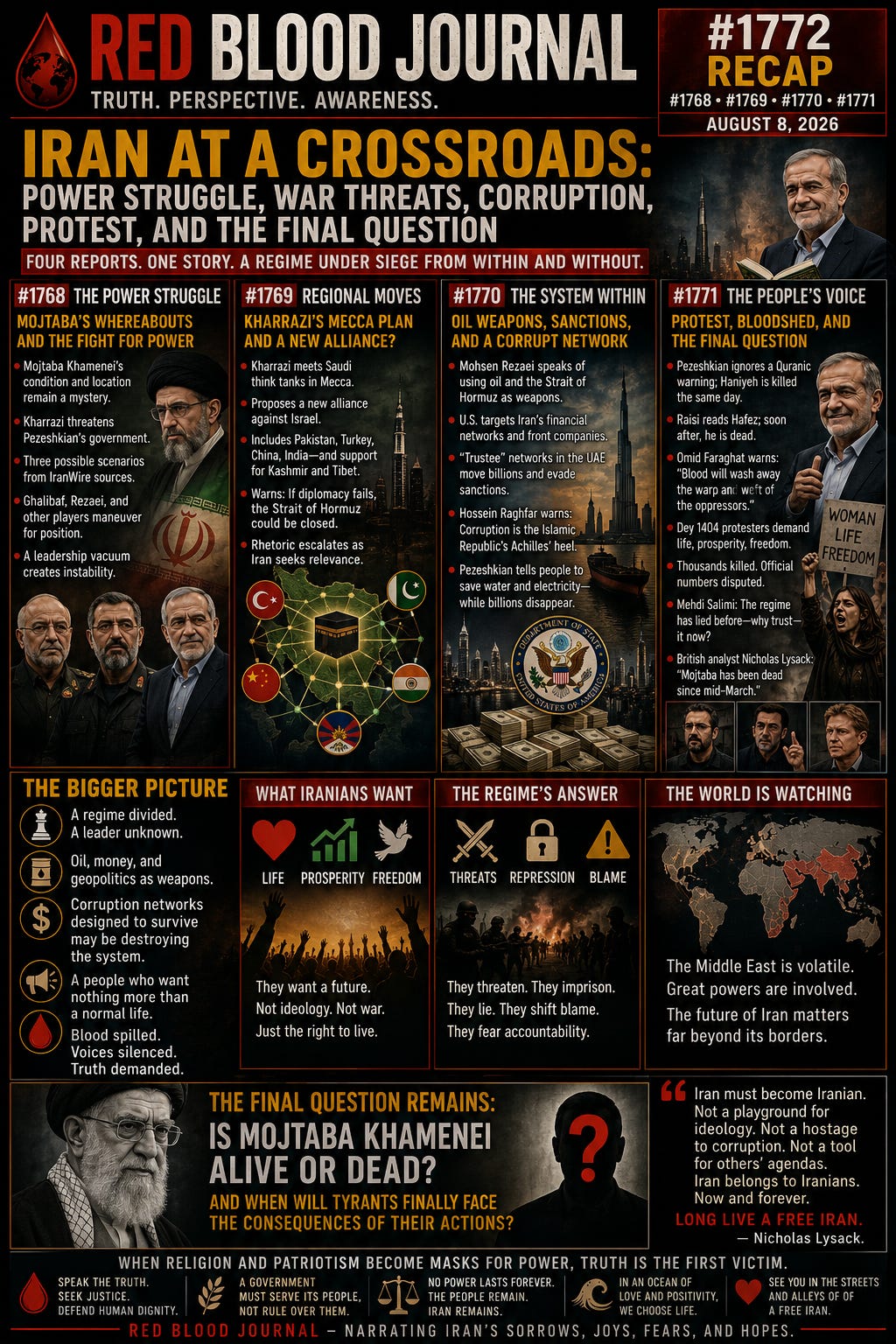
🩸 🇮🇷 #1772 — Iran at a Crossroads
Power Struggle, Regional Realignment, Economic Corruption, Protest — and the Question of Who Actually Controls the Islamic Republic
A Recap of Red Blood Journal Reports #1768–#1771
August 8, 2026
RedBloodJournal.com
Four reports.
Four different windows into Iran.
Yet when placed side by side, they begin to tell one larger story.
Report #1768 examined the mystery surrounding Mojtaba Khamenei and the possibility of a struggle over Iran’s leadership.
Report #1769 moved outward, examining radical rhetoric attributed to Kharrazi, regional fears, Kashmir, Tibet, and the reported Saudi-Turkish-Pakistani alignment.
Report #1770 followed the money—oil, the Strait of Hormuz, sanctions-evasion networks, corruption, and warnings that the mechanisms created to keep the Islamic Republic alive could ultimately weaken it from within.
Report #1771 returned to the Iranian people—protests, repression, competing casualty claims, political accountability, distrust of official narratives, and the simple demand for a normal life.
Individually, these are separate subjects.
Together, they produce a much larger question:
Is the Islamic Republic facing several crises—or one systemic crisis appearing in several different forms?
That distinction matters.
Because a government can survive a political crisis.
It can survive an economic crisis.
It can survive foreign pressure.
It can survive protests.
It can even survive a leadership transition.
But when all of these pressures begin interacting simultaneously, the calculation changes.
This is the larger picture emerging from #1768 through #1771.
🩸 #1768 — The Mystery at the Top
Is Mojtaba Khamenei Alive, Injured, Incapacitated, or Dead?
The investigation began with the simplest question and perhaps the hardest one to answer:
Where is Mojtaba Khamenei?
Reports and rumors described his condition as critical.
Some suggested he was severely wounded.
Others claimed he had already died and that an announcement was being deliberately delayed.
None of these possibilities was established conclusively by the material examined.
But the uncertainty itself became important.
In a centralized political system, the condition of the person at the top is not merely personal information.
It affects:
Military command.
Foreign policy.
Security institutions.
Appointments.
Factional alliances.
Succession.
And the behavior of everyone waiting to see who will control the system tomorrow.
The central lesson of #1768 therefore went beyond Mojtaba himself.
When nobody knows who is actually exercising supreme authority, uncertainty becomes a form of political power.
♟️ Three Mojtaba Scenarios
Report #1768 identified three principal scenarios circulating within the source material.
Scenario One: Mojtaba Is Alive
He remains leader but is isolated because of extraordinary security concerns.
Scenario Two: Mojtaba Is Alive but Gravely Wounded
His condition prevents normal governance, creating a temporary power vacuum while competing factions prepare for succession.
Scenario Three: Mojtaba Is Already Dead
His death has allegedly been concealed until military, political, and regional conditions are stable enough for an announcement.
The evidence examined did not establish which scenario is correct.
But all three lead toward the same institutional question:
Who is making the decisions while Mojtaba remains absent?
That question became the thread connecting all four reports.
🌊 Hormuz and the Timing Question
The mystery surrounding Mojtaba also appeared alongside another development:
Possible negotiations concerning the Strait of Hormuz.
The theory presented in the source was that factions inside Iran might want to stabilize the external confrontation before allowing an internal succession crisis to erupt publicly.
The logic would be:
First, stabilize Hormuz.
Second, reduce military confrontation.
Third, settle the internal balance of power.
Then announce whatever has happened to the leadership.
That theory remains speculative.
But it demonstrates how leadership uncertainty and foreign policy can become interconnected.
🕋 #1769 — The Crisis Moves Beyond Iran
Report #1769 widened the lens.
The question was no longer merely:
What is happening inside Tehran?
It became:
What are Iran’s neighbors preparing for?
The source described a reported security arrangement involving:
🇸🇦 Saudi Arabia
🇹🇷 Turkey
🇵🇰 Pakistan
The significance of such an alignment would be considerable.
Turkey is a NATO member.
Pakistan possesses nuclear weapons.
Saudi Arabia possesses enormous financial resources and occupies one of the most strategically important positions in the Middle East.
The source interpreted their cooperation partly as a response to uncertainty surrounding Iran.
Whether Iran was the primary reason for such cooperation was not established.
But the broader strategic lesson remains:
Countries diversify their alliances when they become uncertain about the security architecture surrounding them.
⚠️ Then Came Kharrazi
Report #1769 also examined extraordinary rhetoric attributed to cleric Kharrazi.
According to the transcript, his vision extended far beyond Iran, Israel, and the Persian Gulf.
It reached toward:
India.
Kashmir.
China.
Tibet.
The most striking phrase attributed to him was:
“These all have crisis points. Their crisis points will soon be activated.”
That statement did not prove the existence of an Iranian government plan.
It could represent factional rhetoric.
Recruitment propaganda.
Personal ambition.
Ideological fantasy.
Or ideas circulating somewhere closer to power.
But the phrase deserves attention because it represents a dangerous geopolitical concept:
Treating unresolved conflicts as weapons waiting to be activated.
☢️ Kashmir Is Not a Toy
Kashmir is especially dangerous because three nuclear powers intersect around the dispute:
India.
Pakistan.
China.
Any ideological movement imagining Kashmir as a convenient pressure point would therefore be entering one of the most dangerous geopolitical environments on Earth.
The same logic applies to Tibet.
A local grievance can become a regional confrontation.
A regional confrontation can draw in major powers.
And major-power confrontation can become something nobody originally intended.
This is why extreme rhetoric matters even when it never becomes official policy.
Ideas can create followers.
Followers can create pressure.
Pressure can eventually influence policy.
👁️ What Was Kharrazi Really Doing?
#1769 therefore raised another unresolved question.
Was Kharrazi speaking for Mojtaba Khamenei?
Was he speaking for a faction surrounding Mojtaba?
Was he revealing discussions occurring inside the system?
Or was he exploiting the leadership vacuum to build his own political and ideological following?
The available material could not establish the answer.
But that uncertainty again returned us to the same problem:
Nobody outside the inner circle seems certain where authority actually resides.
🛢️ #1770 — Follow the Money
Report #1770 shifted the investigation from political power to economic power.
And sometimes the two are impossible to separate.
The report began with statements attributed to Mohsen Rezaei during the Twelve-Day War.
According to the source, Rezaei emphasized capabilities Iran had not yet fully used.
Among them:
Ground forces.
Naval forces.
Regional allies.
Oil.
And most importantly:
The Strait of Hormuz.
Rezaei reportedly described oil and Hormuz as potential weapons.
This matters because Hormuz is not merely an Iranian issue.
It is a global economic artery.
Disrupt it and consequences can spread rapidly through:
Energy markets.
Shipping.
Insurance.
Inflation.
Asian economies.
European economies.
American policy.
The world economy.
Geography itself becomes leverage.
💰 The Other Battlefield: Money
While Iranian figures discussed oil and Hormuz, Washington was targeting financial networks.
The source described American action against exchange houses, front companies, and intermediaries allegedly helping the Islamic Republic circumvent sanctions.
This exposed one of the central contradictions of the Iranian system.
Sanctions created a problem.
Iran created networks to bypass the problem.
Those networks required secrecy.
Secrecy required trusted intermediaries.
Those intermediaries gained access to enormous amounts of money.
And according to economist Hossein Raghfar, the result was not merely sanctions evasion.
It was:
Corruption on an extraordinary scale.
🏦 The “Trustees”
Raghfar described networks of politically trusted intermediaries, many allegedly operating through the United Arab Emirates.
Billions were reportedly placed into these channels.
The stated objective was survival under sanctions.
But Raghfar asked:
Where did the money go?
His argument suggested the emergence of a uniquely Iranian oligarchic structure.
In many countries:
Money buys political power.
In Iran, according to his description:
Political power created private money.
Government insiders gained access to public assets.
Privatization transferred resources.
Political relationships created opportunities.
And people emerging from government became enormously wealthy.
💵 The $540 Billion Claim
Raghfar cited an extraordinary figure of approximately $540 billion associated with Iranian investment in the UAE.
That number was an attributed claim within the source and was not independently established by the transcript.
But the exact figure is less important than the question behind it:
How much national wealth left Iran while ordinary Iranians became poorer?
Oil belongs to the country.
Minerals belong to the country.
Natural resources belong to the country.
And in a deeper sense, these resources also belong to future generations.
When they disappear through opaque networks, tomorrow is being spent today.
⚖️ The Achilles’ Heel
Raghfar said he warned senior officials, including Ebrahim Raisi and Masoud Pezeshkian.
His warning was severe:
“If these conditions do not change, the Islamic Republic will collapse.”
He called corruption the system’s:
Achilles’ heel.
That produced perhaps the greatest irony of #1770.
The Islamic Republic built financial networks to survive sanctions.
Those networks allegedly created enormous opportunities for corruption.
The corruption weakened the economy.
Economic weakness damaged legitimacy.
And now Washington is attacking the same networks from outside.
The mechanism built for survival may have become a vulnerability.
The escape route became the trap.
🚰 Meanwhile, Ordinary People Are Told to Conserve
Against this background, Pezeshkian publicly emphasized water and energy conservation.
His argument itself was economically understandable.
Reduce waste.
Consume less energy.
Free more oil for export.
Redirect the savings toward society.
According to figures he presented, relatively modest reductions in domestic energy consumption could represent enormous amounts of oil.
But the narrator saw a contradiction.
At one level:
Citizens are asked to tolerate shortages.
At another:
Politically connected networks allegedly move extraordinary sums outside the country.
That creates a political question larger than conservation:
Who is being asked to sacrifice?
A population may accept sacrifice during genuine national hardship.
But sacrifice becomes harder to justify when citizens believe those asking for it are exempt.
🇮🇷 #1771 — Then Come the People
The final report moved away from elites.
Away from intelligence.
Away from Hormuz.
Away from financial networks.
And back toward the street.
The central question became:
What do ordinary Iranians actually want?
According to the source, protesters demanded something remarkably uncomplicated:
Life.
Prosperity.
Freedom.
A normal future.
The ability to work.
The ability to marry.
The ability to raise families.
The ability to speak.
The ability to live without constant economic and political pressure.
🕊️ From “Woman, Life, Freedom” to a Normal Life
Governments often interpret protests through national-security language.
Foreign agents.
Enemy governments.
Intelligence operations.
Subversion.
Regime change.
Outside agitation.
Some foreign involvement can certainly exist in political conflicts.
But that does not automatically explain why ordinary people participate.
A young Iranian who cannot afford housing does not require the CIA to explain frustration.
A family facing inflation does not require Mossad to explain anger.
A worker whose salary cannot cover food does not need Washington to explain dissatisfaction.
External actors may attempt to exploit unrest.
But exploitation and original cause are not the same thing.
That distinction matters.
🔢 The Battle Over the Dead
Report #1771 also examined competing claims concerning protest casualties.
Pezeshkian reportedly defended a figure around 3,000 deaths while rejecting claims of 30,000 or 40,000.
Critics argued the official number was far too low.
The source did not establish which figure was correct.
And that leads to the only responsible conclusion:
Demand evidence.
Names.
Dates.
Locations.
Death certificates.
Hospital records.
Independent investigations.
Court records.
Family testimony.
Documentation.
Casualty numbers should not become political merchandise.
Every number represents a human being.
🗞️ When Trust Has Already Collapsed
Political activist Mehdi Salimi responded sarcastically to the government’s demand for trust.
He cited earlier controversies and alleged deceptions to make a larger point:
A government cannot spend decades destroying credibility and then demand that citizens automatically believe today’s statement.
Trust accumulates.
Distrust accumulates too.
When institutional credibility collapses, even truthful government statements may no longer be believed.
That is one of the most dangerous conditions a political system can reach.
Because eventually there is no common reality.
Only competing narratives.
📖 Religion, Omens, and Power
#1771 also examined symbolic stories surrounding Pezeshkian, the Quran, Raisi, and Hafez.
Whether one believes in divination is secondary.
The important phenomenon is psychological.
When a society enters prolonged crisis, people begin interpreting events symbolically.
A poem becomes a warning.
A verse becomes prophecy.
A death becomes fate.
An accident becomes conspiracy.
Why?
Because people are trying to impose meaning upon chaos.
And when official institutions are no longer trusted, symbolic explanations become even more powerful.
👤 Mojtaba — Again
Then, at the end of #1771, the investigation returned to where #1768 began.
Mojtaba Khamenei.
British analyst Nicholas Lysack was quoted claiming that Mojtaba was not merely critically ill but had already been dead since mid-March.
He further alleged that the Revolutionary Guard was preparing the population for a delayed announcement.
That remains an attributed allegation.
It is not established fact.
But after four reports, the question remains unresolved:
Is Mojtaba Khamenei alive or dead?
And perhaps more importantly:
Who is governing while the world asks the question?
🧩 Four Reports — One Picture
Now place #1768, #1769, #1770, and #1771 together.
A pattern emerges.
At the top:
Leadership uncertainty.
Factional competition.
Questions surrounding Mojtaba Khamenei.
Inside the political system:
Pezeshkian.
Ghalibaf.
Kharrazi.
Mohsen Rezaei.
Security institutions.
Competing centers of influence.
Around Iran:
Saudi Arabia.
Turkey.
Pakistan.
India.
China.
Israel.
The United States.
A changing security environment.
Beneath the political system:
Sanctions.
Opaque financial networks.
Corruption.
Capital flight.
Energy shortages.
Water shortages.
Economic pressure.
In the streets:
Protest.
Repression.
Distrust.
Political prisoners.
Families demanding answers.
Young people demanding a future.
These are not automatically parts of one coordinated plan.
But they can still interact.
And that interaction may be more important than any single conspiracy.
⚙️ How Systems Begin to Destabilize
Political systems rarely collapse because of one event.
More often, pressures begin feeding one another.
Leadership uncertainty produces factional competition.
Factional competition weakens decision-making.
Weak decision-making worsens economic problems.
Economic problems increase public dissatisfaction.
Public dissatisfaction produces protest.
Repression damages legitimacy.
Lost legitimacy increases dependence on force.
Foreign adversaries recognize weakness.
External pressure increases.
Resources decline.
Political factions fight harder over the remaining resources.
And the cycle repeats.
At some point:
The system begins fighting itself.
That may be the larger danger facing the Islamic Republic.
Not one enemy.
Not one protest.
Not one sanction.
Not one leader.
But several weaknesses reinforcing one another simultaneously.
🌍 The World Is Watching
Iran’s future does not concern Iran alone.
The country sits at the intersection of:
The Persian Gulf.
Central Asia.
The Caucasus.
The Middle East.
South Asia.
Global energy markets.
Major shipping routes.
American strategy.
Russian strategy.
Chinese strategy.
Israeli security.
Arab Gulf security.
A major destabilization inside Iran would therefore have consequences far beyond its borders.
This is precisely why outside powers will attempt to influence whatever comes next.
And it is precisely why Iranians must think carefully about whose interests are being served.
🇮🇷 “Iran Must Become Iranian”
Of all the sentences appearing across these four reports, this may be the most important:
Iran must become Iranian.
That does not automatically mean monarchy.
It does not automatically mean republic.
It does not mean isolation.
It does not mean hostility toward other nations.
It means something more basic:
Iran should exist for Iranians.
Its resources should benefit its people.
Its foreign policy should serve its national interests.
Its young people should be able to imagine a future.
Its institutions should belong to the nation rather than factions.
Its religion should not become a political weapon.
Its patriotism should not become an excuse to silence criticism.
And its people should not become pieces on somebody else’s geopolitical chessboard.
⚠️ But Replacing a Government Is Not Enough
History offers another warning.
Removing a political system does not automatically create freedom.
A revolution can remove oppression and create new oppression.
A monarchy can become authoritarian.
A republic can become authoritarian.
A religious government can become authoritarian.
A secular government can become authoritarian.
The label does not guarantee the outcome.
Institutions matter.
Law matters.
Checks on power matter.
Free expression matters.
Independent courts matter.
Accountability matters.
And perhaps most importantly:
The next government must not inherit the belief that political opponents are enemies who must be destroyed.
Otherwise the flag changes while the system survives.
🩸 The Red Blood Perspective
After four reports, there is a temptation to predict what happens next.
Resist it.
Too many important facts remain uncertain.
We do not conclusively know Mojtaba Khamenei’s condition from the material examined.
We do not know whether Kharrazi represents a genuine factional strategy or primarily himself.
We do not know the full scale of Iran’s hidden financial networks.
We do not know the final verified casualty count from the protests discussed in the source.
We do not know whether Iran’s competing political factions will compromise or turn against one another.
But uncertainty does not mean nothing can be learned.
The evidence and claims examined point toward several questions worth continuing to watch:
Who controls Iran’s security institutions?
Who controls the money?
Who controls policy surrounding Hormuz?
Who controls the succession?
Who controls the official narrative?
And ultimately:
Who controls Iran?
That is the thread running through #1768, #1769, #1770, and #1771.
The Mojtaba mystery is therefore not merely a story about whether one man is alive or dead.
It is a window into something larger.
A political system built around concentrated authority is entering a period where authority itself appears increasingly difficult to locate.
And when power becomes uncertain at the top, everyone below begins preparing for what comes next.
🌊 Ocean of Love and Positivity Perspective
From high above, geopolitics looks like a chessboard.
Iran.
Saudi Arabia.
Israel.
Turkey.
Pakistan.
India.
China.
Russia.
America.
Black squares.
White squares.
Moves.
Countermoves.
Kings.
Queens.
Pawns.
But come closer.
There are no squares.
There are people.
The Iranian protester is a person.
The government supporter is a person.
The Pakistani is a person.
The Israeli is a person.
The Saudi is a person.
The American is a person.
The Indian is a person.
The Chinese citizen is a person.
Governments teach populations to look horizontally:
At one another.
Who is the enemy?
Who is Sunni?
Who is Shiite?
Who is Jewish?
Who is Christian?
Who is Persian?
Who is Arab?
Who is Western?
Who is Eastern?
But perhaps the greater education is learning to look inward.
What happens when power disappears?
What happens when money disappears?
What happens when the body itself eventually disappears?
What remains?
The lessons.
The choices.
The way we treated one another.
The challenge is not merely creating another government.
The challenge is creating better human beings capable of building better institutions.
Because replacing one group of rulers with another group carrying the same hatred merely restarts the lesson.
Iran deserves peace.
Iranians deserve dignity.
The dead deserve truth.
The living deserve a future.
And future generations deserve a country whose wealth was not stolen before they arrived.
Perhaps that is what “Iran must become Iranian” should ultimately mean.
Not revenge.
Not another ideology.
Not another foreign master.
Not another permanent revolution.
A home.
A place where different people can disagree without becoming enemies.
A country where leadership is temporary but the people remain.
A country where government fears the judgment of its citizens more than citizens fear the government.
And a country where the streets and alleys belong not to rulers, factions, intelligence services, or ideologies—
but to the people walking through them.
In an Ocean of Love and Positivity.
🩸🌊✨ Fantastic!
⚖️
Iran at a Crossroads: Power, Corruption, and Succession
Aug 8, 2026
The provided text offers a comprehensive analysis of the systemic crises currently destabilizing the Islamic Republic of Iran. It explores a high-level power struggle fueled by the uncertain physical condition of Mojtaba Khamenei and the potential for a leadership vacuum. Beyond domestic politics, the reports examine economic decay caused by rampant corruption and the exploitation of sanctions-evasion networks by a new class of oligarchs. Regional tensions are highlighted through radical rhetoric concerning geopolitical flashpoints and shifting alliances among Iran’s neighbors. Ultimately, the source emphasizes the disconnect between an embattled regime and a populace demanding a normal life amidst state repression. Together, these factors suggest a government facing a multidimensional collapse where internal and external pressures reinforce one another.


