


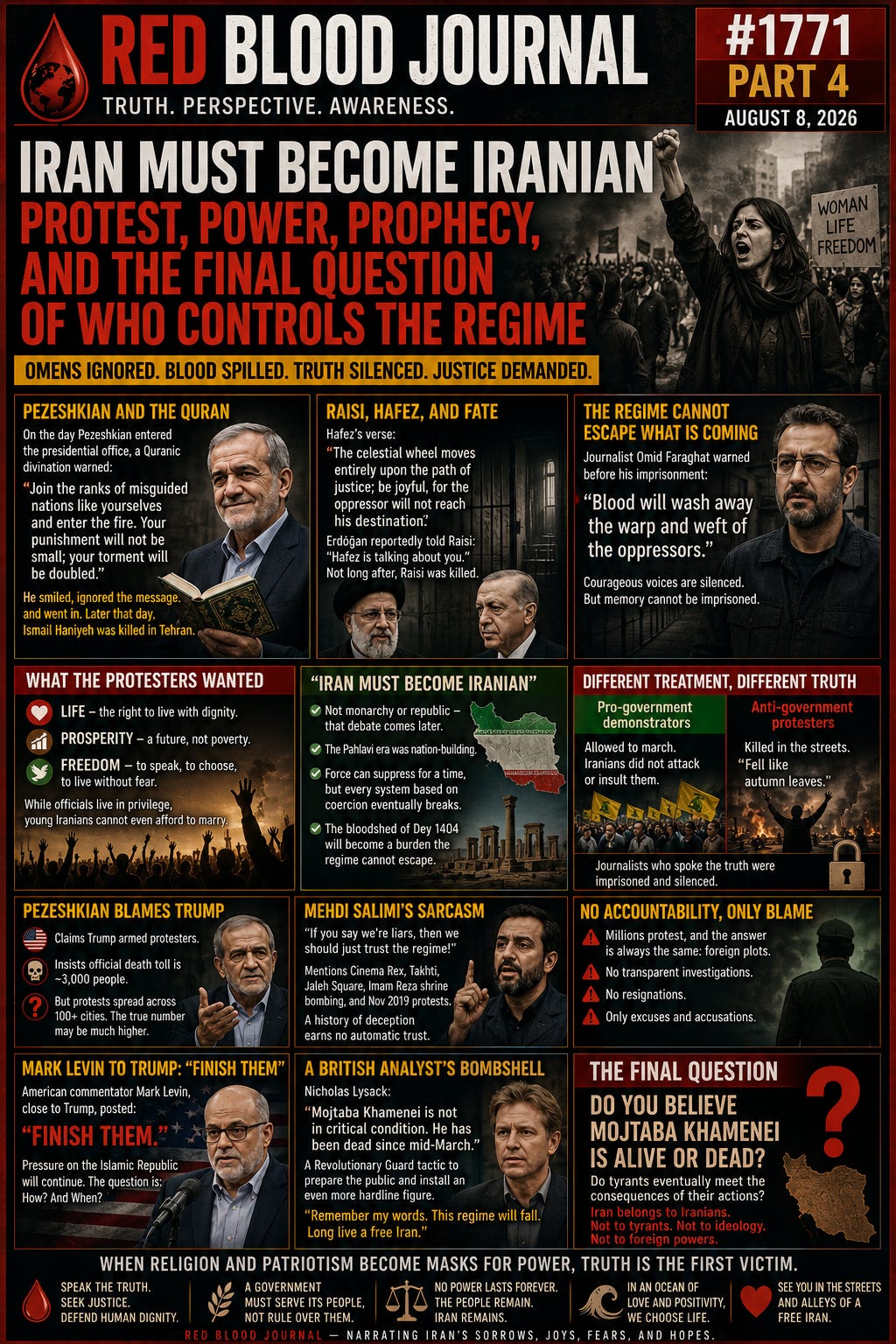
🩸 🇮🇷 #1771 — Iran Must Become Iranian
Protest, Power, Prophecy, and the Final Question of Who Controls the Islamic Republic
August 8, 2026
RedBloodJournal.com
Every political system eventually reaches a moment when its slogans are no longer enough.
Patriotism is tested against reality.
Religion is tested against behavior.
Promises are tested against daily life.
And authority is tested against the willingness of people to continue believing those who exercise it.
Part 4 of this investigation reaches that point.
The previous reports examined:
Mojtaba Khamenei’s mysterious absence.
Rumors concerning whether he is alive, injured, incapacitated, or dead.
Internal struggles involving Pezeshkian, Ghalibaf, Kharrazi, Mohsen Rezaei, and Iran’s security structure.
Oil.
The Strait of Hormuz.
Sanctions.
Corruption.
And financial networks built to keep the Islamic Republic alive.
But the final portion of the source returns to something more fundamental.
The Iranian people themselves.
What do they want?
Whom do they believe?
And at what point does a government’s effort to preserve itself collide with a population simply demanding a normal life?
📖 Pezeshkian and the Quran
The source begins this final section with a symbolic story about Masoud Pezeshkian.
According to the narrator, when Pezeshkian entered the presidential complex at Pasteur, he encountered what was interpreted as an ominous Quranic divination.
The message, as described by the narrator, warned of punishment and misguidance.
Yet Pezeshkian allegedly smiled and continued into the presidential building.
The narrator presents the moment almost like the beginning of a tragedy.
Pezeshkian enters power believing better days may lie ahead.
Then, later that same day:
Ismail Haniyeh is killed in Tehran.
From the narrator’s perspective, that moment marked the beginning of a chain of events that would continue to destabilize both Pezeshkian and the Islamic Republic.
Whether one believes in divination is not the important issue.
The political importance lies in how people interpret events after they happen.
Human beings naturally search for patterns.
Especially during crisis.
📜 Raisi, Hafez, and the Politics of Omen
The narrator then compares Pezeshkian’s experience with an earlier story involving Ebrahim Raisi.
According to the source, Raisi once consulted the poetry of Hafez.
The verse was rendered approximately as:
“The celestial wheel moves entirely upon the path of justice.
Be joyful, for the oppressor will not reach his destination.”
The narrator claims Raisi was reluctant to read part of the verse.
Recep Tayyip Erdoğan is then quoted as telling him:
“Hafez is talking about you.”
Not long afterward, Raisi died.
The narrator turns this into another symbolic connection.
He speculates that Raisi may have been eliminated by Israel or perhaps even by domestic rivals associated with Ghalibaf.
There is no evidence in the source establishing such an internal plot.
It remains speculation.
But the importance of these stories is not necessarily whether prophecy exists.
It is the way unstable societies reinterpret every event as another sign that the system is approaching judgment.
⚖️ When Governments Lose the Benefit of the Doubt
Political stability depends on more than police, armies, and constitutions.
It also depends on something less visible:
Credibility.
When citizens believe government statements most of the time, rumors struggle to survive.
When citizens believe government statements rarely, almost any rumor can become believable.
At that point:
Official denials become suspicious.
Silence becomes evidence.
Contradictions become proof.
Every unexplained death becomes a conspiracy.
Every appointment becomes factional warfare.
Every absence becomes a possible cover-up.
The deeper problem is therefore not merely misinformation.
It is institutional distrust.
🩸 “The Regime Cannot Escape What Is Coming”
The narrator eventually leaves symbolism behind and makes his political judgment directly.
Despite uncertainty surrounding Iran’s competing factions, he argues that those responsible for repression will eventually face consequences.
He introduces journalist Omid Faraghat, described as one of the few journalists willing to speak openly about ordinary Iranian suffering.
According to the source, Faraghat was imprisoned.
Before imprisonment, he reportedly warned:
“Blood will wash away the warp and weft of the oppressors.”
It is deliberately poetic language.
But behind the poetry lies an old political truth.
Governments can suppress demonstrations.
They can imprison journalists.
They can control television.
They can restrict information.
But repression does not necessarily eliminate memory.
Sometimes it strengthens it.
🕊️ What Did the Protesters Actually Want?
This may be the most important question in the entire report.
The source argues that protesters in Dey 1404 were not primarily asking for abstract ideology.
They wanted:
Life.
Prosperity.
Freedom.
A future.
The narrator links this desire to the earlier Woman, Life, Freedom movement.
That distinction matters.
Governments frequently describe protest movements through geopolitical language.
Foreign interference.
Intelligence operations.
Regime change.
Subversion.
National-security threats.
But an individual standing in the street may be thinking about something much simpler.
Rent.
Food.
Marriage.
Employment.
Electricity.
Water.
Dignity.
The ability to plan next year.
The ability to imagine a future for one’s children.
💍 When Young People Cannot Afford Life
The source uses marriage as an example.
Senior political officials may enjoy comfortable lives.
But many young Iranians, according to the narrator, cannot afford even the economic foundation required to marry and establish households.
That matters because marriage is not merely a personal decision.
It reflects:
Housing costs.
Income.
Employment.
Inflation.
Confidence.
Family formation.
And expectations about the future.
A society in which young people repeatedly postpone marriage because basic economic security has disappeared is revealing something deeper than an economic statistic.
It is revealing lost confidence in tomorrow.
🇮🇷 “Iran Must Become Iranian”
Then comes one of the strongest sentences in the entire transcript:
“Iran must become Iranian.”
The narrator argues that the immediate question is not:
Monarchy or republic?
Pahlavi or another political system?
Left or right?
Religious or secular?
Those debates can come later.
The first question, from this perspective, is whether Iran’s institutions exist primarily for Iran and its people.
That phrase can mean many different things politically.
But in the context of the source, it means something relatively straightforward:
Government should serve the country rather than an ideology that extends beyond it.
National wealth should serve Iranians.
Foreign policy should serve Iran’s interests.
Young people should have a future.
Citizens should not live primarily as instruments in someone else’s revolutionary project.
🏗️ The Pahlavi Comparison
The narrator describes the period between the Qajar dynasty and the Islamic Republic—the Pahlavi era—as a period of Iranian nation-building.
That interpretation is politically contested.
Critics of the Pahlavi period would emphasize authoritarian rule, repression, inequality, and SAVAK.
Supporters would emphasize modernization, infrastructure, education, secularization, industrial development, and state-building.
But the narrator is using the comparison for a particular reason.
The argument is not simply that the past was perfect.
It is that a government must ultimately be judged by whether it is building the country.
Roads.
Schools.
Industry.
Water systems.
Institutions.
Living standards.
Future opportunity.
Political slogans cannot replace those things indefinitely.
🩸 Force Has a Limit
The source then makes another fundamental argument:
Force works—until it doesn’t.
A government can use force to clear streets.
It can arrest organizers.
It can intimidate opponents.
It can censor media.
It can temporarily reduce visible dissent.
But none of those actions necessarily solve the reason people protested.
If inflation remains:
The anger remains.
If corruption remains:
The anger remains.
If young people have no future:
The anger remains.
If political legitimacy continues falling:
The anger remains.
Force may interrupt a symptom.
It does not necessarily cure the disease.
🍂 “They Fell Like Autumn Leaves”
The narrator contrasts the treatment of different demonstrations.
He claims that when several hundred pro-government or Hezbollah-aligned demonstrators appeared publicly, ordinary Iranians generally did not attack them.
People may have disagreed with them.
But, according to the source, they were largely allowed to express their views.
The narrator contrasts this with anti-government demonstrations.
He describes protesters as falling:
“Like autumn leaves.”
The language is emotional.
But the underlying question is serious:
Does political tolerance flow both directions?
If supporters of the government can demonstrate safely while opponents risk imprisonment or death, political participation becomes fundamentally unequal.
🗞️ The Journalist’s Role
The source then returns to journalists.
When journalists record suffering, they create memory.
When governments imprison those journalists, they may silence a voice temporarily.
But they also communicate something else:
Certain facts are dangerous to discuss.
That can make those facts even more powerful.
The narrator argues that many courageous Iranian men and women have experienced exactly this.
Their crime, in his telling, was not violence.
It was refusing to remain silent.
🇺🇸 Pezeshkian Blames Trump
The transcript then reaches one of its most controversial sections.
According to the source, Pezeshkian attributed part of the Dey violence to Donald Trump’s support or alleged arming of protesters.
The narrator rejects this explanation.
Pezeshkian is also described as defending an official casualty figure of approximately:
3,000 deaths.
The narrator considers that number implausibly low.
He argues that when unrest occurred across more than one hundred cities, the true total may have been significantly higher.
But here a careful distinction is essential.
The source presents competing numbers.
It does not independently establish the correct number.
Therefore the investigation should not simply replace one unverified number with another.
The proper questions are:
Where are the names?
Where are the death certificates?
Where are the investigations?
Where are the court cases?
Where are the independent records?
Where is the transparent accounting?
🔢 Three Thousand or Thirty Thousand?
Pezeshkian reportedly criticized claims of 30,000 or 40,000 deaths, arguing that exaggerated numbers were used to provoke the public.
That possibility must also be considered.
In highly polarized conflicts, casualty numbers frequently become political weapons.
One side minimizes.
The other maximizes.
Governments have incentives to reduce numbers.
Opposition groups may have incentives to increase them.
Foreign governments may promote figures useful to their narratives.
Social media accelerates the process before facts can be verified.
Therefore:
The answer is not to trust one side automatically.
The answer is documentation.
Names.
Locations.
Dates.
Evidence.
Independent verification.
🧐 Mehdi Salimi’s Sarcasm
Political activist Mehdi Salimi responds with sarcasm.
His message is essentially:
If Pezeshkian believes critics should accept the official account, perhaps Iranians should simply trust the Islamic Republic completely.
Then Salimi begins listing historical controversies.
Cinema Rex.
Gholamreza Takhti.
Jaleh Square.
Palestinian involvement.
The Imam Reza shrine bombing.
The November 2019 protests.
His argument is straightforward:
A government accused repeatedly of deception cannot demand automatic trust simply because today’s statement is official.
Again, each historical claim would require separate investigation.
But Salimi’s larger argument is about credibility.
Trust is cumulative.
So is distrust.
🎭 “We Must Be Very Suspicious People”
Salimi’s sarcasm becomes sharper.
He mocks the idea that millions could oppose a government while mysterious outside forces somehow kill protesters in ways that ultimately benefit the government.
He sarcastically concludes:
“We really are very suspicious people.”
The purpose is rhetorical.
He believes the official explanation asks citizens to accept something inherently implausible.
He also questions whether families of acknowledged victims can genuinely and freely investigate their relatives’ deaths through Iran’s courts.
His larger point is that without transparent justice:
Official numbers remain claims.
⚖️ Responsibility at the Top
Salimi then asks another question.
If a national security structure presides over massive bloodshed, what happens afterward?
Does anyone resign?
Does anyone accept responsibility?
Does anyone face an investigation?
Or does leadership simply blame:
Foreign countries?
Protesters?
Intelligence agencies?
Opposition media?
Outside agitators?
Accountability distinguishes a functioning institution from an institution built solely to preserve itself.
🇺🇸 Mark Levin: “Finish Them”
The source then cites American commentator Mark Levin, described as politically close to Trump.
According to the transcript, Levin posted a message directed toward Trump:
“Finish them.”
The phrase is politically charged and could be interpreted in multiple ways.
The narrator interprets it as further evidence that outside pressure on the Islamic Republic may continue.
But the more important question is what “finish” means.
Military action?
Political collapse?
Economic pressure?
Regime change?
Negotiated transition?
The transcript does not establish the intended mechanism.
Therefore the phrase should not be stretched beyond what is actually stated.
👤 And Then Mojtaba Returns
After protests, corruption, prophecy, political rhetoric, and foreign pressure, the transcript returns exactly where this series began.
Mojtaba Khamenei.
British analyst Nicholas Lysack is quoted making an extraordinary claim:
“Mojtaba Khamenei is not in critical condition. He has been dead since mid-March.”
Lysack further claims that the Revolutionary Guard is preparing the public for the official announcement of a death that allegedly occurred much earlier.
Under his theory, the delay would provide time to install an even more hardline successor.
This is an allegation.
Not established fact.
But it returns us to the central mystery:
Why does uncertainty persist?
🕳️ The Problem With Leadership by Rumor
Imagine a country where citizens cannot confidently answer:
Who is alive?
Who is dead?
Who has authority?
Who gives orders?
Who controls the military?
Who controls national security?
Who controls the money?
Who controls foreign policy?
That uncertainty becomes dangerous in itself.
Not only because outsiders are confused.
Because insiders are also forced to calculate.
Military commanders.
Politicians.
Clerics.
Business networks.
Foreign governments.
Security services.
Everyone begins planning for multiple possibilities.
And once enough people begin preparing for succession:
Succession has already begun.
Even if the leader remains alive.
🩸 The Final Question
The transcript ultimately asks:
Is Mojtaba Khamenei alive or dead?
But perhaps there is now a larger question.
Does it matter?
Of course it matters institutionally.
But politically, the significance may be broader.
If a system becomes so opaque that even the condition of its supreme authority is uncertain, then the crisis is no longer merely about one individual.
It is about the system itself.
A government cannot demand absolute obedience while offering its population almost no transparency about who actually governs them.
🕌 Religion and Political Power
The narrator’s closing message turns away from individual politicians.
He warns about the danger of religion becoming a shield for political interests.
People may call themselves servants of sacred values.
They may speak constantly about God.
They may invoke scripture.
They may wave religious symbols.
But none of those things automatically make political behavior moral.
Sacred language does not sanctify corruption.
A government cannot make injustice holy merely by speaking in God’s name.
Religion may inspire individuals toward morality.
But political institutions must still be judged by what they actually do.
🧠 Patriotism Has the Same Danger
Religion is not the only shield power can use.
Patriotism can be abused in exactly the same way.
Governments can label criticism:
Treason.
Foreign influence.
Anti-national activity.
Subversion.
Disloyalty.
But criticism of government is not automatically criticism of country.
Often it is the opposite.
People may criticize government precisely because they care about their country.
That distinction is essential.
The government is not the nation.
Iran existed before the Islamic Republic.
It can exist after it.
The Iranian people are older than any current political structure.
🇮🇷 Iran Belongs to Iranians
This brings the report back to its central sentence:
Iran must become Iranian.
Not American.
Not Russian.
Not Chinese.
Not Israeli.
Not Saudi.
Not ideological property belonging to one clerical faction.
Not a battlefield for competing foreign powers.
Not an export platform for permanent revolution.
Iranian.
A nation should ultimately exist for its people.
Its oil.
Its minerals.
Its water.
Its land.
Its history.
Its institutions.
Its future.
🩸 The Red Blood Perspective
There is a dangerous temptation during political crisis.
Choose a side.
Then believe everything your side says.
Reject everything the other side says.
That is easy.
Investigation is harder.
Pezeshkian may be misleading people.
His critics may exaggerate.
Foreign governments may manipulate events.
Opposition organizations may publish incorrect casualty figures.
The Islamic Republic may conceal information.
Analysts may mistake speculation for intelligence.
All of these possibilities can exist simultaneously.
That is why the Red Blood approach remains:
Separate evidence from allegation.
Separate people from governments.
Separate patriotism from obedience.
Separate religion from political branding.
Separate hope from wishful thinking.
And keep asking:
Who benefits from this version of the story?
What evidence supports it?
What evidence contradicts it?
What would prove it wrong?
Because truth should not need loyalty.
Truth survives examination.
🌊 Ocean of Love and Positivity Perspective
Political systems divide people into categories.
Regime supporter.
Opposition.
Religious.
Secular.
Monarchist.
Republican.
Left.
Right.
Revolutionary.
Counterrevolutionary.
But these categories disappear when looking inward.
A mother grieving a dead child does not grieve as a political category.
A father who cannot afford food does not suffer as an ideology.
A young couple who cannot afford marriage does not postpone life because of geopolitics.
They simply want to live.
Perhaps that is the deepest meaning hidden inside the phrase:
Woman, Life, Freedom.
Life.
Before ideology.
Human beings before political structures.
Love before hatred.
Understanding before revenge.
Justice without cruelty.
Accountability without becoming what one opposed.
If Iran reaches another political chapter, the greatest challenge will not simply be removing one system.
It will be avoiding the creation of another system that repeats the same mistakes under a different flag.
The true victory would not be one faction defeating another.
It would be a country where nobody needs to fear speaking.
Where government serves citizens.
Where resources serve future generations.
Where religion is personal rather than compulsory.
Where political disagreements do not require blood.
And where an Iranian can simply live as an Iranian.
The original program closes with the hope of someday meeting its unseen audience:
“In the streets and alleys of a free Iran.”
May that freedom, whenever it comes and whatever form it takes, arrive with wisdom rather than vengeance.
With justice rather than hatred.
With dignity rather than humiliation.
And above all:
With life.
In an Ocean of Love and Positivity.
🩸🌊✨ Fantastic!
🇮🇷
Iran Must Become Iranian: The Struggle for Legitimacy
Aug 8, 2026
This report explores the growing divide between the Iranian government and its citizens, emphasizing that institutional legitimacy is collapsing due to systemic distrust. It examines the symbolic omens and internal power struggles surrounding leaders like Pezeshkian and Raisi, while highlighting the mysterious disappearance of Mojtaba Khamenei as a sign of regime instability. The text argues that the public is driven by basic economic and social needs rather than abstract ideologies, moving beyond past movements toward a desire for a “normal life.” Ultimately, the source posits that genuine patriotism means serving the nation’s people rather than a rigid political or religious project. It concludes that while force can suppress dissent, it cannot resolve the underlying grievances of a population demanding a future defined by dignity and transparency.


