


🩸 🛢️ #1770 — The System Built to Survive May Be Destroying It From Within
Mohsen Rezaei, the Strait of Hormuz, Sanctions-Evasion Networks, and Iran’s Economic Achilles’ Heel
August 8, 2026
RedBloodJournal.com
A government under pressure usually looks outward for the source of its problems.
Sanctions.
Foreign enemies.
Military threats.
Economic warfare.
Sabotage.
But sometimes the greatest threat is created inside the system itself.
That is the central question emerging from Part 3 of this investigation.
The Islamic Republic built enormous networks designed to survive international sanctions.
Money needed to move.
Oil needed to be sold.
Currency needed to cross borders.
Front companies were needed.
Trusted intermediaries were needed.
Foreign accounts were needed.
The system adapted.
But according to economist Hossein Raghfar, something happened along the way.
The mechanism designed to keep the Islamic Republic alive became an enormous opportunity for politically connected people to become extraordinarily wealthy.
And now, according to his warning:
The network created to save the system may become the network that destroys it.
At the same time, Iranian officials were publicly discussing another weapon:
Oil itself.
And at the center of that discussion stood one of the world’s most strategically important waterways:
The Strait of Hormuz.
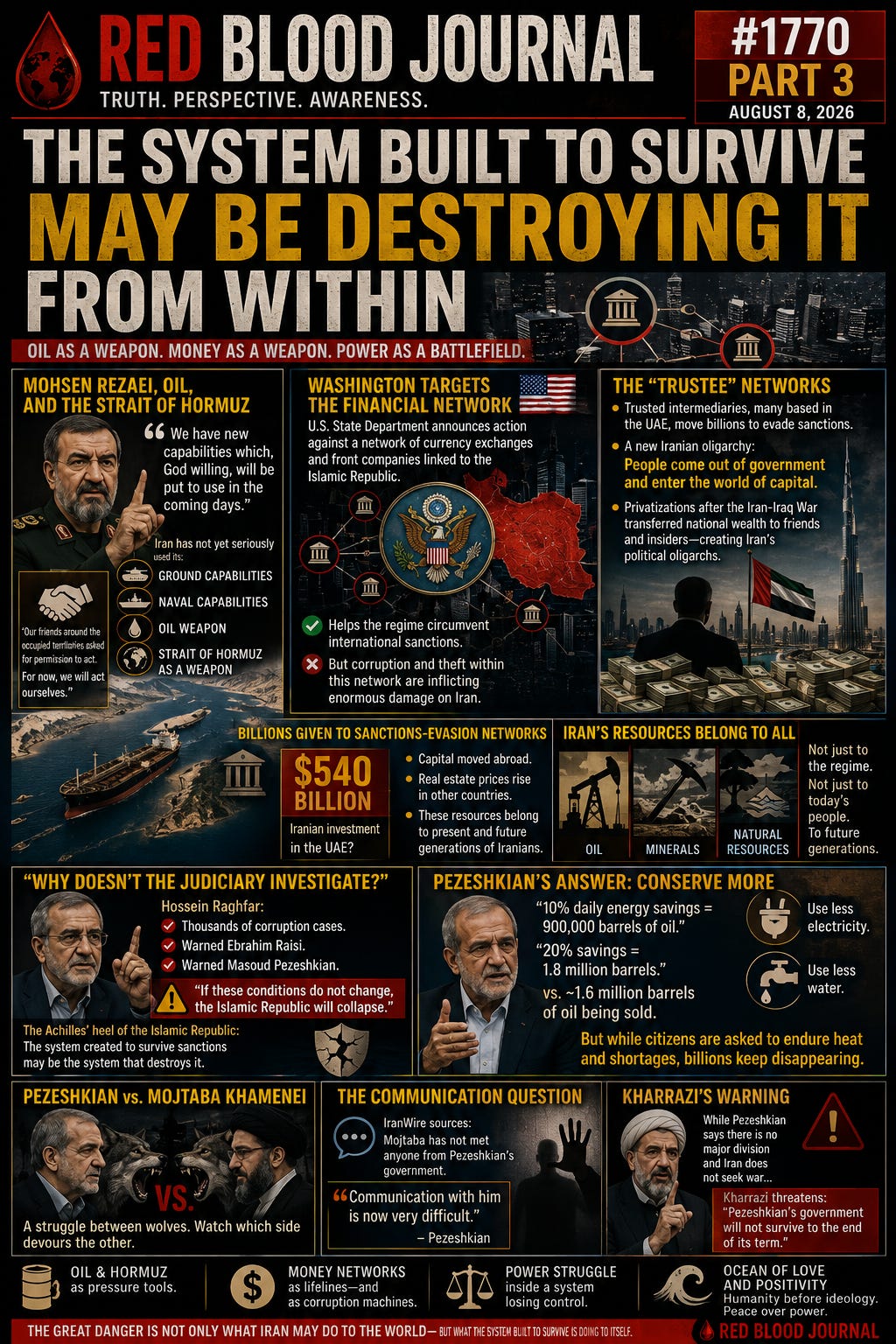
🛢️ Mohsen Rezaei and the Oil Weapon
The investigation begins by returning to statements attributed to Mohsen Rezaei during the Twelve-Day War.
According to the source, Rezaei’s comments suggested that Iran had not yet used all of the tools available to it.
He spoke of:
Iran’s ground capabilities.
Iran’s naval capabilities.
The oil weapon.
And the Strait of Hormuz.
His message was essentially:
Iran still had cards left to play.
Rezaei reportedly said:
“We have new capabilities which, God willing, will be put to use in the coming days.”
He then emphasized that Iran had not seriously used its naval capabilities or what he described as its oil-related leverage.
Most importantly:
Iran had not yet used the Strait of Hormuz as a weapon.
🌊 Why Hormuz Is Different
There are military weapons.
There are economic weapons.
And then there are geographic weapons.
The Strait of Hormuz belongs to the third category.
Iran does not need to own the entire Persian Gulf to influence global calculations.
Its geography gives it enormous strategic importance.
Any serious disruption to shipping through Hormuz can immediately affect expectations surrounding:
Oil.
Natural gas.
Shipping costs.
Insurance.
Asian energy security.
European markets.
American military planning.
And eventually consumers thousands of miles away from the Middle East.
That is why statements about closing or disrupting Hormuz are never merely regional statements.
They are messages to the world economy.
⚔️ Rezaei’s Other Message
Rezaei also reportedly said that allies in countries surrounding what he called the “occupied territories” had asked for permission to act.
According to the source, Iran’s response was:
“For now, we will act ourselves.”
The significance is not necessarily whether every threatened capability could actually be used successfully.
The importance lies in the strategy being communicated.
Ground warfare.
Naval pressure.
Oil.
Hormuz.
Regional allies.
All are presented as pieces on the same board.
That makes the possible attempt to elevate Mohsen Rezaei inside Iran’s national-security structure particularly interesting.
It raises the question:
Was his potential appointment merely bureaucratic—or connected to a much larger confrontation strategy?
💰 Then Washington Attacks the Money
While Iranian figures were talking about oil and Hormuz, the United States was attacking another battlefield:
Finance.
According to the source material, the U.S. State Department announced action against a network of currency exchanges and front companies connected to the Islamic Republic.
The stated purpose, as described in the transcript, was to cut financial channels helping sustain Iran’s governing system.
This is where the confrontation becomes more complicated.
The Islamic Republic needs these networks because sanctions make ordinary international finance difficult.
So alternative systems emerge.
Intermediaries.
Exchange houses.
Front companies.
Unofficial financial channels.
Trusted businessmen.
Foreign entities.
The purpose is survival.
But survival networks create another opportunity:
Secrecy.
And secrecy can become fertile ground for corruption.
🕳️ The Sanctions Paradox
Sanctions are designed to restrict a government.
But restrictions can create black markets.
Black markets require trusted intermediaries.
Trusted intermediaries gain access to enormous flows of money.
And once large amounts of money move through opaque channels, another question arises:
Who is watching the people trusted to move it?
This is the paradox described in the source.
The Islamic Republic allegedly created a system to bypass sanctions.
That system helped keep money moving.
But according to Raghfar, it also created politically connected oligarchs who became wealthy through their access to state resources.
The very secrecy required to avoid international enforcement could also protect internal corruption.
🧑💼 Iran’s “Trustees”
Raghfar discusses individuals the transcript describes as “trustees.”
These are people or entities trusted by the government to move money abroad and conduct transactions that conventional channels cannot easily perform.
Many, according to his description, are based in or connected to the United Arab Emirates.
Billions were supposedly entrusted to these intermediaries.
But Raghfar’s concern is not merely that money moved.
His question is:
Where did all of it go?
He describes figures so large that, in his words, they are astonishing.
According to him, huge quantities of Iranian capital flowed outside the country.
Some of that money, he argues, eventually entered foreign real-estate markets.
Meanwhile ordinary Iranians continued struggling with inflation, housing costs, employment, water shortages, electricity shortages, and declining purchasing power.
🏦 A Different Kind of Oligarchy
Raghfar makes an especially interesting observation about Iran’s oligarchic class.
In many political systems:
Money enters government.
Wealthy people acquire influence.
They finance campaigns.
They build relationships.
They lobby.
They convert wealth into political power.
But Raghfar argues that Iran developed the reverse process.
Government entered money.
People first gained access to political authority.
Then that political access gave them opportunities to acquire enormous capital.
According to his argument, postwar privatization transferred major public assets into the hands of friends, insiders, and politically connected individuals.
The result:
A new class of oligarchs.
Not necessarily businessmen who bought political power.
But political insiders who transformed political power into private wealth.
🇮🇷 Whose Money Was It?
This question deserves more attention than it normally receives.
Oil revenue does not belong to a president.
Mineral wealth does not belong to a political party.
Natural resources do not belong to a security agency.
Those resources belong to a country.
And in a deeper sense, Raghfar argues, they belong not merely to Iranians living today.
They also belong to:
Iranians who have not yet been born.
Oil removed today cannot be removed again tomorrow.
A mineral deposit transferred today cannot be returned to a future generation after it is exhausted.
When national resources disappear into opaque financial networks, therefore, the loss is not merely present-day corruption.
It becomes an extraction of wealth from the future.
💵 The $540 Billion Claim
At one point, Raghfar cites an extraordinary figure:
Approximately $540 billion associated with Iranian investment in the UAE.
This number is presented in the source as his claim.
The transcript itself does not provide documentation sufficient to independently verify the figure.
Therefore it should be treated as an attributed claim rather than established fact.
But even if the exact figure were substantially smaller, the underlying question would remain:
How much Iranian wealth has left Iran through politically protected financial channels?
And perhaps more importantly:
Who benefited?
⚖️ “Why Doesn’t the Judiciary Investigate?”
Raghfar then asks the obvious question.
Where is the judiciary?
If these networks are so corrupt, why have investigators not dismantled them?
He claims that he could identify thousands of cases.
He also says that senior officials were warned.
According to him, he personally spoke about the problem with:
Ebrahim Raisi
and
Masoud Pezeshkian.
His warning could hardly have been stronger:
“If these conditions do not change, the Islamic Republic will collapse.”
And he describes the problem as:
The Achilles’ heel of the Islamic Republic.
🩸 The Greatest Irony
Consider the structure.
Sanctions threaten the Islamic Republic.
The Islamic Republic creates secret financial networks to survive sanctions.
Those networks successfully move money.
People operating the networks acquire extraordinary influence.
Corruption grows.
National resources disappear.
The economy deteriorates.
Public confidence falls.
And the same structure designed to protect the government gradually weakens it.
The system begins consuming itself.
That is the irony at the heart of this report.
The escape route may have become the trap.
🇺🇸 America’s Strategy
This may explain why Washington is increasingly interested in these networks.
Traditional sanctions target governments, banks, industries, ships, oil exports, and individual officials.
But targeting the financial middlemen can be different.
Remove the intermediary and transactions become harder.
Freeze companies.
Target exchange houses.
Expose front companies.
Restrict access to international finance.
Follow the money.
If the Islamic Republic depends on these networks to survive sanctions, destroying them creates pressure far beyond the individuals named in any particular enforcement action.
The objective becomes:
Dry up the financial circulation system.
The narrator goes further and suggests that American pressure could eventually squeeze these networks so severely that both the network and the government depending upon it begin to weaken together.
That remains the narrator’s interpretation.
But strategically, the logic is clear.
🚰 And What Are Ordinary Iranians Told?
This is where the source turns sharply toward Masoud Pezeshkian.
While Raghfar talks about enormous corruption networks and billions leaving the country, Pezeshkian publicly talks about:
Saving electricity.
Saving water.
Using less energy.
Enduring heat.
Reducing consumption.
A journalist complained about heat and lack of water.
Pezeshkian reportedly responded by questioning why someone could not tolerate being without water for a short time.
The conversation even referenced the suffering at Karbala.
The narrator sees a disturbing contrast.
At the top:
Billions allegedly move through opaque networks.
At the bottom:
Citizens are told to tolerate shortages.
⚡ Pezeshkian’s Energy Mathematics
Pezeshkian’s argument, however, deserves to be presented accurately.
He claims that relatively modest reductions in domestic energy consumption could have enormous economic consequences.
According to figures given in the conversation:
10% energy savings = approximately 900,000 barrels of oil per day.
20% energy savings = approximately 1.8 million barrels per day.
He compares this with approximately 1.6 million barrels of oil being sold under the conditions he describes.
His point is straightforward.
Iran heavily subsidizes energy.
Reduce consumption.
Reduce waste.
Free resources.
Redirect that money toward citizens and public needs.
On its own, energy conservation is not an irrational argument.
Every country benefits from efficiency.
But the narrator asks a different question:
Why must conservation begin with ordinary people while corruption at the top remains untouched?
🪭 “We Didn’t Have Fans”
Pezeshkian then reaches into his childhood.
He recalls periods when his family did not even have an electric fan.
Another participant says that while serving in Zabol, he also had no fan.
The intended lesson appears to be:
Previous generations endured hardship.
Today’s population can tolerate some discomfort.
But this argument creates a dangerous political problem.
Citizens do not compare themselves only to their grandparents.
They compare themselves to their rulers.
If the political class appears wealthy while citizens are told to accept deteriorating living standards, historical stories about hardship can sound less like leadership and more like justification.
The question becomes:
Why should technological and economic progress lead backward?
A society should remember hardship.
But it should not be asked to reproduce it unnecessarily.
🐺 Pezeshkian vs. Mojtaba
Then the transcript returns once again to the struggle at the top.
If Mojtaba Khamenei is alive, the narrator argues, the confrontation between his faction and Pezeshkian may be more serious than it appears.
The narrator uses the image of wolves turning against each other.
Crude language.
But revealing imagery.
Two power centers.
Two factions.
Competing networks.
Competing visions.
And an uncertain authority structure.
The fight is no longer merely ideological.
It may determine who controls the institutions necessary to survive the crisis.
👁️ The IranWire Contradiction
Another unanswered question remains.
According to the IranWire sources described in the transcript:
No member of Pezeshkian’s government had met Mojtaba Khamenei.
Yet Pezeshkian has spoken publicly in ways that suggest communication with the new Supreme Leader.
So which account is correct?
Perhaps meetings occurred.
Perhaps communication was indirect.
Perhaps security restrictions explain the difficulty.
Perhaps IranWire’s sources were wrong.
Or perhaps the leadership structure is much stranger than outsiders understand.
The available source does not settle the issue.
But Pezeshkian himself reportedly provided another intriguing sentence.
❓ “Communication With Him Is Very Difficult”
Speaking about the previous Supreme Leader, Pezeshkian described a close relationship.
He said the former leader stood behind his government:
“Like a mountain.”
He could speak openly.
He could discuss problems.
There was access.
Then he described the present situation.
According to the transcript:
“Communication with him is now very difficult.”
That sentence produces several questions.
Why?
Security?
Health?
Isolation?
Factional control?
Incapacity?
Or something else?
No answer has yet been established.
But when access to the supreme authority becomes uncertain, questions about who actually controls the government inevitably follow.
⚠️ Kharrazi Says Something Different
This becomes even more interesting when compared with statements attributed to Kharrazi.
Pezeshkian says:
There is no major division.
Iran does not seek war.
The government continues.
Kharrazi allegedly sends a very different message.
According to the transcript, he threatens that:
Pezeshkian’s government will not reach the end of its term.
One system.
Two messages.
One says stability.
The other says removal.
One says no war.
The other speaks in increasingly confrontational language.
The difference may represent political theater.
Or it may represent a genuine struggle for control.
That is precisely what must be investigated.
🧩 Three Battles, One Crisis
By this point in the investigation, three separate battles have emerged.
The External Military Battle
Oil.
Hormuz.
Naval power.
Regional allies.
The External Economic Battle
American sanctions.
Front companies.
Exchange houses.
Financial intermediaries.
The Internal Political Battle
Pezeshkian.
Mojtaba Khamenei.
Kharrazi.
Mohsen Rezaei.
Ghalibaf.
Security institutions.
These may appear to be separate stories.
They are not necessarily separate.
Control the political system and you influence Hormuz.
Control the security institutions and you influence the sanctions networks.
Control financial networks and you acquire political power.
Control the succession and you determine who controls everything else.
That is why the question at the center of this series keeps returning:
Who is actually in charge?
🩸 The Red Blood Perspective
Foreign sanctions alone rarely explain the collapse of a government.
Military pressure alone rarely explains it.
Corruption alone rarely explains it.
Public anger alone rarely explains it.
Governments usually enter genuine danger when several weaknesses begin reinforcing each other.
Economic decline increases public dissatisfaction.
Corruption destroys legitimacy.
Sanctions reduce available resources.
Internal factions fight over what remains.
Leadership uncertainty weakens decision-making.
Foreign adversaries recognize the weakness and increase pressure.
The cycle accelerates.
The Islamic Republic created mechanisms to survive.
But survival mechanisms can develop interests of their own.
A sanctions-busting network eventually employs people.
Creates fortunes.
Builds loyalties.
Controls information.
Pays political allies.
Protects itself.
At that point it stops being merely a financial tool.
It becomes a center of power.
And centers of power do not voluntarily disappear.
This may be the deepest warning contained in Raghfar’s argument.
The greatest danger to the Islamic Republic may not be simply that America cuts off its money.
It may be that the people controlling the hidden money have become too powerful for the Islamic Republic itself to control.
The system created the network.
Then the network created its own system.
🌊 Ocean of Love and Positivity Perspective
There is an uncomfortable simplicity beneath billions of dollars, sanctions, oil routes, military planning, and political conflict.
Every dollar that disappears from a nation’s resources represents something that was not built.
A hospital.
A school.
A water system.
A road.
A home.
A future.
Every barrel of oil is ultimately only matter pulled from the earth.
Money is only an agreement between people.
Political office is temporary.
Power disappears.
Titles disappear.
Governments disappear.
But the consequences of what people do with those temporary possessions can remain for generations.
There is nothing noble about asking ordinary people to suffer unnecessarily.
There is also nothing wrong with conservation when conservation serves everyone.
The difference is fairness.
Sacrifice becomes meaningful when those asking for sacrifice participate in it.
Leadership becomes credible when the person at the top carries more responsibility rather than simply demanding more endurance from those below.
And perhaps that is the lesson far beyond Iran.
The health of a society cannot be measured only by how much wealth it produces.
It must also be measured by whether that wealth serves life.
The purpose of oil should not be power.
The purpose of money should not be domination.
The purpose of government should not be survival for its own sake.
All of these are tools.
And tools should ultimately serve human beings.
In an Ocean of Love and Positivity.
🩸🌊✨ Fantastic!
⚖️
The Iranian Paradox: Sanctions, Oligarchs, and the Strait of Hormuz
Aug 8, 2026
The provided text explores the internal and external pressures threatening the stability of the Islamic Republic of Iran. It details how sanctions-evasion networks, originally designed for state survival, have evolved into corrupt systems of oligarchy that drain national wealth into private hands. While officials like Mohsen Rezaei threaten to use the Strait of Hormuz and the “oil weapon” against foreign adversaries, the domestic economy suffers from deteriorating infrastructure and resource shortages. A stark contrast is drawn between the billions of dollars allegedly flowing through opaque financial channels and the government’s demand that ordinary citizens endure economic hardship. Ultimately, the source suggests that the very mechanisms created to bypass international pressure may now constitute an Achilles’ heel that destroys the system from within. This multifaceted crisis is further complicated by a fractured leadership structure and a opaque struggle for political succession.


