


🩸 ⚠️ #1769 — From Kashmir to Tibet: What Is Kharrazi Signaling?
Mojtaba Khamenei, Iran’s Internal Power Struggle, and the Fear of a Wider Regional Conflict
August 8, 2026
RedBloodJournal.com
Sometimes the most revealing political statements are not official government announcements.
They come from people operating near power.
People who may know something.
People who may believe they know something.
Or people who simply want everyone else to believe that they speak for those who control the system.
That is what makes the extraordinary rhetoric attributed to cleric Kharrazi worth examining.
In Report #1768, the investigation focused on the unanswered questions surrounding Mojtaba Khamenei:
Is he alive?
Is he critically wounded?
Is he already dead?
And if his condition is being concealed, who benefits from the silence?
Part 2 opens a different door.
The question is no longer simply what happened to Mojtaba Khamenei.
The question becomes:
What is happening around him?
Because while rumors circulate about Mojtaba’s condition, rhetoric attributed to Kharrazi reaches far beyond Iran—to Saudi Arabia, Pakistan, India, Kashmir, China, and Tibet.
If the rhetoric means nothing, it may be the performance of an ideological provocateur.
If it means something, the implications are considerably more serious.
🕋 The Mecca Pact and Tehran’s Reaction
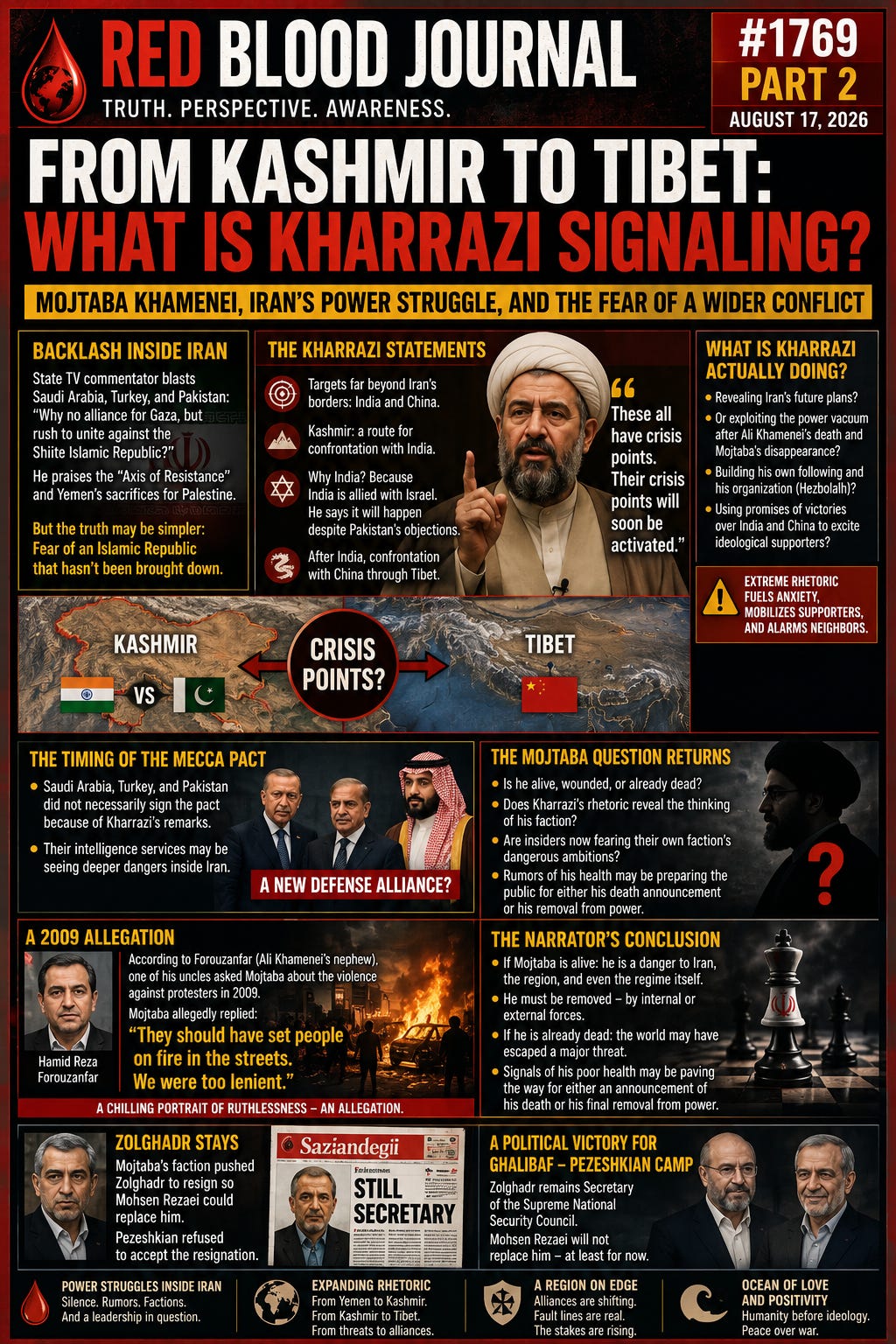
The reported defense arrangement involving Saudi Arabia, Turkey, and Pakistan immediately attracted attention inside the Islamic Republic.
According to the source material, an Indian-born commentator appearing on Iranian state television reacted angrily.
His complaint was revealing.
Why, he essentially asked, had these Sunni Muslim countries failed to create such an alliance to defend Sunni Palestinians in Gaza, yet now appeared willing to organize themselves rapidly when confronted with regional rivalry involving the Shiite Islamic Republic?
The commentator contrasted this with the so-called Axis of Resistance.
From his perspective, Iran and its aligned movements had directed their struggle toward Israel and the United States rather than toward fellow Muslim governments.
Yemen, he argued, had also paid an enormous price for Palestine.
But there is another interpretation.
Perhaps Saudi Arabia, Turkey, and Pakistan are not organizing themselves because of Sunni-Shiite rivalry.
Perhaps they are responding to something much simpler:
Fear.
Fear of instability.
Fear of an unpredictable Iran.
Fear of regional escalation.
And perhaps fear that the Islamic Republic’s internal crisis could eventually become everyone else’s crisis.
⚠️ Enter Kharrazi
This is where the rhetoric attributed to cleric Kharrazi becomes important.
According to the transcript, Kharrazi presents himself as someone operating in connection with Mojtaba Khamenei.
But his rhetoric does not stop at Iran’s borders.
It reaches toward:
🇸🇦 Saudi Arabia
🇵🇰 Pakistan
🇮🇳 India
🇨🇳 China
and some of the most dangerous territorial fault lines in Asia.
The source portrays him speaking about future confrontation involving Kashmir and eventually Tibet.
If accurately represented, these are extraordinary statements.
They would go considerably beyond ordinary Iranian rhetoric about Israel, the United States, or the Persian Gulf.
They would introduce the possibility of confrontation with two enormous Asian powers:
India and China.
🇮🇳 Why Kashmir?
Kashmir has been one of the world’s most dangerous territorial disputes since the partition of British India in 1947.
India and Pakistan both claim the territory.
Both administer portions of it.
China controls another portion.
And both India and Pakistan possess nuclear weapons.
This means Kashmir is not merely disputed territory.
It sits at the intersection of three nuclear powers.
According to the transcript, Kharrazi’s rhetoric presents Kashmir as a potential route for confrontation with India.
Why?
The answer attributed to this worldview is India’s relationship with Israel.
The source portrays Kharrazi and those around him as seeing the India-Israel relationship through an ideological lens in which future confrontation with India becomes part of a larger struggle.
The rhetoric is particularly provocative because Pakistan cannot treat Kashmir as somebody else’s battlefield.
For Pakistan, Kashmir is directly connected to national security.
Therefore, any outside movement discussing Kashmir as a platform for its own ideological war would have obvious reasons to alarm Islamabad.
☢️ Pakistan’s Impossible Position
Consider Pakistan’s position.
Pakistan has spent decades managing its confrontation with India.
It knows how dangerous escalation can become.
It possesses nuclear weapons precisely because the strategic balance with India is existential.
Now imagine an ideological movement from another country declaring that Kashmir could become a launching point for a completely different confrontation.
Pakistan would immediately face an uncomfortable question:
Who controls escalation?
Islamabad?
Tehran?
Religious movements?
Proxy organizations?
Independent militants?
This may help explain why the source interprets Pakistan’s relationship with Saudi Arabia and Turkey as more than a symbolic alliance.
If instability spreads outward from Iran, Pakistan has powerful reasons to ensure that someone else does not decide when and where its confrontation with India begins.
🇨🇳 Then Comes Tibet
The rhetoric becomes even more extraordinary when China enters the discussion.
According to the transcript, Tibet is described in similar language—as another potential “crisis point.”
The key statement attributed to Kharrazi is:
“These all have crisis points. Their crisis points will soon be activated.”
That sentence deserves attention.
Not because it proves that any plan exists.
It does not.
But because of the worldview it represents.
Kashmir is viewed not simply as disputed territory.
Tibet is viewed not simply as contested history.
They become pressure points.
Places where instability could theoretically be activated.
If this accurately reflects the thinking of anyone with meaningful influence inside Iran’s power structure, neighboring governments would have reasons to pay attention.
🧨 Activating the World’s Fault Lines
Every major geopolitical system contains fault lines.
Taiwan.
Kashmir.
Tibet.
The Korean Peninsula.
The Persian Gulf.
The Caucasus.
The Balkans.
The South China Sea.
The danger begins when governments or ideological movements stop viewing these places as problems to contain and begin viewing them as tools to activate.
That is the distinction that makes the rhetoric in this transcript important.
The question is not whether Iran possesses the capability to ignite conflicts across Asia.
The source does not establish that.
The more interesting question is whether certain ideological figures believe instability itself can be weaponized.
Because belief influences behavior.
👁️ What Is Kharrazi Actually Doing?
There are at least two possibilities within the source’s own framework.
Possibility One: He Knows Something
Kharrazi could be revealing ideas being discussed somewhere inside the Iranian power structure.
Perhaps he is saying publicly what others discuss privately.
If so, his statements deserve serious scrutiny.
But there is another possibility.
Possibility Two: He Is Building His Own Power
What if Kharrazi is exploiting the vacuum created by the death of Ali Khamenei and the mysterious absence of Mojtaba?
Political vacuums create opportunities.
If the central authority is weakened, ambitious ideological figures can attempt to create their own following.
Grand promises are useful tools.
Conquering enemies.
Defeating India.
Confronting China.
Destroying Israel.
Defeating America.
These are enormous promises.
But enormous promises can attract people searching for certainty during political chaos.
Under this interpretation, Kharrazi may not be revealing government strategy.
He may be marketing himself.
🧠 The Psychology of Revolutionary Rhetoric
This is where the story becomes larger than one cleric.
Radical political movements frequently depend upon an endless enemy.
Victory can never completely arrive because the movement requires another struggle.
One enemy disappears.
Another appears.
One battlefield closes.
Another opens.
The enemy can be Israel today.
America tomorrow.
India afterward.
China next.
The ideological machine survives because the struggle never ends.
This is why extreme rhetoric should be studied even when it does not become official policy.
Words create expectations.
Expectations create followers.
Followers create pressure.
And eventually pressure can create policy.
🕋 Why the Timing of the Mecca Pact Matters
The transcript makes an important distinction.
It does not establish that Saudi Arabia, Turkey, and Pakistan formed their reported arrangement because Kharrazi made provocative statements.
That would be an unsupported leap.
Instead, the narrator proposes something more plausible within the source’s theory:
Perhaps those governments’ intelligence services are seeing broader instability developing inside Iran.
Kharrazi’s rhetoric may therefore be only one visible symptom of a larger problem.
Governments possess information ordinary citizens do not.
Diplomatic reporting.
Military intelligence.
Intercepted communications.
Human sources.
Satellite surveillance.
Internal assessments.
Therefore, when governments suddenly adjust their alliances, investigators should ask:
What changed in their threat assessment?
🩸 Back to Mojtaba Khamenei
And once again, every road in this investigation seems to lead back to Mojtaba Khamenei.
If he is healthy and governing normally, why does uncertainty surrounding his condition continue?
If he is injured, who is exercising authority?
If he is incapacitated, which faction is gaining power?
If he is dead, why has the announcement allegedly been delayed?
And if Kharrazi truly speaks for Mojtaba’s faction, does his rhetoric represent that faction’s thinking?
Or is Kharrazi exploiting Mojtaba’s absence precisely because nobody can easily contradict him?
These questions matter because uncertainty at the top of a centralized political system can rapidly spread downward.
When nobody knows exactly where authority resides, everyone begins preparing for what comes next.
🔥 The 2009 Allegation
The transcript then introduces one of its darkest allegations.
Hamid Reza Forouzanfar, identified in the source as Ali Khamenei’s nephew, is said to have described a conversation concerning Mojtaba Khamenei after the 2009 Iranian protests.
According to the account, one of his uncles questioned Mojtaba about the violence used against demonstrators.
Mojtaba allegedly responded that authorities had been too restrained.
The most disturbing allegation is that he supposedly said protesters should have been set on fire in the streets.
This is an extremely serious allegation.
The transcript does not independently establish that the conversation occurred, and therefore it should not be presented as proven fact.
But its inclusion explains why the narrator views Mojtaba Khamenei in such dark terms.
The narrator sees a connection between alleged internal brutality and the expansionist rhetoric now attributed to people supposedly operating around Mojtaba.
⚔️ When the Regime Fears Its Own Faction
This produces one of the most interesting theories in the entire source.
Perhaps factions inside the Islamic Republic were willing to tolerate brutality when that brutality was directed against Iranian protesters.
But what happens when the same faction becomes dangerous to the regime itself?
Political systems frequently tolerate extremists while those extremists remain useful.
The relationship changes when the extremist threatens the survival of the system.
Under the narrator’s theory, Mojtaba’s faction may have crossed—or may be approaching—that line.
The narrator speculates that insiders could therefore decide that Mojtaba must be politically removed.
Again:
This is a theory contained in the source, not an established conclusion.
But it provides a framework for understanding why rumors concerning his death, health, or disappearance have become politically explosive.
♟️ Then Comes Zolghadr
The final clue in this portion of the transcript concerns Mohammad Bagher Zolghadr.
According to the source, Mojtaba’s faction wanted Zolghadr removed from his position so Mohsen Rezaei could replace him.
Zolghadr reportedly submitted his resignation.
But Pezeshkian allegedly refused to accept it.
The newspaper Sazandegi then reportedly published Zolghadr’s photograph with a headline that essentially said:
“Still Secretary.”
If the account is correct, the significance goes beyond one government position.
It would mean an attempted personnel change had failed.
And personnel decisions inside a power struggle are rarely just personnel decisions.
They reveal who can appoint.
Who can remove.
Who can resist.
And ultimately:
Who actually holds power.
⚖️ Ghalibaf–Pezeshkian vs. the Mojtaba Camp?
The narrator interprets the Zolghadr episode as a temporary victory for the Ghalibaf-Pezeshkian faction.
If that interpretation is correct, the internal battlefield becomes easier to visualize.
On one side:
Political figures attempting to preserve or consolidate control of the existing state machinery.
On the other:
A faction associated—accurately or inaccurately—with Mojtaba Khamenei and more radical ideological figures.
Between them:
Military institutions.
Security agencies.
Economic networks.
Religious establishments.
And potentially competing claims to legitimacy.
This is exactly the type of environment where rumors become strategic weapons.
🛢️ Why Mohsen Rezaei Matters
The proposed replacement of Zolghadr with Mohsen Rezaei is particularly interesting because the next part of the source connects Rezaei with another major issue:
Oil.
And more specifically:
The Strait of Hormuz.
That takes the investigation away from internal appointments and directly into the economic bloodstream of the world.
Because whoever controls Iranian strategy surrounding Hormuz does not merely influence Tehran.
They influence:
Oil markets.
Shipping.
Insurance.
Gulf security.
American military calculations.
Asian energy supplies.
And potentially the global economy.
That is where the next part of this investigation begins.
🩸 The Red Blood Perspective
The easiest mistake when examining political chaos is to choose one explanation too early.
Kharrazi could be revealing something.
He could be exaggerating.
He could be recruiting.
He could be speaking for a faction.
He could be speaking primarily for himself.
Mojtaba Khamenei could be governing.
He could be injured.
He could be incapacitated.
He could be dead.
The available source does not settle those questions.
Therefore, neither should we.
But something else is visible.
Uncertainty itself has become part of Iranian politics.
And uncertainty can be weaponized.
If neighboring governments cannot confidently predict who controls Tehran tomorrow, they must prepare today.
That may be one reason alliances are shifting.
That may be one reason Saudi Arabia, Turkey, and Pakistan are looking toward one another.
And that may be why statements about Kashmir, India, China, and Tibet deserve attention even if they never become government policy.
The investigation should therefore continue asking:
Who speaks for whom?
Who actually controls the institutions?
Which statements are ideology, and which are strategy?
Which alliances are temporary, and which represent structural change?
And above all:
Who benefits from the uncertainty?
🌊 Ocean of Love and Positivity Perspective
There is another way to look at the map.
Politicians see borders.
Generals see strategic corridors.
Intelligence agencies see vulnerabilities.
Ideologues see enemies.
But ordinary people see homes.
A family in Kashmir does not wake each morning hoping to become somebody else’s geopolitical pressure point.
A family in Tibet does not exist as a square on a strategist’s chessboard.
An Iranian family does not become less human because Tehran’s rulers fight for power.
An Indian child is not responsible for relations between India and Israel.
A Pakistani worker is not responsible for decisions made by generals.
A Saudi family is not a military alliance.
A Turkish citizen is not NATO.
The greatest danger begins when human beings disappear from the map and only strategy remains.
Perhaps the wiser civilization will someday learn to look at these so-called “crisis points” differently.
Not as places waiting to be activated.
But as places where millions of human beings are waiting to live.
The goal should not be learning how to activate the world’s wounds.
The goal should be learning how to heal them.
In an Ocean of Love and Positivity.
🩸🌊✨ Fantastic!
🌎
Tehran’s Power Struggle and the Activation of Regional Fault Lines
Aug 8, 2026
This text examines a volatile internal power struggle in Iran following the death of Ali Khamenei and the mysterious absence of his son, Mojtaba. It highlights the provocative rhetoric of an ideological figure named Kharrazi, who suggests weaponizing global flashpoints like Kashmir and Tibet to challenge powers such as India and China. These radical statements, combined with Iran’s domestic instability, have reportedly driven neighbors like Saudi Arabia, Turkey, and Pakistan to form new defensive alliances. The source analyzes whether this extreme discourse represents actual state strategy or is merely a self-serving marketing tactic used by factions during a leadership vacuum. Ultimately, the narrative warns that when political authority becomes uncertain, geopolitical fault lines are often exploited as tools of war. This instability threatens to transform human populations into mere strategic chess pieces in a dangerous regional game.


