


🩸 🌐 #1768 — Mojtaba Khamenei: Critical, Wounded, or Already Dead?
Power Struggles Inside Iran, the Strait of Hormuz, and a Changing Regional Security Order
August 8, 2026
RedBloodJournal.com
Something unusual happens when a government built around centralized authority suddenly becomes unclear about who is actually exercising that authority.
Silence becomes information.
Absence becomes evidence to be examined.
Rumors become political weapons.
And every unexplained movement inside the government begins to acquire greater significance.
That is the atmosphere surrounding the latest claims about Mojtaba Khamenei.
The central question is simple:
Where is he, what is his condition, and who benefits from keeping the answer uncertain?
This report does not claim to know whether Mojtaba Khamenei is alive, critically wounded, dying, or already dead.
The available material does not establish any of those possibilities conclusively.
What it does reveal is something potentially just as important:
Different factions and observers are interpreting the same silence in radically different ways.
And that uncertainty is unfolding while Iran faces internal political competition, confrontation in the Persian Gulf, negotiations surrounding the Strait of Hormuz, and what the source describes as a potentially significant reorganization of regional security.
🔴 The Rumor That Started Spreading
According to the source material behind this report, news circulated on Thursday concerning the possible removal of Mohammad Bagher Zolghadr and his replacement by Mohsen Rezaei within Iran’s Supreme National Security Council.
Then came another story.
This one was considerably more explosive.
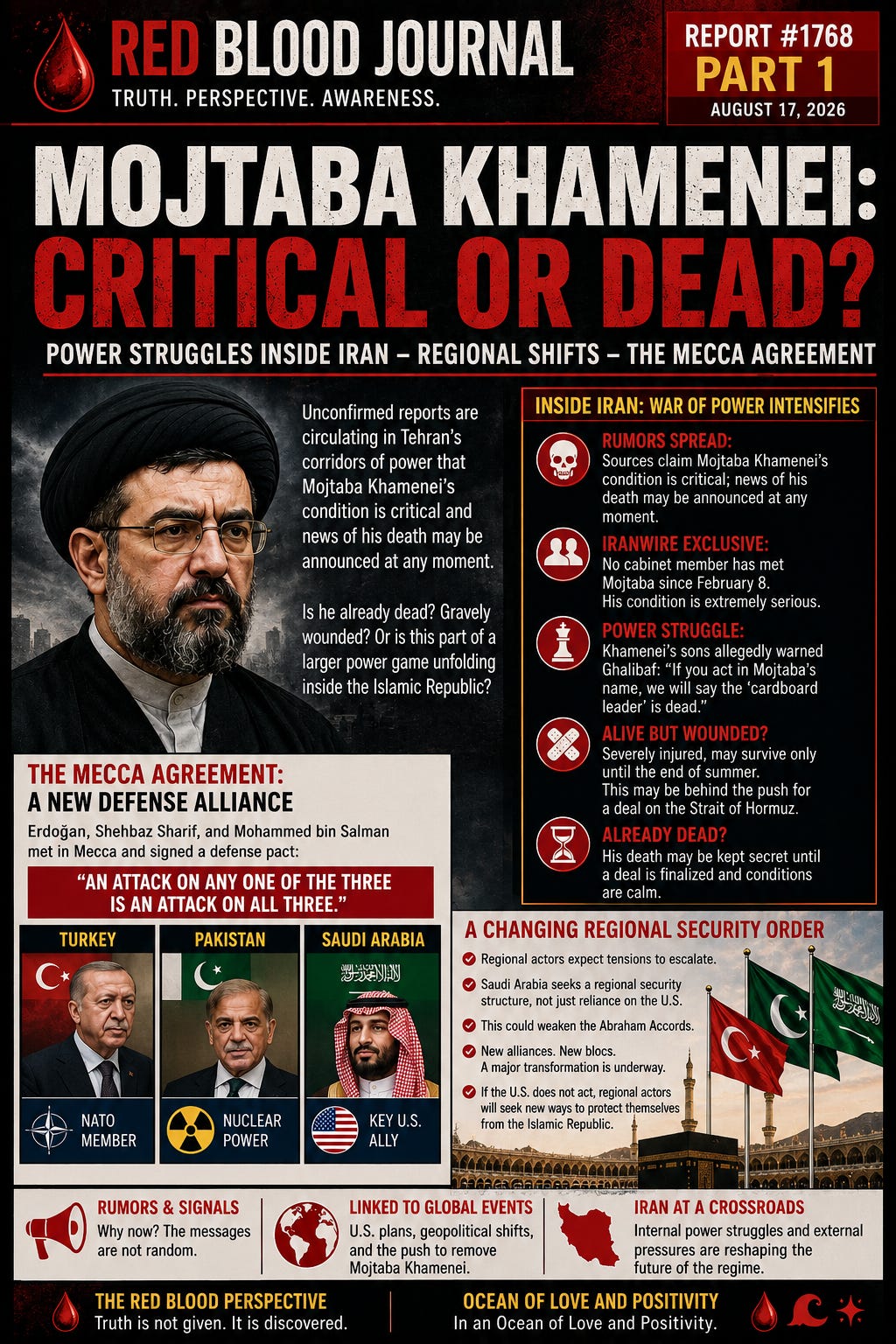
An unconfirmed report began circulating that Mojtaba Khamenei was in critical condition and that an announcement of his death could come at any moment.
Persian-language social-media channels began attributing the story to Israeli media.
But according to the source material, the report originated with IranWire, after which Israeli and Persian-language outlets amplified it.
The IranWire report was described under the headline:
“Exclusive: Iranian Leaders Concerned as Mojtaba Khamenei’s Health Deteriorates.”
According to the account, two sources close to the Pezeshkian government claimed that Mojtaba Khamenei had not met with members of the cabinet since the February 8 American attack on the Supreme Leader’s compound, in which his father and other family members were reportedly killed.
If accurate, that would raise another question:
What happened to reports that Pezeshkian had met with him?
The sources reportedly claimed that rumors of Mojtaba’s deteriorating physical condition were circulating even within the highest levels of the government.
None of this, however, establishes that he is dead.
It establishes that questions about his condition have become politically significant.
And that distinction matters.
♟️ The Power Struggle Behind the Rumor
The story becomes more consequential when placed against the alleged struggle taking place inside the Islamic Republic.
Mojtaba Khamenei’s prolonged absence has created an information vacuum.
And political vacuums rarely remain empty.
Israeli media, Persian-language outlets, Western observers, and analysts began repeating or commenting on the IranWire report.
American analyst Jason Brodsky, according to the source material, reposted it, as did Open Source Intel.
But Iranian observers began asking a different question.
What if this is not merely a story about someone’s health?
What if it is connected to a battle over who controls Iran after Ali Khamenei?
Some observers cited in the source believe that a political project to remove Mojtaba Khamenei may already be underway.
That theory leads to several competing scenarios.
🩸 Scenario One — He Is Already Dead
The most dramatic theory is also the most difficult to prove:
Mojtaba Khamenei may already be dead.
Under this interpretation, factions inside the government would have an obvious reason to delay an announcement.
Timing.
Announcing the death of a leader during military confrontation, political instability, economic pressure, and an unresolved succession struggle could create precisely the type of vacuum the government would want to avoid.
The theory therefore suggests that Mojtaba’s political image could temporarily be more valuable than the truth about his physical condition.
If different factions can continue acting under his supposed authority, his absence could paradoxically preserve stability—at least temporarily.
But that arrangement would also create enormous danger.
Because sooner or later someone would have to answer:
Who is actually giving the orders?
🩹 Scenario Two — Alive, but Gravely Wounded
The second theory is less absolute.
Mojtaba may still be alive but severely injured.
According to rumors described in the source, his doctors may have little hope of recovery and his remaining life could be measured in weeks or months.
Again, this remains speculation.
But if true, the political consequences would resemble those of the first scenario.
The government would know that a succession crisis is approaching.
That possibility becomes especially interesting when examined alongside discussions involving the Strait of Hormuz.
The source describes speculation that Iran may be moving toward an agreement involving Oman and the complete reopening of the Strait.
If Mojtaba were indeed gravely wounded, proponents of this theory argue that factions inside Iran might want to stabilize the external battlefield before confronting an internal succession battle.
The logic would be straightforward:
End one crisis before the next one begins.
A leadership death while Iran remained engaged militarily with the United States in the Persian Gulf could produce simultaneous external and internal crises.
That would be one of the most dangerous combinations imaginable for any government.
⚰️ Scenario Three — The Death Announcement Is Being Saved
The third possibility combines elements of the first two.
Perhaps the death has already occurred.
Perhaps political actors are simply waiting for the correct moment to announce it.
Under this theory, the announcement would come only after military conditions stabilized, negotiations concluded, and the immediate danger of uncontrolled political competition diminished.
That would make the timing of the announcement itself part of the political strategy.
The question would no longer be:
When did Mojtaba Khamenei die?
It would become:
When did those in power decide the public was allowed to know?
That distinction is central to understanding authoritarian information systems.
Control of information can become another instrument of government.
👁️ The Kharrazi Factor
The source also places considerable importance on the emergence of cleric Kharrazi and his increasingly provocative rhetoric.
One interpretation presented in the material is that Kharrazi has become part of an internal struggle involving Ghalibaf, Pezeshkian, and members of the Khamenei family.
The allegation goes even further.
According to one theory, Ali Khamenei’s sons could threaten to expose Mojtaba’s death if political rivals attempted to govern falsely in his name.
Whether that allegation is true cannot be established from the material.
But the existence of such a theory demonstrates how badly the information environment has deteriorated.
When citizens cannot independently establish whether the country’s supreme political figure is healthy, injured, incapacitated, or dead, almost every political action becomes open to reinterpretation.
That is not merely a communications problem.
It is a legitimacy problem.
🌊 Why the Strait of Hormuz Matters
The Strait of Hormuz is not simply another waterway.
It is one of the world’s most strategically important energy corridors.
That makes any attempt to connect Iranian succession politics with negotiations over Hormuz worthy of attention—but not automatic acceptance.
The source’s theory is that factions inside Iran could prefer to resolve or reduce the confrontation surrounding the Strait before allowing a leadership crisis to become public.
If so, the sequence would matter:
First stabilize the external conflict.
Then manage the internal transition.
And only afterward:
Reveal the true condition of the leadership.
It is an intriguing hypothesis.
But at this stage, it remains a hypothesis.
🕋 The Reported “Mecca Agreement”
The source then moves beyond Iran and describes what it calls the Mecca Agreement.
According to the transcript, three major regional leaders met in Mecca:
Recep Tayyip Erdoğan of Turkey
Shehbaz Sharif of Pakistan
Mohammed bin Salman of Saudi Arabia
The transcript describes the result as a new defense arrangement under which:
An attack against one would effectively be considered an attack against all three.
If the arrangement exists exactly as described, its strategic significance would be considerable.
Consider the three participants.
🇹🇷 Turkey is a member of NATO.
🇵🇰 Pakistan possesses nuclear weapons.
🇸🇦 Saudi Arabia remains one of Washington’s most important security partners in the Persian Gulf.
Together, they would represent a formidable combination of military capability, geography, economic power, and political influence.
🌍 A New Security Architecture?
This leads to the larger question raised by the source.
Is the Middle East beginning to construct a new security architecture?
For decades, regional security has depended heavily upon relationships with outside great powers—especially the United States.
But countries do not remain passive when they believe the existing security system may no longer guarantee their protection.
They diversify.
They negotiate.
They create new relationships.
They build backup plans.
From this perspective, Saudi cooperation with Turkey and Pakistan could represent something larger than a temporary arrangement.
It could represent strategic insurance.
Pakistan brings nuclear deterrence.
Turkey brings NATO membership, a substantial military, and geographic influence.
Saudi Arabia brings enormous financial resources, energy importance, and strategic position.
The combination deserves attention.
🇸🇦 Saudi Arabia Chooses Another Road
The source makes another interesting comparison.
The United Arab Emirates invested heavily in its relationship with Israel through the Abraham Accords.
Saudi Arabia has followed a more cautious path.
Instead of placing its security future entirely within an American-Israeli regional structure, Riyadh may be exploring deeper relationships with two major Muslim powers:
Turkey and Pakistan.
That does not necessarily mean abandoning Washington.
Nor does it automatically mean abandoning eventual normalization with Israel.
International relationships are rarely that binary.
Saudi Arabia can cooperate with Washington while simultaneously strengthening ties with Ankara and Islamabad.
The important development would be diversification itself.
Saudi Arabia may be building more than one security option.
❓ Did Washington Know?
That produces perhaps the most interesting question in this portion of the investigation:
Did the United States encourage, tolerate, or simply observe these developments?
The source asks whether Saudi Arabia, Turkey, and Pakistan may have received some kind of message from Washington.
There is not enough evidence in the provided material to answer that.
But the question is legitimate.
Major security arrangements involving a NATO member, a nuclear-armed state, and one of America’s most important Middle Eastern partners would inevitably attract Washington’s attention.
Whether the United States helped design such an arrangement is a different question entirely.
Evidence would be required.
🧩 Put the Pieces Together
Viewed separately, these developments can appear unrelated.
Mojtaba Khamenei disappears from public view.
Rumors spread concerning his health.
Iranian factions maneuver internally.
Questions emerge surrounding Ghalibaf, Pezeshkian, Kharrazi, and the Khamenei family.
Negotiations concerning the Strait of Hormuz attract attention.
Saudi Arabia strengthens relationships with Turkey and Pakistan.
Regional security structures begin shifting.
But investigation requires resisting two opposite mistakes.
The first mistake is assuming that everything is connected.
The second is assuming that nothing is connected.
Reality usually exists somewhere between them.
Governments respond to multiple pressures simultaneously.
Domestic succession concerns can affect foreign policy.
Military confrontation can affect internal political calculations.
Economic pressure can accelerate factional conflict.
And uncertainty about American policy can encourage regional powers to construct alternatives.
The important task is therefore not to force every event into one conspiracy.
It is to watch whether the events begin producing a recognizable pattern.
🩸 The Red Blood Perspective
The most important fact in this story may not yet be whether Mojtaba Khamenei is alive or dead.
It may be that the outside world cannot confidently determine the answer.
That uncertainty tells its own story.
When power becomes concentrated behind closed doors, information becomes currency.
Rumors become weapons.
Silence becomes strategy.
And the public is left attempting to reconstruct reality from fragments.
The disciplined investigator therefore does not choose the most exciting theory merely because it is exciting.
Ask instead:
What is confirmed?
What is merely reported?
Who originated the claim?
Who repeated it?
Who benefits if it is believed?
And what future event would prove or disprove it?
Mojtaba Khamenei may be alive.
He may be gravely wounded.
He may already be dead.
But until evidence establishes which is true, all three must remain possibilities—not conclusions.
The larger transformation may be easier to see.
Iran is facing internal pressure while the regional security structure surrounding it appears to be changing.
That combination deserves watching carefully.
🌊 Ocean of Love and Positivity Perspective
Behind every government, military alliance, intelligence operation, border, ideology, and geopolitical calculation are human beings.
The ordinary Iranian does not control succession battles in Tehran.
The ordinary Saudi does not design military alliances.
The ordinary Turkish or Pakistani family does not determine the strategy of governments.
And ordinary Americans do not sit inside the rooms where decisions about war and peace are made.
Yet ordinary people are usually the ones who pay when those decisions fail.
That is why knowledge should not be used merely to create fear.
It should create awareness.
Observe the storm without becoming the storm.
Question power without surrendering the mind to hatred.
Distinguish evidence from rumor.
Distinguish people from governments.
And remember that every political structure is temporary compared with the human desire to live, raise families, find peace, and leave something better behind.
Whatever happens next in Iran, the greatest victory would not be another faction defeating another faction.
It would be ordinary people reaching a future in which political transition no longer requires bloodshed.
In an Ocean of Love and Positivity.
🩸🌊✨ Fantastic!
🇮🇷
Shadows of Succession: The Mystery of Mojtaba Khamenei
Aug 8, 2026
Recent reports suggest that Mojtaba Khamenei, a central figure in the Iranian leadership, may be critically ill or deceased, leading to a significant information vacuum and internal power struggles. This uncertainty regarding the succession of power in Iran coincides with potential regional security shifts, including a rumored defense pact between Saudi Arabia, Turkey, and Pakistan. Various factions within the Iranian government may be manipulating silence or spreading rumors to stabilize the country during sensitive negotiations over the Strait of Hormuz. While the exact status of the leadership remains unconfirmed, the situation highlights a volatile political atmosphere where information is used as a strategic weapon. Ultimately, the text explores how domestic instability and emerging international alliances are currently reshaping the geopolitical landscape of the Middle East.


